
The $4.4 Billion Battle for Digital Tokenized Gold – PAXG vs XAUT
The $4.4 Billion Battle for Digital Gold
Why PAXG and XAUT are fighting for tokenized gold dominance, and what it means for commodity tokenization.
Gold just hit $4,865 an ounce, its best year in nearly half a century.
But the real story isn’t happening in London vaults or Swiss banks. It’s happening on the blockchain.
According to a CEX.io research report, tokenized gold trading volume hit $178 billion in 2025, beating every gold ETF except the largest (SPDR GLD). Two tokens control 95% of this market.
This is the battle for digital gold.
Table of Contents
The Numbers That Matter
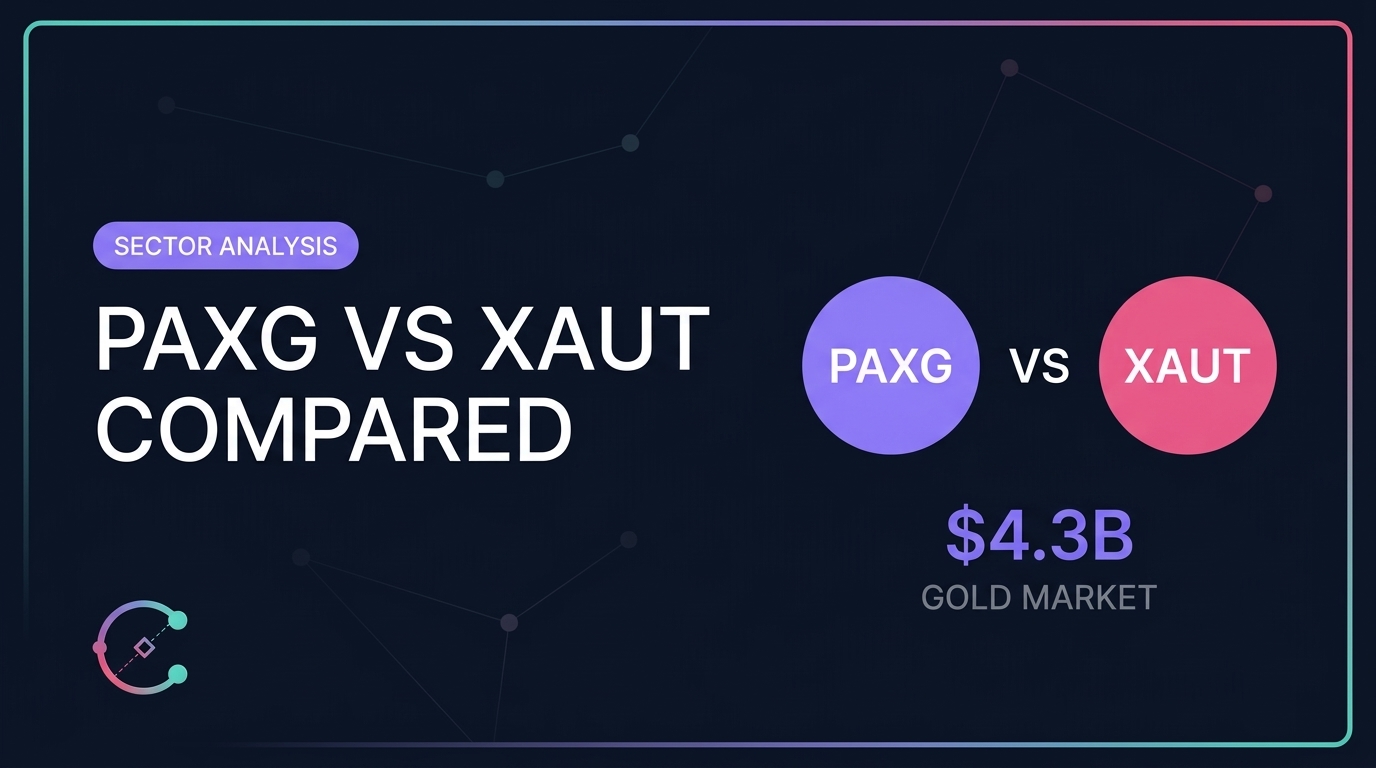
The tokenized gold market just crossed $4.4 billion. Tether Gold (XAUT) leads with $2.4B and 57% market share. Paxos Gold (PAXG) follows at $1.6B with 40% market share. Everyone else accounts for roughly 3%.
What happened in 2025 tells the story of acceleration. Market cap grew 177%, adding nearly $2.8 billion in net value, absorbing nearly a quarter of all net RWA growth over the past 12 months. Trading volume hit $178B, second only to SPDR GLD.
Q4 alone accounted for $126B in volume, surpassing the combined volume of five major gold ETFs. Tokenized gold outperformed physical gold and most gold ETFs across the year, expanding 2.6 times faster than physical gold.
As Yahoo Finance reported, if tokenized gold were an ETF, it would already rank as the second largest by trading volume.
The Market Leader: Tether Gold (XAUT)
Issued by TG Commodities (a Tether subsidiary), XAUT is the largest tokenized gold asset by market cap. Each token represents one fine troy ounce of physical gold stored in LBMA-accredited vaults in Switzerland.
XAUT holds several advantages. It has the largest market cap at $2.4B, multi-chain availability across Ethereum and Tron with expansion to 15+ chains via XAUT0, the deepest liquidity with 75% of Q4 2025 trading volume, a lower redemption threshold at 50 tokens minimum, and backing from Tether’s massive gold reserves.
Tether isn’t just issuing tokens. They’re becoming a gold infrastructure company. According to a Jefferies analyst report covered by CoinDesk, Tether accumulated 116 tons of gold by the end of Q3 2025, making it one of the largest non-sovereign holders of gold globally, comparable to the central banks of South Korea and Hungary.
The company invested over $300M in mining and refining operations, including acquiring a 32% stake in Elemental Altus Royalties, and announced plans to acquire 100+ additional tons in 2026. This vertical integration strengthens XAUT’s backing and reduces counterparty risk.
The concern with XAUT is jurisdiction. As CoinDesk reported, XAUT operates under El Salvador’s digital asset framework, not US federal regulation. For compliance-focused institutions, this is a significant consideration.
The Regulated Challenger: Paxos Gold (PAXG)
Issued by Paxos Trust Company, PAXG is the only gold-backed token under US federal regulatory oversight.
PAXG’s strengths center on trust and compliance. It became OCC-regulated in December 2025 as the first and only federally supervised gold token.
According to Paxos, it undergoes monthly KPMG audits, charges zero on-chain transfer fees since August 2025, stores gold in LBMA-accredited London vaults, and is the only gold token redeemable for physical Good Delivery bars. Compliance-focused institutions generally prefer it for portfolio allocation.
The limitation is scale. PAXG has a smaller market cap at $1.6B, is available on Ethereum only, and has lower trading volume than XAUT. For high-frequency traders, liquidity matters.
The OCC Game-Changer
On December 12, 2025, Paxos became federally regulated. As confirmed in the official OCC approval letter, the OCC approved Paxos to convert from NYDFS state oversight to a national trust charter under federal supervision.
Paxos announced that PAXG would become the only institutional-grade gold token issued under federal regulatory oversight.
What this means in practice: Paxos now operates under the same regulatory framework as national banks.
It’s aligned with GENIUS Act stablecoin requirements. Institutional investors can hold it with compliance confidence. And Paxos can operate across all 50 states under one regulator.
For pension funds, ETFs, and compliance-heavy allocators, regulatory clarity isn’t optional. It’s required. PAXG’s OCC status removes the biggest barrier to institutional adoption of tokenized gold.
What Tokenized Gold Does That ETFs Can’t
Why did $178B in trading volume move to blockchain rails in 2025?
Tokenized gold trades 24/7 while gold ETFs are limited to market hours. As TradingView reported, tokenized gold now handles 100% of weekend price discovery while CME futures are closed. Settlement happens in seconds versus T+2 for ETFs.
Fractional ownership allows purchases as small as 0.000001 XAUT, something impossible with physical gold bars. DeFi integration means tokenized gold can serve as collateral in lending protocols and yield strategies, while ETF shares cannot.
Both XAUT and PAXG can be redeemed for actual gold bars, something most ETFs don’t offer to retail investors. And self-custody lets holders store tokenized gold in their own wallet rather than requiring a brokerage account.
Which One Should You Choose?
Choose PAXG if regulatory clarity is essential for your allocation, if you want monthly KPMG audits, if you’ll transfer frequently and want zero on-chain fees, or if you’re US-based and need federal oversight assurance.
Choose XAUT if liquidity matters most, if you want multi-chain access including Tron and upcoming omnichain expansion, if lower redemption thresholds matter for your use case, or if you’re confident in Tether’s gold infrastructure buildout.
The honest answer: both are backed by real, allocated, LBMA-grade gold. Both have functioned as intended. The choice depends on whether you prioritize liquidity (XAUT) or regulatory clarity (PAXG).
For institutions entering this space, PAXG’s OCC status likely tips the scale. For crypto-native traders, XAUT wins on volume and access.
The Bottom Line
Tokenized gold isn’t competing with crypto anymore. It’s competing with ETFs.
With $178B in trading volume, federal regulation for PAXG, and gold at record highs, digital gold has earned its place in institutional portfolios.
Welcome to Commodara, your edge in real world assets.
If this breakdown was useful, share it with someone evaluating tokenized gold for their portfolio. And if you’re new here, this is where we make sense of the tokenized economy.
Frequently Asked Questions
What is tokenized gold and how does it work?
Tokenized gold is a digital token on a blockchain where each token represents ownership of physical gold stored in accredited vaults. The two largest tokens, PAXG and XAUT, each represent one fine troy ounce of LBMA-grade gold. Holders can trade tokens 24/7, use them as DeFi collateral, or redeem them for physical gold bars.
What is the difference between PAXG and XAUT?
PAXG is issued by Paxos Trust Company under US federal OCC regulation, undergoes monthly KPMG audits, and is available on Ethereum with zero on-chain transfer fees. XAUT is issued by Tether’s subsidiary TG Commodities under El Salvador’s regulatory framework, has larger market cap and deeper liquidity, and is available across multiple blockchains. PAXG prioritizes regulatory compliance while XAUT prioritizes liquidity and access.
Is PAXG regulated by the US government?
Yes. In December 2025, the OCC approved Paxos to operate under a national trust charter with federal supervision, making PAXG the only gold-backed token under US federal regulatory oversight. This places Paxos under the same regulatory framework as nationally chartered banks and aligns with GENIUS Act stablecoin requirements.
How big is the tokenized gold market in 2026?
The tokenized gold market surpassed $4.4 billion in total market capitalization, with $178 billion in trading volume during 2025. XAUT holds 57% market share at $2.4B and PAXG holds 40% at $1.6B. If tokenized gold were classified as an ETF, it would rank second largest by trading volume behind only SPDR GLD.
Can you redeem tokenized gold for physical gold?
Yes. Both PAXG and XAUT offer redemption for physical gold. PAXG holders can redeem for LBMA-accredited Good Delivery bars stored in London vaults. XAUT holders can redeem from Swiss vaults with a minimum threshold of 50 tokens. This physical backing and redemption capability distinguishes tokenized gold from synthetic or derivative gold products.