
Real Estate Tokenization: The $300 Trillion Opportunity With the Hardest Path
The $300 Billion Paradox: Real Estate Tokenization Has the Biggest Promise and the Hardest Path
Real estate tokenization should be RWA tokenization biggest success story.
It’s the world’s largest asset class, valued at over $300 trillion globally. It’s notoriously illiquid, with transactions taking months and costing thousands in fees. Minimum investments typically start at hundreds of thousands of dollars, locking out most retail investors.
Table of Contents
On paper, blockchain fixes all of this. Fractional ownership, instant settlement, 24/7 trading, global access.
And yet, while tokenized Treasuries have hit $9 billion and private credit dominates at $14 billion, tokenized real estate remains stubbornly small at roughly $2-3 billion in actual deployed capital. The forecasts are massive (Deloitte predicts $4 trillion by 2035), but the gap between hype and reality is wider here than anywhere else in the RWA space.
So what’s actually happening? This week, we break down the real estate tokenization paradox: why it’s simultaneously the most promising and most challenging RWA frontier, and what’s finally changing in 2026.
The Current State: Smaller Than It Looks
Despite headlines about “billion-dollar tokenization,” the actual market for tokenized real estate is modest. Various estimates put the total between $2-3 billion in active tokenized value, with some projections reaching $10 billion when counting all platforms and structures.
For context, that’s roughly 0.001% of the global real estate market.
The leading platforms tell the real story. RealT has tokenized over 970 properties across the U.S., Panama, and Colombia, with total asset value exceeding $130 million. They’ve built a community of 16,000+ investors in 125 countries, with 88% investing less than $5,000. Daily rental income is paid in stablecoins directly to investor wallets, with average yields ranging from 6-16%.
Lofty has onboarded 170+ properties across 11 U.S. states, worth approximately $27 million collectively. Their innovation is instant liquidity, having launched the world’s first automated market maker for real estate that allows investors to buy and sell property shares instantly.
RedSwan CRE plays at a different scale entirely. They’ve tokenized over $5 billion in commercial real estate assets across the U.S. and secured an exclusive assignment to tokenize a $4 billion Dubai portfolio of 36 mixed-use properties.
The pattern is clear: residential platforms have achieved proof of concept with thousands of properties and investors, but total values remain modest. Commercial platforms are tokenizing billions in assets, but the actual capital raised and traded remains a fraction of that.
Dubai: The Government-Backed Experiment
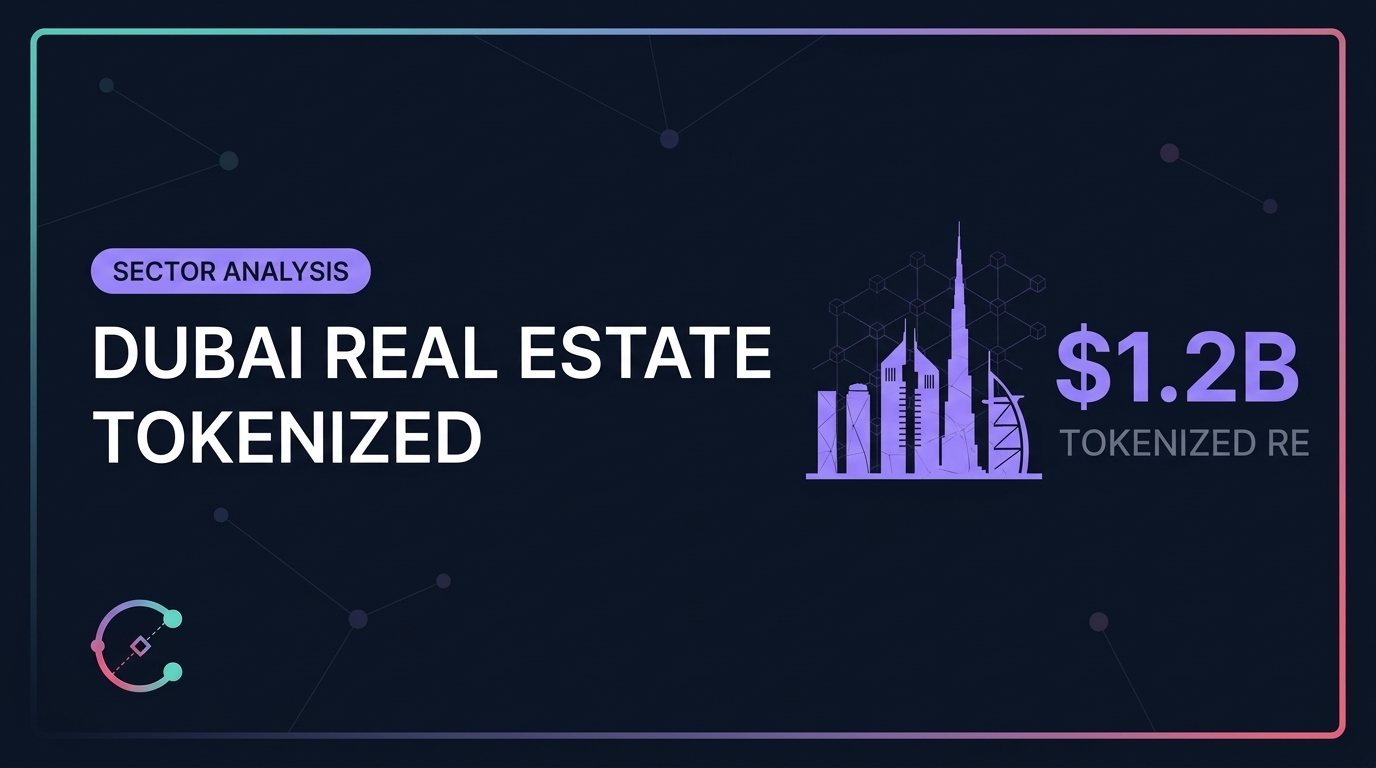
While most tokenization happens in regulatory gray zones, Dubai has done something unprecedented: government-backed, fully regulated real estate tokenization with official land registry integration.
On February 20, 2026, the Dubai Land Department launched Phase 2 of its Real Estate Tokenization Project, enabling secondary market trading for approximately 7.8 million tokens tied to ten Dubai properties worth about $5 million (18.5 million AED).
What makes Dubai different is the multi-agency regulatory structure. The Dubai Land Department directly supervises property registration. VARA (Virtual Assets Regulatory Authority) created the regulatory structure for digital assets. The UAE Central Bank monitors financial transactions. Every step is controlled to ensure legal and operational integrity.
As CoinDesk reported, tokens are created on the XRP Ledger, sold through the PRYPCO Mint platform, and secured using Ripple’s custody system. This isn’t a crypto experiment running parallel to the legal system. It’s a regulated securities structure integrated directly with official property records.
The pilot phase results were striking. One villa worth approximately $480,000 sold out in under five minutes. Properties attracted investors from 50+ nationalities. Minimum investment starts at just $545 (AED 2,000), making Dubai luxury real estate accessible to small investors for the first time. Waitlists reached over 10,700 for later offerings.
Dubai’s government has set an ambitious target: $16 billion in tokenized real estate by 2033, representing approximately 7% of the emirate’s property market.
Why Real Estate Is Harder Than Everything Else
Tokenizing Treasuries is relatively simple. Government bonds are standardized, highly liquid, frequently priced, and exist within well-understood legal frameworks. Tokenizing a house is fundamentally different.
Heterogeneity. No two properties are identical. A commercial building in Manhattan is nothing like a residential rental in Detroit. Each asset requires individual due diligence, appraisal, and ongoing management.
Legal complexity. In most jurisdictions, you cannot tokenize the property itself. What gets tokenized are economic rights, typically through an SPV or LLC that owns the actual property.
Ongoing management. Unlike a Treasury bond that just pays interest, real estate requires tenants, maintenance, repairs, insurance, property management, and legal compliance.
Valuation uncertainty. Private real estate doesn’t have daily pricing like public markets. NAV calculations involve subjective appraisals, creating 15-25% bid-ask spreads.
Secondary market thin liquidity. Most platforms demonstrate average daily trading volumes below $50,000 per property token, compared to hundreds of millions for large-cap REITs.
The Institutional Wave
Despite the challenges, institutional interest is accelerating. The last 90 days have seen significant moves from players who matter.
Grant Cardone announced plans to tokenize his firm’s $5 billion real estate portfolio, stating the goal is to give investors “collateral and liquidity in the secondary markets.” Barry Sternlicht, founder of Starwood Capital which manages over $125 billion, recently said his firm is ready to tokenize assets but faces U.S. regulatory barriers.
The Trump Organization is tokenizing loan revenue tied to a new Maldives resort project, showing that real estate tokenization is crossing into mainstream development finance.
And BlackRock has filed for blockchain-based tokenized real estate fund structures, with their 2026 Thematic Outlook explicitly naming tokenization of real estate and equities as themes driving markets in unprecedented ways.
The Supply-First Thesis
Here’s the strategic insight that separates successful real estate tokenization from failed experiments: supply quality matters more than retail traffic.
The platforms gaining traction in 2026 aren’t those building the fanciest trading interfaces. They’re the ones solving the operator problem: onboarding quality real estate assets with proper legal structures, reliable property management, and verified income streams.
Investors will find quality assets. But quality assets won’t tokenize without proper infrastructure, compliance frameworks, and operational support. The bottleneck isn’t demand. It’s supply.
This is why RedSwan’s focus on institutional-grade commercial properties, complete with Cushman and Wakefield appraisals and SEC registration, has allowed them to build a $10 billion pipeline. It’s why Dubai’s DLD partnership with licensed banks and regulated custodians created immediate sell-outs.
The 2026 Outlook
Several things are actually changing this year. Secondary markets are becoming real, with Dubai’s DLD launching regulated secondary trading and Swift’s cross-chain transfer protocols in testing. Liquidity is improving from “essentially nonexistent” to “meaningful but limited.”
Institutional infrastructure is maturing. BlackRock, JPMorgan, and others have proven that blockchain-based fund structures work at institutional scale. Regulatory frameworks are crystallizing, with the UAE, EU, and Switzerland providing clear pathways and platforms increasingly structuring for global distribution.
Industry predictions remain ambitious. Deloitte forecasts $4 trillion in tokenized real estate by 2035 at 27% CAGR. BCG projects $3.2 trillion by 2030 at 49% CAGR. And ScienceSoft estimates $3 trillion by 2030, representing 15% of real estate AUM.
The Bottom Line
Real estate tokenization has the biggest promise and the hardest path of any RWA category.
The current market is $2-3 billion, not the billions often claimed in headlines. RealT, Lofty, and RedSwan lead with different approaches across residential and commercial. Dubai launched the first government-backed, registry-integrated secondary market.
Liquidity remains the central challenge, improving but not yet solved. Institutional players including Cardone, Sternlicht, and BlackRock are signaling readiness. The supply-first thesis is winning, with quality assets mattering more than trading features. And projections point to $3-4 trillion by 2030-2035.
The players building infrastructure today are positioning for what could become a multi-trillion dollar market by decade’s end.
Welcome to Commodara, your edge in real world assets.
If this breakdown helped you understand the real state of real estate tokenization, share it with someone in property, investing, or fintech who needs the full picture. And if you’re new here, this is where we track the moves that matter in the tokenized economy.
Frequently Asked Questions
What is real estate tokenization?
Real estate tokenization converts ownership rights in physical property into digital tokens on a blockchain. Each token represents a fractional stake in a specific property, enabling investors to buy, sell, and trade real estate exposure with lower minimums, faster settlement, and greater transparency. In most jurisdictions, what gets tokenized are economic rights held through an SPV or LLC, not the physical property itself.
How big is the tokenized real estate market in 2026?
The actual market for tokenized real estate is approximately $2-3 billion in active deployed capital, representing roughly 0.001% of the global $300 trillion real estate market. Leading platforms include RealT ($130M across 970+ properties), Lofty ($27M across 170+ properties), and RedSwan CRE ($5B+ in tokenized commercial assets). Industry forecasts project $3-4 trillion by 2030-2035.
What is Dubai’s real estate tokenization project?
The Dubai Land Department launched the MENA region’s first government-backed real estate tokenization initiative through the PRYPCO Mint platform, with tokens created on the XRP Ledger and secured by Ripple Custody. Phase 2, launched February 20, 2026, enabled secondary market trading for 7.8 million tokens across ten properties. The project targets $16 billion in tokenized real estate by 2033, representing 7% of Dubai’s property market.
Why is real estate tokenization growing slower than other RWA categories?
Real estate faces unique challenges that standardized assets like Treasuries do not. Every property is different, requiring individual due diligence and appraisal. Legal structures vary by jurisdiction. Properties require ongoing management (tenants, maintenance, insurance). Valuations are subjective with 15-25% bid-ask spreads. And secondary market liquidity remains thin, with most property tokens trading below $50,000 in daily volume.
Can you invest in tokenized real estate with a small amount?
Yes. Platforms like RealT allow investment starting from as little as $50 per property token, with 88% of their investors putting in less than $5,000. Dubai’s PRYPCO Mint starts at AED 2,000 (approximately $545). These low minimums are one of tokenization’s core value propositions, making real estate accessible to investors who can’t meet traditional minimums of $100,000 or more.