
Ondo Finance Review: OUSG, USDY, and Tokenized Treasuries Explained
Ondo Finance has emerged as the dominant platform for tokenized treasury products, managing over $1.4 billion in total value locked across its OUSG and USDY offerings. In a market where dozens of protocols are competing to bring US government debt on-chain, Ondo Finance has separated itself through a combination of institutional-grade fund structures, broad chain deployment, and investor accessibility that spans from $500 retail minimums to multi-million-dollar institutional allocations.
This Ondo Finance review covers everything an investor needs to evaluate before committing capital: how each product works, what yields to expect, the legal structures behind the tokens, the risks to watch, and how OUSG and USDY compare to competing tokenized treasury products from BlackRock, Franklin Templeton, and others. Whether you are a first-time buyer or an institutional allocator sizing the opportunity, this analysis provides the data and context required for an informed decision.
Table of Contents
This review begins with an overview of Ondo Finance and its position in the tokenized treasury market. It then examines OUSG and USDY in detail, covering structure, yield, and access requirements. The following sections analyze how Ondo Finance compares to competitors, the risks investors should evaluate, and a practical guide for getting started.
What Is Ondo Finance and Why Does It Matter?
Ondo Finance is a decentralized finance protocol that specializes in bringing institutional-grade fixed income products on-chain. Founded by Nathan Allman, a former Goldman Sachs vice president, the platform launched its first tokenized treasury fund in early 2023 and has since grown to become one of the largest issuers of tokenized US government debt. The protocol operates across multiple blockchains including Ethereum, Solana, Polygon, Mantle, and Aptos, giving it broader distribution than most competitors.
What makes Ondo Finance significant is not just its scale but its positioning. The platform sits at the intersection of DeFi accessibility and institutional compliance. Its products are structured through regulated fund vehicles, managed by professional asset managers, and custodied at institutional-grade providers. At the same time, the tokens are composable with DeFi protocols, meaning they can be used as collateral, traded on decentralized exchanges, and integrated into yield strategies that traditional treasury products cannot access.
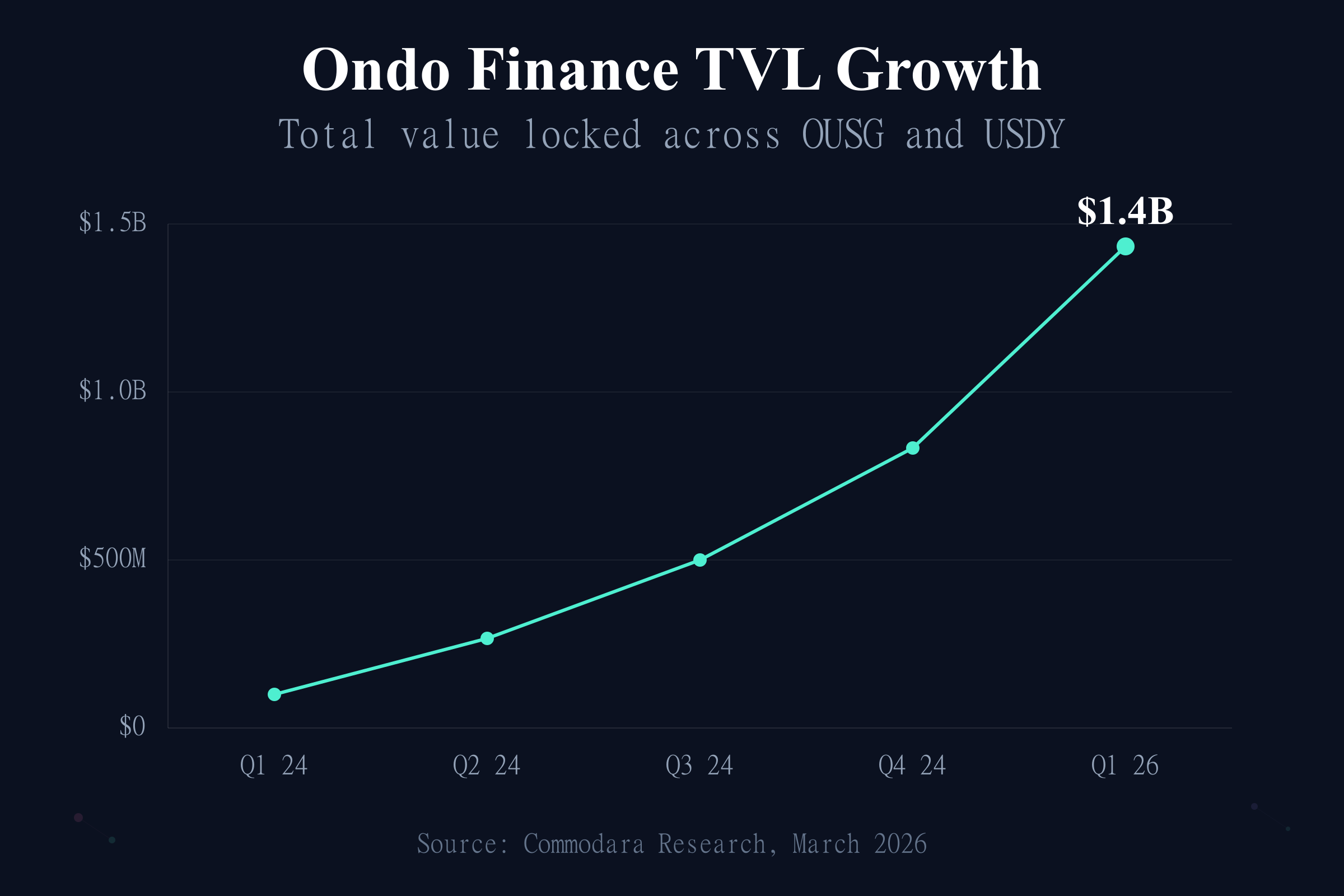
The broader context matters too. Tokenized treasuries are the largest segment of the tokenized real world assets market at $8.7 billion in total value. Ondo Finance controls approximately 16% of that market through OUSG and USDY alone, making it the second-largest issuer behind BlackRock’s BUIDL fund. For investors evaluating where to allocate capital in tokenized fixed income, understanding Ondo Finance is essential groundwork.
OUSG Explained: Ondo’s Institutional Tokenized Treasury Fund
OUSG is Ondo Finance’s flagship tokenized treasury fund. The token represents a share in a fund that holds short-term US Treasury securities, primarily through BlackRock’s iShares Short Treasury Bond ETF (SHV). Each OUSG token is backed by actual Treasury exposure, not a synthetic derivative or algorithmic peg. The fund is structured as a Cayman Islands exempted company and managed by an independent fund administrator.
The mechanics of OUSG are straightforward. Investors subscribe to the fund by depositing USDC, which the fund converts to USD and uses to purchase Treasury securities. The net asset value of each OUSG token increases daily as the underlying Treasuries accrue interest. There is no separate yield distribution; instead, the token price itself appreciates, similar to how an accumulating ETF works. This design simplifies tax reporting in many jurisdictions compared to products that distribute yield as separate payments.
OUSG Yield and Performance
OUSG currently offers an annualized yield of approximately 4.5%, reflecting the prevailing yield on short-term US Treasury securities. This yield is net of Ondo Finance’s 0.15% annual management fee, which is competitive with traditional Treasury ETFs and significantly lower than many DeFi yield products. The yield fluctuates with changes in the federal funds rate and the broader interest rate environment, just as any Treasury product would.
Since launch, OUSG has maintained a stable correlation with its underlying assets and has not experienced any depegging events. The fund rebalances its holdings regularly to maintain exposure to short-dated Treasuries, typically with maturities under one year. This short duration reduces interest rate risk compared to longer-dated bond products.
OUSG Access Requirements
OUSG is available only to qualified purchasers, which in the US means individuals with at least $5 million in investable assets or institutions. The minimum investment is $5,000 for initial subscriptions. KYC and AML verification are required through Ondo Finance’s onboarding process, which typically takes two to five business days. Subscriptions and redemptions are processed on a T+1 basis during business days.
This access structure limits OUSG to sophisticated investors, which is a deliberate design choice by Ondo Finance to maintain regulatory compliance under US securities law. For retail investors who do not meet the qualified purchaser threshold, USDY is the alternative product specifically designed for broader accessibility.
USDY Token: Tokenized Treasury Yield for Everyone
The USDY token is Ondo Finance’s answer to the accessibility gap in tokenized treasuries. Unlike OUSG, which requires qualified purchaser status, USDY is available to non-US investors with a minimum investment of just $500. This makes it one of the most accessible tokenized treasury fund products in the market and a key reason why Ondo Finance has achieved broad adoption across multiple investor segments.
USDY is structured as a tokenized note that is backed by short-term US Treasuries and bank deposits. It accrues yield daily, with the token price increasing to reflect accumulated interest. The current annualized yield is approximately 4.5%, matching OUSG since both products hold similar underlying assets. Ondo Finance charges the same 0.15% management fee on USDY as it does on OUSG.
USDY Distribution and Chain Availability
One of the strategic advantages of the USDY token is its multi-chain deployment. USDY is available on Ethereum, Solana, Polygon, Mantle, Aptos, Sui, and several other networks. This broad availability means investors can hold yield-bearing Treasury exposure on whichever blockchain they prefer, and use USDY as collateral or a settlement asset across different DeFi ecosystems.
USDY has also been integrated as a collateral asset on several lending protocols, allowing holders to borrow against their Treasury yield position without selling. This composability is a significant differentiator compared to traditional Treasury products and even compared to some competing tokenized funds. The ability to earn Treasury yield while simultaneously using the position as DeFi collateral is a functionality that only on-chain products can provide.
USDY vs Stablecoins
A common question from investors new to this space is how the USDY token differs from a stablecoin like USDC or USDT. The key distinction is yield: stablecoins maintain a fixed $1 peg and generate no return for holders, while USDY appreciates in value as the underlying Treasury interest accrues. Holding $10,000 in USDC earns nothing. Holding $10,000 in USDY earns approximately $450 per year at current rates.
The trade-off is that USDY is not pegged to $1. Its price increases over time, which means it does not function as a unit of account in the same way stablecoins do. USDY also carries the compliance overhead of Ondo Finance’s KYC requirements, while most stablecoins can be held anonymously on decentralized platforms. For investors who want their idle capital working, USDY offers a compelling alternative to parking funds in non-yielding stablecoins.
Ondo Finance vs Competitors: How OUSG and USDY Compare
The tokenized treasury market in 2026 includes products from some of the largest names in finance. Understanding how Ondo Finance compares to these alternatives is critical for informed allocation. The institutional tokenization strategies of BlackRock, JPMorgan, and DTCC have created a competitive landscape where product selection depends on investor profile, access requirements, and intended use case.
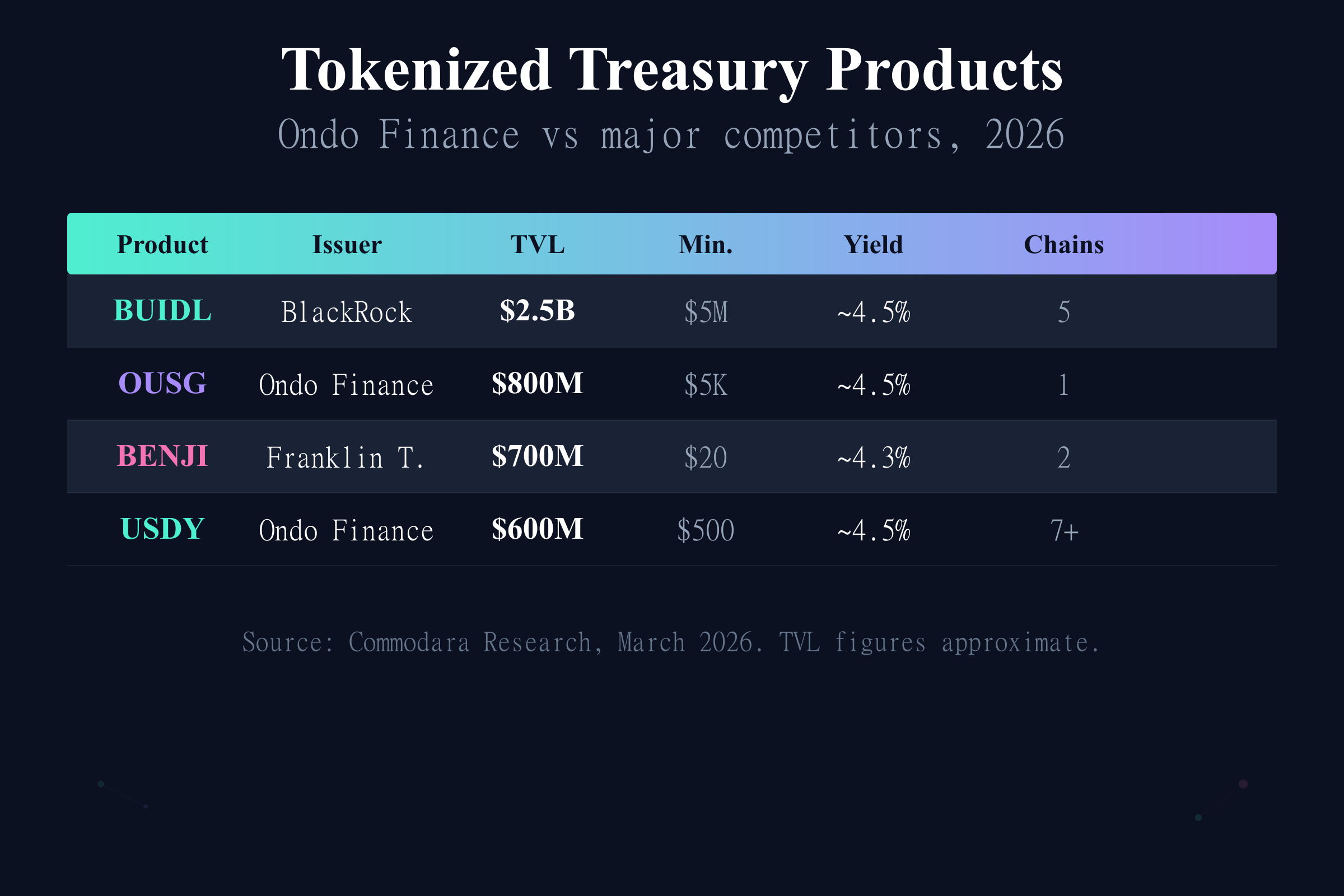
BlackRock’s BUIDL is the largest tokenized treasury product at $2.5 billion in TVL, but it requires a $5 million minimum and accredited investor status through Securitize. Franklin Templeton’s BENJI offers the lowest minimum at $20, but it is available only through Franklin’s own platform and has limited DeFi composability. Backed Finance’s bIB01 provides European investors with tokenized exposure to short-term US Treasuries on Ethereum.
Ondo Finance occupies a distinctive middle ground. OUSG serves institutional investors with a $5,000 minimum, significantly below BUIDL’s threshold. USDY serves non-US retail investors with a $500 minimum and multi-chain availability that exceeds any competitor. No other platform in the tokenized treasury fund space offers both an institutional product and a broadly accessible retail product from the same issuer with the same underlying asset quality.
Risks of Investing Through Ondo Finance
No investment is risk-free, and Ondo Finance products carry specific risks that investors must evaluate. Understanding these risks is particularly important because the tokenized treasury space is still relatively new, and the legal and operational frameworks are still maturing.
Smart Contract and Protocol Risk
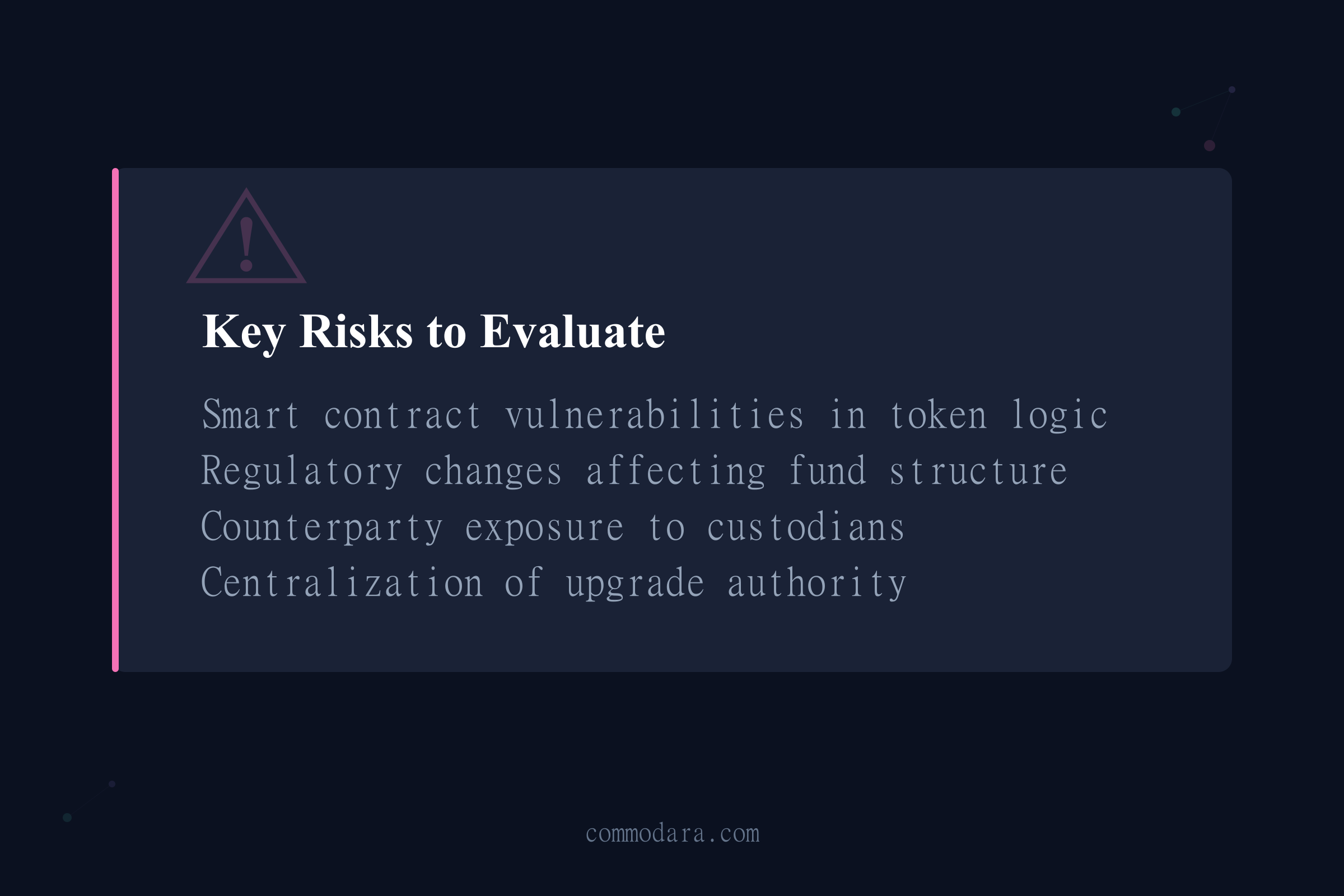
Both OUSG and USDY depend on smart contracts for minting, redemption, transfer restrictions, and compliance enforcement. While Ondo Finance has subjected its contracts to multiple independent audits from firms including Code4rena and other security researchers, smart contract risk can never be fully eliminated. A vulnerability in the token contract could theoretically freeze transfers, disrupt redemptions, or create other operational issues.
Ondo Finance mitigates this risk through upgrade mechanisms that allow the team to patch vulnerabilities if discovered, and through a multi-signature governance structure for critical contract functions. However, this upgrade capability itself introduces centralization risk, as the Ondo Finance team retains significant control over contract behavior.
Regulatory and Legal Risk
Ondo Finance operates in a regulatory environment that is still evolving. The OUSG fund structure relies on specific exemptions under US securities law, and changes to those exemptions could affect the product’s availability or structure. USDY’s exclusion of US investors is a deliberate compliance strategy, but changes in non-US regulatory frameworks could impact USDY’s availability in specific jurisdictions.
The broader regulatory trajectory for tokenized securities remains uncertain in many markets. While frameworks like MiCA in Europe and the GENIUS Act in the US are providing more clarity, Ondo Finance and its investors must continuously adapt to new requirements. Investors should monitor regulatory developments in their own jurisdiction, as the compliance status of any tokenized product can change.
Counterparty and Custodial Risk
OUSG and USDY depend on third-party custodians and fund administrators to hold and manage the underlying Treasury securities. If the custodian or administrator were to face insolvency or operational failure, investor assets could be at risk. Ondo Finance uses institutional-grade custody providers, but counterparty risk is inherent in any financial product that involves third-party intermediaries.
How to Invest Through Ondo Finance
For investors who have evaluated the products and risks, the process to invest through Ondo Finance is straightforward. The platform’s onboarding flow is designed to be accessible for both crypto-native users and traditional investors entering the on-chain space for the first time.
OUSG: The Institutional Path
To purchase OUSG, investors must visit the Ondo Finance platform and complete the qualified purchaser verification process. This requires identity documentation, proof of qualification status, and AML screening. Once approved, investors deposit USDC on Ethereum and subscribe to the fund. The minimum initial investment is $5,000, and subsequent investments can be lower. Redemptions are processed on a T+1 basis during business days.
USDY: The Retail Path
Non-US investors can purchase the USDY token with a simpler process. After completing KYC verification on the Ondo Finance platform, investors deposit USDC or USDT and receive USDY in return. The minimum purchase is $500. USDY can then be bridged to other supported blockchains using Ondo Finance’s cross-chain infrastructure. If you are evaluating whether this product fits your portfolio, the Commodara Tokenization Readiness Tool can help you assess your eligibility and readiness.
For a broader overview of the process and alternative platforms, see our complete guide on how to buy tokenized assets in 2026.
Frequently Asked Questions
What is Ondo Finance and what does it do?
Ondo Finance is a DeFi protocol that creates tokenized versions of institutional fixed income products, primarily US Treasury securities. Its two main products, OUSG and USDY, allow investors to earn Treasury yield on-chain through tokens that can be held, traded, and used as collateral across multiple blockchains.
What is the difference between OUSG and USDY?
OUSG is designed for qualified purchasers and US-eligible investors with a $5,000 minimum. USDY is designed for non-US investors with a $500 minimum. Both products hold similar underlying Treasury assets and offer approximately the same yield, but they differ in access requirements, legal structure, and chain availability.
What yield does Ondo Finance offer?
Both OUSG and USDY currently offer approximately 4.5% annualized yield, which reflects the prevailing rate on short-term US Treasury securities minus Ondo Finance’s 0.15% annual management fee. The yield fluctuates with changes in the federal funds rate.
Is Ondo Finance safe to invest in?
Ondo Finance uses institutional-grade fund structures, independent custodians, and audited smart contracts. However, all investments carry risk including smart contract vulnerabilities, regulatory changes, and counterparty exposure. Investors should conduct their own due diligence and only invest capital they can afford to lose.
Can US investors use Ondo Finance?
US investors who meet the qualified purchaser threshold can invest in OUSG. USDY is explicitly not available to US persons due to regulatory compliance requirements. Ondo Finance enforces these restrictions through its KYC process and smart contract transfer restrictions.
The Bottom Line
Ondo Finance has established itself as the most versatile platform in the tokenized treasury market. With OUSG serving institutional investors and USDY providing accessible yield to non-US retail participants, the protocol covers a wider investor base than any single competitor. Its multi-chain deployment, DeFi composability, and institutional-grade fund structures position it as a long-term infrastructure player in the tokenized economy.
The risks are real: smart contract vulnerabilities, evolving regulation, and counterparty exposure all require careful evaluation. But for investors seeking on-chain exposure to US Treasury yield, Ondo Finance offers one of the most established and transparent options available in 2026.
As the tokenized treasury market continues to grow beyond its current $8.7 billion valuation, Ondo Finance is positioned to capture a significant share of both institutional and retail flows. The infrastructure being built today by platforms like Ondo Finance will define how the next generation of fixed income markets operates. Subscribe to the Commodara newsletter for ongoing coverage of tokenized treasury products and the platforms that power them.