
RWA Market Size 2026: How Big Is the Tokenized Asset Economy?
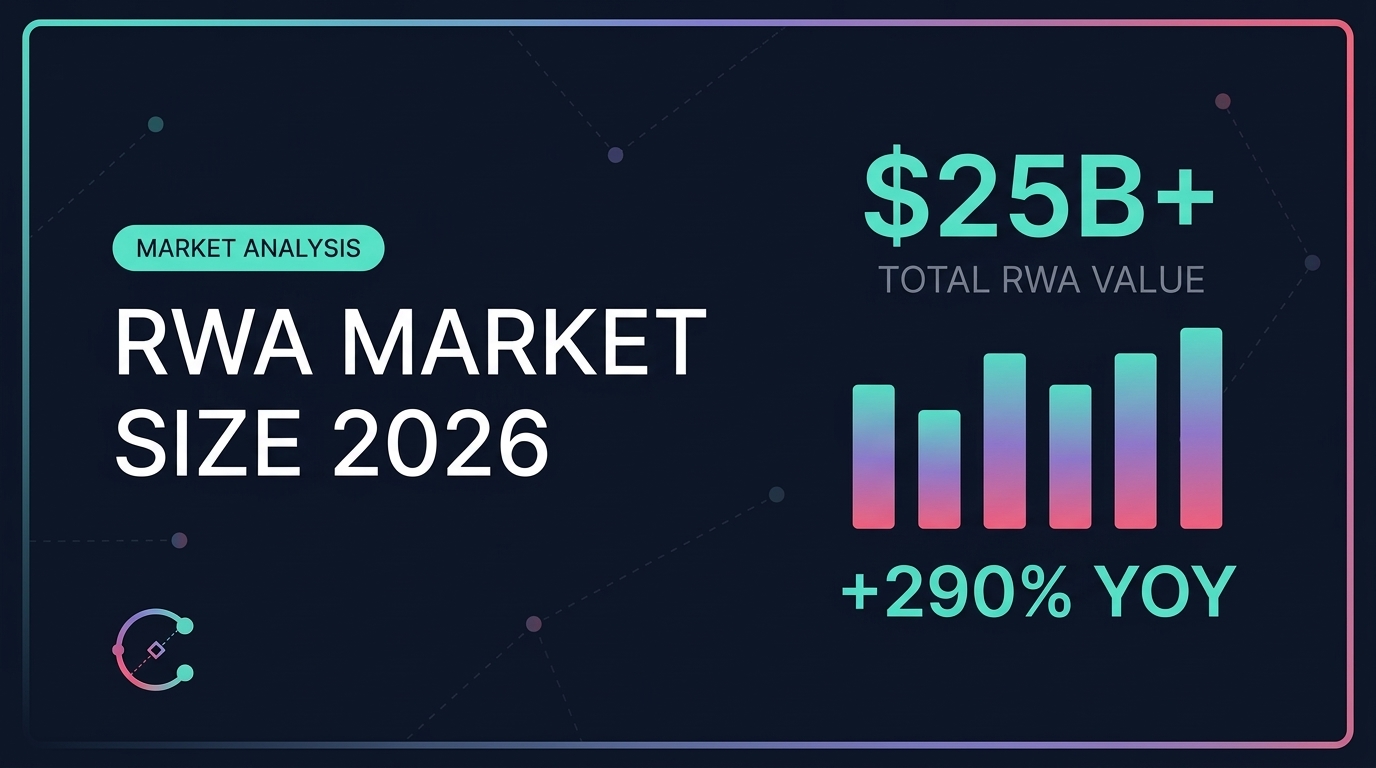
The RWA market size 2026 has surpassed $25 billion in on-chain value, nearly quadrupling from $6.4 billion just one year ago, with six asset categories now exceeding $1 billion each. This growth rate has outpaced even the most optimistic institutional projections from 2024, when most analysts expected the market to reach $10 billion to $15 billion by mid-decade. The reality has exceeded those forecasts by a wide margin, driven by institutional capital deployment, regulatory clarity, and the maturation of tokenization infrastructure across every major asset class.
This article breaks down the RWA market size 2026 by asset class, identifies the growth drivers behind each category, examines the institutional players shaping the market, and provides the data context that decision-makers need for strategic planning. For institutional allocators evaluating the tokenized asset opportunity and industry builders sizing their addressable market, these numbers define the landscape.
RWA Market Size 2026: Total Market Overview
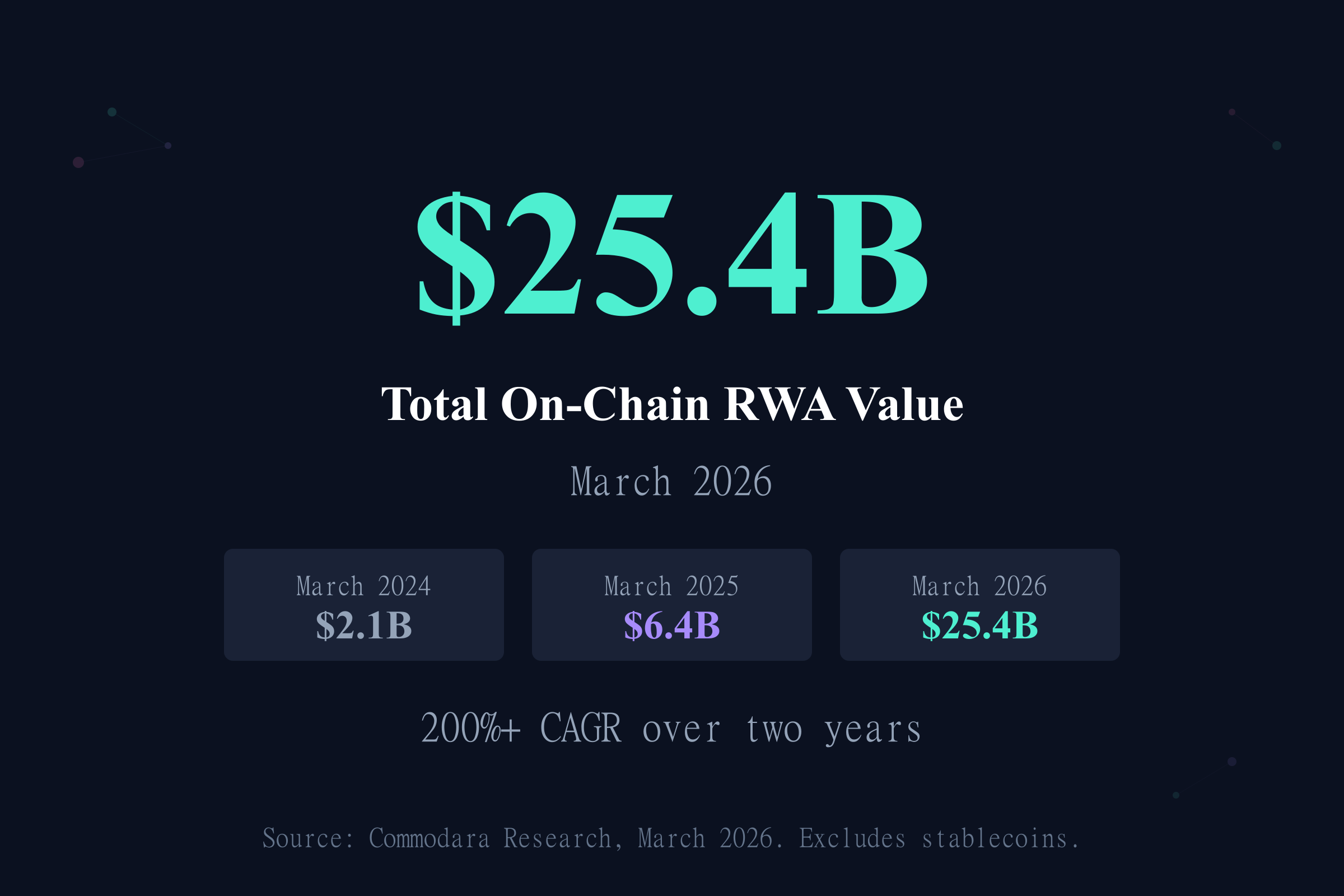
The total on-chain RWA market size 2026 stands at approximately $25.4 billion in tokenized asset value as of March 2026. This figure represents the aggregate value of tokenized assets deployed across all blockchain networks, excluding stablecoins, which are sometimes counted in broader RWA definitions but represent a distinct product category with a separate market dynamic.
The growth trajectory has been striking. The RWA TVL 2026 figure of $25.4 billion compares to $6.4 billion in March 2025 and approximately $2.1 billion in March 2024. This represents a compound annual growth rate exceeding 200% over the two-year period. The acceleration from 2025 to 2026 was particularly notable, driven by BlackRock’s BUIDL fund crossing $2.5 billion, the tokenized gold market benefiting from rising gold prices, and private credit platforms scaling their origination volumes.
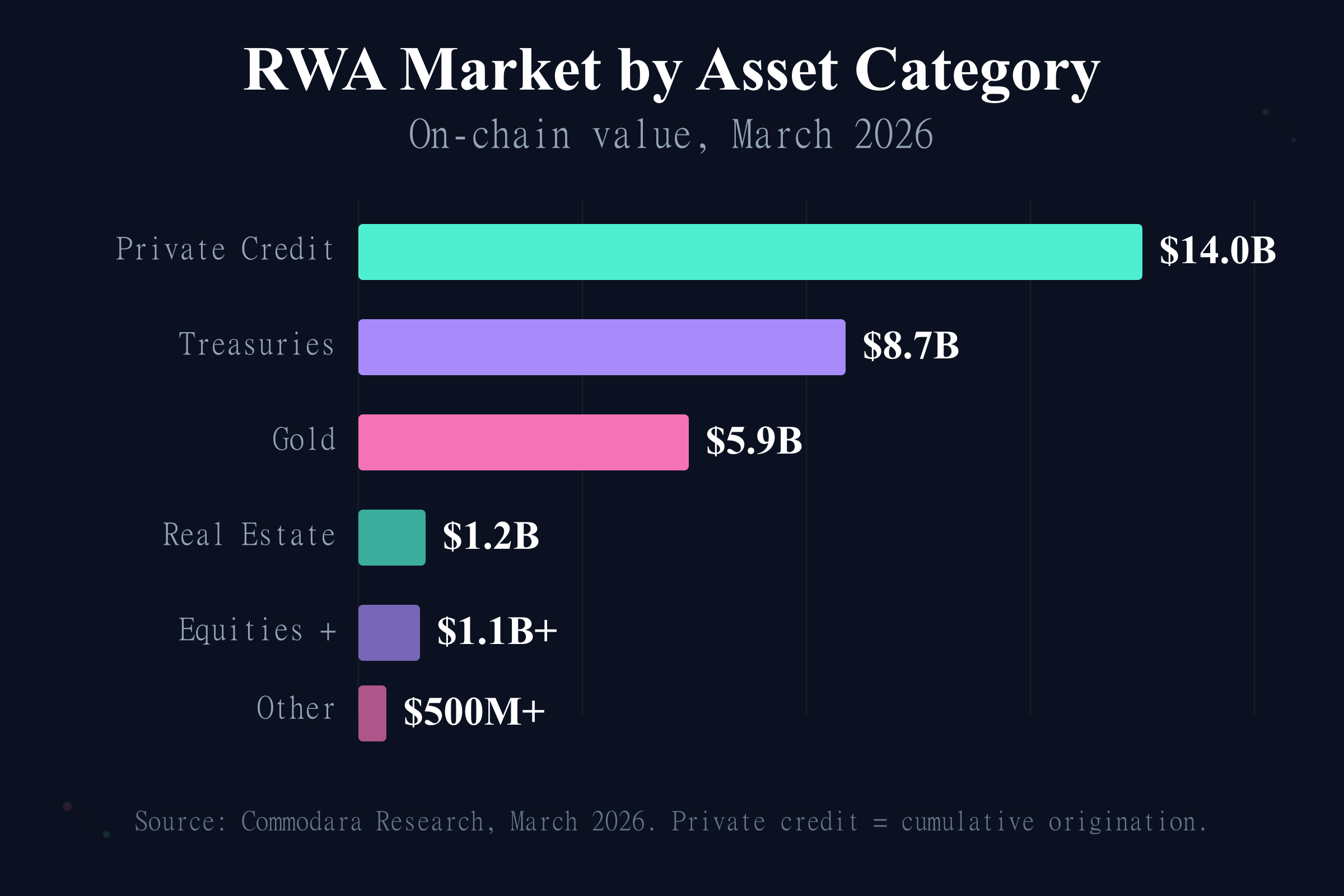
The milestone of six asset categories each exceeding $1 billion arrived approximately eighteen months ahead of consensus projections. Private credit leads at $14 billion in cumulative on-chain origination. Tokenized treasuries follow at $8.7 billion. Tokenized gold stands at $5.9 billion in market capitalization. Tokenized real estate, tokenized equities, and other tokenized commodities each now exceed the $1 billion threshold. The $33 billion RWA market reality check published earlier provides important context on how on-chain figures compare to the total addressable market for tokenized assets.
RWA Market Size 2026 by Asset Class
Breaking the RWA market size 2026 into its component asset classes reveals where capital is concentrated and where growth is accelerating fastest.
Tokenized Private Credit: $14 Billion
Tokenized private credit is the largest category by cumulative on-chain origination, with over $14 billion in loans originated through blockchain-based platforms since inception. Active outstanding loans represent a subset of this figure, as loans are originated, serviced, and repaid over their lifecycles. The distinction between cumulative origination and active TVL is important: the $14 billion represents the total volume of institutional lending that has flowed through on-chain rails, demonstrating the scale of institutional confidence in blockchain-based credit infrastructure.
Maple Finance, Centrifuge, Goldfinch, and Credix are the primary platforms driving private credit origination. Maple’s SyrupUSDC product alone has facilitated billions in institutional lending to market makers, trading firms, and fintech companies. The yields available through on-chain private credit, typically 8% to 15%, have attracted capital from investors seeking returns above what tokenized treasuries provide.
Tokenized Treasuries: $8.7 Billion
Tokenized US treasuries are the second-largest category and the fastest-growing by percentage in the past twelve months. The sector grew from approximately $1.5 billion in March 2025 to $8.7 billion by March 2026, representing a nearly sixfold increase. This growth was driven primarily by BlackRock’s BUIDL fund, which crossed $2.5 billion in assets, and by Ondo Finance’s OUSG and USDY products, which collectively surpassed $1.4 billion.
The tokenized treasuries comparison provides detailed product-level analysis. At the market level, the tokenized assets market cap for treasuries reflects institutional demand for on-chain yield products that combine the safety of US government debt with the efficiency and composability of blockchain settlement. Franklin Templeton’s BENJI fund and WisdomTree’s tokenized treasury product have also contributed to the category’s growth, though at smaller scale than BlackRock and Ondo.
Tokenized Gold: $5.9 Billion
The tokenized gold market reached $5.9 billion in market capitalization in 2026, with annual trading volume of $178 billion. This trading volume makes tokenized gold the second-largest gold investment product globally by volume, trailing only physically-backed gold ETFs. Paxos Gold (PAXG) and Tether Gold (XAUT) dominate the category, collectively representing over 95% of the tokenized gold market capitalization.
The growth in tokenized gold has been amplified by rising gold prices throughout 2025 and early 2026, with gold reaching new all-time highs above $3,000 per ounce. The real world asset market growth in this category reflects both price appreciation of the underlying commodity and net new capital inflows from investors seeking gold exposure through blockchain rails rather than traditional ETF or physical ownership structures.
Tokenized Real Estate: $1.2 Billion
Tokenized real estate has crossed the $1 billion threshold in on-chain value, though it remains smaller than other categories relative to the massive size of the global real estate market. The tokenized real estate market is distributed across platforms like RealT, Lofty, Propy, and several regional platforms in the Middle East, Europe, and Southeast Asia. The category includes both residential and commercial properties, with commercial properties representing the majority of value.
The relatively modest on-chain value of tokenized real estate compared to the $330 trillion global real estate market reflects the early stage of adoption rather than a lack of interest. Regulatory complexity, the need for SPV structures in each jurisdiction, and the illiquidity of secondary markets for tokenized property tokens are constraints that are being addressed but have not yet been fully resolved.
Tokenized Equities and Other Assets: $1.1 Billion+
Tokenized equities have crossed the $1 billion mark as NYSE, Nasdaq, and Robinhood advance their on-chain equity infrastructure. These products are still in early deployment stages, but the institutional commitment from major exchanges signals that tokenized equities will be a significant growth category in the coming years. Other tokenized assets, including carbon credits, intellectual property, and infrastructure, collectively represent several hundred million dollars in on-chain value and are growing from a small base.
What Is Driving RWA Market Growth in 2026?
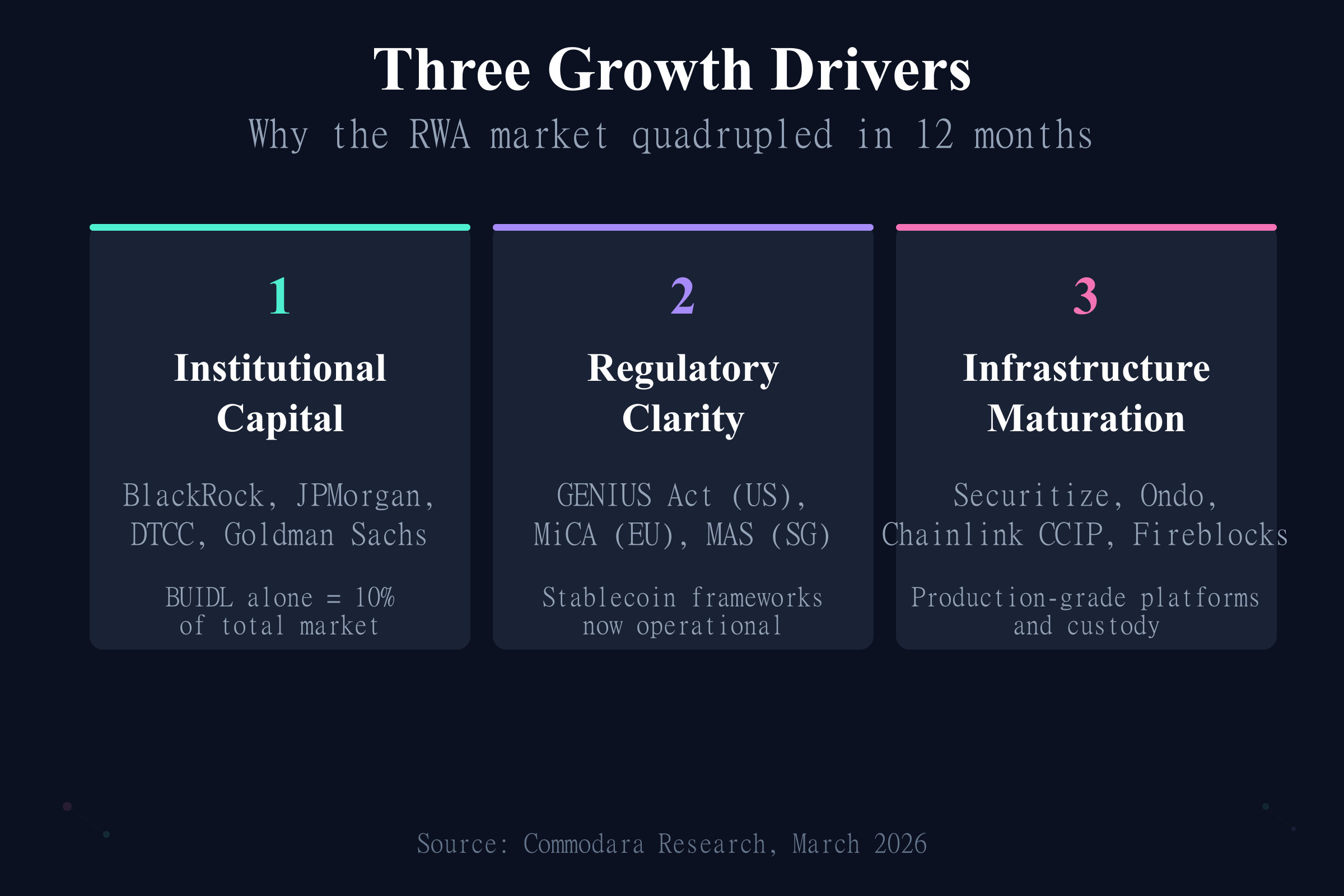
The real world asset market growth from $6.4 billion to over $25 billion in twelve months was not the result of a single catalyst. Three structural forces converged to accelerate adoption beyond consensus expectations.
Institutional Capital Deployment
The entry of BlackRock, JPMorgan, Goldman Sachs, Franklin Templeton, and the DTCC transformed the tokenized asset market from a crypto-native experiment into a serious institutional infrastructure category. BlackRock’s BUIDL fund alone accounts for roughly 10% of the total RWA market size 2026. The complete guide to tokenized real world assets details how these institutional commitments have validated the market for a broader range of allocators.
Institutional capital brought three things that the market previously lacked: scale, credibility, and distribution. When BlackRock launches a tokenized fund, asset managers, pension funds, and family offices that would never have engaged with a crypto-native tokenization platform take notice. The institutional endorsement effect has been the single most important driver of the tokenization market data trends observed in 2026.
Regulatory Clarity
The GENIUS Act in the United States, MiCA in Europe, and evolving frameworks in Singapore, the UAE, and the United Kingdom have provided the regulatory clarity that institutional investors require before deploying capital. Stablecoins, which serve as the primary settlement currency for most tokenized products, now operate under clear regulatory frameworks in the US and EU for the first time. This regulatory foundation has removed the legal uncertainty that previously deterred institutional participation.
Infrastructure Maturation
Tokenization platforms like Securitize, Ondo Finance, and Centrifuge have matured from early-stage protocols into production-grade infrastructure capable of handling billions of dollars in assets. Smart contract standards have been audited, tested, and battle-hardened through years of operation. Cross-chain interoperability through protocols like Chainlink CCIP has enabled multi-chain deployment strategies. Custody solutions from providers like Fireblocks have achieved the security certifications that institutional compliance teams require. The infrastructure layer is no longer the bottleneck; the market is now constrained primarily by regulatory expansion and investor education.
Market Projections: Where Is the RWA Market Heading?
Industry projections for the tokenized asset market vary widely but converge on a trajectory of continued rapid growth. Boston Consulting Group has projected the tokenized asset market could reach $16 trillion by 2030. McKinsey estimates a range of $2 trillion to $4 trillion by 2030 in a base case. Citigroup has projected $4 trillion to $5 trillion by 2030. These projections include both on-chain tokenized assets and tokenized deposits and securities that may operate on permissioned or hybrid infrastructure.
The current RWA market size 2026 of $25 billion represents less than 0.2% of the $16 trillion high-end projection for 2030. This gap suggests that the market has substantial room for growth, but also that achieving the higher-end projections would require exponential scaling of infrastructure, regulatory frameworks, and investor adoption over the next four years. The more conservative projections of $2 trillion to $4 trillion by 2030 imply an 80x to 160x increase from current levels, which would require compound annual growth rates of 150% to 200%, roughly in line with the growth rates observed from 2024 to 2026.
The tokenization market data suggests that the most likely path to these projections runs through two catalysts that have not yet fully materialized. First, the tokenization of mainstream equities by NYSE, Nasdaq, and other major exchanges would add trillions of dollars in tokenizable asset value. Second, the adoption of tokenized deposits and settlement infrastructure by the global banking system would fundamentally change the scale of assets flowing through blockchain rails.
Frequently Asked Questions
What is the RWA market size in 2026?
The RWA market size in 2026 is approximately $25.4 billion in on-chain tokenized asset value, excluding stablecoins. This figure nearly quadrupled from $6.4 billion in March 2025, with six asset categories each exceeding $1 billion in value.
What is the largest tokenized asset class?
Tokenized private credit leads with over $14 billion in cumulative on-chain origination. Tokenized US treasuries are second at $8.7 billion in total value locked. Tokenized gold is third at $5.9 billion in market capitalization.
How fast is the tokenized asset market growing?
The tokenized asset market has grown at a compound annual growth rate exceeding 200% from March 2024 to March 2026. The market grew from $2.1 billion to $6.4 billion to $25.4 billion over this period, consistently outpacing industry projections.
What are the projections for the RWA market by 2030?
Industry projections range from $2 trillion (McKinsey base case) to $16 trillion (BCG high-end estimate) by 2030. Achieving the higher-end projections requires exponential scaling of infrastructure, regulation, and the tokenization of mainstream equities and banking settlement.
Does the RWA market size include stablecoins?
The $25.4 billion figure excludes stablecoins, which are sometimes counted in broader RWA definitions. The stablecoin market exceeds $200 billion separately. Including stablecoins would significantly inflate the headline number but conflates two distinct product categories.
The Bottom Line
The RWA market size 2026 tells a clear story: tokenized assets have moved from experiment to infrastructure at a pace that has exceeded industry expectations. With $25.4 billion in on-chain value across six asset categories, the market has achieved a scale that validates the institutional thesis for tokenization. Private credit, treasuries, and gold lead the market, while real estate and equities are positioned for significant growth as regulatory frameworks and secondary market infrastructure mature.
For institutional decision-makers, the tokenization market data in this article provides the quantitative foundation for allocation decisions and strategic planning. The market is still in its early stages relative to industry projections of $2 trillion to $16 trillion by 2030, which means the opportunity for early movers remains substantial. The question is no longer whether tokenized assets will achieve scale, but which asset classes and platforms will capture the largest share of the growth ahead.
Subscribe to the Commodara newsletter for monthly updates on RWA market size 2026 data, asset class performance, and the institutional developments driving the tokenized economy forward.