
$8B JPMorgan, Ondo Tokenized Treasury Settlement On XRP Ledger
Key Points
- JPMorgan’s Kinexys, Ondo Finance, Mastercard, and Ripple completed the first near real-time cross-border redemption of a tokenized U.S. Treasury fund.
- The settlement landed as the Ethereum tokenized U.S. Treasury market hit $8 billion in total value, doubling in the past six months.
- Ondo Finance President Ian De Bode said the milestone “lays the groundwork for 24/7 global markets that never close.”
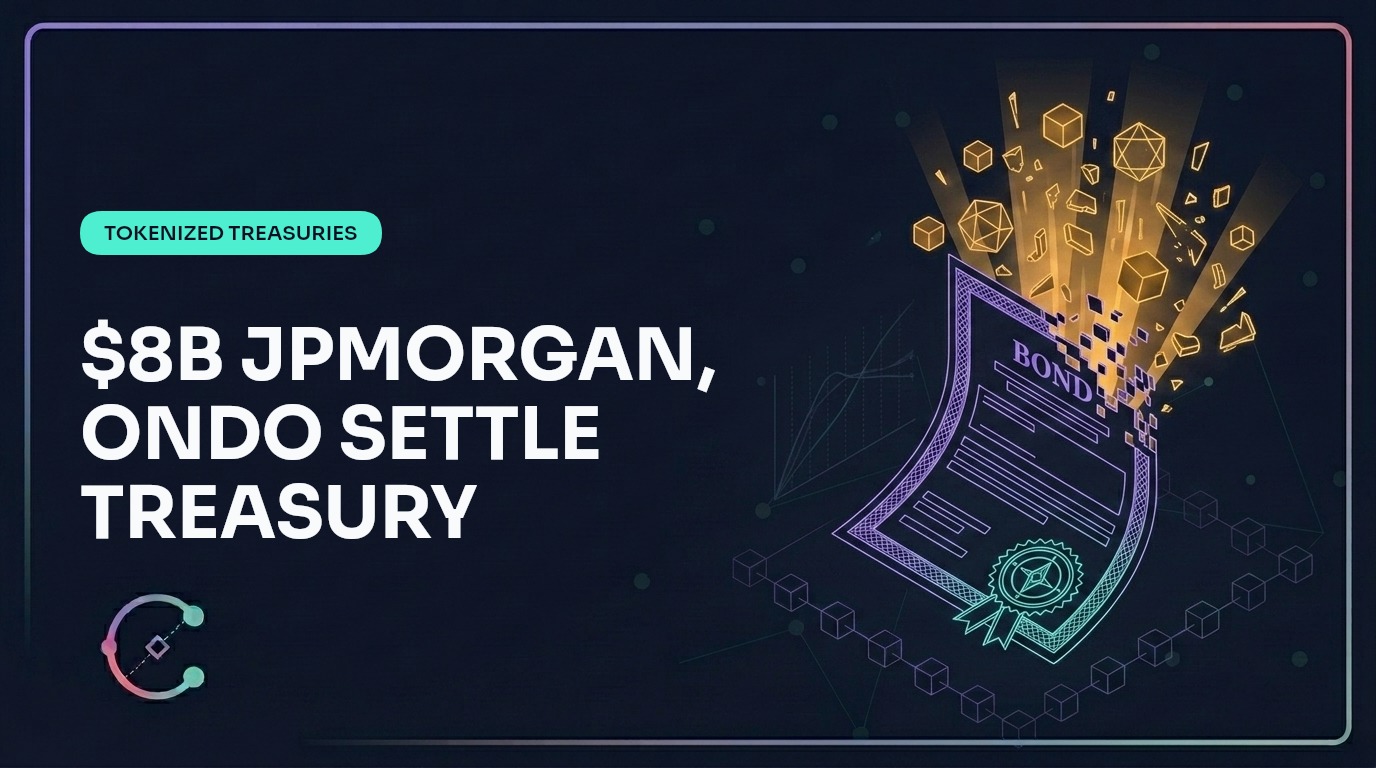
JPMorgan’s Kinexys, Ondo Finance, Mastercard, and Ripple completed the first near real-time cross-border redemption of a tokenized U.S. Treasury fund on Tuesday, with Ondo’s Ian De Bode saying the milestone “lays the groundwork for 24/7 global markets that never close.”
The XRP Ledger Settlement Flow
Per the announcement, Ripple initiated the redemption of tokenized assets on the XRP Ledger, triggering the on-chain transaction.
Mastercard’s Multi-Token Network then relayed settlement instructions across institutional systems, translating blockchain execution into traditional financial messaging.
JPMorgan‘s Kinexys infrastructure handled the fiat leg, routing USD through its correspondent banking network into Ripple’s Singapore account.
The settlement completed within the same business window, bypassing the banking cut-off restrictions that delay conventional cross-border transfers.
Each leg of the flow was orchestrated as a single connected transaction rather than the sequential handoffs that characterize current tokenized asset redemption.
The four-firm coordination is the integration model the rest of the category has been waiting for.
The integration uses the XRP Ledger as the on-chain execution layer rather than a private blockchain network.
That decision reflects the firms’ bet that public-chain throughput and settlement finality have matured enough to handle institutional-scale flows.
The $8B Tokenized Treasury Category
The pilot lands as the broader Ethereum tokenized U.S. Treasury market hit $8 billion in total value on Tuesday, according to Token Terminal data cited by Wu Blockchain.
The category has roughly doubled in the past six months, expanding by 100% since November 2025 and pacing toward an estimated 200% year-over-year by mid-2026.
BlackRock’s BUIDL, issued through Securitize, remains the largest product by market capitalization.
Franklin Templeton’s iBENJI, WisdomTree’s WTGXX, Ondo Finance‘s USDY, Centrifuge’s JSTRY, and Superstate’s USTB round out the top tier of issuers.
The $8 billion figure still represents a small fraction of the $27 trillion U.S. Treasury market, putting on-chain supply at roughly 0.03% of total Treasury issuance.
The category is expanding faster than any other on-chain asset class in Q1 2026, drawing institutional capital from segments that had previously sat on the sidelines.
Within the top-tier issuer cohort, BlackRock holds the largest share of category AUM.
Securitize provides the transfer agent rails for BUIDL and several of the smaller competing tokenized treasury products on the platform.
JPMorgan’s Cross-Border Pilot Reaction
Industry analysts have framed the pilot as a structural milestone rather than a one-off demonstration.
Ondo Finance has positioned USDY as a natural distribution vehicle for cross-border tokenized treasury redemption.
The pilot also surfaces JPMorgan’s Kinexys as the institutional fiat rail of choice for tokenized asset partners that need same-window cross-border execution.
Mastercard’s Multi-Token Network had previously been used in domestic interbank pilots, but this is its first publicly disclosed deployment in a cross-border tokenized treasury redemption.
The reframe matters: this pilot is not a proof-of-concept on a single fund but a working integration of three institutional rails with public blockchain redemption.
With Token Terminal showing the category at $8 billion and growing at roughly 100% every six months, the integration model has a growing pool of tokenized assets to scale across.
Activity on the XRP Ledger has been picking up alongside the pilot, with rising transfer volumes, accelerating tokenized U.S. Treasury adoption, and record network address growth.
Ripple’s Singapore presence has historically anchored its Asia-Pacific institutional flows, and the use of a Singapore account in the pilot reflects that footprint.
Institutions evaluating similar settlement infrastructure can estimate the cost of tokenizing institutional assets before committing to a venue.
Whether other tokenized treasury issuers follow the cross-border redemption playbook depends on how quickly Mastercard, JPMorgan, and Ripple roll out the integration to additional fund partners.
For a deeper breakdown of how BUIDL, OUSG, BENJI, and USDY compare on yield, fees, and settlement, read Commodara’s tokenized treasuries comparison.