
Canton Network Explained: The Institutional Blockchain for Wall Street
Canton Network is the blockchain that DTCC, JPMorgan, Goldman Sachs, and Franklin Templeton have chosen as the foundation for institutional tokenization infrastructure. Unlike public blockchains such as Ethereum or Solana that were designed for open, permissionless participation, Canton Network was purpose-built for regulated financial institutions that require privacy, interoperability between siloed systems, and the ability to process transactions under strict compliance requirements. In a market where most tokenization discussions focus on public chains, Canton Network represents the institutional alternative that Wall Street is actually deploying at scale.
This article explains what Canton Network is, how its architecture differs from public blockchains, which institutions are building on it, what use cases it supports, and why it matters for the future of tokenized financial markets. For institutional decision-makers evaluating blockchain infrastructure and for industry builders analyzing the competitive landscape, understanding Canton Network is essential context for the direction that institutional tokenization is heading.
What Is Canton Network?
Canton Network is a privacy-enabled, interoperable blockchain network designed specifically for institutional financial applications. The network was developed by Digital Asset, a financial technology company founded by former JPMorgan executive Blythe Masters, and launched in 2023 with a consortium of over 30 financial institutions participating in its initial pilot programs. The Canton Network blockchain uses the Daml smart contract language, also developed by Digital Asset, which was designed from the ground up for financial transactions that require privacy, regulatory compliance, and atomic settlement.
The core design philosophy of Canton Network is fundamentally different from public blockchains. On Ethereum, every transaction is visible to every participant on the network. On Canton Network, transactions are visible only to the parties directly involved, with cryptographic proofs ensuring that the broader network can verify transaction validity without seeing transaction details. This privacy-by-default architecture is what makes Canton Network acceptable to institutions that cannot expose their trading activity, portfolio positions, or client data on a public ledger.
The Daml Smart Contract Language
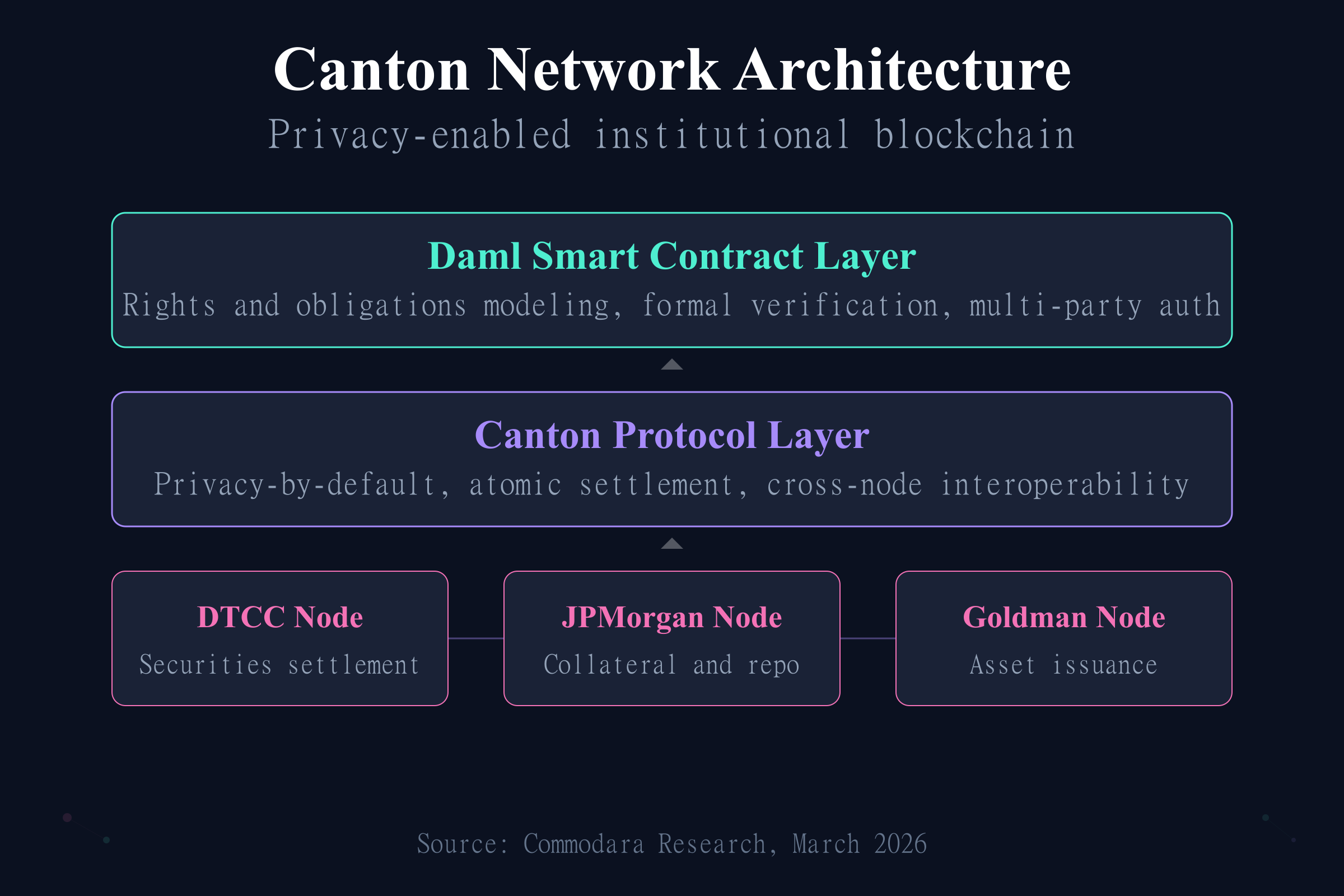
Canton Network runs on Daml, a purpose-built smart contract language that Digital Asset created specifically for financial applications. Daml differs from Solidity (Ethereum’s smart contract language) in several important ways that reflect institutional requirements. Daml contracts model rights and obligations between parties rather than account balances, which maps more naturally to financial agreements. The language includes built-in support for authorization workflows, meaning that multi-party approvals can be encoded directly into the contract logic rather than bolted on through external governance mechanisms.
Daml also provides formal verification capabilities that allow smart contracts to be mathematically proven correct before deployment. For institutions processing billions of dollars in transactions, the ability to formally verify that a smart contract will behave as intended under all conditions is a significant advantage over languages that rely primarily on auditing and testing. This engineering rigor is one of the reasons that DTCC Canton deployment proceeded with institutional confidence.
Interoperability Through the Canton Protocol
One of the most distinctive features of Canton Network is its approach to interoperability. Rather than requiring all participants to use a single shared ledger, Canton Network allows institutions to run their own nodes and applications while maintaining the ability to transact atomically with other participants on the network. This means that JPMorgan can run its own Canton node for internal operations while still settling transactions with Goldman Sachs or DTCC through the shared Canton protocol, without either party seeing the other’s internal data.
This interoperability model solves a fundamental problem in institutional blockchain adoption. Banks and asset managers have been reluctant to adopt shared ledgers because they do not want competitors to see their transaction data. Canton Network addresses this by providing a network where participants share a common protocol but maintain private, isolated views of the data that is relevant to them. The result is the settlement efficiency of a shared network with the privacy guarantees that institutions require.
Who Is Building on Canton Network?
The list of institutions building on Canton Network reads like a directory of the world’s largest financial infrastructure providers. Understanding who is deploying on the network and what they are building provides the clearest signal of Canton Network’s trajectory and strategic importance.
DTCC: The Settlement Backbone
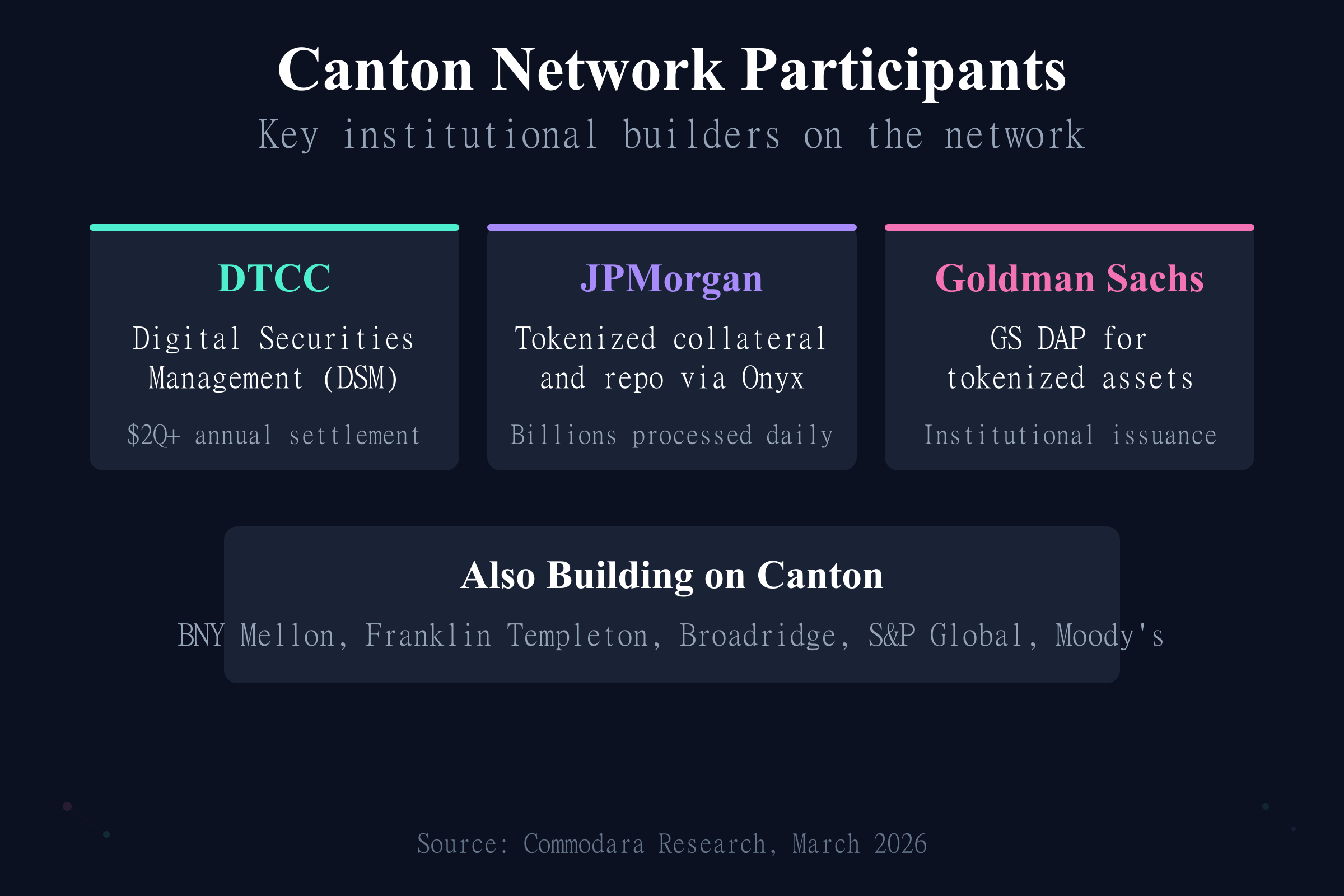
The Depository Trust and Clearing Corporation, which settles over $2 quadrillion in securities transactions annually, has deployed its Digital Securities Management (DSM) platform on Canton Network. DSM is designed to handle the issuance, transfer, and settlement of tokenized securities on institutional-grade infrastructure. This deployment is not a pilot; it is a production system that DTCC is positioning as a core component of its future settlement infrastructure.
The significance of the DTCC Canton deployment cannot be overstated. DTCC is the plumbing of the US securities market. Its decision to build on Canton Network signals that the institution views this blockchain as meeting the operational, regulatory, and scalability requirements for processing real securities transactions at institutional scale. No other blockchain network has received this level of endorsement from the entity that underpins the existing settlement infrastructure.
JPMorgan: Tokenized Collateral and Repo
JPMorgan’s Onyx division, which operates the bank’s blockchain and digital asset initiatives, has been one of the most active builders on Canton Network. The bank has deployed tokenized collateral management and tokenized repo transaction capabilities on the network. These applications allow JPMorgan to process intraday collateral movements and short-term financing transactions on-chain, reducing settlement times from days to minutes and freeing up capital that would otherwise be locked during traditional settlement windows.
JPMorgan’s Canton Network applications process real institutional capital, not test transactions. The bank has publicly disclosed that it processes billions of dollars in tokenized transactions daily through its Onyx platform, a portion of which now runs on Canton infrastructure. This production-scale deployment demonstrates that Canton Network can handle the transaction volumes and complexity that the world’s largest banks require.
Goldman Sachs, Franklin Templeton, and Others
Goldman Sachs has deployed its Digital Asset Platform (GS DAP) on Canton Network, enabling the bank to issue and manage tokenized assets for its institutional clients. Franklin Templeton, which operates the BENJI tokenized treasury fund, participates in the Canton ecosystem for settlement and interoperability purposes. Additional participants include BNY Mellon, Broadridge, S&P Global, Moody’s, and several major insurance companies and asset managers.
The breadth of this participant base is what distinguishes Canton Network from other institutional blockchain initiatives. Previous enterprise blockchain projects often attracted a handful of participants for specific use cases. Canton Network has assembled a critical mass of the world’s most important financial infrastructure providers, creating network effects that make the platform increasingly valuable as more participants join and interoperate. The institutions exploring tokenized stock trading on NYSE and Nasdaq are evaluating Canton as potential settlement infrastructure for these new venues.
Canton Network Use Cases in Production
Canton Network supports several categories of institutional use cases that are either in production or in advanced pilot stages. These use cases illustrate how the network’s architecture translates into practical financial applications.
Tokenized Securities Settlement
The primary use case for Canton Network is the settlement of tokenized securities. DTCC’s DSM platform enables issuers to create digital securities on Canton and settle trades between institutional counterparties with finality in minutes rather than the traditional T+1 or T+2 settlement cycle. This accelerated settlement reduces counterparty risk, frees up capital, and enables same-day settlement for asset classes that traditionally require multi-day processing.
Collateral Management and Repo
Canton Network enables tokenized collateral to be pledged, transferred, and returned in real time. JPMorgan’s tokenized repo application allows the bank to conduct intraday repurchase agreements on-chain, which is not possible with traditional settlement infrastructure that operates on daily cycles. This capability is particularly valuable for large institutions that manage complex collateral pools across multiple counterparties and need to optimize capital allocation in real time.
Fund Administration and Transfer Agency
Several asset managers are using Canton Network for tokenized fund operations, including subscription processing, redemption handling, and NAV calculation. These applications replace manual, paper-based fund administration processes with automated on-chain workflows that reduce operational costs and processing times. The privacy features of Canton Network are essential for these applications because fund data, including investor identities and position sizes, must remain confidential.
Canton Network vs Public Blockchains
The relationship between Canton Network and public blockchains like Ethereum is not purely competitive. The two types of networks serve different segments of the institutional market and may ultimately interoperate rather than replace each other.
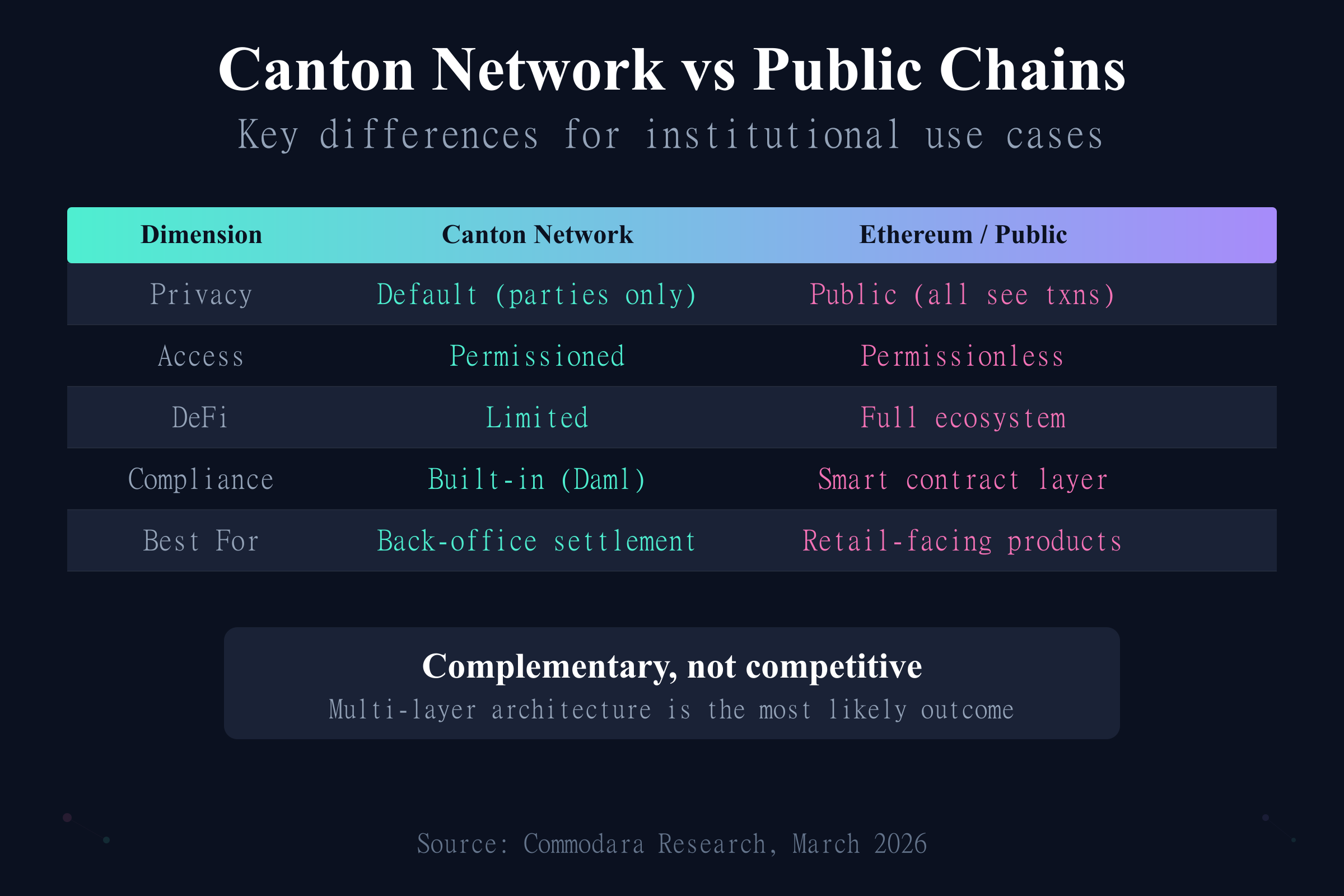
Public blockchains excel at transparency, permissionless access, and composability with the broader DeFi ecosystem. Products like BlackRock’s BUIDL and Ondo’s OUSG are issued on Ethereum precisely because they benefit from public chain liquidity, DeFi integration, and broad wallet compatibility. Canton Network excels at privacy, institutional compliance, and interoperability between regulated entities. Applications like DTCC settlement and JPMorgan collateral management require the privacy and compliance features that public chains do not provide.
The most likely outcome is a multi-layer architecture where public chains handle retail-facing tokenized products and DeFi composability, while Canton Network and similar institutional networks handle back-office settlement, collateral management, and inter-institutional transactions. Cross-chain bridges and interoperability protocols may eventually connect these layers, allowing a tokenized security issued on Ethereum to settle through Canton Network infrastructure when traded between institutional counterparties.
For investors and institutions evaluating blockchain infrastructure, the key insight is that the institutional blockchain landscape is not winner-take-all. Canton Network and Ethereum serve different functions in the emerging tokenized financial system, and understanding where each fits is essential for informed infrastructure decisions. The central bank settlement infrastructure being developed globally adds yet another layer to this multi-network architecture.
Challenges and Limitations
Canton Network faces several challenges that could affect its adoption trajectory. The network’s institutional focus means it lacks the retail accessibility and developer ecosystem of public blockchains. Building on Canton requires expertise in the Daml language, which has a smaller developer community than Solidity or Rust. This talent constraint could slow the pace of application development on the network.
Governance is another open question. Canton Network is governed by a consortium of institutional participants, which creates potential conflicts of interest when governance decisions affect competitive dynamics between participants. How the network resolves disputes, manages upgrades, and admits new participants will determine whether the consortium model scales or becomes a bottleneck.
Regulatory treatment of institutional blockchain networks is still evolving. While regulators have generally been supportive of institutional efforts to modernize settlement infrastructure, the specific regulatory frameworks for networks like Canton are still being developed. Changes in regulatory expectations could require modifications to the network’s architecture or governance structure.
Frequently Asked Questions
What is Canton Network?
Canton Network is a privacy-enabled, interoperable blockchain designed for institutional financial applications. Built by Digital Asset, it uses the Daml smart contract language and is deployed by DTCC, JPMorgan, Goldman Sachs, and over 30 other financial institutions for tokenized securities settlement and collateral management.
How is Canton Network different from Ethereum?
Canton Network provides transaction privacy by default, meaning only involved parties see transaction data. Ethereum transactions are public. Canton is permissioned and designed for regulated institutions; Ethereum is permissionless and open to all. They serve different market segments and may eventually interoperate.
Why did DTCC choose Canton Network?
DTCC selected Canton Network for its Digital Securities Management platform because the network provides the privacy, compliance, and interoperability features required for institutional securities settlement at scale. The Daml smart contract language also offers formal verification capabilities that institutional systems demand.
Can retail investors use Canton Network?
Canton Network is designed for institutional participants and is not directly accessible to retail investors. However, retail investors indirectly benefit when products they hold, such as tokenized fund shares, settle through Canton infrastructure between institutional counterparties.
Is Canton Network a competitor to Ethereum?
Canton Network and Ethereum serve different segments. Ethereum excels at public, transparent, DeFi-composable tokenized products. Canton excels at private institutional transactions. The two may ultimately form complementary layers in the tokenized financial system rather than competing directly.
The Bottom Line
Canton Network represents the institutional blockchain infrastructure that traditional finance is actually deploying at production scale. While public discourse about tokenization often focuses on Ethereum and DeFi, the world’s largest financial institutions are building their core settlement, collateral, and fund administration systems on Canton Network. The participation of DTCC, JPMorgan, Goldman Sachs, and Franklin Templeton is not speculative; these are production deployments processing real institutional capital.
The network’s privacy-by-default architecture, the Daml smart contract language, and the interoperability model that allows institutions to transact without exposing proprietary data address the specific requirements that have prevented institutional adoption of public blockchains for back-office operations. Canton Network is not a replacement for public chains; it is the institutional layer that sits alongside them in an emerging multi-network financial architecture.
For institutional decision-makers and industry builders, Canton Network is the infrastructure that defines where Wall Street is heading with tokenization. Subscribe to the Commodara newsletter for ongoing coverage of institutional blockchain infrastructure and the platforms shaping the future of tokenized financial markets.