
Chainlink CCIP for RWA: How Oracles Power Tokenized Asset Infrastructure
Chainlink CCIP is the cross-chain interoperability protocol that institutions including the Bank of England, DTCC, and Swift have selected to power tokenized asset settlement. In a market where tokenized products exist across dozens of blockchain networks, the ability to move assets and data securely between chains is not a convenience; it is a requirement for institutional-scale operations. Chainlink CCIP solves this problem by providing a standardized, auditable messaging layer that connects blockchains with the reliability and security that regulated financial institutions demand.
This article explains what Chainlink CCIP is, how it works, which institutions are deploying it for tokenized asset use cases, and why cross-chain infrastructure matters for the future of the RWA market. For industry builders evaluating interoperability solutions and institutional decision-makers assessing the technology stack behind tokenized products, understanding Chainlink CCIP is essential for navigating the multi-chain landscape that defines tokenized finance in 2026.
What Is Chainlink CCIP?
Chainlink CCIP, which stands for Cross-Chain Interoperability Protocol, is an infrastructure layer developed by Chainlink Labs that enables secure communication and token transfers between different blockchain networks. The protocol allows smart contracts on one blockchain to send messages, trigger actions, and transfer tokens to smart contracts on another blockchain, with cryptographic guarantees that the message was delivered accurately and has not been tampered with.
The need for Chainlink CCIP in the tokenized asset market is driven by a fundamental reality: tokenized products are deployed across multiple chains. BlackRock’s BUIDL exists on Ethereum, Polygon, Avalanche, Optimism, and Aptos. Ondo Finance’s USDY operates on seven or more networks. A tokenized real estate fund might issue on Ethereum while its investors hold wallets on Solana. Without a secure interoperability layer, these multi-chain deployments create fragmented liquidity and settlement challenges that limit the market’s growth potential.
How Chainlink CCIP Works
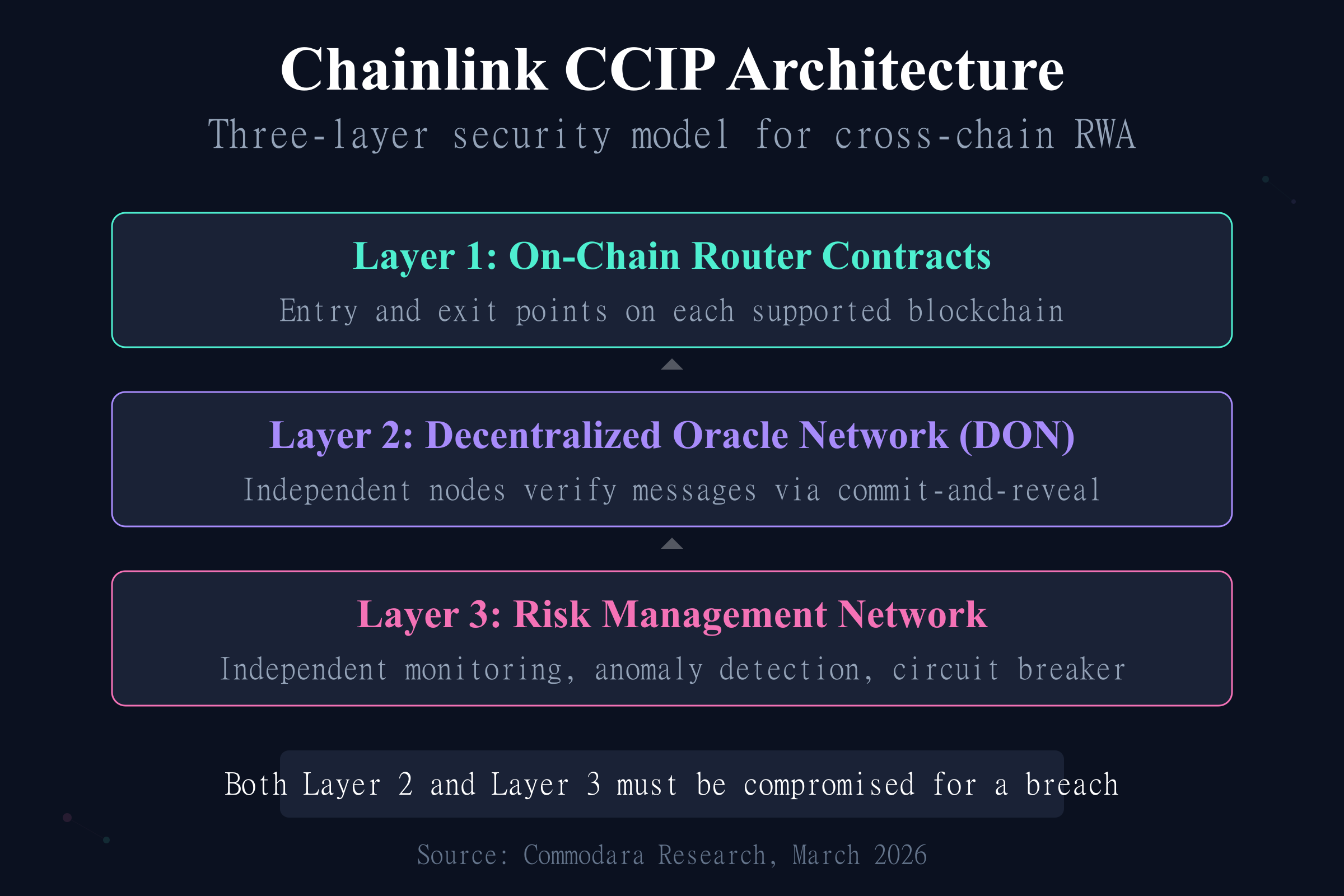
Chainlink CCIP operates through a three-layer architecture designed to maximize security. The first layer is the on-chain router contract, which exists on each supported blockchain and serves as the entry and exit point for cross-chain messages. When a smart contract on Ethereum wants to send a message to a contract on Avalanche, it submits the message to the CCIP router on Ethereum.
The second layer is the Decentralized Oracle Network (DON), which consists of independent node operators who observe the source chain, verify the message, and deliver it to the destination chain. The DON uses a commit-and-reveal mechanism where nodes first commit to the message content and then reveal their attestations, ensuring that no single node can fabricate or alter a message. This decentralized verification is what distinguishes Chainlink CCIP from centralized bridge solutions that rely on a single operator or small multisig to validate cross-chain transactions.
The third layer is the Risk Management Network, a separate and independent set of nodes that monitors all cross-chain transactions for anomalies. This secondary verification layer can pause the protocol if it detects suspicious activity, providing an additional security guarantee that does not exist in most competing interoperability solutions. The Risk Management Network operates independently from the DON, meaning that both systems would need to be compromised simultaneously for a security breach to succeed.
Why Security Matters for RWA Cross-Chain Infrastructure
Cross-chain bridges have historically been one of the most exploited categories in blockchain infrastructure. Over $2 billion in value was stolen from bridge exploits between 2021 and 2023, including high-profile attacks on Wormhole, Ronin, and Nomad. These incidents demonstrated that poorly designed interoperability solutions create catastrophic single points of failure. For institutional users moving billions of dollars in tokenized assets across chains, the security of the cross-chain layer is not a secondary consideration; it is the primary one.
Chainlink CCIP addresses this concern through its multi-layered verification architecture, its use of established Chainlink oracle infrastructure that already secures over $75 billion in DeFi value, and its independent Risk Management Network. These security properties are why institutions like the Bank of England and DTCC have selected Chainlink CCIP over alternative interoperability solutions for their tokenization pilots and production deployments.
Institutional Deployments of Chainlink CCIP
The most compelling evidence for Chainlink CCIP’s importance in the tokenized asset market comes from the institutions that are actively deploying it. These are not speculative partnerships or vague memoranda of understanding; they are production-grade integrations that process real institutional value.
Swift and Cross-Border Settlement
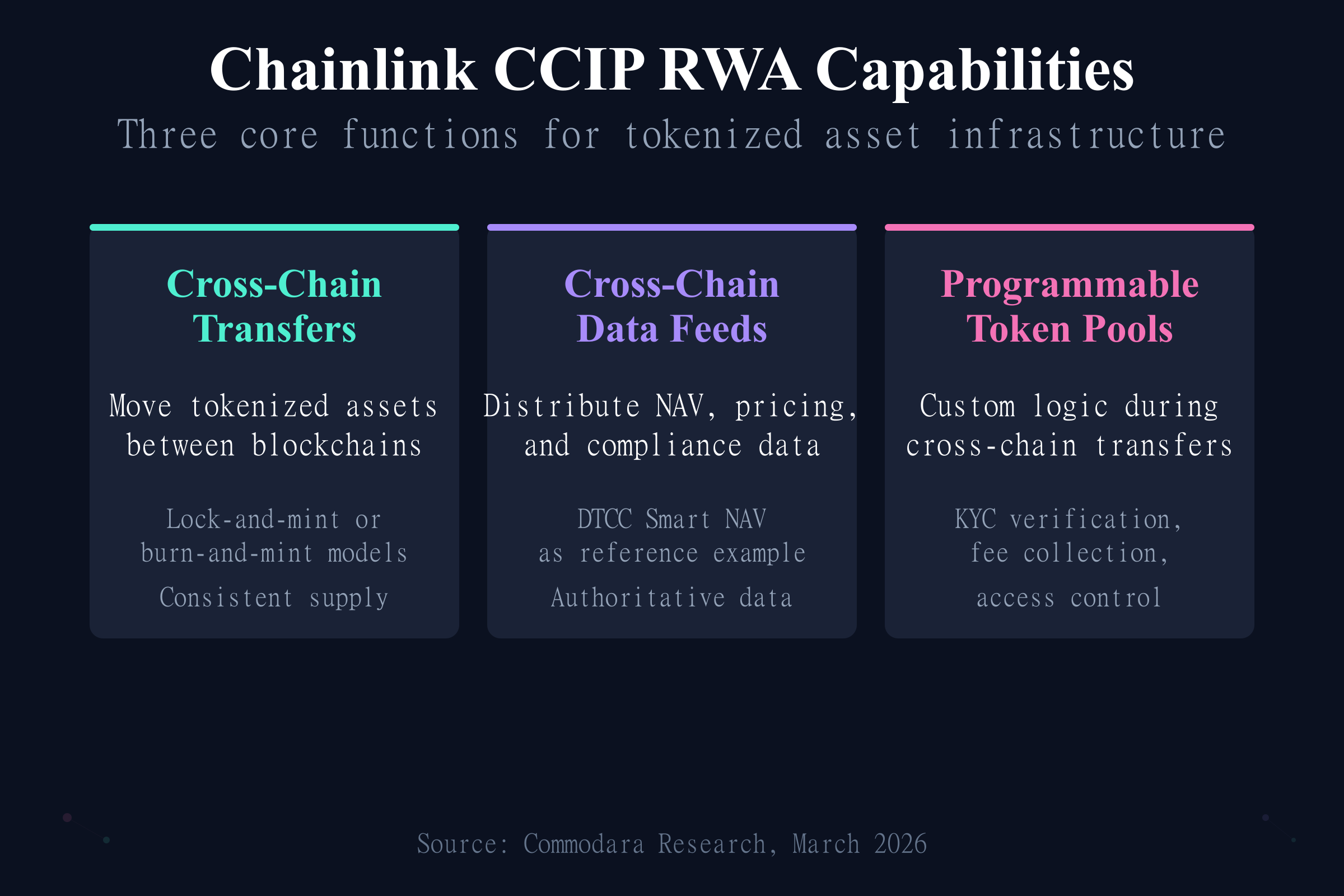
Swift, the global messaging network that connects over 11,000 financial institutions and processes trillions of dollars in daily transactions, has partnered with Chainlink to explore how Chainlink CCIP can enable cross-chain settlement for tokenized assets using existing Swift infrastructure. The pilot demonstrated that banks could use their existing Swift connections to initiate tokenized asset transfers across multiple blockchains without needing to interact with each chain’s native infrastructure directly.
This integration is strategically significant because it means that the 11,000+ institutions already connected to Swift could potentially access tokenized assets across any blockchain supported by Chainlink CCIP without building new technical connections. For the tokenized asset market, Swift’s adoption of Chainlink CCIP as its blockchain interoperability layer could accelerate institutional adoption by removing the technical barrier of multi-chain connectivity.
DTCC and Tokenized Securities
The DTCC has integrated Chainlink CCIP into its Smart NAV pilot, which brings mutual fund net asset value data on-chain across multiple blockchain networks. This pilot demonstrated that Chainlink CCIP can deliver verified financial data from DTCC’s infrastructure to smart contracts on Ethereum, Avalanche, and other networks, enabling tokenized fund products to access authoritative pricing data regardless of which blockchain they operate on. The DTCC’s broader institutional tokenization strategy positions Chainlink CCIP as a key component of its multi-chain data distribution infrastructure.
Bank of England and Central Bank Pilots
The Bank of England selected Chainlink CCIP for its digital pound pilot program, exploring how a central bank digital currency could interact with tokenized assets on various blockchain networks. This selection by one of the world’s most important central banks signals institutional confidence in Chainlink CCIP’s security model and operational reliability. The central bank settlement infrastructure being developed globally increasingly relies on cross-chain interoperability, and Chainlink CCIP is positioning itself as the default institutional choice for this critical layer.
How Chainlink CCIP Powers Tokenized Asset Infrastructure
Beyond specific institutional deployments, Chainlink CCIP provides several infrastructure capabilities that are fundamental to how the tokenized asset market operates at scale.
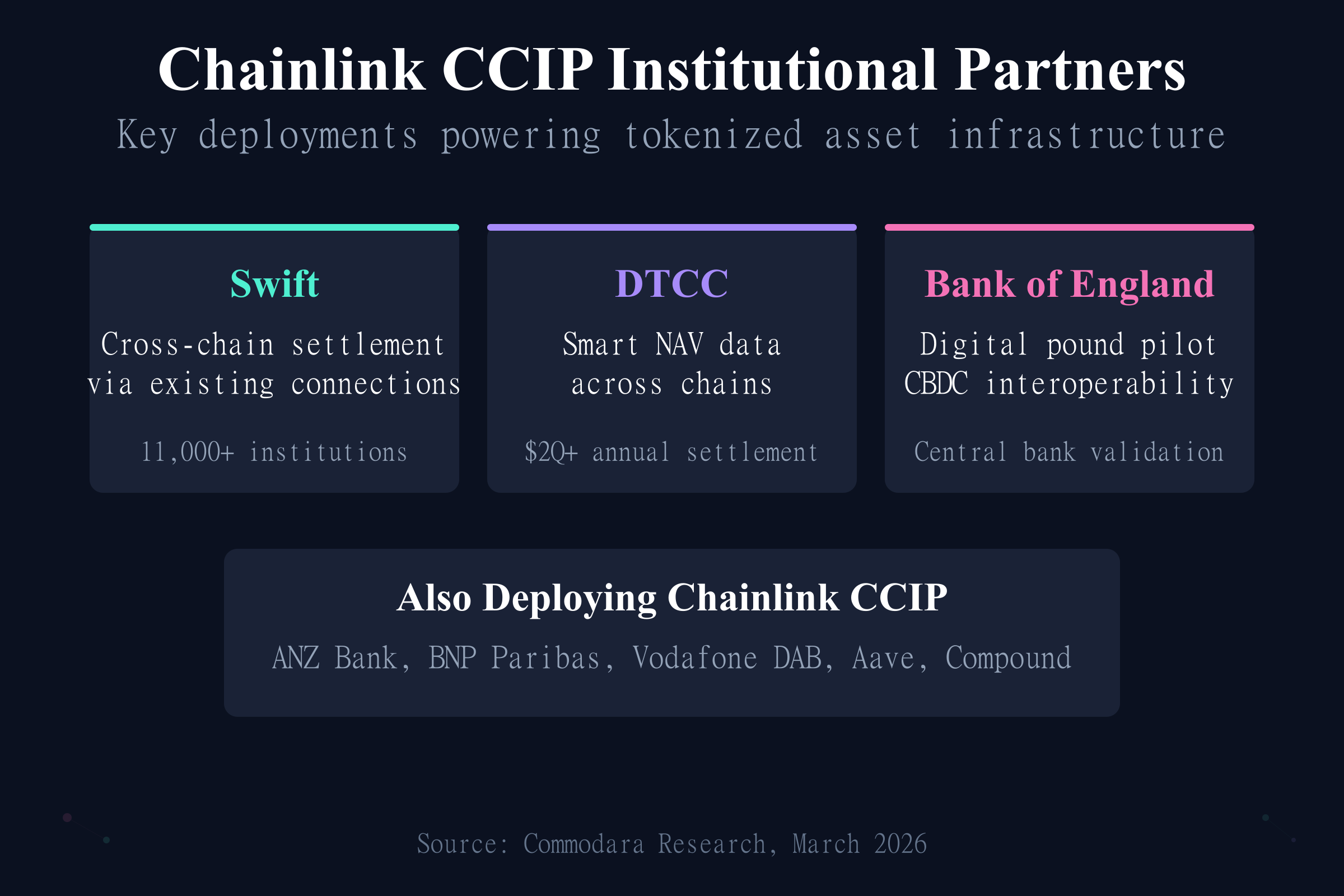
Cross-Chain Token Transfers
The most direct application of Chainlink CCIP for tokenized assets is enabling tokens to move between blockchains. When a tokenized treasury product like USDY needs to be available on Ethereum, Solana, and Polygon simultaneously, Chainlink CCIP can facilitate the cross-chain transfers that allow investors to move their positions between networks. This capability is essential for multi-chain products that need to maintain consistent token supply and compliance state across all supported chains.
Chainlink CCIP supports two models for cross-chain token transfer. The lock-and-mint model locks tokens on the source chain and mints equivalent tokens on the destination chain. The burn-and-mint model burns tokens on the source chain and mints new ones on the destination. Both models maintain total supply consistency and are compatible with compliance-embedded tokens that enforce transfer restrictions. For tokenized securities that require investor qualification checks before transfers, Chainlink CCIP’s programmable messaging allows compliance verification to be included in the cross-chain transfer process.
Cross-Chain Data Feeds for RWA Pricing
Chainlink’s oracle network already provides price feeds and data services that are foundational to the DeFi ecosystem. Chainlink CCIP extends this capability across chains by enabling verified data from one network to be consumed by smart contracts on another. For tokenized assets, this means that NAV data, interest rate feeds, collateral valuations, and compliance status information can be distributed across all networks where a tokenized product is deployed.
The DTCC Smart NAV pilot is a concrete example: mutual fund NAV data calculated by DTCC is delivered to smart contracts on multiple blockchains through Chainlink CCIP, ensuring that all chain deployments reference the same authoritative pricing data. Without this cross-chain data distribution, each blockchain deployment would need its own separate data feed, creating inconsistencies and increasing operational overhead.
Programmable Token Pools
Chainlink CCIP introduced the concept of programmable token pools, which allow token issuers to define custom logic that executes during cross-chain transfers. For tokenized assets, this capability enables issuers to embed compliance checks, fee collection, rate limiting, and access control directly into the cross-chain transfer process. A tokenized securities issuer could configure their CCIP token pool to verify that the destination wallet has completed KYC before allowing the cross-chain transfer to complete.
This programmability distinguishes Chainlink CCIP from generic bridge solutions that simply move tokens without understanding the compliance context. For institutional tokenized products that must maintain regulatory compliance across every chain they operate on, programmable token pools provide a mechanism to enforce consistent rules regardless of the destination network. The Canton Network’s institutional blockchain addresses similar compliance concerns through its privacy architecture, while Chainlink CCIP solves them through programmable cross-chain logic on public chains.
Chainlink CCIP vs Alternative Interoperability Solutions
The cross-chain interoperability market includes several alternatives to Chainlink CCIP, each with different security models, chain support, and institutional adoption profiles. Understanding the competitive landscape helps industry builders and institutions evaluate which solution best fits their tokenization infrastructure requirements.
LayerZero is the most prominent alternative, offering a modular interoperability framework that supports over 70 blockchain networks. LayerZero uses a different security model based on Decentralized Verifier Networks (DVNs) that can be configured by application developers. While LayerZero’s flexibility and broad chain support have made it popular for DeFi applications, its adoption among regulated financial institutions is less extensive than Chainlink CCIP’s.
Axelar Network provides another cross-chain messaging protocol, focusing on general-purpose interoperability with a validator-based security model. Wormhole, despite its 2022 exploit, has rebuilt its infrastructure and continues to operate as a cross-chain messaging layer, primarily serving DeFi applications. IBC (Inter-Blockchain Communication) serves the Cosmos ecosystem specifically, with limited reach outside that network.
Chainlink CCIP’s competitive advantage for RWA and institutional use cases comes from three factors. First, its security architecture with the independent Risk Management Network provides defense-in-depth that competitors do not match. Second, its existing relationships with Swift, DTCC, and central banks give it institutional credibility that newer protocols have not yet established. Third, the integration with Chainlink’s broader oracle infrastructure, which already secures the majority of DeFi value, provides a unified data and interoperability stack that reduces the number of vendors institutions must evaluate and manage.
Limitations and Considerations
Chainlink CCIP is not without limitations. The protocol currently supports a more limited set of blockchain networks compared to some competitors, although its chain coverage continues to expand. Cross-chain transactions through Chainlink CCIP involve gas costs on both the source and destination chains plus Chainlink service fees, which can make small-value transfers economically impractical. The latency of cross-chain transfers, while significantly faster than traditional settlement, is slower than native on-chain transactions due to the verification overhead required for security.
Centralization concerns have also been raised. While the DON and Risk Management Network are decentralized, Chainlink Labs retains significant influence over the protocol’s development, node operator selection, and upgrade processes. For institutions that require fully decentralized infrastructure, this governance model may warrant additional due diligence. However, most institutional users prioritize the operational reliability and accountability that a well-resourced development team provides over theoretical decentralization maximalism.
The dependency risk of building on Chainlink CCIP should also be evaluated. If Chainlink CCIP experiences downtime or a security incident, all cross-chain operations that depend on it would be affected simultaneously. Institutions building critical infrastructure on Chainlink CCIP should consider whether backup interoperability pathways are appropriate for their specific use case and risk tolerance.
Frequently Asked Questions
What is Chainlink CCIP?
Chainlink CCIP is a cross-chain interoperability protocol that enables secure communication and token transfers between different blockchain networks. It uses a three-layer architecture with decentralized oracle verification and an independent Risk Management Network to provide institutional-grade security for cross-chain operations.
Why do tokenized assets need cross-chain infrastructure?
Tokenized products are deployed across multiple blockchains. A tokenized treasury fund might exist on Ethereum, Polygon, and Solana simultaneously. Chainlink CCIP enables these multi-chain deployments by providing secure cross-chain token transfers, data distribution, and compliance verification across all supported networks.
Which institutions use Chainlink CCIP?
Swift, DTCC, the Bank of England, ANZ Bank, and several other major financial institutions have integrated or piloted Chainlink CCIP for tokenized asset settlement, cross-chain data distribution, and digital currency interoperability. These are production-grade deployments, not theoretical partnerships.
How is Chainlink CCIP different from other bridges?
Chainlink CCIP uses a three-layer security architecture including an independent Risk Management Network that monitors all transactions for anomalies. Most competing bridges use simpler verification models. This defense-in-depth approach is why institutions choose Chainlink CCIP over alternatives for high-value tokenized asset operations.
What are programmable token pools in Chainlink CCIP?
Programmable token pools allow token issuers to define custom logic that executes during cross-chain transfers, including compliance checks, fee collection, and access control. This enables tokenized securities to maintain regulatory compliance across every blockchain they operate on.
The Bottom Line
Chainlink CCIP has emerged as the institutional standard for cross-chain infrastructure in the tokenized asset market. Its selection by Swift, DTCC, and the Bank of England for production pilots and deployments provides a level of institutional validation that no competing interoperability protocol has achieved. The three-layer security architecture, programmable token pools, and integration with Chainlink’s broader oracle infrastructure create a comprehensive cross-chain stack that addresses the specific requirements of regulated financial institutions.
For the tokenized asset market, Chainlink CCIP solves a fundamental infrastructure problem: how to maintain secure, compliant, and efficient operations across the multi-chain landscape that defines modern blockchain deployment. As more tokenized products launch on multiple networks and institutional capital flows increase, the demand for reliable cross-chain infrastructure will only grow.
The infrastructure layer is where the future of tokenized finance is being built, and Chainlink CCIP is at the center of that construction. Subscribe to the Commodara newsletter for ongoing coverage of the infrastructure protocols and platforms that power the tokenized economy.