
CLARITY Act 2026: Digital Asset Classification and What It Means for Tokens
The CLARITY Act is expected to become law in 2026, and its classification of digital assets as either securities or commodities will determine how every tokenized product is regulated. For years, the US digital asset industry has operated under a regulatory gray zone where the Securities and Exchange Commission and the Commodity Futures Trading Commission have competed for jurisdiction. The CLARITY Act resolves this by drawing a definitive line between digital securities and digital commodities, giving issuers, platforms, and investors a framework they can build on with confidence.
This article explains what the CLARITY Act contains, how it classifies different types of tokens, what it means for the tokenized asset market, and what issuers and investors need to do to prepare. The legislation has implications for every participant in the tokenized economy, from retail investors holding tokenized treasury tokens to institutions evaluating large-scale tokenization strategies.
What Is the CLARITY Act?
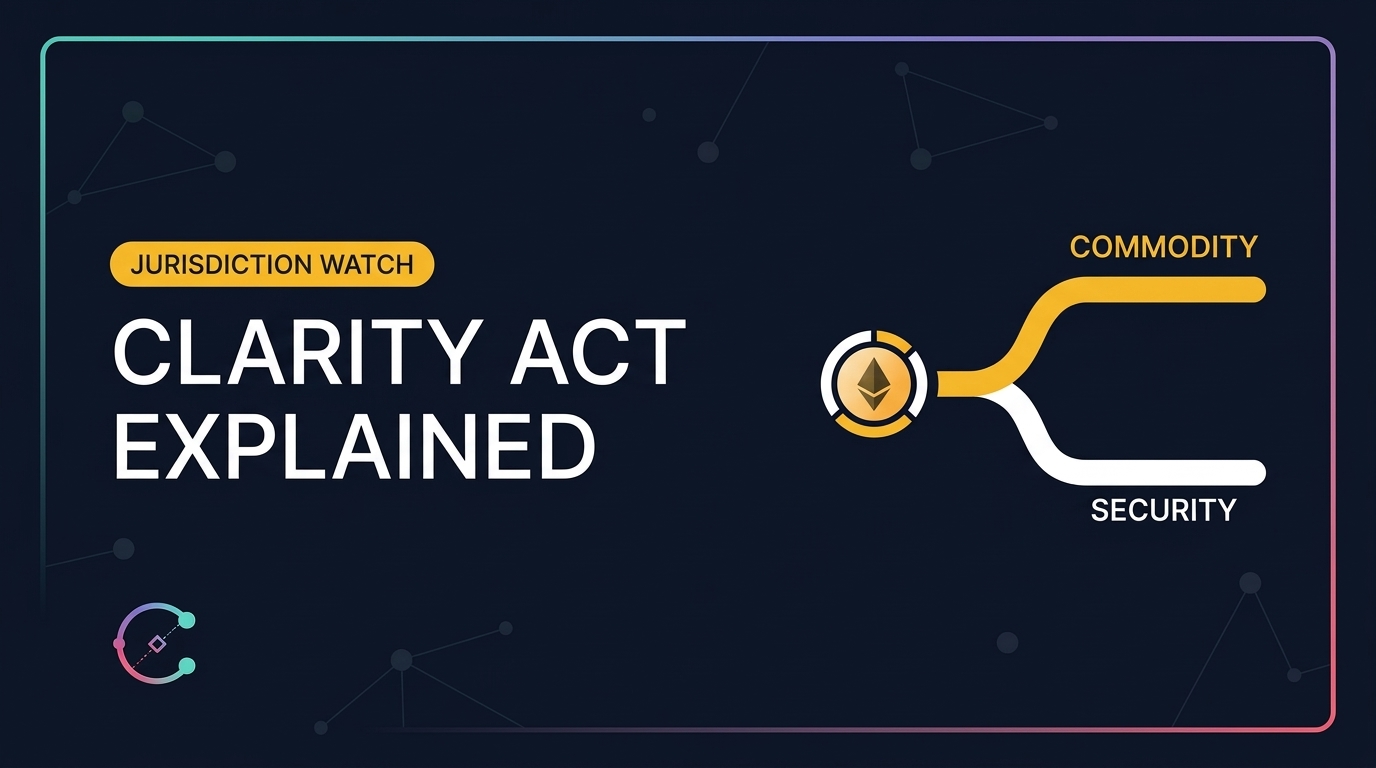
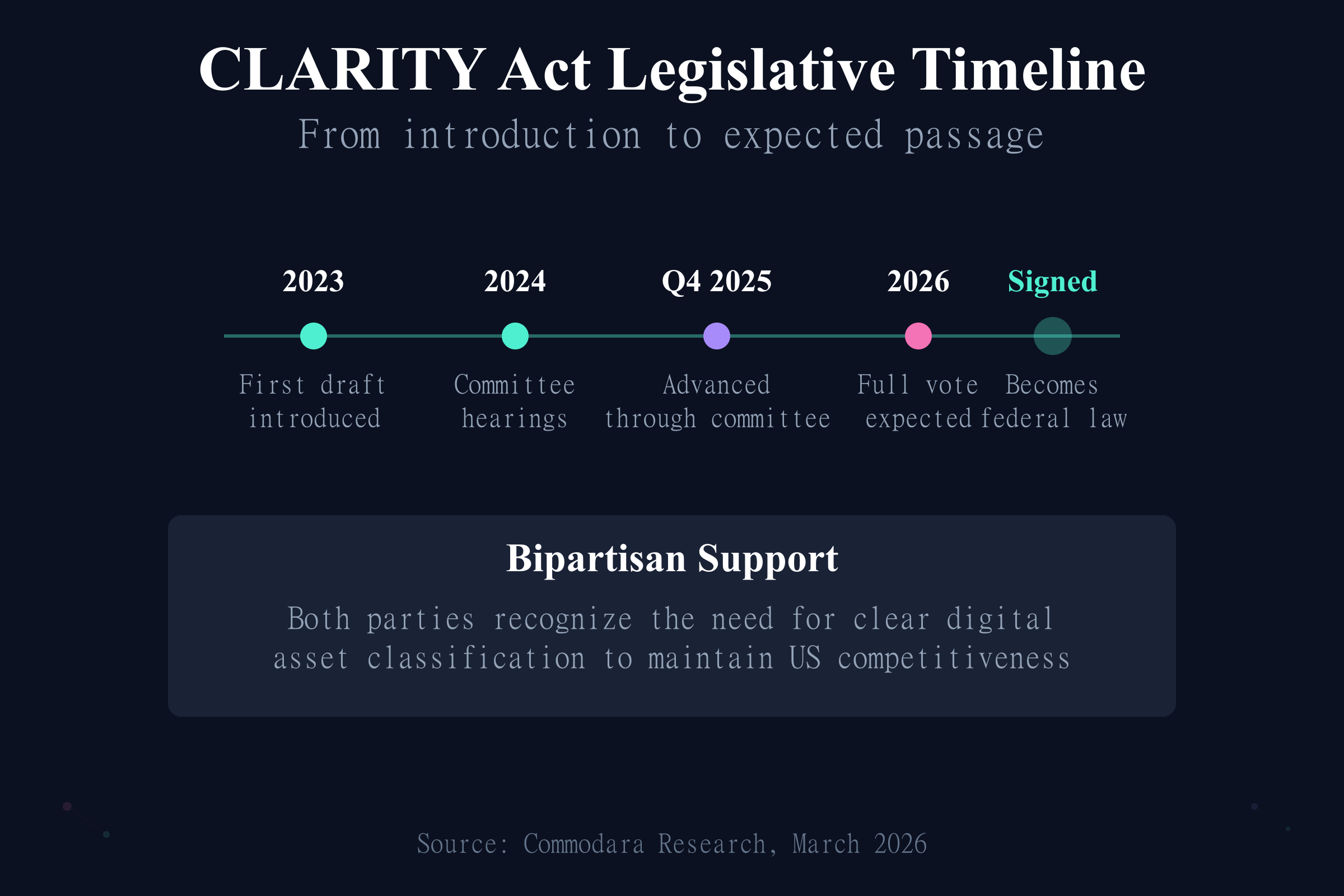
The CLARITY Act, formally titled the Crypto Legal Advocacy, Regulatory Innovation, and Technology for the Year Act, was introduced in the US House of Representatives and advanced through committee in late 2025. The legislation is designed to resolve the jurisdictional ambiguity that has defined US digital asset regulation since the early days of cryptocurrency. Its central purpose is to establish clear criteria for determining whether a digital asset is a security, regulated by the SEC, or a commodity, regulated by the CFTC.
The need for this legislation has been acute. Since 2017, the SEC has applied the Howey Test, a 1946 Supreme Court standard, to determine whether digital assets qualify as securities. This approach has led to enforcement actions against dozens of projects, but the case-by-case nature of enforcement left the broader market without clear rules. The CLARITY Act replaces this ambiguity with statutory definitions that apply uniformly across the market.
The Securities vs Commodities Distinction
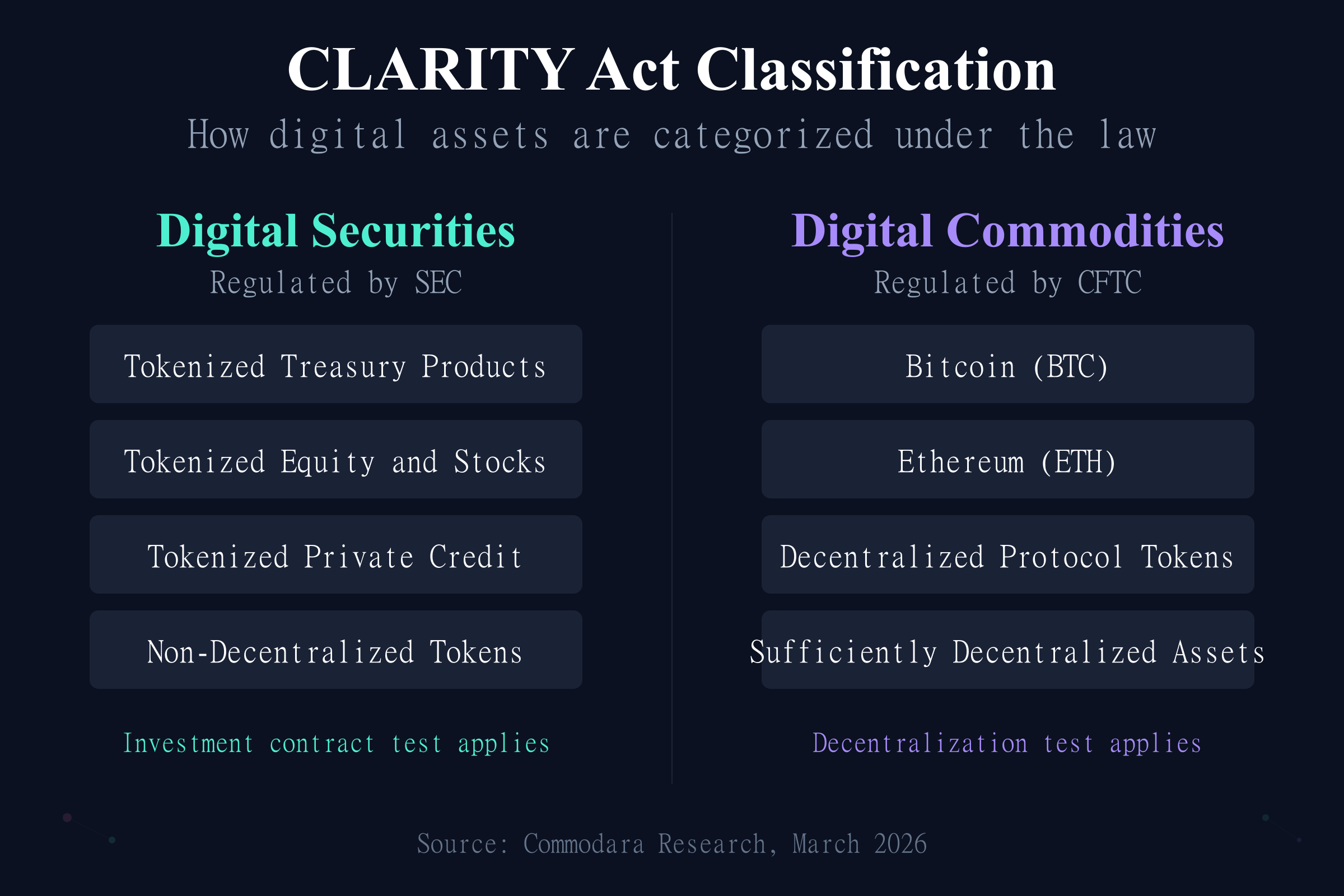
Under the CLARITY Act, a digital asset is classified as a security if it represents an investment contract, meaning the holder has an expectation of profits derived primarily from the efforts of others, and the asset’s underlying network is not sufficiently decentralized. If the network on which the asset operates meets specific decentralization criteria defined in the legislation, the asset is classified as a digital commodity and falls under CFTC jurisdiction instead.
The decentralization test is the most consequential provision in the CLARITY Act digital assets framework. It evaluates factors including the distribution of token ownership, the degree to which any single entity controls the network’s governance, the openness of the protocol’s source code, and the extent to which the network functions independently of its original developers. Tokens that pass this test graduate from SEC oversight to CFTC oversight, which generally involves lighter regulatory requirements.
How Tokenized Real World Assets Are Classified
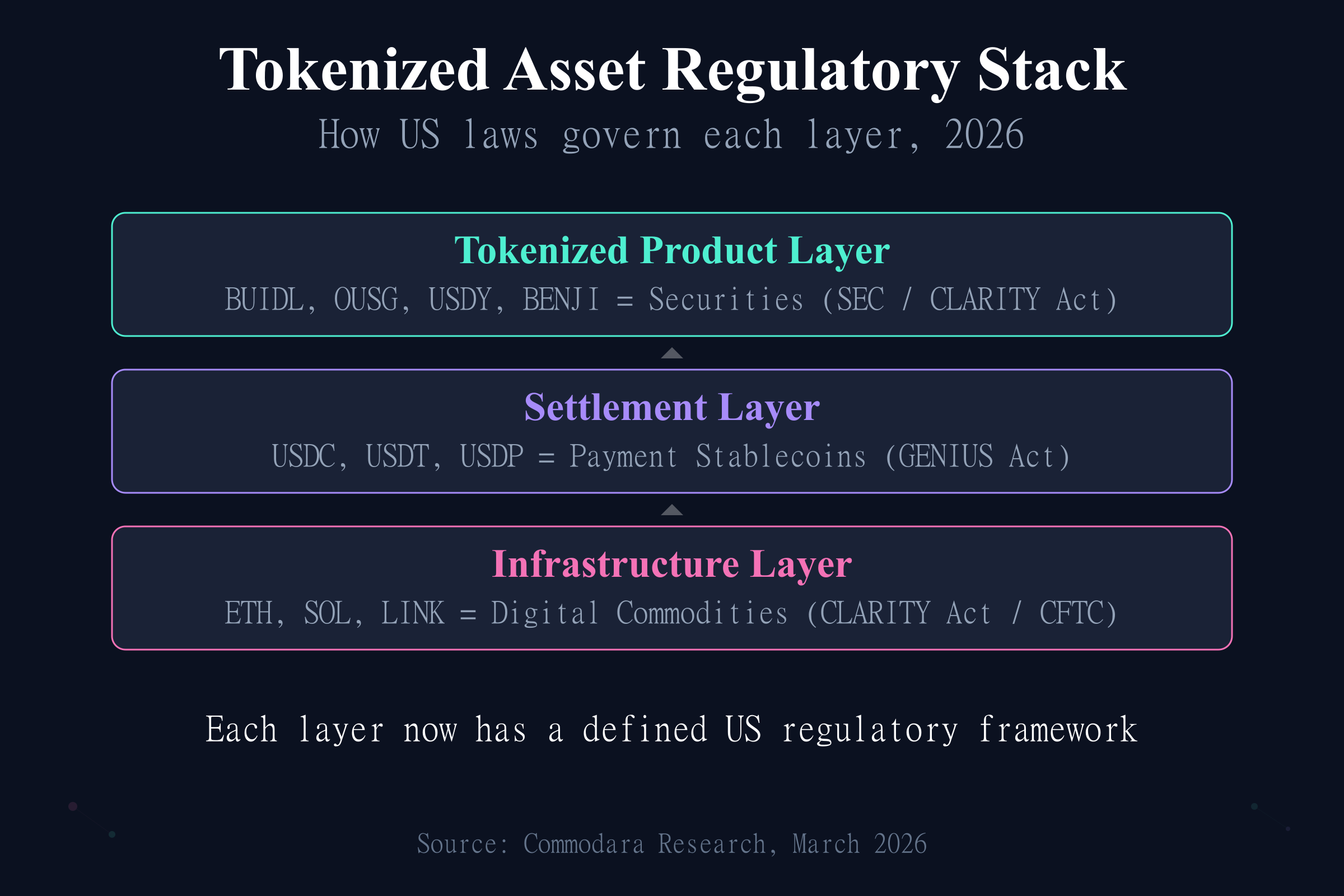
For the tokenized asset market specifically, the CLARITY Act provides important clarity. Tokenized securities, such as tokenized treasury products, tokenized equity, and tokenized private credit, remain classified as securities regardless of the blockchain they are issued on. A tokenized share of a US Treasury fund is a security whether it exists on Ethereum, Solana, or a private permissioned chain. This classification is intuitive and aligns with how most institutional issuers already treat their products.
The more significant impact is on the infrastructure tokens and utility tokens that support the tokenization ecosystem. Tokens that power blockchain networks, oracle systems, and DeFi protocols may qualify as digital commodities if their networks meet the decentralization criteria. This distinction matters because platforms like Chainlink, Ethereum, and Solana underpin the infrastructure on which tokenized assets are built, and their regulatory classification affects the entire stack.
How the CLARITY Act Impacts the Tokenized Asset Market
The CLARITY Act impacts the tokenized asset market through three primary channels: regulatory certainty for issuers, clearer compliance pathways for platforms, and increased confidence for institutional investors. Each of these channels contributes to an environment where tokenized products can scale more efficiently and attract broader capital participation.
Regulatory Certainty for Issuers
Before the CLARITY Act, issuers of tokenized products faced a fundamental question: which regulator governs this product? The answer was often unclear, forcing issuers to either register with multiple agencies, seek expensive legal opinions, or avoid the US market entirely. The CLARITY Act eliminates this uncertainty by providing statutory classifications that issuers can apply before launching a product.
For tokenized securities issuers, the path is now explicit. Products like BlackRock’s BUIDL, Ondo Finance’s OUSG, and Franklin Templeton’s BENJI are clearly securities under the CLARITY Act framework and remain subject to SEC registration requirements or applicable exemptions. This clarity actually benefits these issuers because it removes the lingering question of whether future regulatory changes could reclassify their products or subject them to additional oversight.
Clearer Compliance for Platforms
Tokenization platforms and exchanges benefit from the CLARITY Act because they can now design their compliance programs around defined categories rather than ambiguous guidance. A platform that lists only tokenized securities can register as a broker-dealer or alternative trading system under SEC rules. A platform that lists only digital commodities can register with the CFTC. Platforms that list both can structure dual registration frameworks.
This clarity is particularly valuable for the secondary market infrastructure that tokenized assets need to achieve liquidity. The NYSE, Nasdaq, and other major exchanges exploring tokenized securities can now design their tokenized trading venues with confidence about which regulatory framework applies. The CLARITY Act digital assets classification removes a major planning obstacle for these institutional-scale infrastructure projects.
Institutional Investor Confidence
For institutional investors, the CLARITY Act resolves a compliance concern that has slowed adoption. Fund managers, pension funds, and insurance companies operate under strict mandates that require them to understand the regulatory classification of every asset they hold. When that classification was uncertain, many institutions simply avoided digital assets entirely rather than accepting the regulatory ambiguity.
With the CLARITY Act providing definitive classifications, institutional compliance teams can evaluate tokenized products using the same frameworks they apply to traditional securities and commodities. A tokenized Treasury fund is a security. The USDC stablecoin used to settle the transaction is governed by the GENIUS Act stablecoin framework. The Ethereum network on which the token is issued is a digital commodity. Each component has a clear regulatory classification, which makes the entire stack assessable for institutional due diligence.
The CLARITY Act and the SEC vs CFTC Jurisdiction Question
One of the most debated aspects of digital asset regulation has been the jurisdictional competition between the SEC and CFTC. The SEC has historically taken an expansive view, arguing that most digital assets are securities. The CFTC has maintained that major assets like Bitcoin and Ethereum are commodities. The CLARITY Act resolves this tension by establishing objective criteria rather than leaving classification to agency discretion.
The SEC retains authority over digital assets that function as investment contracts and over all tokenized securities, including the tokenized real world assets that represent the fastest-growing segment of the digital asset market. The CFTC gains explicit statutory authority over digital commodities, including oversight of spot markets for these assets. This division gives each agency a defined lane and reduces the enforcement-driven approach that characterized the previous regulatory environment.
The CLARITY Act also creates a certification process through which digital asset issuers can request a determination of their asset’s classification. This process provides legal certainty in advance, rather than requiring issuers to wait for an enforcement action to learn which rules apply to their product. For the tokenized asset market, this certification process is particularly valuable because it allows new products to launch with regulatory clarity from day one.
Limitations and What the CLARITY Act Does Not Address
The CLARITY Act is a significant step forward, but it does not resolve every regulatory question facing the digital asset market. Several important areas remain outside the scope of this legislation.
DeFi protocol regulation is not directly addressed. While the CLARITY Act classifies tokens, it does not establish a comprehensive framework for decentralized protocols that operate without a central entity. Questions about whether DeFi lending protocols, automated market makers, or yield aggregators must register with regulators remain open. This gap is relevant for tokenized assets because many tokenized products are used within DeFi ecosystems.
Cross-border harmonization is another limitation. The CLARITY Act establishes a US framework, but tokenized assets and the blockchains they operate on are global. How the CLARITY Act’s definitions interact with the European Union’s MiCA regulation, Singapore’s framework, and other jurisdictional standards is still being worked out. An asset classified as a digital commodity in the US might be treated differently in Europe or Asia, creating compliance challenges for globally distributed tokens.
Tax treatment is also outside the scope. The CLARITY Act classifies assets for securities and commodities regulation purposes but does not change how digital assets are taxed. The IRS continues to apply existing guidance, which treats most digital asset transactions as taxable events. Separate legislation would be needed to address the tax complexities that tokenized asset holders face.
How Issuers and Investors Should Prepare
For issuers of tokenized products, the immediate priority is to evaluate where their products fall under the CLARITY Act classification framework. Tokenized securities issuers should confirm that their existing SEC registration or exemption status aligns with the new statutory definitions. Infrastructure token issuers should assess whether their networks meet the decentralization criteria for digital commodity classification.
Investors should understand how the CLARITY Act affects the products they hold or are considering. Tokenized Treasury products, tokenized equity, and tokenized private credit remain securities and are subject to the same investor protection frameworks that govern traditional securities. If you are evaluating whether your portfolio or organization is prepared for these regulatory changes, the Commodara Tokenization Readiness Tool can help you assess your compliance posture and identify gaps.
For a broader understanding of the asset classes affected by this legislation, see our comprehensive guide to tokenized real world assets, which covers the full market landscape that the CLARITY Act now governs.
Frequently Asked Questions
What is the CLARITY Act?
The CLARITY Act is proposed US federal legislation that establishes clear criteria for classifying digital assets as either securities, regulated by the SEC, or commodities, regulated by the CFTC. It replaces the case-by-case enforcement approach with statutory definitions based on decentralization and investment contract analysis.
How does the CLARITY Act classify tokenized assets?
Tokenized securities such as tokenized Treasury products, equity, and private credit remain classified as securities under the CLARITY Act. Infrastructure tokens that power sufficiently decentralized networks may qualify as digital commodities. The classification depends on the asset’s structure and the network’s decentralization.
What is the decentralization test in the CLARITY Act?
The decentralization test evaluates whether a digital asset’s underlying network operates independently of its original developers. It considers factors including token ownership distribution, governance control, source code openness, and network independence. Assets passing this test are classified as digital commodities.
Does the CLARITY Act affect stablecoins?
Stablecoins are primarily governed by the GENIUS Act, which provides a separate federal framework for payment stablecoins. The CLARITY Act complements this by clarifying the classification of other digital assets, but stablecoin regulation remains under the GENIUS Act framework.
When will the CLARITY Act become law?
The CLARITY Act advanced through committee in late 2025 and is expected to reach a full congressional vote in 2026. The exact timeline depends on the legislative calendar and any amendments introduced during floor debate. Industry observers expect passage in 2026 based on bipartisan support.
The Bottom Line
The CLARITY Act represents the missing piece in the US regulatory framework for digital assets. While the GENIUS Act resolved the stablecoin settlement question, the CLARITY Act addresses the fundamental classification problem that has held back institutional adoption for years. By establishing clear, statutory criteria for distinguishing securities from commodities, the legislation gives every participant in the tokenized economy a foundation for compliance.
For the tokenized asset market specifically, the CLARITY Act reinforces what institutional issuers already understood: tokenized securities are securities, and they are regulated accordingly. The more transformative impact is on the infrastructure layer, where clear classification of blockchain networks and protocol tokens reduces regulatory uncertainty for the entire technology stack that tokenized products depend on.
As this legislation moves toward passage, issuers and investors who prepare now will be best positioned to operate efficiently under the new framework. Subscribe to the Commodara newsletter for ongoing analysis of the CLARITY Act’s progress and its implications for the tokenized economy.