Fireblocks for RWA: How Institutional Custody Powers Tokenized Assets
Fireblocks has become the dominant institutional custody provider for tokenized assets, serving over 1,800 institutions including banks, exchanges, and asset managers navigating the RWA market. In a tokenized economy where billions of dollars in assets exist as smart contracts on public blockchains, the custody layer is the infrastructure that determines whether institutional capital can participate safely. Fireblocks provides this layer: a platform that combines multi-party computation security, policy-based governance, and multi-chain support into a custody solution that meets the compliance and security requirements of regulated financial institutions.
This article reviews Fireblocks as a custody platform for tokenized assets, covering its security architecture, its role in the RWA infrastructure stack, the institutions that depend on it, and how it compares to alternative custody solutions. For institutional decision-makers evaluating custody providers and industry builders selecting infrastructure partners, this Fireblocks review provides the analysis needed for an informed decision.
What Is Fireblocks and Why Does Custody Matter for RWA?
Fireblocks is a digital asset infrastructure platform founded in 2018 that provides custody, transfer, and tokenization capabilities for institutional clients. The platform has secured over $6 trillion in cumulative digital asset transfers and raised over $1 billion in venture capital funding, reaching a valuation of $8 billion at its peak. Its client list includes BNY Mellon, BNP Paribas, ANZ Bank, Revolut, and dozens of the largest banks and financial institutions globally.
Custody matters for tokenized assets because the private keys that control tokens on a blockchain represent the ultimate proof of ownership. If those keys are lost, stolen, or compromised, the assets they control are permanently gone. There is no customer service number to call, no chargeback mechanism, and no court order that can reverse a blockchain transaction. For institutions managing billions of dollars in tokenized securities, treasury products, or real estate tokens, the custody solution must provide the same level of security, governance, and auditability that they expect from traditional asset custodians like BNY Mellon or State Street.
Fireblocks addresses this need through a purpose-built infrastructure layer that eliminates single points of failure in private key management while providing the policy controls, audit trails, and regulatory compliance features that institutional compliance teams require. The platform’s dominance in institutional crypto custody has made it a default choice for tokenization projects that need to attract regulated capital.
Fireblocks Security Architecture
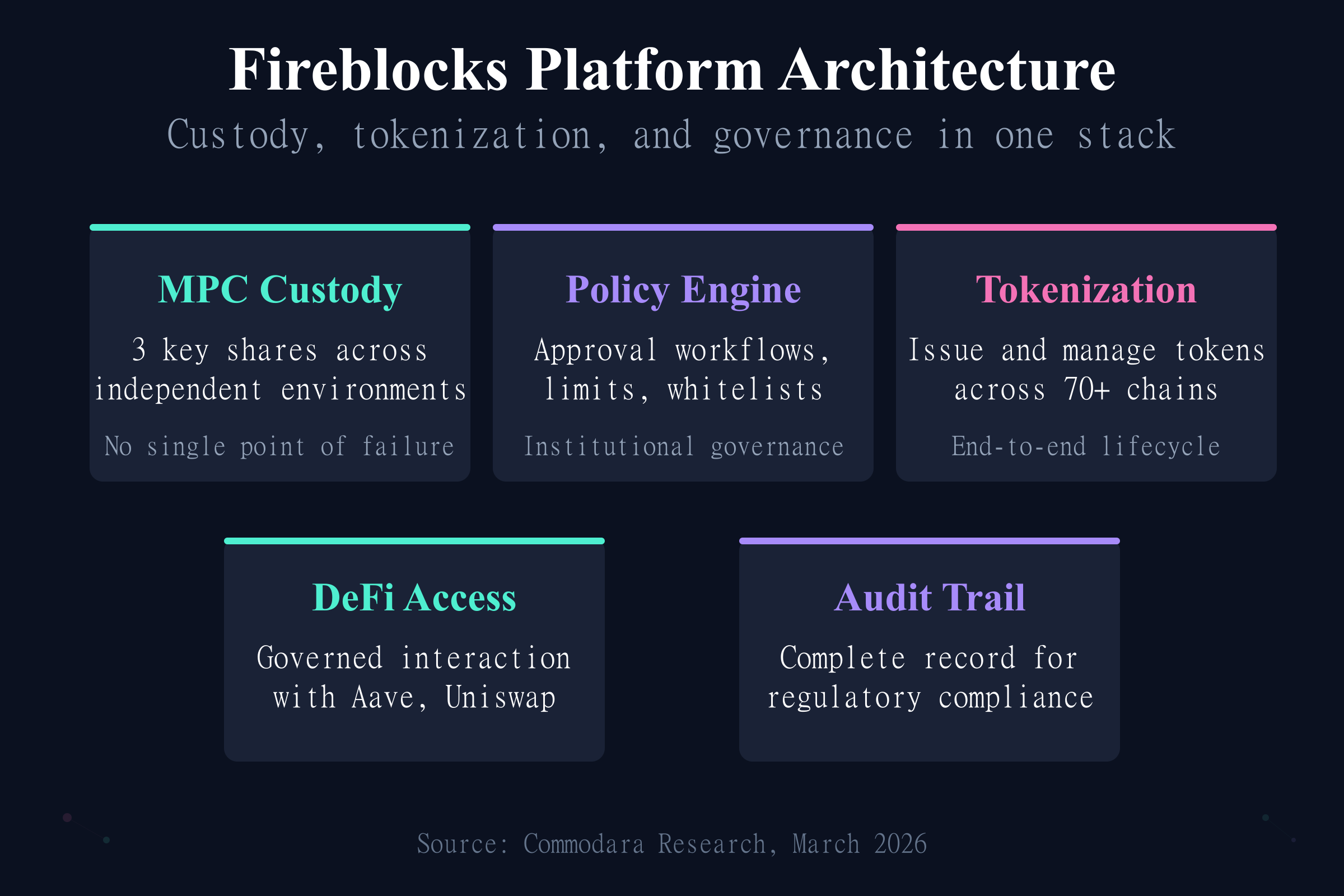
The security model that underpins Fireblocks is its primary competitive advantage and the reason institutions choose it over alternative custody solutions. Understanding how this architecture works is essential for evaluating whether Fireblocks meets your institution’s security requirements.
Multi-Party Computation (MPC)
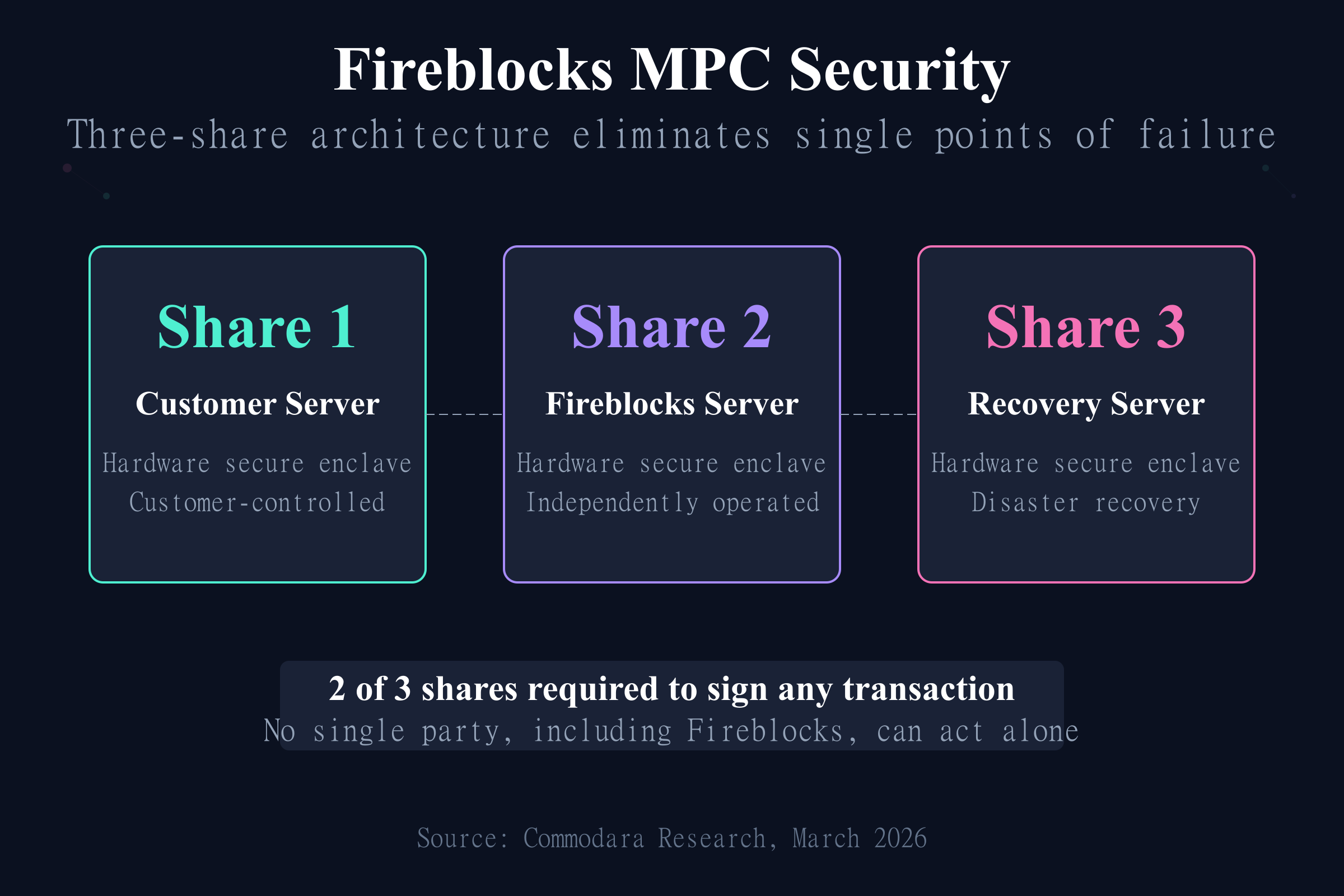
Fireblocks uses multi-party computation cryptography to eliminate the single point of failure inherent in traditional private key management. In a standard crypto wallet, the private key exists as a single piece of data; whoever possesses it controls the assets. MPC distributes the key generation and signing process across multiple independent parties so that the complete key never exists in a single location at any point in its lifecycle.
In Fireblocks’ implementation, three MPC key shares are distributed across three independent environments: the customer’s server, the Fireblocks server, and a disaster recovery server. A transaction requires at least two of the three shares to participate in the signing process. No single party, including Fireblocks itself, can unilaterally sign a transaction. This architecture means that a breach of any single environment does not compromise the assets, because the attacker would obtain only one of the three key shares, which is mathematically insufficient to reconstruct the signing capability.
Secure Enclave Technology
Each MPC key share is stored within a hardware-secured enclave, specifically Intel SGX or equivalent secure hardware. These enclaves create isolated execution environments where the key share is processed but never exposed to the host operating system, the network layer, or even the Fireblocks engineers who maintain the servers. Even if an attacker gains root access to the server, the key share within the secure enclave remains protected by hardware-level isolation.
The combination of MPC and secure enclave technology creates a defense-in-depth architecture that has not been breached since Fireblocks’ inception. The platform’s security track record is one of the primary reasons institutions like BNY Mellon, which custodies over $46 trillion in traditional assets, selected Fireblocks for their digital asset custody infrastructure.
Policy Engine and Governance
Security is not just about preventing unauthorized access; it is also about enforcing organizational policies on authorized transactions. Fireblocks’ policy engine allows institutions to define granular rules that govern how digital assets can be moved. These rules can include transaction amount limits, required approvals from specific individuals or roles, time-based restrictions, whitelist-only destinations, and multi-level approval workflows.
For tokenized asset operations, the policy engine is particularly valuable. An asset manager operating a tokenized fund can configure policies that require dual approval from a portfolio manager and a compliance officer for any transfer above a certain threshold, restrict transfers to pre-approved counterparty wallets, and enforce time delays on large redemptions. These governance controls mirror the operational procedures that institutions use in traditional finance, making Fireblocks familiar to compliance teams that may be new to digital asset infrastructure.
Fireblocks Tokenization and RWA Capabilities
Beyond custody, Fireblocks has expanded its platform to include tokenization capabilities that allow institutions to issue, manage, and distribute tokenized assets directly through the Fireblocks infrastructure.
Token Issuance and Management
Fireblocks provides tools for creating and managing tokens across multiple blockchain networks. Institutions can deploy smart contracts for tokenized securities, configure token properties such as supply limits and transfer restrictions, and manage the entire token lifecycle from issuance through distribution and eventual redemption. This issuance capability means that an asset manager can use Fireblocks for both the custody of the underlying assets and the technical issuance of the tokens that represent them, reducing the number of vendors in the tokenization stack.
The Securitize platform review covers the leading alternative for token issuance, and many institutions use both platforms: Securitize for the issuance, compliance, and distribution layer, and Fireblocks for the underlying custody and key management infrastructure. This combination has become something of an industry standard for institutional tokenization projects, with BlackRock’s BUIDL fund representing the highest-profile example of this Securitize-plus-Fireblocks architecture.
Multi-Chain Support
Fireblocks supports over 70 blockchain networks, including Ethereum, Polygon, Avalanche, Solana, Aptos, Base, and the Canton Network. This broad chain support is critical for tokenized asset operations because different products are deployed on different chains. A custody provider that only supports Ethereum would force institutions to use multiple custody solutions for a multi-chain portfolio, creating operational complexity and additional security risk.
The multi-chain capability also enables institutions to participate in DeFi protocols across multiple networks. Tokenized treasury products like USDY operate on seven or more chains, and the institution that issues or manages these products needs a custody solution that can handle key management and transaction signing across all supported networks from a single platform. Fireblocks provides this unified multi-chain custody layer.
DeFi Access and Integration
Fireblocks provides institutional access to DeFi protocols through its WalletConnect integration and its DeFi Access Portal. This capability allows institutions to interact with lending protocols like Aave, decentralized exchanges like Uniswap, and yield optimization platforms while maintaining the full security and governance controls of the Fireblocks platform. All DeFi transactions are subject to the institution’s policy engine, meaning that compliance rules and approval workflows apply to DeFi interactions just as they apply to simple token transfers.
For RWA operations, DeFi access is increasingly important. Tokenized treasury products are being integrated into DeFi lending markets as collateral. Tokenized securities may need to interact with decentralized exchange protocols for secondary trading. The ability to access these DeFi opportunities from within a governed, policy-controlled custody environment is a significant advantage for institutions that need to participate in DeFi without compromising their compliance posture.
Who Uses Fireblocks for Tokenized Assets?
The breadth of Fireblocks’ institutional adoption provides the clearest evidence of its position in the RWA custody market.
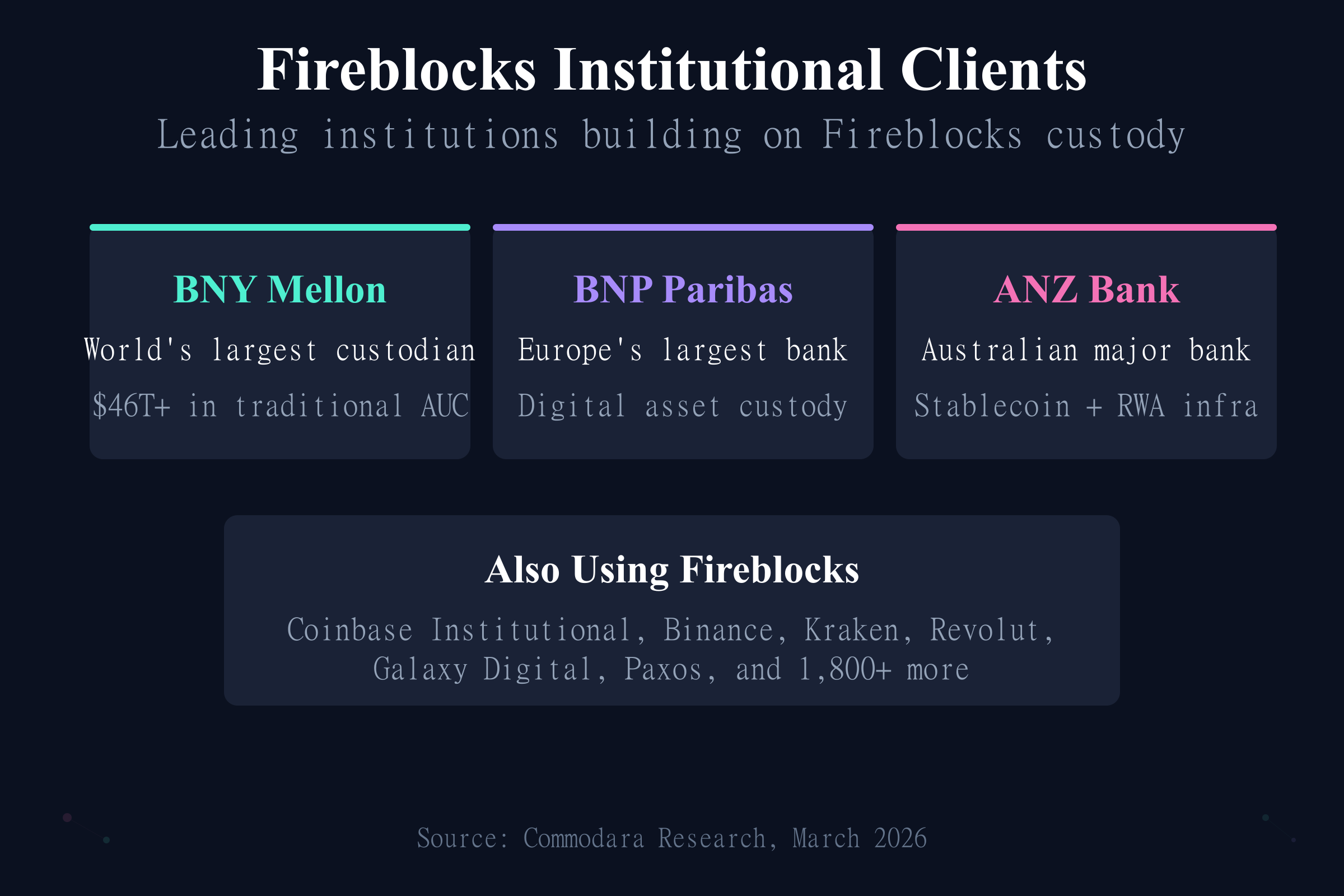
BNY Mellon, the world’s largest custodian with over $46 trillion in assets under custody, selected Fireblocks as the technology partner for its digital asset custody platform. This selection by the institution that custodies more assets than any other on earth represents the highest possible institutional validation for a digital asset custody provider. ANZ Bank, one of Australia’s largest banks, built its stablecoin and tokenized asset infrastructure on Fireblocks. BNP Paribas, Europe’s largest bank by assets, uses Fireblocks for its digital asset custody and tokenization operations.
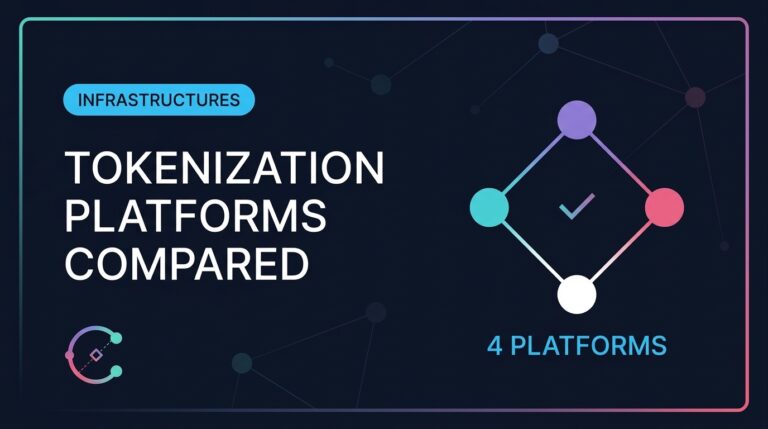
Beyond banks, major crypto exchanges including Coinbase Institutional, Binance, and Kraken use Fireblocks for their custody and transfer infrastructure. Asset managers, payment companies, and fintech platforms collectively represent over 1,800 institutional clients. The tokenization platforms comparison shows how Fireblocks fits alongside Securitize, Ondo, and other platforms in the broader infrastructure stack.
Fireblocks vs Alternative Custody Solutions
The institutional crypto custody market includes several alternatives to Fireblocks, each with different strengths, security models, and target markets.
Copper.co offers a custody platform with ClearLoop technology that enables off-exchange trading while assets remain in cold storage. BitGo provides qualified custodian services and has the advantage of being regulated as a trust company. Anchorage Digital is a federally chartered digital asset bank, giving it a unique regulatory position in the US market. Ledger Enterprise offers a hardware-centric custody approach that appeals to institutions that prefer hardware security modules over MPC.
Fireblocks differentiates from these alternatives on three dimensions. First, scale: with over 1,800 institutional clients and $6 trillion in cumulative transfers, Fireblocks operates at a scale that no competitor matches. Second, breadth: the combination of custody, tokenization, DeFi access, and policy governance in a single platform reduces vendor complexity. Third, security track record: Fireblocks has not experienced a security breach since its founding, a claim that several competitors cannot make.
The primary limitation of Fireblocks is cost. The platform’s pricing is designed for institutional clients with significant digital asset operations, and smaller organizations may find the cost prohibitive. For smaller tokenization projects or organizations with limited digital asset activity, self-custody solutions or less expensive custodians may be more appropriate. However, for institutions managing institutional-scale tokenized assets where a security breach would be catastrophic, the cost of Fireblocks is a fraction of the potential loss from inadequate custody infrastructure.
Evaluating Fireblocks for Your Tokenization Project
For institutions considering Fireblocks for their tokenized asset custody, the evaluation should focus on four key questions.
First, does your tokenization project involve assets at a scale where MPC-based institutional custody is justified? If you are managing millions of dollars or more in tokenized assets, the answer is almost certainly yes. Second, do you need multi-chain support? If your tokenized products will be deployed across multiple blockchains, Fireblocks’ 70+ chain support eliminates the need for separate custody arrangements per chain.
Third, does your compliance team require policy-based governance for digital asset transactions? If yes, Fireblocks’ policy engine provides the approval workflows, transaction limits, and audit trails that compliance teams need. Fourth, do you need DeFi access within a governed environment? If your tokenized products will interact with lending protocols, DEXes, or yield platforms, Fireblocks provides this access without sacrificing governance controls.
The Commodara Tokenization Readiness Tool includes custody infrastructure as one of its evaluation dimensions, helping organizations determine whether their current custody arrangements are sufficient for their tokenization objectives or whether a platform like Fireblocks is needed.
Frequently Asked Questions
What is Fireblocks?
Fireblocks is a digital asset infrastructure platform providing institutional custody, transfer, and tokenization capabilities. It serves over 1,800 institutions including BNY Mellon, BNP Paribas, and ANZ Bank, using multi-party computation security to protect private keys without single points of failure.
How does Fireblocks secure tokenized assets?
Fireblocks uses multi-party computation (MPC) to distribute private key shares across three independent environments. No single party can sign transactions alone. Key shares are stored in hardware secure enclaves. This architecture has not been breached since the platform’s founding.
Which institutions use Fireblocks for RWA custody?
BNY Mellon (the world’s largest custodian), BNP Paribas (Europe’s largest bank), ANZ Bank, Coinbase Institutional, and over 1,800 other institutions use Fireblocks for digital asset custody. The platform has processed over $6 trillion in cumulative transfers.
Can Fireblocks be used for token issuance?
Yes. Fireblocks provides token issuance tools that allow institutions to create and manage tokens across 70+ blockchain networks. Many institutions use Fireblocks for custody combined with Securitize for compliance and distribution, as seen in BlackRock’s BUIDL fund architecture.
How does Fireblocks compare to other custody providers?
Fireblocks leads in scale (1,800+ clients), breadth (custody plus tokenization plus DeFi access), and security track record (no breaches). Alternatives include Copper.co, BitGo, Anchorage Digital, and Ledger Enterprise. Fireblocks’ pricing targets institutional-scale operations.
The Bottom Line
Fireblocks has established itself as the institutional standard for digital asset custody in the tokenized asset market. Its MPC security architecture, policy governance engine, multi-chain support, and tokenization capabilities create a comprehensive infrastructure layer that addresses the specific requirements of regulated financial institutions. The platform’s adoption by BNY Mellon, BNP Paribas, and over 1,800 other institutions validates its position as the custody provider that institutional compliance teams trust with billions in digital asset value.
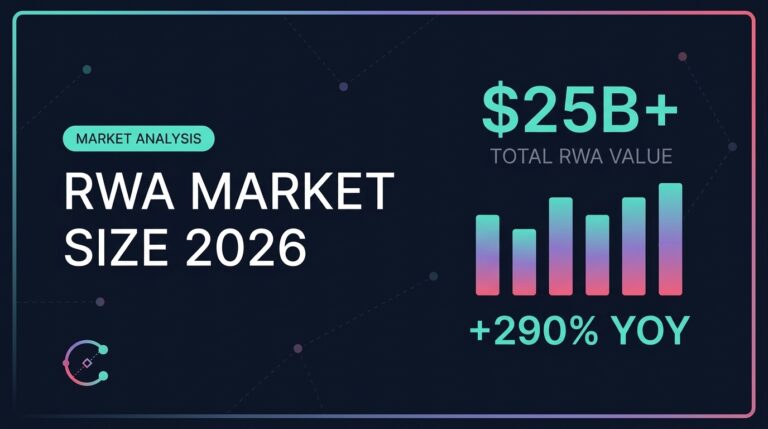
For the tokenized asset market, Fireblocks solves a foundational problem: how to give institutions the security and governance they require while enabling participation in the blockchain-based financial infrastructure that tokenization demands. As the RWA market scales from $25 billion toward the trillions that industry projections forecast, the custody layer will become even more critical, and Fireblocks is positioned at the center of that infrastructure.
Subscribe to the Commodara newsletter for ongoing coverage of the custody, infrastructure, and platform developments powering the tokenized economy.