


GENIUS Act Explained: How Stablecoin Law Reshapes Tokenization
The GENIUS Act, signed into law in 2025, established the first comprehensive federal regulatory framework for stablecoins in the United States, and its impact on tokenization is now accelerating. Before this legislation, stablecoin issuers operated under a patchwork of state money transmitter licenses with no unified federal standard. The GENIUS Act changed that by creating clear reserve requirements, issuer licensing categories, and consumer protection standards that apply uniformly across the country.
For the tokenized asset market, the implications are enormous. Stablecoins are the settlement layer for virtually every tokenized product, from Treasury tokens to fractionalized real estate. By establishing regulatory clarity around these settlement instruments, the GENIUS Act has removed one of the largest sources of institutional hesitation. This article explains what the law requires, how it reshapes the tokenization landscape, and what investors and issuers need to understand going forward.
What Is the GENIUS Act and Why Was It Needed?
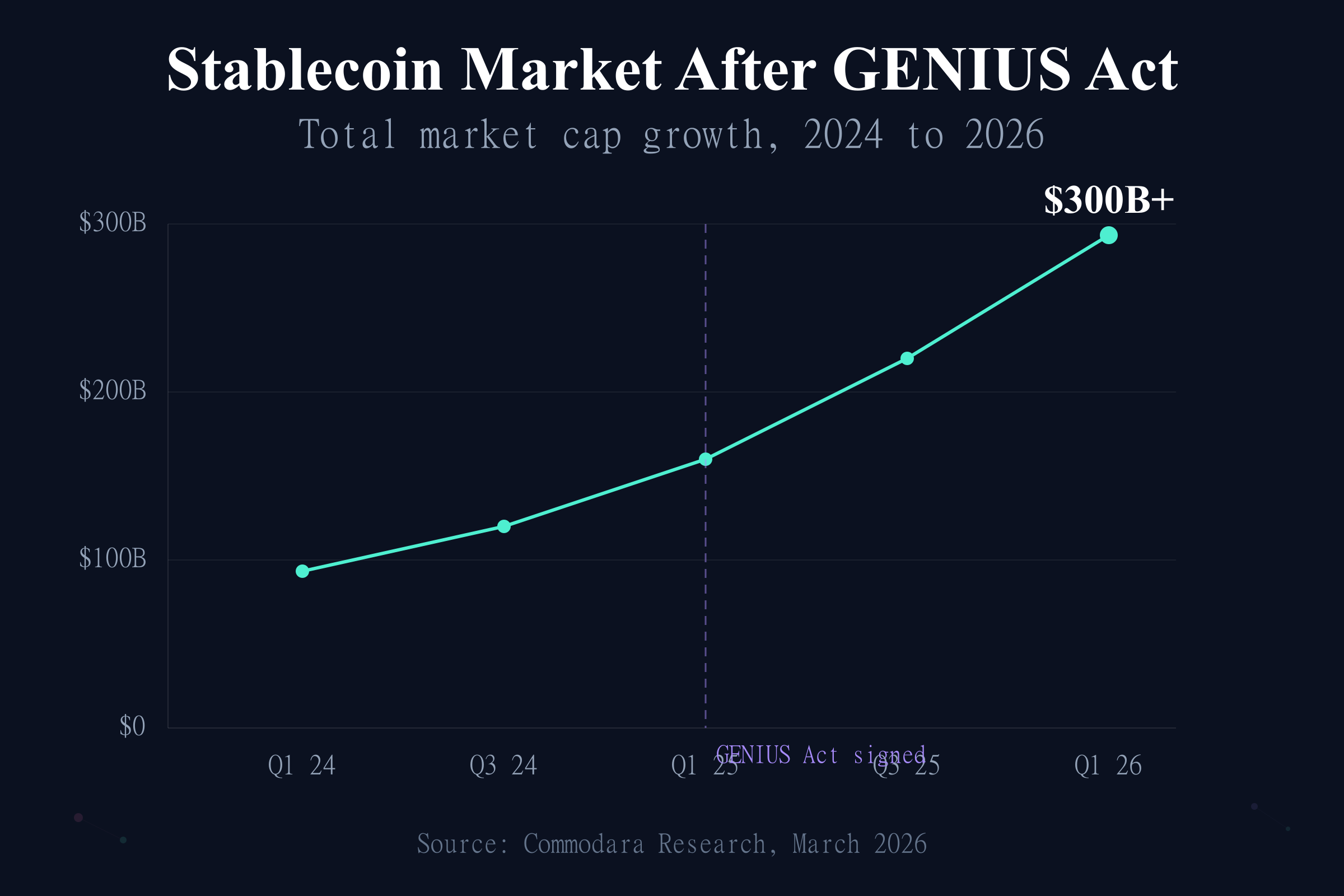
The GENIUS Act, formally titled the Guiding and Establishing National Innovation for US Stablecoins Act, was introduced in the US Senate in early 2025 and signed into law later that year. The legislation was a direct response to the rapid growth of the stablecoin market, which had surpassed $200 billion in total circulation by the time the bill reached the Senate floor. Lawmakers recognized that stablecoins had become systemically important to digital asset markets and needed a federal regulatory framework to match.
Before the GENIUS Act, US stablecoin regulation was fragmented. Issuers like Circle (USDC) and Paxos (USDP) operated under New York’s BitLicense and various state money transmitter licenses. Tether (USDT) operated largely outside US regulatory jurisdiction. This inconsistency created confusion for institutional investors and limited the willingness of banks and asset managers to integrate stablecoins into their operations. The GENIUS Act stablecoin framework resolved this by establishing a single federal standard.
Key Provisions of the GENIUS Act
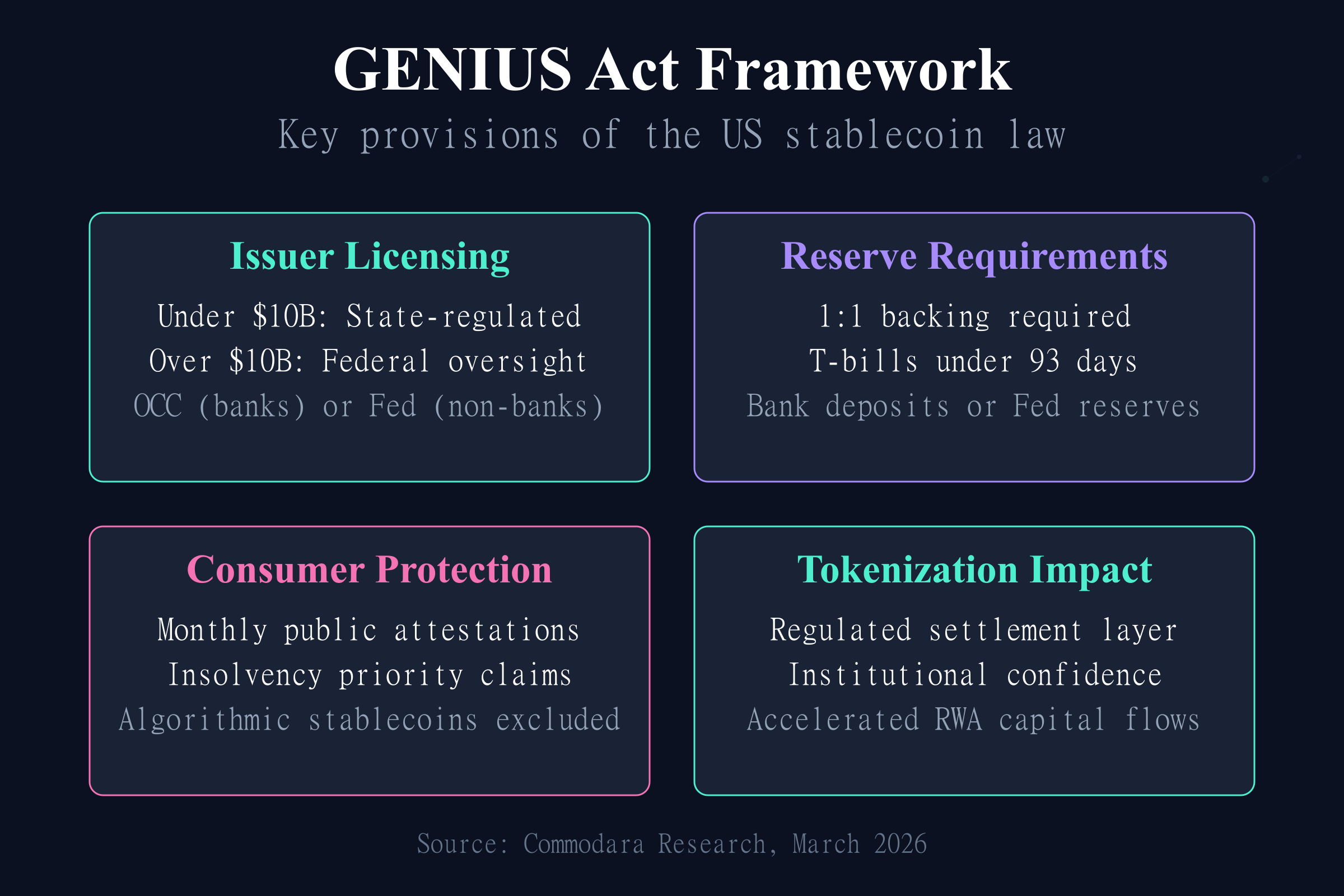
The legislation establishes two categories of stablecoin issuers. Permitted payment stablecoin issuers with less than $10 billion in outstanding stablecoins can operate under state regulatory frameworks that meet minimum federal standards. Issuers above the $10 billion threshold must register with a federal regulator, either the Office of the Comptroller of the Currency for bank issuers or the Federal Reserve for non-bank issuers. This tiered structure preserves state innovation while ensuring that systemically important issuers face federal oversight.
Reserve requirements under the GENIUS Act are prescriptive. Issuers must back their stablecoins one-to-one with high-quality liquid assets: US Treasury securities with maturities under 93 days, insured bank deposits, Federal Reserve repurchase agreements, or reserves held at the Federal Reserve itself. This requirement eliminates the ambiguity that previously surrounded stablecoin reserves and gives institutional investors confidence that settlement instruments are fully backed.
The GENIUS Act 2025 legislation also mandates monthly public attestations of reserves by registered public accounting firms, prohibits algorithmic stablecoins from qualifying as permitted payment stablecoins, and establishes consumer protection provisions including priority claims in the event of issuer insolvency. These protections address the concerns that emerged after the TerraUSD collapse in 2022, which destroyed approximately $40 billion in value and eroded public trust in the stablecoin market.
How the GENIUS Act Reshapes Tokenization
The connection between the GENIUS Act and tokenization is direct and consequential. Stablecoins serve as the primary settlement currency for tokenized assets. When an investor purchases a tokenized Treasury product like OUSG or BUIDL, the transaction settles in USDC or another stablecoin. When rental income from a tokenized real estate position is distributed, it arrives as a stablecoin payment. The entire tokenized economy runs on stablecoin settlement rails.
By establishing clear regulatory standards for these settlement instruments, the GENIUS Act stablecoin provisions have removed a critical barrier to institutional adoption. Banks and asset managers that previously avoided stablecoins due to regulatory uncertainty can now integrate them with confidence that the instruments meet defined federal standards. This single change has been one of the most important catalysts for institutional capital flowing into tokenized real world assets during 2025 and 2026.
Institutional Confidence and Capital Flows
The impact on institutional behavior has been measurable. In the twelve months following the GENIUS Act’s passage, the total value of tokenized assets on-chain grew from approximately $8 billion to over $25 billion. While multiple factors contributed to this growth, industry participants consistently cite US stablecoin regulation clarity as a primary enabler. Institutions that were evaluating tokenized products but hesitating due to settlement layer uncertainty began deploying capital once the regulatory framework was established.
The GENIUS Act also enabled several large banks to begin using stablecoins for internal settlement and client transactions. JPMorgan expanded its JPM Coin operations, and several regional banks began piloting stablecoin-based settlement for tokenized securities. The central bank settlement infrastructure being developed globally has also accelerated, as US regulatory clarity provides a model that other jurisdictions are now referencing in their own legislative processes.
Impact on Stablecoin Market Structure
The GENIUS Act has reshaped the competitive landscape of the stablecoin market itself. USDC, issued by Circle, has benefited disproportionately from the legislation because Circle was already operating under US regulatory frameworks and could quickly demonstrate compliance with the new requirements. Tether’s USDT, which is issued outside US jurisdiction, faces increasing pressure as institutional users prefer stablecoins that are clearly subject to US federal oversight.
New entrants have also emerged. Several traditional financial institutions have announced plans to issue their own stablecoins under the GENIUS Act framework, recognizing that regulated stablecoins represent a significant revenue opportunity through the yield earned on reserve assets. The $300 billion stablecoin market is now attracting competition from banks, payment companies, and fintech firms that see the GENIUS Act as providing the regulatory certainty needed to enter the space.
What the GENIUS Act Means for Different Market Participants
For Institutional Investors
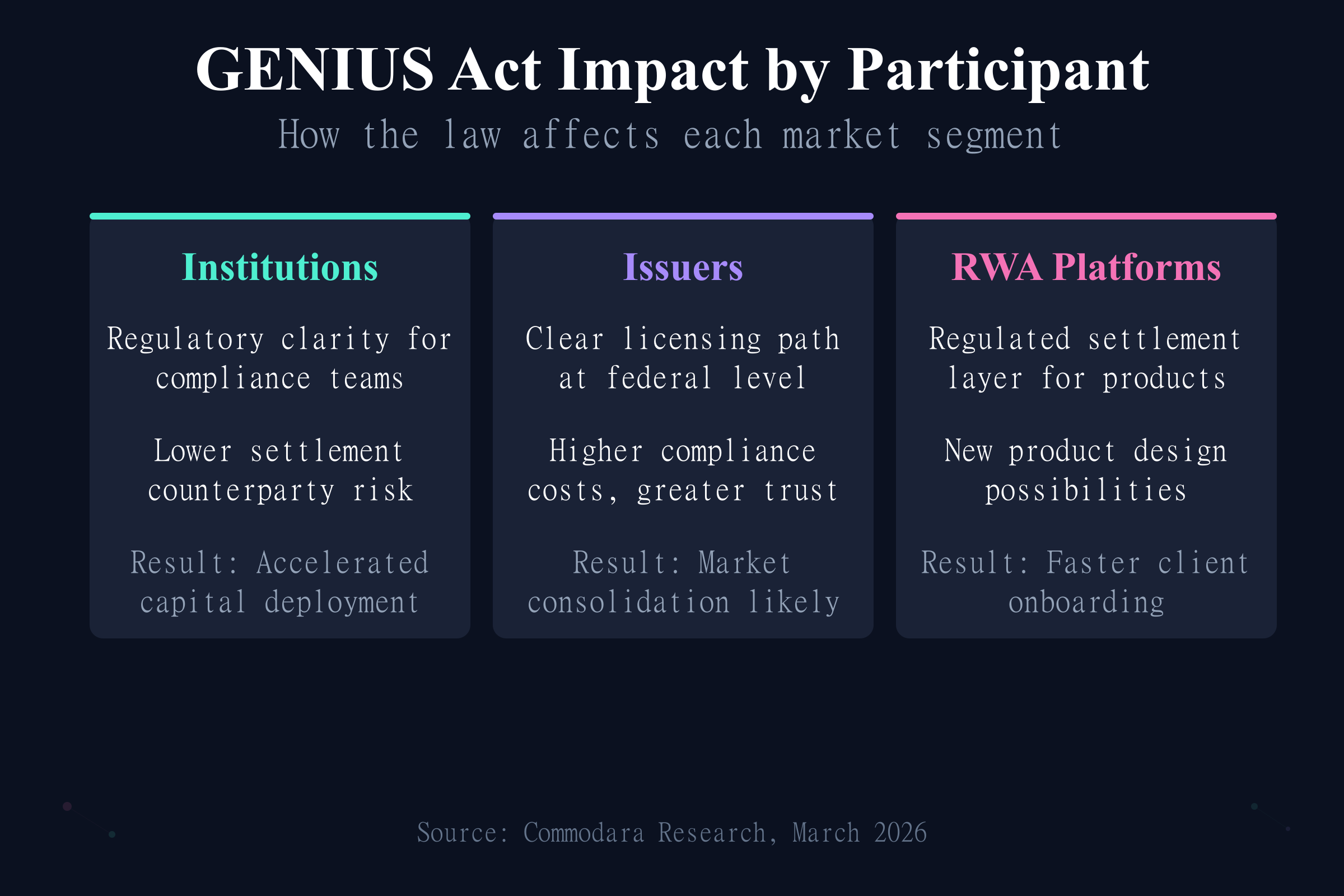
The GENIUS Act provides the regulatory clarity that compliance departments require before approving stablecoin usage. Institutional investors can now integrate stablecoins into their settlement workflows knowing that permitted payment stablecoins are backed by specified high-quality assets and subject to regular attestation. This removes the operational and legal ambiguity that previously required extensive internal legal review for each stablecoin interaction.
For institutions already investing in tokenized products, the GENIUS Act reduces settlement risk. The one-to-one reserve requirement and insolvency protections mean that the stablecoins used to settle tokenized asset transactions carry lower counterparty risk than they did before the legislation. This improvement in settlement infrastructure makes tokenized products more attractive on a risk-adjusted basis.
For Stablecoin Issuers
Issuers face both opportunities and compliance burdens under the GENIUS Act. The federal framework provides legitimacy and a clear path to scale, but it also imposes significant regulatory costs. Monthly reserve attestations, capital requirements, and ongoing supervision by federal regulators require substantial compliance infrastructure. Smaller issuers may find these requirements challenging, potentially consolidating the market around larger, well-capitalized participants.
The prohibition on algorithmic stablecoins qualifying as permitted payment stablecoins is particularly significant. This provision effectively creates a regulatory moat around fully-reserved stablecoins, giving compliant issuers a structural advantage over algorithmic alternatives. The GENIUS Act stablecoin classification system makes clear that US regulators view full reserve backing as a non-negotiable requirement for any stablecoin that functions as a payment instrument.
For Tokenization Platforms and RWA Issuers
Platforms that issue tokenized assets benefit from the GENIUS Act because their products settle in instruments that now carry federal regulatory endorsement. This reduces the friction involved in onboarding institutional clients who previously questioned the reliability of stablecoin settlement. Tokenization platforms can now point to specific federal legislation when institutional compliance teams ask about the safety of the settlement layer.
The stablecoin law tokenization connection also opens new product design possibilities. With greater confidence in stablecoin stability, platforms can build more sophisticated products that depend on reliable settlement, including automated distribution systems, real-time redemption mechanisms, and cross-chain settlement flows that require consistent stablecoin behavior across multiple blockchains.
Limitations and Open Questions
The GENIUS Act addresses stablecoins specifically, not the broader digital asset market. It does not resolve the classification of tokenized securities, the regulatory status of DeFi protocols, or the treatment of non-stablecoin tokens. These questions remain subject to ongoing legislative and regulatory processes, including the proposed CLARITY Act, which aims to establish clear boundaries between securities and commodities in the digital asset space.
International coordination is another open question. The GENIUS Act establishes a US framework, but stablecoins operate globally. How US-regulated stablecoins interact with frameworks like the European Union’s MiCA regulation, Singapore’s Payment Services Act, and other jurisdictional standards is still being worked out. Cross-border settlement using stablecoins may face compliance challenges when different jurisdictions impose conflicting requirements on the same instrument.
There is also debate about whether the reserve requirements are appropriately calibrated. Some industry participants argue that restricting reserves to Treasury securities and bank deposits limits innovation, while consumer advocates contend that the requirements should be even stricter. The GENIUS Act includes provisions for periodic review, suggesting that the framework will evolve as the market matures and regulators gather more data on how stablecoins are used in practice.
Frequently Asked Questions
What is the GENIUS Act?
The GENIUS Act is the first comprehensive US federal law governing stablecoins. Signed in 2025, it establishes licensing categories for stablecoin issuers, mandates one-to-one reserve backing with high-quality liquid assets, requires monthly public attestations, and creates consumer protection provisions including insolvency priority claims.
How does the GENIUS Act affect tokenized assets?
The GENIUS Act affects tokenized assets by regulating the stablecoins used to settle tokenized transactions. With clear federal standards for stablecoin reserves and issuer oversight, institutions have greater confidence in the settlement layer that underpins all tokenized products, accelerating adoption and capital flows.
Does the GENIUS Act regulate all cryptocurrencies?
No. The GENIUS Act specifically regulates payment stablecoins, not broader cryptocurrencies or digital assets. It does not address the classification of tokens as securities or commodities, which falls under separate legislative proposals like the CLARITY Act and existing SEC and CFTC authority.
What reserve requirements does the GENIUS Act impose?
Stablecoin issuers must back their tokens one-to-one with US Treasury securities maturing in under 93 days, insured bank deposits, Federal Reserve repurchase agreements, or reserves held at the Federal Reserve. Monthly attestations by registered public accounting firms are mandatory.
Are algorithmic stablecoins allowed under the GENIUS Act?
No. The GENIUS Act explicitly prohibits algorithmic stablecoins from qualifying as permitted payment stablecoins. Only stablecoins backed by specified high-quality liquid assets on a one-to-one basis can receive the permitted payment stablecoin designation under the federal framework.
The Bottom Line
The GENIUS Act represents the most consequential piece of US legislation for the tokenized asset market since the original securities laws of the 1930s. By establishing clear, enforceable standards for the stablecoin settlement layer, it has removed the single largest source of regulatory uncertainty for institutions evaluating tokenized products. The result has been a measurable acceleration in institutional capital flows, platform development, and product innovation across the tokenized economy.
The law is not a complete solution. It addresses stablecoins but leaves the classification of tokenized securities, the regulatory status of DeFi, and international coordination as open questions. However, by solving the settlement layer problem, the GENIUS Act has created a foundation upon which the rest of the regulatory framework can be built.
For investors and issuers operating in tokenized markets, understanding the GENIUS Act is no longer optional. The law defines the rules of the settlement infrastructure that every tokenized product depends on. Subscribe to the Commodara newsletter for ongoing coverage of regulatory developments that shape the tokenized economy.