
How Solana RWA Tokenization Infrastructure Has Become Wall Street’s Favorite Go-To
The Speed Thesis Wins: Solana RWA Ecosystem
Solana RWA tokenization ecosystem hit $1.66 billion in total tokenized value as of mid-February 2026, nearly doubling from its $873 million record set just six weeks earlier. That’s 325% growth through 2025, followed by roughly 90% growth in the first six weeks of 2026.
Table of Contents
At the February 2026 “Accelerate APAC” conference in Hong Kong, Solana’s leadership made a declaration that would have seemed absurd two years ago: “Less memecoin mania, more internet capital markets.”
The audience wasn’t crypto degens. It was Mirae Asset, ChinaAMC, CME Group, Fireblocks, and Cumberland, all discussing SOL ETFs, tokenized securities, stablecoin payment rails, and regulatory-compliant products.
Something fundamental has shifted. The blockchain that dominated Ethereum in memecoin trading volume is now positioning itself as institutional infrastructure for tokenized real world assets. And as Blockchain Reporter confirmed, the numbers suggest it’s working.
The Numbers That Matter IN Solana RWA Tokenization
Solana ranks as the third-largest blockchain for tokenized real world assets by value, capturing approximately 4.57% of the global RWA market (excluding stablecoins). Ethereum leads at $12.3 billion with 65.26% market share, followed by BNB Chain at $2+ billion, with Solana’s $1.66 billion growing fast behind them.
The absolute numbers favor Ethereum overwhelmingly. But growth rates tell a different story. Solana tokenized equity assets grew 200% over six months versus Ethereum’s 6.7%. Galaxy Research projects Solana’s “Internet Capital Markets” will expand to $2 billion by the end of 2026.
The Ondo Explosion
The single biggest catalyst for Solana RWA tokenization surge arrived in January 2026: Ondo Finance brought 200+ tokenized U.S. stocks and ETFs to Solana.
Ondo delivers 24/7 trading of tokenized U.S. stocks and ETFs with near-instant settlement, a custody-backed structure with actual securities held with U.S.-registered broker-dealers, Wall Street liquidity with execution quality matching traditional exchanges, and compliance built in via KYC/AML through Solana’s Token Extensions.
The execution quality is remarkable. Testing showed that purchasing $500,000 of tokenized Google shares incurred only 0.03% slippage, with pricing “effectively the same” as exchange-traded equivalents.
Western Union: The 175-Year-Old Bet
Perhaps the most significant institutional endorsement came from an unexpected direction: Western Union.
In October 2025, the 175-year-old remittance giant announced it would launch USDPT (U.S. Dollar Payment Token), a dollar-backed stablecoin built on Solana and issued by Anchorage Digital Bank. The launch is expected in the first half of 2026.
Western Union processes $150 billion in annual remittance volume and serves 150 million customers across 200+ countries through 600,000+ agent locations. This isn’t a crypto experiment. It’s a fundamental infrastructure choice.
Solana’s head of payments noted that PayPal, Fiserv, and now Western Union all chose Solana as the chain for their stablecoin.
The Technical Edge: Firedancer and Alpenglow
Solana’s institutional appeal rests on a simple premise: it’s faster and cheaper than alternatives. But the network is about to get dramatically better.
Firedancer, Jump Crypto’s high-performance validator client, went live in December 2025 and demonstrated 600,000+ transactions per second in testing, with targets of 1 million+ TPS at full migration.
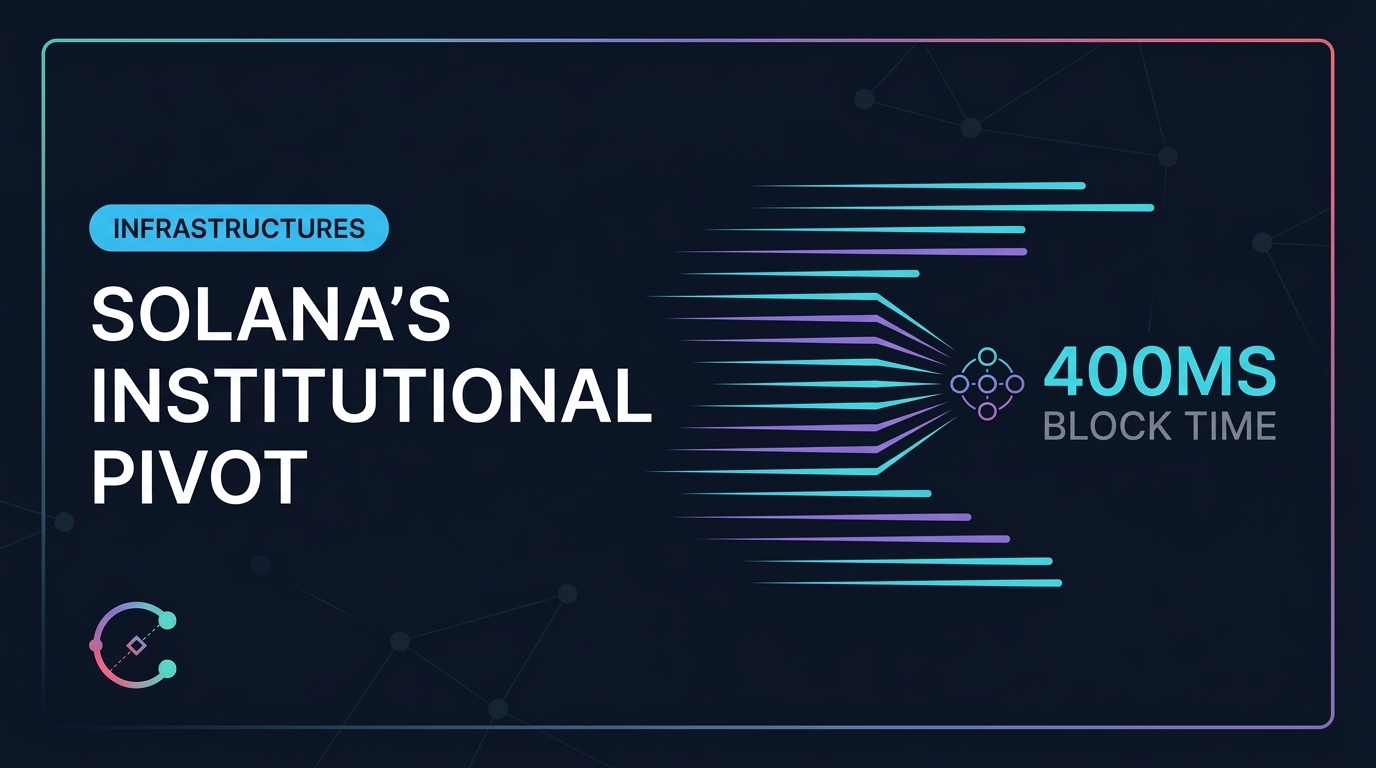
The more significant upgrade is Alpenglow, expected on mainnet in Q1 2026. It reduces transaction finality from 12 seconds to 150 milliseconds, an 80x improvement. That’s faster than Visa’s payment authorization. Multicoin Capital’s Kyle Samani calls Alpenglow “the most significant rewrite of the Solana protocol to date.”
The ETF Catalyst
Institutional capital flows accelerated dramatically with Solana ETF approvals in late 2025. In October 2025, the SEC approved spot Solana ETFs, with Bitwise’s Solana ETF and others launching on NYSE and Nasdaq. The products include 5% staking yields, creating a dynamic that draws income-focused institutional capital.
Cumulative inflows have exceeded $765 million to date. JPMorgan projected $3-6 billion in first-year inflows. Standard Chartered has rated Solana’s transformation as investment-grade, setting a $2,000 price target for 2030.
Why Speed Wins for RWAs
For tokenized real world assets, the calculus is different than store-of-value assets.
Settlement matters because traditional T+2 settlement ties up capital and creates counterparty risk, and instant settlement eliminates both. Costs matter because when tokenizing millions of transactions, the difference between $0.001 and $1.00 per transaction compounds dramatically.
And user experience matters because institutions comparing blockchain rails to existing infrastructure expect comparable performance.
Solana’s thesis is that RWAs will flow to the infrastructure that best matches the requirements of the underlying assets. For high-frequency, high-volume, cost-sensitive use cases, that means Solana.
The Bottom Line
Solana’s pivot from memecoin hub to institutional infrastructure isn’t just marketing. It’s backed by $1.66 billion in tokenized assets, 200+ tokenized equities from Ondo, Western Union’s stablecoin commitment, and technical upgrades that will push the network’s capabilities beyond any competitor.
As SpendNode’s analysis noted, the composition of Solana’s RWA ecosystem has diversified beyond stablecoins into genuine expansion across new asset classes including treasuries, equities, and private credit, meaning the $1.66 billion figure represents real breadth, not just stablecoin growth.
Solana isn’t trying to replace Ethereum. It’s positioning itself as the speed-first alternative for use cases where performance matters most.
Welcome to Commodara, your edge in real world assets.
If this breakdown helped you understand the multi-chain future of tokenization, share it with someone evaluating blockchain infrastructure for real world assets. And if you’re new here, this is where we track the moves that matter in the tokenized economy.
Frequently Asked Questions
How big is Solana’s RWA ecosystem?
Solana’s tokenized real world asset ecosystem reached $1.66 billion in total value as of February 15, 2026, nearly doubling from $873 million just six weeks earlier. This makes Solana the third-largest blockchain for RWA tokenization behind Ethereum ($12.3B) and BNB Chain ($2B+), capturing approximately 4.57% of the global market.
What tokenized stocks are available on Solana?
Ondo Finance launched over 200 tokenized U.S. stocks and ETFs on Solana in January 2026. These are custody-backed with actual securities held by U.S.-registered broker-dealers, offering 24/7 trading with near-instant settlement. Testing demonstrated only 0.03% slippage on a $500,000 purchase of tokenized Google shares, with pricing matching exchange-traded equivalents.
Why did Western Union choose Solana for its stablecoin?
Western Union announced USDPT (U.S. Dollar Payment Token) on Solana in October 2025, issued by Anchorage Digital Bank. Western Union processes $150 billion in annual remittance volume across 200+ countries through 600,000+ agent locations. Solana’s high throughput and low transaction costs make it suitable for high-volume, cross-border payment processing at the scale Western Union requires.
What are Firedancer and Alpenglow?
Firedancer is Jump Crypto’s high-performance validator client for Solana, live since December 2025, which demonstrated 600,000+ transactions per second in testing. Alpenglow is a consensus upgrade expected in Q1 2026 that reduces transaction finality from 12 seconds to 150 milliseconds, an 80x improvement that would make Solana faster than Visa’s payment authorization for settlement purposes.
How does Solana compare to Ethereum for RWA tokenization?
Ethereum dominates with $12.3 billion in tokenized RWAs and 65% market share. However, Solana’s growth rate is significantly faster, with tokenized equity assets growing 200% over six months compared to Ethereum’s 6.7%. Solana offers lower transaction costs ($0.001 vs $1+ on Ethereum) and faster settlement, making it more attractive for high-frequency, cost-sensitive tokenization use cases. Galaxy Research projects Solana’s RWA market could reach $2 billion by end of 2026.