
KYC and AML for Tokenized Assets: Compliance Guide for Issuers and Investors
KYC AML tokenized assets requirements are the compliance foundation that every issuer and platform must build on, and getting them wrong can result in regulatory enforcement, investor losses, or both. Know Your Customer and Anti-Money Laundering obligations apply to tokenized securities, tokenized funds, and most tokenized commodity products in every major jurisdiction. The blockchain does not exempt financial products from these obligations; it changes how they are implemented, often making compliance more efficient and auditable than traditional processes.
This guide covers the complete KYC and AML framework for tokenized assets: what the requirements are, how they differ across jurisdictions, how smart contracts enforce compliance on-chain, what issuers must build into their tokenization stack, and what investors should expect when participating in compliant token offerings. For asset owners preparing to tokenize and institutional decision-makers evaluating compliance infrastructure, this is the operational playbook.
Why KYC AML Tokenized Assets Compliance Is Non-Negotiable
Every tokenized product that qualifies as a security, which includes the vast majority of tokenized real estate, private credit, equity, and fund products, is subject to KYC and AML requirements under the laws of the jurisdiction where it is offered. These are not optional best practices; they are legal mandates enforced by financial regulators including the SEC, FinCEN, the FCA, ESMA, and MAS. Non-compliance can result in enforcement actions, fines, criminal prosecution, and the forced unwinding of the token offering.
The tokenization compliance landscape is shaped by three regulatory realities. First, most tokenized products are securities and are regulated as such. Second, the platforms that facilitate trading and custody of these tokens are typically classified as financial intermediaries with their own KYC and AML obligations. Third, the blockchain’s permanent and transparent record of transactions creates both an opportunity and a risk: regulators can trace every transaction, which means compliance failures are more visible and more prosecutable than they are in traditional markets where records are siloed and fragmented.
For issuers, implementing robust KYC AML tokenized assets procedures is not just about avoiding enforcement; it is about unlocking institutional capital. No institutional investor, pension fund, or family office will participate in a tokenized offering that lacks proper compliance infrastructure. The compliance stack is a prerequisite for capital formation, not an afterthought.
KYC Requirements for Tokenized Asset Issuers
Know Your Customer procedures for tokenized assets mirror those required for traditional securities offerings, with blockchain-specific adaptations for on-chain enforcement. The core requirement is the same: the issuer or its designated agent must verify the identity of every investor before allowing them to purchase tokens.
Identity Verification
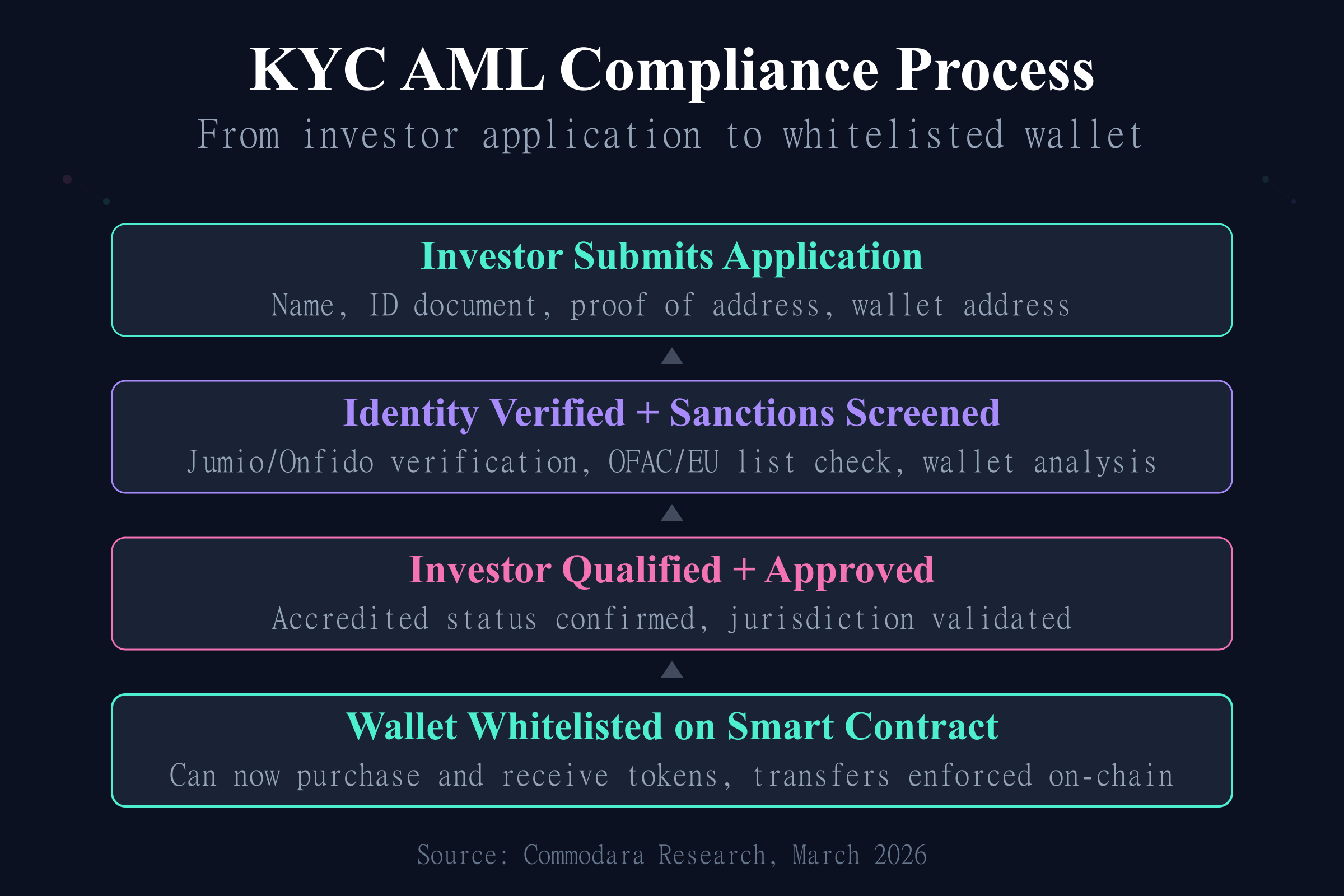
At minimum, KYC for tokenized assets requires collecting and verifying the investor’s full legal name, date of birth, residential address, and a government-issued identification document. For institutional investors, this extends to entity verification: confirming the legal existence of the entity, identifying its beneficial owners, and verifying the authority of the individual acting on behalf of the entity. Most tokenization platforms use third-party identity verification providers like Jumio, Onfido, or Sumsub to automate document verification and facial recognition checks.
The verification must occur before the investor’s wallet address is added to the token’s whitelist. Once verified, the wallet address is associated with the investor’s KYC record in the platform’s compliance database. The smart contract checks the whitelist before processing any token transfer, ensuring that only verified investors can hold or receive the token. This is the fundamental mechanism by which KYC requirements RWA products enforce at the blockchain level.
Investor Qualification
Beyond basic identity verification, many tokenized offerings require investor qualification checks. In the United States, Regulation D offerings require investors to be accredited, which means they must meet income or net worth thresholds defined by the SEC. Regulation A+ offerings are open to all investors but require SEC qualification of the offering statement. In Europe, MiCA and the Prospectus Regulation define different investor categories with different access rights.
The qualification check is typically integrated into the KYC process. The investor provides documentation of their accredited status (tax returns, bank statements, or a letter from a financial advisor), and the platform verifies this documentation before whitelisting their wallet. For Regulation S offerings targeting non-US persons, the KYC process must confirm the investor’s non-US residency status and enforce geographic restrictions on token access. The GENIUS Act stablecoin framework has further clarified how US-based compliance requirements apply to the stablecoin settlement layer that underlies most tokenized product transactions.
AML Requirements and Blockchain-Specific Considerations
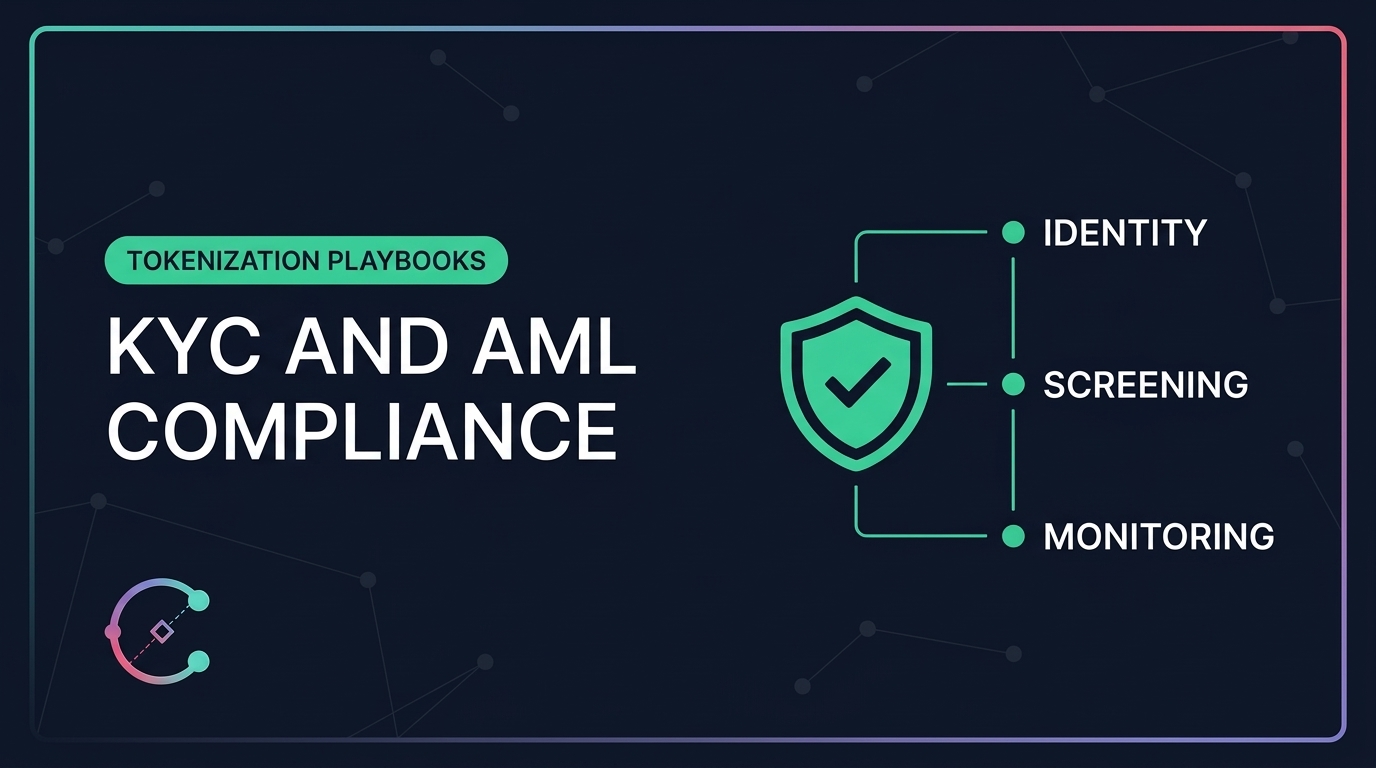
Anti-Money Laundering obligations for KYC AML tokenized assets extend beyond identity verification to include ongoing transaction monitoring, sanctions screening, and suspicious activity reporting. These obligations apply to issuers, platforms, and in some jurisdictions, to secondary market venues where tokens are traded.
Sanctions Screening
Every investor must be screened against global sanctions lists maintained by OFAC (US), the EU, the UN, and other national authorities before they are allowed to participate in a tokenized offering. This screening must be performed at the time of initial KYC and must be repeated on an ongoing basis, as sanctions lists are updated regularly. Wallet addresses associated with sanctioned individuals or entities must be permanently blocked from interacting with the token’s smart contract.
The blockchain adds a specific dimension to sanctions compliance that does not exist in traditional finance: wallet address screening. Tools like Chainalysis, Elliptic, and TRM Labs can analyze the transaction history of a wallet address to determine whether it has interacted with sanctioned entities, darknet markets, or other high-risk addresses. This AML blockchain capability enables a level of transaction-level compliance that is actually more granular than what traditional banking systems provide.
Transaction Monitoring
Ongoing transaction monitoring for tokenized assets involves tracking the movement of tokens to identify patterns that may indicate money laundering, terrorist financing, or other illicit activity. Unusual transaction volumes, rapid cycling of tokens between addresses, transactions just below reporting thresholds, and transfers to high-risk jurisdictions are all red flags that compliance systems must detect and escalate.
The transparency of blockchain transactions makes monitoring more efficient than in traditional finance, where transaction data is fragmented across multiple institutions. On the blockchain, every transfer of a tokenized security is visible to the compliance monitoring system in real time. This transparency is one of the paradoxes of tokenized finance: while critics sometimes associate blockchain with anonymity, the reality is that compliant tokenized securities create one of the most transparent and auditable financial records in existence.
Suspicious Activity Reporting
In the United States, financial institutions involved in tokenized asset issuance or trading are required to file Suspicious Activity Reports (SARs) with FinCEN when they detect transactions that may involve illegal activity. Similar reporting obligations exist under the EU’s Anti-Money Laundering Directives and in other major jurisdictions. The issuer’s compliance team or the platform’s compliance function must have procedures in place for detecting, documenting, and reporting suspicious activity within the required timeframes.
Smart Contract Compliance: How On-Chain Enforcement Works
One of the most significant innovations in KYC AML tokenized assets is the embedding of compliance logic directly into the smart contract that governs the token. This approach, known as smart contract compliance, automates the enforcement of transfer restrictions, investor qualifications, and regulatory requirements at the protocol level.
Whitelist-Based Transfer Restrictions
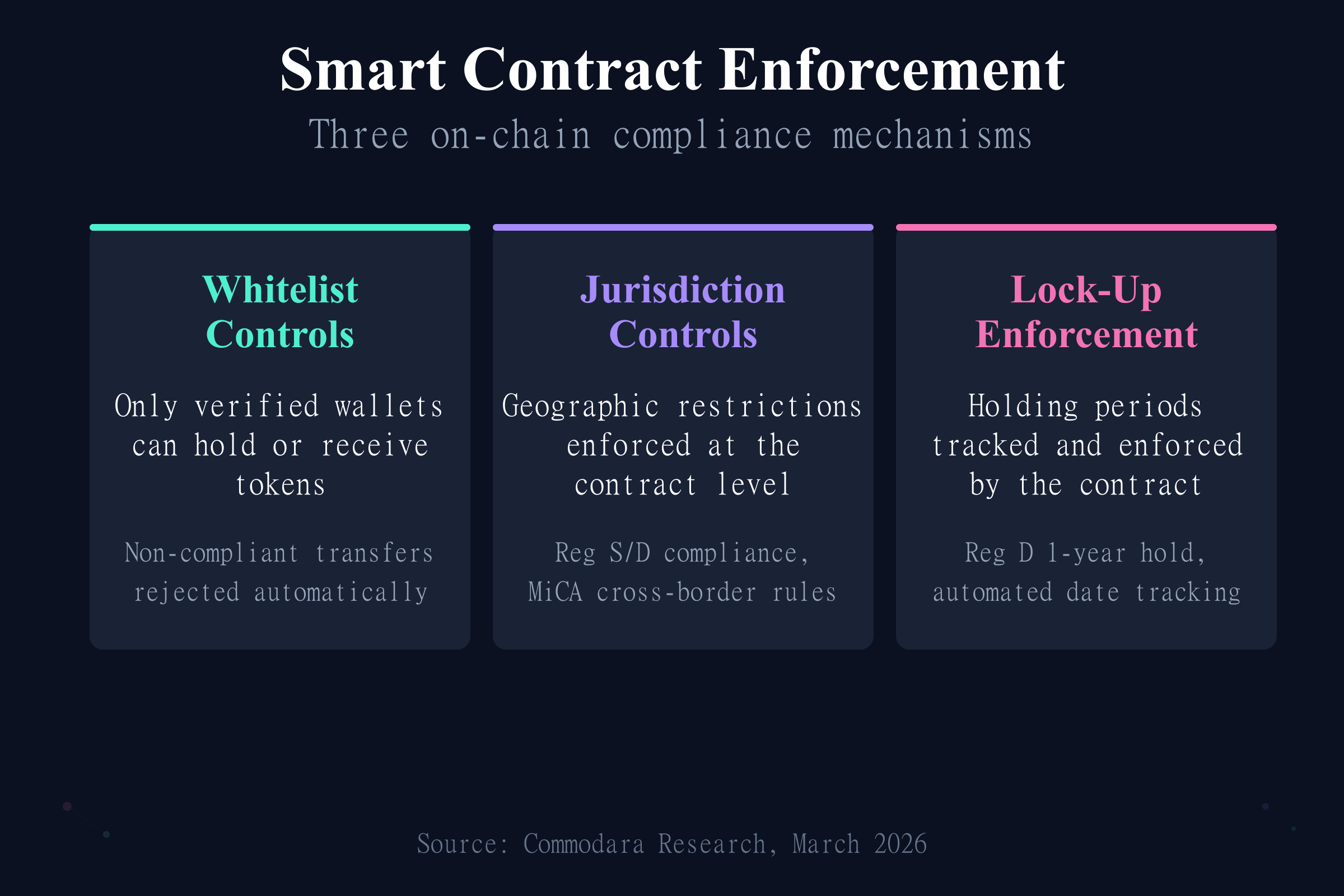
The most common smart contract compliance mechanism is the whitelist. The smart contract maintains a list of approved wallet addresses, and any transfer to a non-whitelisted address is automatically rejected by the contract. The whitelist is managed by the issuer or the compliance platform, and addresses are only added after the investor completes KYC verification and any required qualification checks.
This mechanism ensures that tokens can only be held by verified investors, regardless of where the transfer is initiated. An investor cannot simply send their tokens to a friend’s wallet or sell them to an unverified buyer on a decentralized exchange. The smart contract enforces the transfer restriction at the code level, making non-compliant transfers technically impossible rather than merely prohibited by contract terms.
Jurisdiction-Based Controls
Smart contracts can also enforce jurisdiction-based restrictions. A Regulation S offering that excludes US investors can encode this restriction in the contract, blocking transfers to any wallet address associated with a US-verified investor. A product that is licensed for distribution in Singapore but not in Japan can enforce this geographic limitation on-chain. These jurisdiction controls are particularly important for cross-border tokenized offerings that must comply with multiple regulatory frameworks simultaneously.
The MiCA tokenization framework in Europe has specific requirements for how token issuers handle cross-border distribution within the EU, and smart contract compliance tools can automate the enforcement of these requirements across all supported blockchain networks.
Lock-Up Periods and Transfer Timing
Securities regulations often impose holding periods before tokens can be resold. Regulation D offerings typically require a one-year holding period, and the smart contract can enforce this by tracking the purchase date for each token holder and blocking transfers until the holding period expires. This automated enforcement eliminates the need for manual tracking and reduces the compliance burden on the issuer’s administration team.
Jurisdictional Differences in KYC AML Requirements
The specific KYC and AML requirements for KYC AML tokenized assets vary significantly across jurisdictions. Issuers offering tokens to investors in multiple countries must navigate these differences carefully to avoid compliance gaps.
United States
US requirements are among the most stringent globally. The Bank Secrecy Act, the USA PATRIOT Act, and SEC regulations collectively require identity verification, beneficial ownership identification, sanctions screening, ongoing transaction monitoring, and suspicious activity reporting. The GENIUS Act has added specific requirements for stablecoin issuers that affect the settlement layer of most tokenized transactions.
European Union
The EU’s Anti-Money Laundering Directives (AMLD5 and the forthcoming AMLD6) and MiCA establish a comprehensive framework for KYC and AML compliance for digital asset service providers. MiCA specifically requires crypto-asset service providers to conduct customer due diligence, monitor transactions, and report suspicious activities. The Travel Rule, which requires the sharing of sender and receiver information for transfers above certain thresholds, applies to tokenized security transfers within the EU.
Singapore
The Monetary Authority of Singapore (MAS) enforces KYC and AML requirements through the Payment Services Act and the Securities and Futures Act. Digital payment token service providers must implement customer due diligence measures, screen against sanctions lists, and report suspicious transactions. Singapore’s framework is considered one of the most balanced globally, providing regulatory clarity without imposing the compliance burden that can stifle innovation.
United Arab Emirates
The UAE has established dedicated regulatory frameworks for virtual assets through VARA (Virtual Assets Regulatory Authority) in Dubai and the FSRA (Financial Services Regulatory Authority) in Abu Dhabi’s ADGM. Both frameworks include KYC and AML requirements that align with FATF recommendations. The UAE’s approach has attracted significant tokenization activity from issuers seeking a jurisdiction with clear rules and a supportive regulatory environment.
Building Your Tokenization Compliance Stack
For issuers preparing to launch a tokenized offering, the compliance stack must be designed and implemented before the first token is minted. Retrofitting compliance into an existing token is significantly more complex and expensive than building it in from the start.
Essential Components
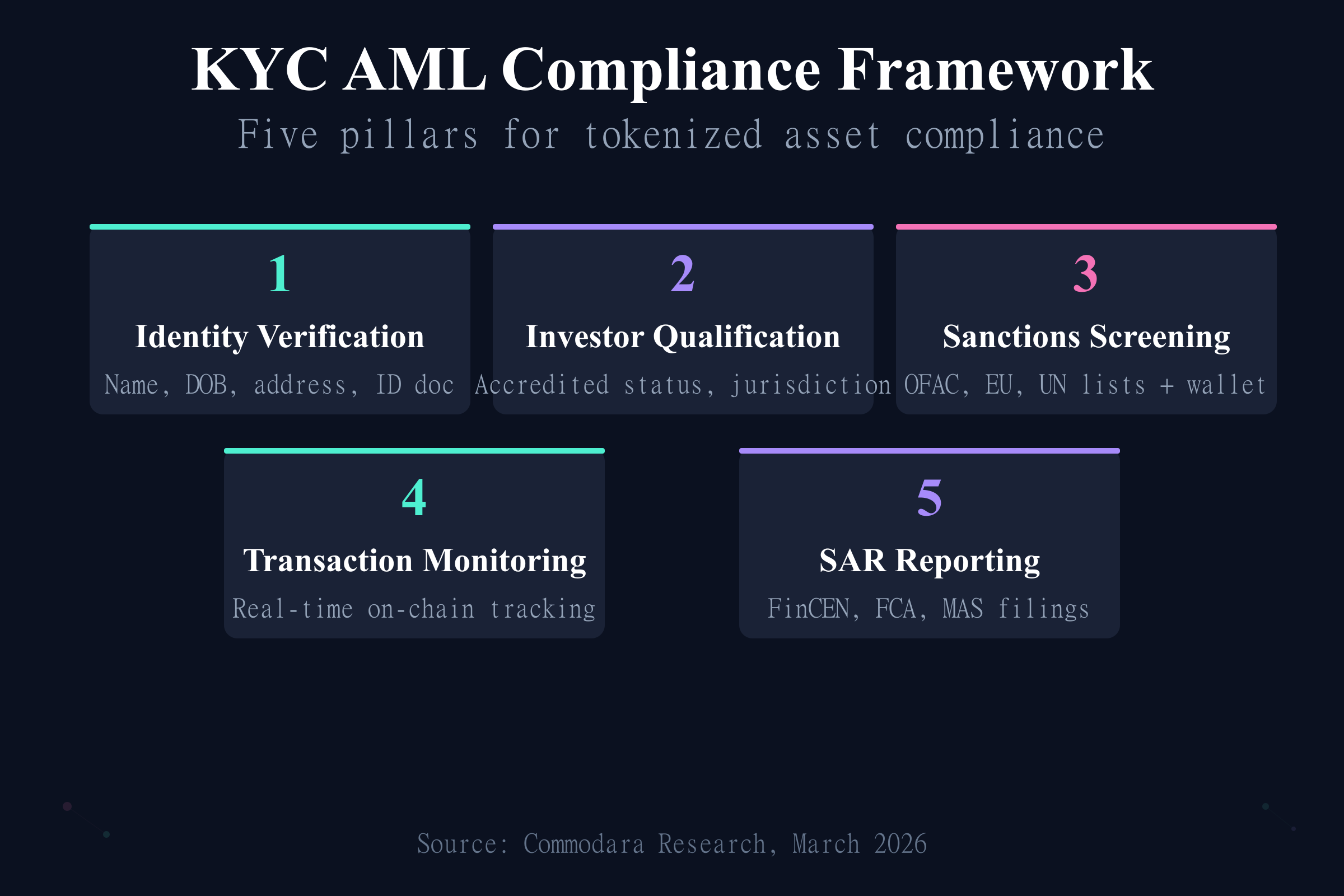
A complete tokenization compliance stack includes five components. First, a KYC/identity verification provider that can handle individual and entity verification across your target jurisdictions. Second, a sanctions screening service that checks against all relevant lists and provides ongoing monitoring. Third, a blockchain analytics tool for wallet screening and transaction monitoring. Fourth, a smart contract architecture that supports whitelisting, transfer restrictions, and jurisdiction controls. Fifth, a compliance management platform that ties all of these components together and provides the audit trail that regulators require.
The SPV tokenization guide covers how these compliance components integrate with the legal entity structure. For organizations assessing their compliance readiness, the Commodara Tokenization Readiness Tool evaluates your current compliance infrastructure and identifies gaps that must be addressed before launching a tokenized offering.
Cost Considerations
Compliance infrastructure represents a significant portion of the total cost of launching a tokenized offering. KYC verification services typically charge $2 to $10 per verification depending on the jurisdiction and the depth of the check. Ongoing sanctions screening and transaction monitoring add recurring costs. Blockchain analytics subscriptions range from $10,000 to $100,000+ annually depending on the provider and the volume of transactions monitored. Smart contract audit costs for compliance-embedded contracts range from $20,000 to $100,000 depending on complexity.
These costs are not optional for compliant offerings. However, they represent a fraction of the compliance costs associated with traditional fund structures, where transfer agent services, manual KYC processing, and paper-based record-keeping create substantial ongoing administrative expenses. The efficiency gains from automated, on-chain compliance are one of the underappreciated value propositions of tokenization for issuers who have the scale to amortize the upfront infrastructure investment. For organizations seeking tailored compliance cost estimates, a paid consultation with Commodara’s advisory team provides specific guidance based on your asset class, jurisdiction, and investor base.
Frequently Asked Questions
What are KYC and AML requirements for tokenized assets?
KYC AML tokenized assets requirements include identity verification for all investors, sanctions screening, investor qualification checks (accredited status for Reg D offerings), ongoing transaction monitoring, and suspicious activity reporting. These obligations apply to issuers and platforms in every major jurisdiction.
How do smart contracts enforce KYC compliance?
Smart contracts use whitelists to restrict token transfers to verified wallet addresses only. Addresses are added to the whitelist after the investor completes KYC verification. The contract automatically rejects transfers to non-whitelisted addresses, making non-compliant transfers technically impossible.
Do investors need to complete KYC for tokenized securities?
Yes. Any tokenized product classified as a security requires investor KYC verification before purchase. This typically includes identity verification, address confirmation, and in many cases, accredited investor qualification. The process is usually completed online through the issuing platform.
How does AML monitoring work on blockchain?
AML blockchain monitoring uses tools like Chainalysis and Elliptic to analyze wallet transaction histories, screen for sanctioned addresses, and detect suspicious patterns. The transparency of blockchain transactions enables more granular real-time monitoring than traditional banking systems.
What happens if an issuer fails to implement KYC AML compliance?
Non-compliance can result in regulatory enforcement actions, fines, criminal prosecution, and forced unwinding of the token offering. It also prevents institutional investors from participating, as no regulated institution will invest in an offering that lacks proper compliance infrastructure.
The Bottom Line
KYC AML tokenized assets compliance is the infrastructure layer that separates legitimate tokenized products from unregulated offerings. The requirements are clear: identity verification, investor qualification, sanctions screening, transaction monitoring, and suspicious activity reporting. The innovation is in how these requirements are implemented, with smart contract enforcement, blockchain analytics, and automated compliance creating a system that is actually more efficient and more transparent than traditional compliance processes.
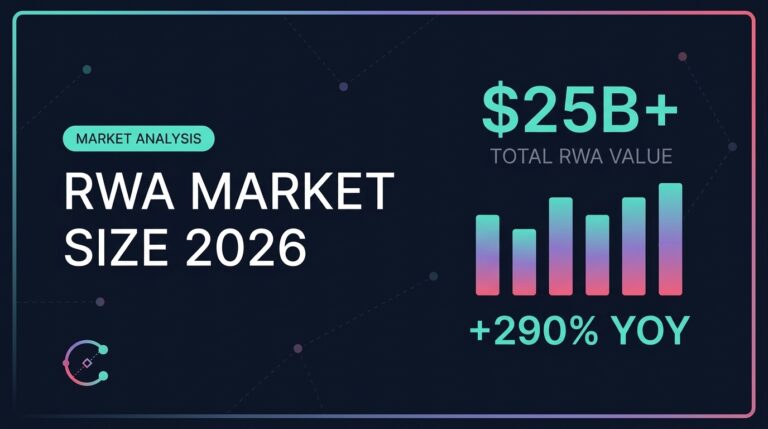
For issuers, building compliance into the tokenization stack from the start is both a legal obligation and a strategic advantage. Institutional capital flows to compliant offerings. Regulatory clarity is expanding. The issuers and platforms that build the strongest compliance infrastructure today will be best positioned to capture the growth of the tokenized asset market as it scales from $25 billion toward the trillions that industry projections forecast.
For asset owners evaluating their compliance readiness, the Commodara Tokenization Readiness Tool provides a structured assessment of your KYC, AML, and regulatory infrastructure. Subscribe to the Commodara newsletter for ongoing compliance guidance as regulations continue to evolve across global jurisdictions.