
Securitize Platform Review: The Infrastructure Behind BlackRock BUIDL
Securitize is the tokenization platform behind BlackRock’s $2.5 billion BUIDL fund, and it has become the infrastructure standard for institutional-grade digital securities. While dozens of tokenization platforms compete for market share, Securitize has separated itself by securing partnerships with the world’s largest asset managers and by operating as an SEC-registered transfer agent, broker-dealer, and alternative trading system. This combination of regulatory licensing and institutional relationships makes Securitize the most consequential platform in the tokenized asset market today.
This Securitize review examines the platform’s architecture, its role in the tokenization stack, the products built on its infrastructure, its compliance framework, and the competitive dynamics that define its market position. Whether you are an asset owner evaluating where to tokenize, an investor assessing products built on Securitize, or an industry builder analyzing the competitive landscape, this analysis provides the depth required for informed decision-making.
Table of Contents
This review begins with an overview of Securitize and its role in the tokenization infrastructure. It then examines the Securitize and BlackRock relationship, the platform’s technical architecture, its compliance and regulatory framework, how Securitize compares to competitors, and how to evaluate the platform for your own tokenization needs.
What Is Securitize and Why Does It Matter?
Securitize is a Miami-based technology company founded in 2017 by Carlos Domingo, a former Telefonica executive, with the specific mission of bringing institutional securities issuance on-chain. Unlike many platforms in the digital asset space that started in decentralized finance and later pivoted toward institutional clients, Securitize was built from the ground up to serve regulated capital markets. This institutional-first DNA defines every aspect of the platform’s design, from its compliance architecture to its investor onboarding flow.
The company operates three SEC-registered entities: a transfer agent, a broker-dealer, and an alternative trading system. This trifecta of registrations is unique among tokenization platforms and gives Securitize the regulatory foundation to handle the entire lifecycle of a digital security, from initial issuance through secondary market trading to ongoing investor management and corporate actions. No other tokenization platform in the market holds all three registrations.
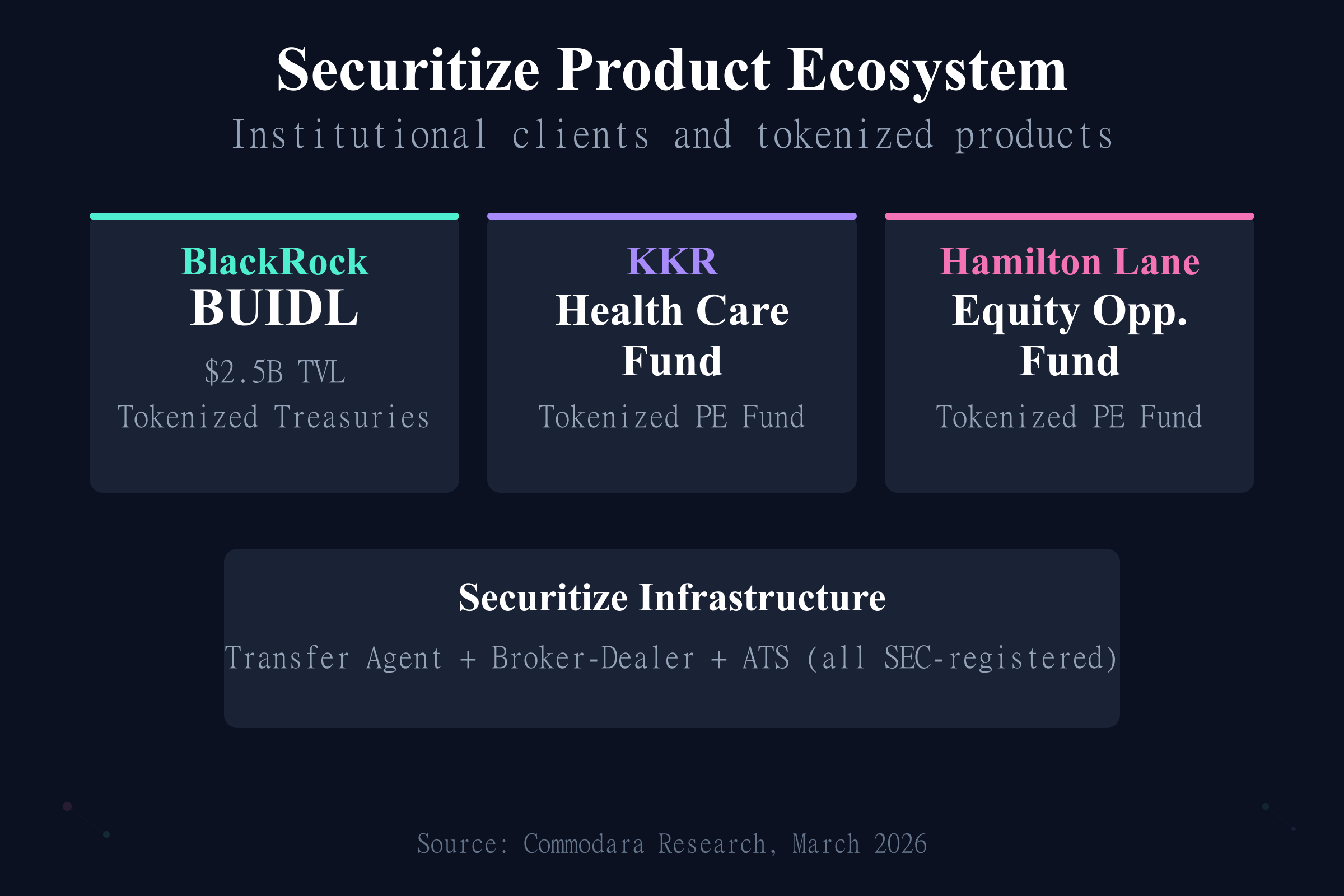
What makes Securitize matter beyond its regulatory credentials is the caliber of its clients. In addition to BlackRock, the platform serves KKR, Hamilton Lane, Ares Management, and several other institutional asset managers. These are not pilot programs or proof-of-concept experiments. They are production deployments managing billions of dollars in tokenized assets. The institutional adoption of tokenization by BlackRock and other major firms has been built primarily on Securitize infrastructure, which signals the platform’s central role in the market’s long-term trajectory.
Securitize and BlackRock: The BUIDL Partnership
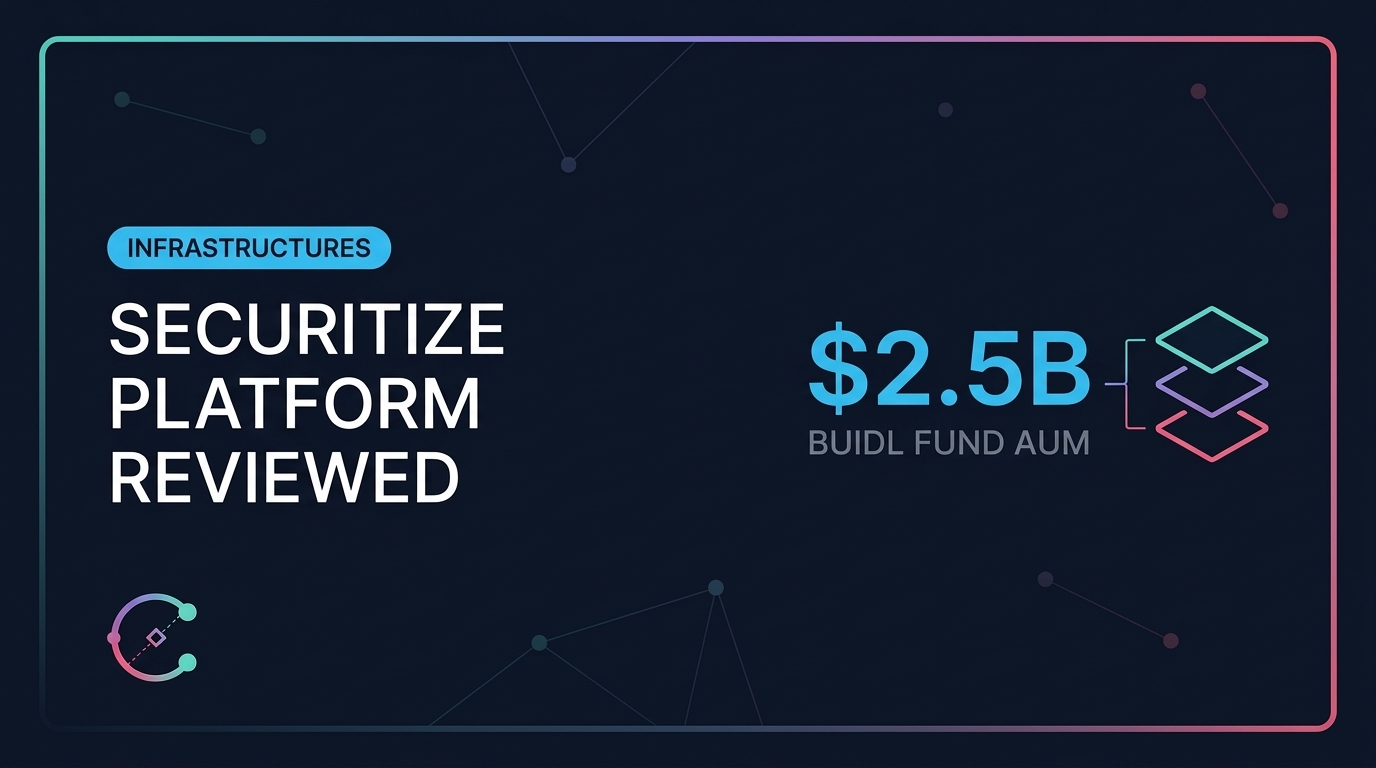
The partnership between Securitize and BlackRock on the BUIDL fund is the most significant relationship in the tokenized asset market. BUIDL, the BlackRock USD Institutional Digital Liquidity Fund, launched in March 2024 and has grown to over $2.5 billion in total value, making it the largest tokenized fund product in existence. Securitize serves as the tokenization platform, transfer agent, and placement agent for the fund.
The mechanics of the Securitize BlackRock relationship illustrate how institutional tokenization works in practice. BlackRock manages the fund’s investment portfolio, which consists of short-term US Treasury securities. Securitize handles the token issuance on Ethereum and other supported blockchains, manages the investor registry, processes subscriptions and redemptions, and enforces transfer restrictions through smart contract compliance logic. The fund is structured as a British Virgin Islands limited company, and Bank of New York Mellon serves as custodian for the underlying assets.
Why BlackRock Chose Securitize
BlackRock’s selection of Securitize was driven by three factors that other potential partners could not match. First, Securitize’s SEC registrations provided the regulatory infrastructure that BlackRock’s compliance team required. Second, the platform’s existing track record with institutional issuances demonstrated operational maturity. Third, Securitize’s investor management capabilities, including KYC/AML processing, accreditation verification, and ongoing reporting, aligned with BlackRock’s requirements for institutional-grade fund administration.
The partnership has also expanded beyond BUIDL. Securitize now powers tokenized fund products for multiple BlackRock strategies, and the two companies have explored additional use cases including tokenized money market funds and tokenized collateral management. This deepening relationship suggests that Securitize has become a strategic infrastructure partner for BlackRock’s broader digital asset strategy, not merely a vendor for a single product.
Securitize Platform Architecture
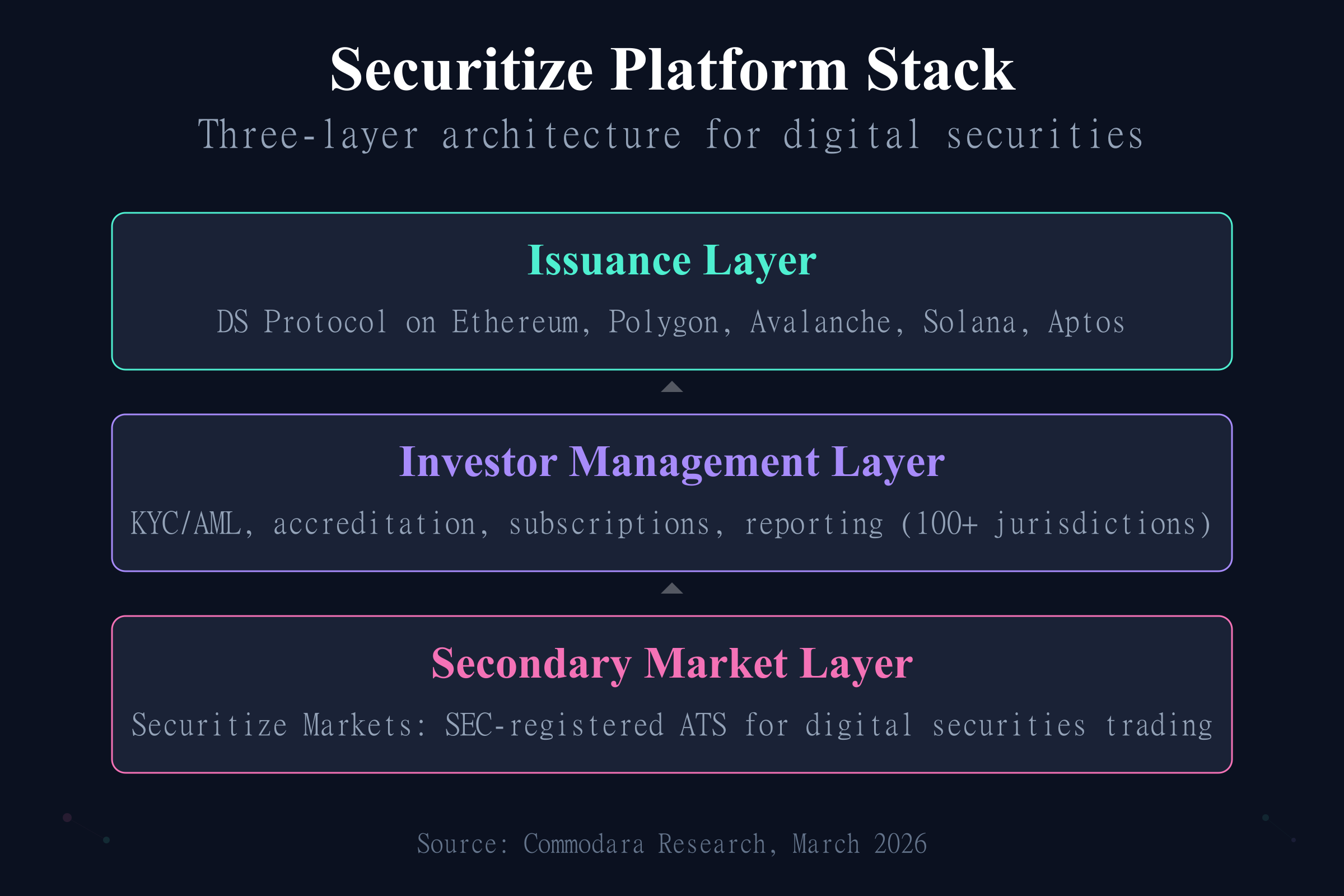
The Securitize platform is structured as a modular stack that covers the complete lifecycle of a digital security. Understanding this architecture is essential for asset owners evaluating whether to build on Securitize and for investors assessing the infrastructure quality behind the products they hold.
Issuance Layer
The issuance layer handles the creation of digital securities on blockchain networks. Securitize supports issuance on Ethereum, Polygon, Avalanche, Solana, and Aptos, with additional chains under development. The platform uses its proprietary DS Protocol, a set of smart contracts that embed compliance logic directly into the token. This means that transfer restrictions, investor qualification requirements, and holding limits are enforced at the protocol level, not through off-chain systems that can be bypassed.
The DS Protocol is the technical foundation that makes Securitize digital securities fundamentally different from standard ERC-20 tokens. Each token includes a compliance layer that checks every proposed transfer against a registry of qualified holders. If the sender, the recipient, or the transaction itself violates any compliance rule, the transfer is automatically blocked by the smart contract. This on-chain enforcement is what gives institutional issuers confidence that their securities will remain within regulated distribution channels.
Investor Management Layer
Securitize operates a comprehensive investor management system that handles identity verification, accreditation checks, subscription processing, and ongoing investor communications. The platform processes KYC and AML checks for investors across more than 100 jurisdictions, using a combination of automated verification systems and manual review for complex cases.
For issuers, this layer eliminates the need to build separate investor management infrastructure. A fund manager launching a tokenized product on Securitize can rely on the platform’s existing compliance infrastructure rather than developing their own, which significantly reduces time-to-market and operational costs. This turnkey approach is one of the primary reasons institutional issuers choose Securitize over building custom tokenization solutions.
Secondary Market Layer
Securitize Markets, the company’s SEC-registered alternative trading system, provides a regulated secondary market for digital securities issued on the platform. This is a critical differentiator because secondary market liquidity is one of the primary challenges facing tokenized products. Most tokenized securities have limited secondary trading options, but securities issued through Securitize can be traded on a platform that is specifically registered and regulated for this purpose.
The trading volumes on Securitize Markets remain modest compared to traditional securities exchanges, which reflects the early-stage maturity of the tokenized securities market as a whole. However, the regulatory infrastructure for secondary trading is in place, and as the market grows, Securitize is positioned to capture a significant share of tokenized securities trading activity.
Securitize Compliance and Regulatory Framework
The compliance framework is arguably the most important aspect of the Securitize platform for institutional users. The regulatory registrations that Securitize holds are not merely licensing requirements; they define the operational capabilities that the platform can offer and the level of trust that institutional clients place in it.
SEC Registrations
Securitize holds three distinct SEC registrations. The transfer agent registration allows the company to maintain the official record of security ownership, process transfers, and handle corporate actions like dividend distributions. The broker-dealer registration enables Securitize to facilitate the buying and selling of securities and to earn transaction-based compensation. The ATS registration allows Securitize Markets to operate as a regulated secondary trading venue.
These registrations subject Securitize to ongoing SEC examination, reporting requirements, and capital adequacy standards. For institutional clients, this regulatory oversight provides a level of assurance that the platform operates within established securities law frameworks. Asset managers evaluating Securitize tokenization can point to these registrations as evidence of regulatory compliance when presenting tokenized products to their own compliance committees and boards.
Global Compliance Capabilities
Beyond US securities regulation, Securitize has established compliance capabilities across multiple jurisdictions. The platform supports securities issuance under EU regulations, Cayman Islands frameworks, and several Asian jurisdictions. This multi-jurisdictional capability is essential for institutional issuers who distribute products to a global investor base and need a single platform that can handle compliance across different regulatory regimes.
The compliance infrastructure also includes ongoing monitoring capabilities. Securitize continuously screens its investor base against sanctions lists, monitors for suspicious transaction patterns, and provides issuers with regular compliance reports. This ongoing monitoring is a regulatory requirement for securities transfer agents and is a capability that most competing tokenization platforms do not offer at the same level of sophistication.
Securitize vs Competitors: Platform Comparison
The tokenization platform market includes several competitors, each with different strengths and positioning. Understanding where Securitize fits relative to alternatives is important for asset owners making platform selection decisions and for investors evaluating the infrastructure behind tokenized products.
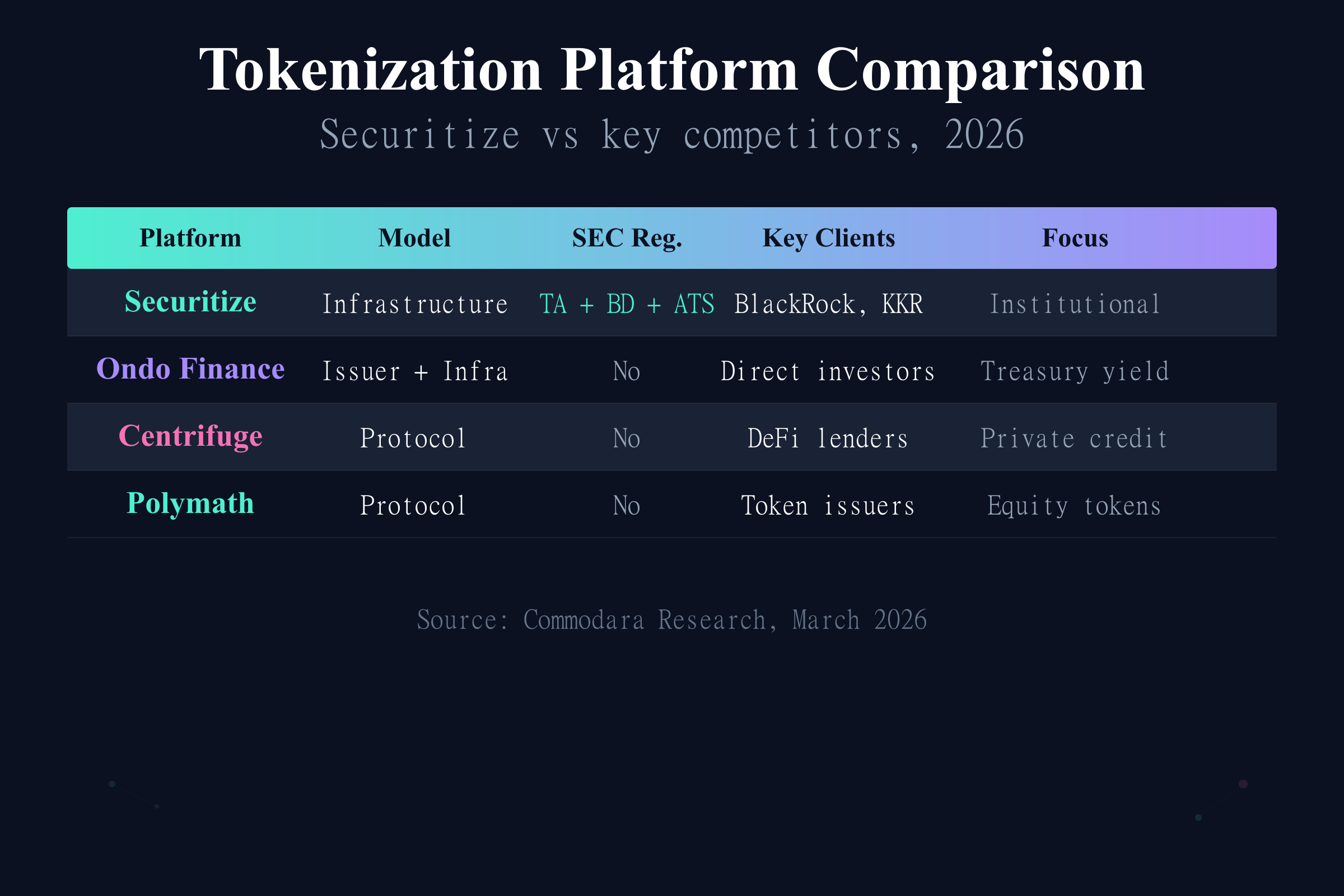
Ondo Finance is the closest competitor in the tokenized treasury space, but it operates a fundamentally different model. Ondo issues its own fund products (OUSG, USDY) and serves as both issuer and platform. Securitize, by contrast, is pure infrastructure; it does not issue its own funds but provides the technology and regulatory framework for other issuers to tokenize their products. This distinction means that Securitize and Ondo are more complementary than directly competitive in most scenarios.
Centrifuge focuses on tokenizing private credit and real-world collateral for DeFi lending, serving a different market segment than Securitize’s institutional focus. Maple Finance similarly targets on-chain lending markets rather than securities issuance. Polymath and Tokeny provide tokenization technology but lack the SEC registrations that Securitize holds. For institutional issuers who require a fully regulated infrastructure stack, Securitize remains the clear market leader.
The competitive advantage of Securitize ultimately comes down to a combination that no competitor has replicated: SEC-registered transfer agent, broker-dealer, and ATS, combined with a client roster that includes the world’s largest asset managers, and a multi-chain technical infrastructure that supports compliant token issuance across five blockchains.
Evaluating Securitize for Your Tokenization Needs
For Asset Owners Considering Tokenization
If you are an asset owner evaluating whether to tokenize a fund, a real estate portfolio, or another asset class, Securitize is the platform that institutional investors and their compliance teams will recognize. The platform’s regulatory registrations and institutional client roster reduce the due diligence burden for your investors, which can accelerate capital raising. However, Securitize is designed for institutional-scale projects; smaller issuances may find the platform’s onboarding requirements and cost structure better suited to larger deals.
To assess whether Securitize tokenization aligns with your needs, start by evaluating your asset class, target investor base, jurisdictional requirements, and expected fund size. The Commodara Tokenization Readiness Tool can help you evaluate your readiness and identify whether an institutional platform like Securitize is the right fit or whether a more retail-oriented platform would better serve your distribution strategy.
For Investors Evaluating Securitize-Issued Products
As an investor, understanding that a tokenized product is built on Securitize infrastructure tells you several important things. The security was issued through an SEC-registered transfer agent, meaning the ownership records are maintained to regulatory standards. The token includes on-chain compliance logic that restricts transfers to qualified holders. And a regulated secondary market is available for trading, even if volumes are currently limited.
These infrastructure qualities do not eliminate investment risk, but they do provide a baseline of operational and regulatory quality that is relevant to your due diligence. For a broader view of platforms and how to evaluate them, see our guide on how to buy tokenized assets in 2026.
Frequently Asked Questions
What is Securitize?
Securitize is an SEC-registered tokenization platform that provides the technology and regulatory infrastructure for institutional-grade digital securities. It serves as the transfer agent, broker-dealer, and ATS operator for tokenized products including BlackRock’s $2.5 billion BUIDL fund.
Why did BlackRock choose Securitize for BUIDL?
BlackRock selected Securitize for its unique combination of SEC registrations, operational maturity with institutional issuances, and comprehensive investor management capabilities including KYC/AML processing and accreditation verification. No other platform offered all three SEC registrations that BlackRock’s compliance requirements demanded.
How is Securitize different from Ondo Finance?
Securitize is pure infrastructure: it provides the platform and regulatory framework for other issuers to tokenize their products. Ondo Finance issues its own fund products like OUSG and USDY. Securitize serves asset managers; Ondo Finance serves investors directly. The two are more complementary than competitive.
What blockchains does Securitize support?
Securitize supports token issuance on Ethereum, Polygon, Avalanche, Solana, and Aptos. The platform’s DS Protocol embeds compliance logic into the token on each chain, ensuring that transfer restrictions and investor qualification requirements are enforced at the smart contract level regardless of network.
Can small projects use Securitize for tokenization?
Securitize is designed for institutional-scale tokenization projects. The platform’s onboarding process, compliance infrastructure, and cost structure are optimized for larger issuances. Smaller projects may find retail-oriented platforms like RealT or Centrifuge more appropriate for their scale and distribution needs.
The Bottom Line
Securitize has established itself as the infrastructure standard for institutional tokenization. Its unique combination of SEC registrations, blue-chip client relationships, and multi-chain technical capabilities creates a competitive position that no other platform has replicated. The BUIDL partnership with BlackRock is the most visible proof point, but the platform’s relationships with KKR, Hamilton Lane, and other major asset managers demonstrate that Securitize’s value extends across the institutional landscape.
The platform is not without limitations. Its institutional focus means it is not the right choice for every tokenization project. Secondary market volumes remain early-stage. And the concentration of the tokenized securities market on a single platform introduces its own form of infrastructure risk. But for institutional issuers who need a fully regulated, operationally mature tokenization stack, Securitize is the benchmark against which all alternatives are measured.
As the tokenized securities market continues to grow beyond its current scale, Securitize is positioned to capture a disproportionate share of institutional issuance. The infrastructure being built today will define how the next generation of capital markets operates on-chain. Subscribe to the Commodara newsletter for ongoing coverage of tokenization platforms and the infrastructure that powers the tokenized economy.