
The $300 Billion Race for the World’s Default Stablecoins
Paper Money Goes Digital: The $300 Billion Race to Become the World’s Default Digital Dollar
According to Bloomberg, citing Artemis Analytics data, stablecoins processed $33 trillion in transaction volume in 2025, a 72% increase from the prior year. USDC led with $18.3 trillion in transactions, while USDT recorded $13.3 trillion.
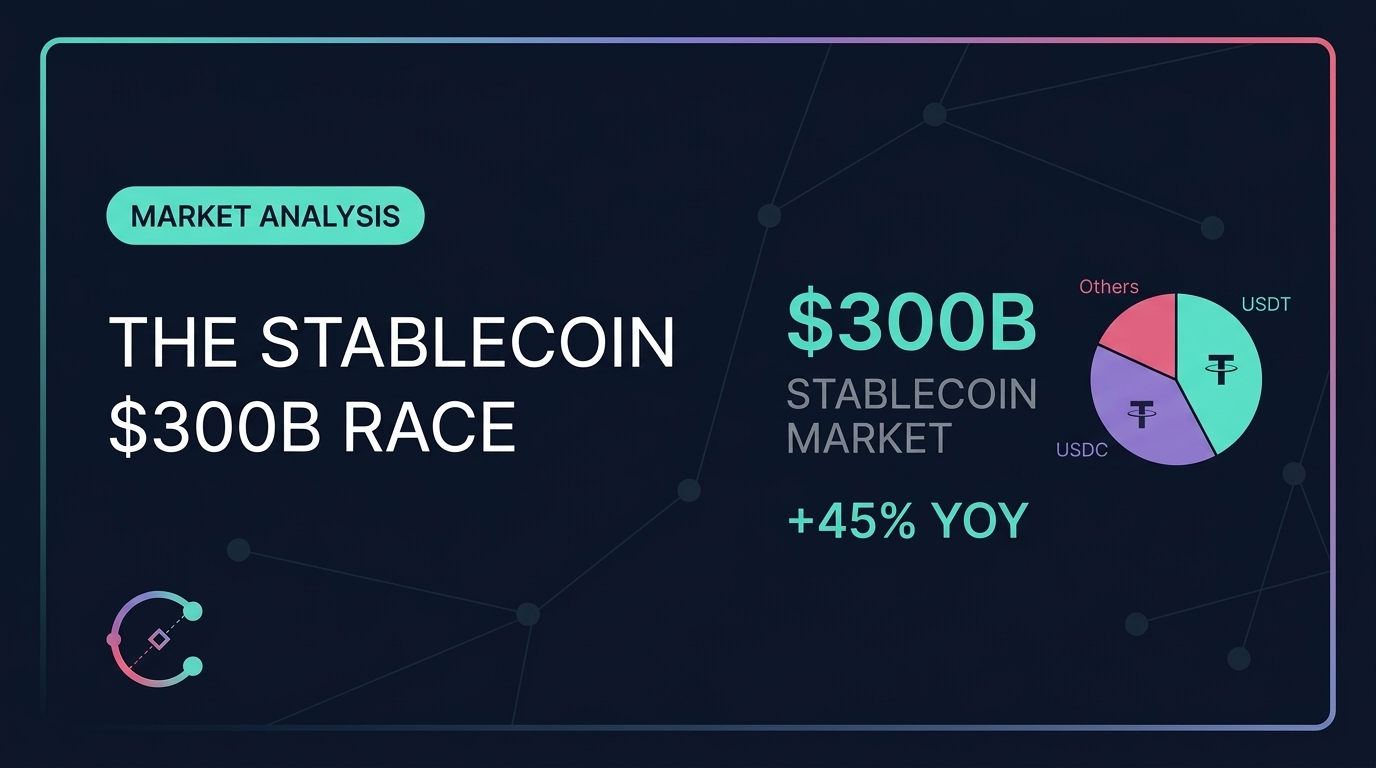
That exceeds PayPal’s annual volume by more than 20x and approaches the throughput of Visa’s global network. The total market cap has crossed $300 billion, with stablecoin issuers collectively holding more U.S. Treasuries than most sovereign nations.
This isn’t a crypto story anymore. It’s a money story.
And the battle for who controls the world’s digital dollars is entering its decisive phase. Tether reported $10 billion in profit for 2025. Circle just went public at a $16.7 billion valuation.
Western Union chose Solana for its stablecoin. Banks are lining up to issue their own. And the GENIUS Act has created the first federal regulatory framework that legitimizes stablecoins as financial infrastructure.
Table of Contents
The Trillion-Dollar Oligopoly
Two companies control 93% of the stablecoin market. Understanding their positions is essential to understanding what comes next.
Tether (USDT) holds a market cap of approximately $186 billion, representing roughly 60% market share. They reported over $10 billion in profit for 2025. Their U.S. Treasury exposure stands at $141 billion, making them the 17th largest holder globally. The platform serves 500+ million users worldwide.
Tether’s profit model is elegant: earn interest on Treasury reserves while charging nothing to hold USDT. With front-end yields around 4-5%, gross interest income approaches $6 billion annually. Operating costs are minimal. The result is one of the most profitable businesses in finance.
Circle (USDC) holds a market cap of approximately $75 billion with roughly 24% market share. They generated $2.75 billion in 2025 revenue, with 95% coming from Treasury interest. Circle went public on June 5, 2025 at a $16.7 billion valuation (NYSE: CRCL), with shares surging 168% on day one.
On-chain transaction volume reached $11.9 trillion, representing 247% year-over-year growth. The company holds licenses in 46 U.S. states plus the EU, UK, Singapore, and other jurisdictions. CEO Jeremy Allaire has explicitly sought Federal Reserve regulation, positioning Circle as “the regulated choice” for institutions.
The GENIUS Act: Stablecoins Become Financial Infrastructure
The passage of the GENIUS Act in July 2025 marks the most significant regulatory development in crypto history. For the first time, the United States has a federal framework that legitimizes stablecoins as payment infrastructure.
Only permitted payment stablecoin issuers (PPSIs) can issue, including bank subsidiaries, OCC-supervised nonbanks, and state-chartered entities. Reserve requirements mandate 1:1 backing with U.S. dollars, short-term Treasuries, or government money market funds, with no algorithmic backing permitted.
Stablecoin issuers cannot pay interest directly to holders, preventing competition with bank deposits. And payment stablecoins are explicitly excluded from securities and commodities definitions, providing regulatory clarity.
As Arkham Intelligence’s research report noted, stablecoin issuers are now the 7th largest purchasers of U.S. government debt, a structural shift that positions them as critical participants in Treasury markets rather than peripheral crypto instruments.
The Fintech Assault
Stripe signaled its stablecoin ambitions through the acquisition of Bridge for $1.1 billion in early 2025. Bridge won the competitive bid to issue USDH for Hyperliquid, then launched Open Issuance, a platform allowing any business to create its own branded stablecoin in days.
PayPal’s PYUSD represents the most significant consumer-facing stablecoin launch, with a current market cap of approximately $3.7 billion. PayPal and Venmo provide access to over 430 million consumers and 36 million merchants.
Western Union’s USDPT, launching in H1 2026 on Solana, will serve $150 billion in annual remittances through 600,000+ agent locations. This is the most aggressive legacy financial institution bet on stablecoin adoption.
The Bank Response
Banks initially watched stablecoins with skepticism. The GENIUS Act changed the calculus. Now they’re preparing to compete.
Early Warning Services, the bank-led consortium that operates Zelle (Bank of America, JPMorgan Chase, Wells Fargo, and others), is developing its own stablecoin. Qivalis, a consortium of 10 major European banks including ING and BNP Paribas, is launching a euro-backed stablecoin in H2 2026.
The competitive dynamic is clear: banks fear deposit flight to stablecoins held at fintechs, while recognizing stablecoins could be a new revenue stream if they issue their own.
Visa and Mastercard: The Settlement Layer
Visa’s stablecoin settlement volumes hit $4.5 billion annualized by January 2026. The card network allows U.S. banks to settle daily card transactions in USDC on Solana rather than through traditional wire transfers.
Card-linked payments funded by stablecoins grew from $250 million monthly in early 2023 to over $1.5 billion monthly by mid-2024. The card networks’ embrace of stablecoins validates the technology while potentially limiting disruption to their core business.
The 2026 Outlook
The total stablecoin market is forecast to reach $2 trillion by the end of 2028 according to Standard Chartered, with monthly transaction volumes approaching $1 trillion by December 2026.
Regulatory clarity is accelerating adoption through the GENIUS Act framework. Banks are entering the market through GENIUS Act-compliant subsidiaries. Fintech infrastructure is maturing with stablecoin-as-a-service platforms.
Settlement use cases are dominating, particularly B2B payments, treasury management, and cross-border transactions. And emerging market adoption continues independent of crypto market cycles, with Standard Chartered estimating that $1 trillion in bank deposits in emerging countries could flow into stablecoins.
The Bottom Line
Stablecoins have matured from crypto trading tools into financial infrastructure. The $300 billion market cap and $33 trillion in annual transaction volume place them alongside traditional payment networks in scale.
Tether and Circle hold 93% combined market share. Tether’s $10 billion in 2025 profit rivals Goldman Sachs. Their $141 billion in Treasury holdings makes them the 17th largest holder globally. Circle’s IPO at $16.7 billion validated the model for public markets. Visa is settling $4.5 billion annualized through stablecoin rails. And the GENIUS Act transformed stablecoins from regulatory gray zone to legitimate financial infrastructure.
The stablecoin market is no longer about whether digital dollars will exist. It’s about who will issue them, who will control the infrastructure, and who will capture the economics.
Welcome to Commodara, your edge in real world assets.
If this breakdown helped you understand the forces reshaping global money, share it with someone in payments, banking, or fintech who needs the full picture. And if you’re new here, this is where we track the moves that matter in the tokenized economy.
Frequently Asked Questions
How big is the stablecoin market in 2026?
The stablecoin market surpassed $300 billion in total market capitalization, with $33 trillion in transaction volume during 2025 (a 72% year-over-year increase). Tether (USDT) leads with approximately $186 billion market cap and 60% market share, followed by Circle (USDC) at $75 billion with 24% share. Together they control 93% of the market.
What is the GENIUS Act and how does it affect stablecoins?
The GENIUS Act, signed into law in July 2025, is the first comprehensive U.S. federal regulatory framework for stablecoins. It defines who can issue stablecoins (permitted payment stablecoin issuers), requires 1:1 backing with dollars or Treasuries, prohibits algorithmic backing, bans interest payments to holders, and explicitly excludes payment stablecoins from securities and commodities definitions. It provides the regulatory clarity that institutions and banks needed to enter the market.
How profitable is Tether?
Tether reported over $10 billion in profit for 2025, putting it on par with Goldman Sachs ($10.2B) and ahead of Morgan Stanley ($9.5B). The profit comes primarily from interest earned on $141 billion in U.S. Treasury reserves that back USDT, while operating costs remain minimal. This makes Tether one of the most profitable financial businesses in the world relative to its headcount.
Which companies are launching stablecoins?
Beyond Tether and Circle, PayPal launched PYUSD ($3.7B market cap), Stripe acquired Bridge for $1.1B to build stablecoin infrastructure, Western Union is launching USDPT on Solana for its $150B remittance network, the Zelle consortium (Bank of America, JPMorgan, Wells Fargo) is developing a bank-issued stablecoin, and European bank consortium Qivalis (ING, BNP Paribas) is launching a euro-backed stablecoin in H2 2026.
Are stablecoins bigger than Visa and PayPal?
By transaction volume, stablecoins processed $33 trillion in 2025, which exceeds PayPal’s annual volume by more than 20x and approaches Visa’s global network throughput. However, the comparison requires context: a significant portion of stablecoin volume comes from DeFi trading and settlement rather than consumer payments. In pure payment use cases, Visa and PayPal still lead, but the gap is narrowing as stablecoins expand into B2B payments, remittances, and cross-border settlement.