
The Institutional Adoption of RWA Tokenization – BlackRock, JPMorgan, and DTCC
RWA Tokenization: Institutional Adoption
The institutional adoption of RWA tokenization is no longer experimental. BlackRock’s $2.5B on-chain fund, JPMorgan’s two blockchain product launches, and DTCC tokenizing US Treasuries.
In the past 90 days, the three most powerful names in traditional finance made moves that would have been unthinkable two years ago.
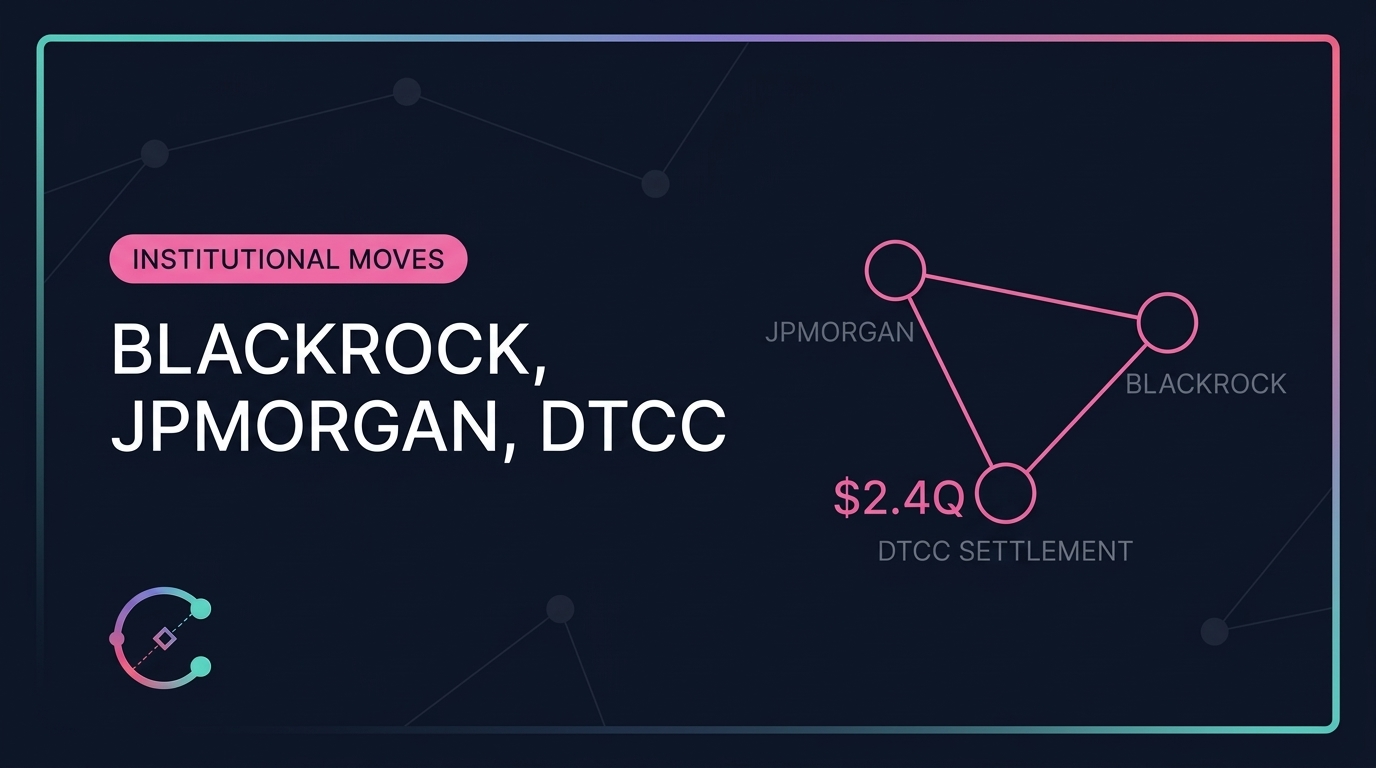
BlackRock’s tokenized fund is now accepted as collateral on Binance. JPMorgan launched two blockchain products in 30 days. And DTCC, the firm that settles $3.7 quadrillion in transactions annually, announced it’s tokenizing US Treasuries.
RWA tokenization isn’t experimentation anymore. This is infrastructure.
Table of Contents
The Numbers That Matter
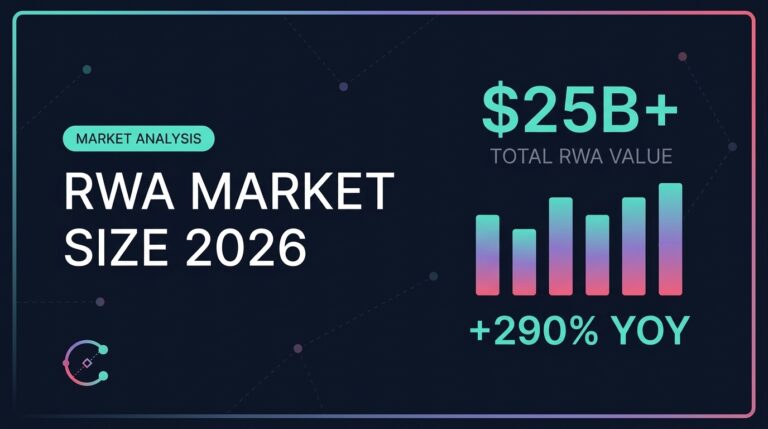
The RWA tokenization market just crossed $36 billion (excluding stablecoins). In early 2025, that number sat around $5.5 billion. That’s roughly 550% growth in a single year.
Where the money is: US Treasuries lead at $8.7B as the largest segment, followed by private credit at $14B, commodities at $4.3B (95% of which is gold), and real estate at $500M.
What changed in 2025 is the composition. Institutional products now dominate rather than DeFi experiments. Regulatory clarity arrived through the GENIUS Act and SEC no-action letters. And the biggest names in finance stopped watching and started building.
BlackRock: The $2.5B RWA Tokenization
When BlackRock launched BUIDL in March 2024, skeptics wondered if the world’s largest asset manager was serious about tokenization. The numbers answered that question.
BUIDL has surpassed $2.5B in assets under management, distributed over $100M in dividends since launch, and is now live on nine blockchains including Ethereum, Solana, Polygon, Avalanche, Arbitrum, Optimism, Aptos, and BNB Chain. It’s accepted as collateral on Binance, Deribit, and Crypto.com.
What’s remarkable is that 68% of BUIDL’s assets are now deployed outside of Ethereum. BlackRock didn’t just put a fund on-chain, they built infrastructure that works across the entire blockchain ecosystem.
The collateral use case is massive. When Binance, the world’s largest crypto exchange, accepts a BlackRock product as collateral, you’re seeing TradFi and crypto infrastructure merge in real time.
The playbook is clear: start with treasuries (simple, regulated), expand across multiple ecosystems, become the go-to collateral for everyone.
JPMorgan: The 30-Day Blitz
If BlackRock proved tokenization works, JPMorgan is proving it scales.
In December 2025, the largest GSIB (Global Systemically Important Bank) launched two major blockchain products in 30 days.
MONY Fund (December 15, 2025). JPMorgan’s first tokenized money market fund launched on Ethereum with $100 million in seed capital. The fund, called “My OnChain Net Yield” Fund, invests exclusively in US Treasuries, making it the first institutional liquidity platform to integrate both traditional and digital assets. Qualified investors can subscribe using fiat or stablecoins like USDC.
JPM Coin on Canton Network (January 7, 2026). Three weeks later, JPMorgan announced it would bring JPM Coin (ticker: JPMD), its bank-issued deposit token, to the Canton Network. JPM Coin isn’t a stablecoin issued by a crypto company. It’s a digital representation of actual US dollar deposits held at JPMorgan, enabling 24/7 near-instant settlement for institutional clients.
The signal is unmistakable: JPMorgan is building both the yield products (MONY) and the payment rails (JPM Coin) for institutional finance.
DTCC: The $3.7 Quadrillion Endorsement
If you don’t know DTCC, here’s what you need to know: they’re the backbone of US capital markets. The Depository Trust and Clearing Corporation processes $3.7 quadrillion in transactions annually and custodies approximately $99 trillion in securities. When DTCC makes a technology decision, Wall Street follows.
On December 17, 2025, DTCC announced the tokenization of US Treasury securities on the Canton Network. The timeline starts with an MVP in a controlled production environment during Q1 2026, followed by a broader industry rollout in Q2 2026, with a multi-year roadmap for additional DTC-eligible assets. The SEC also granted DTCC a no-action letter, providing a three-year pilot window with regulatory clarity.
Here’s why this matters more than anything else: if DTCC goes on-chain, everyone follows. They’re not just a participant in the financial system, they are the system’s infrastructure.
The Canton Convergence
You might have noticed a pattern: DTCC, JPMorgan, and several other major players are all building on the Canton Network.
DTCC is tokenizing US Treasuries on Canton. JPMorgan is bringing JPM Coin. Franklin Templeton’s Benji platform is there. Goldman Sachs, BNP Paribas, and Euroclear are participating. And Lloyds Bank completed a pilot deposit token transaction in January 2026.
Canton is purpose-built for regulated finance. It offers privacy (institutions need confidentiality), atomic settlement (assets and payments move together), and interoperability with existing permissioned systems. Unlike public blockchains designed for retail, Canton was architected from the ground up for institutional requirements.
The emerging institutional stack is taking shape: Canton as the settlement layer, BUIDL and MONY as yield products, JPM Coin as payment rails, and DTCC handling asset tokenization.
The Bottom Line
Two years ago, “institutional tokenization” was a conference talking point.
Today, the world’s largest asset manager has $2.5B on-chain. The largest GSIB launched a tokenized fund on Ethereum. The backbone of US capital markets is going on-chain.
The question is no longer “will institutions adopt blockchain?” It’s “how fast can the rest of the market catch up?”
Welcome to Commodara, your edge in real world assets.
If this analysis was valuable, share it with someone who needs to understand how institutional tokenization is reshaping finance. And if you’re new here, this is where we track the moves that matter in the tokenized economy.
Frequently Asked Questions
What is BlackRock’s BUIDL fund and how big is it?
BUIDL is BlackRock’s tokenized money market fund launched on Ethereum in March 2024. It has grown to over $2.5B in assets under management, distributed more than $100M in dividends, and expanded to nine blockchains. It is now accepted as collateral on major exchanges including Binance, Deribit, and Crypto.com.
What is JPMorgan’s MONY fund?
MONY (My OnChain Net Yield) is JPMorgan’s first tokenized money market fund, launched on Ethereum in December 2025 with $100M in seed capital. It invests exclusively in US Treasuries and allows qualified investors to subscribe using fiat currency or stablecoins like USDC, making it one of the first institutional products to bridge traditional and digital asset infrastructure.
Why is DTCC tokenizing US Treasuries important?
DTCC processes $3.7 quadrillion in transactions annually and custodies approximately $99 trillion in securities. Their decision to tokenize US Treasury securities on the Canton Network signals that blockchain settlement is moving from experimental to production-grade. When DTCC adopts a technology, it effectively becomes the standard for US capital markets.
What is the Canton Network and why are institutions using it?
The Canton Network is a blockchain built specifically for regulated financial institutions. It provides privacy for confidential transactions, atomic settlement where assets and payments move simultaneously, and interoperability with existing systems. DTCC, JPMorgan, Franklin Templeton, Goldman Sachs, BNP Paribas, and Euroclear are all building or participating on Canton.
How fast is the RWA tokenization market growing?
The RWA tokenization market grew from approximately $5.5 billion in early 2025 to over $36 billion by early 2026, representing roughly 550% growth in a single year. US Treasuries ($8.7B) and private credit ($14B) are the largest segments, with institutional products now dominating market composition over earlier DeFi-native experiments.
Sources
Binance Integrates BlackRock’s BUIDL as Off-Exchange Collateral
https://www.binance.com/en/support/announcement/detail/cf86a08282344844a05d15b4a8a78d0c
J.P. Morgan Asset Management Launches Its First Tokenized Money Market Fund (MONY)
Digital Asset and Kinexys by J.P. Morgan announce intention to bring USD JPM Coin (JPMD) natively to the Canton Network
DTCC Partners with Digital Asset to Tokenize U.S. Treasuries on Canton Network