
Tokenization Platforms Compared: Securitize vs Ondo vs Centrifuge vs Maple
Tokenization platforms are the infrastructure layer that determines how assets are issued, distributed, and traded on-chain, and choosing the right one is the most consequential technical decision in any tokenization project. The platform you select dictates which blockchains your tokens can operate on, what compliance frameworks are enforced, which investor types can participate, and how secondary trading is facilitated. In 2026, the tokenization platform landscape has matured from a field of early experiments into a market with clear leaders, each serving distinct asset classes and investor profiles.
This article compares the four most significant tokenization platforms in the market today: Securitize, Ondo Finance, Centrifuge, and Maple Finance. Each platform has a different focus, a different compliance model, and a different target user. For asset owners evaluating where to tokenize, industry builders assessing the competitive landscape, and institutional decision-makers selecting infrastructure partners, this comparison provides the data-driven analysis needed to make an informed choice.
Table of Contents
This comparison begins with an overview of why tokenization platforms matter and the criteria for evaluation. It then provides individual profiles of Securitize, Ondo Finance, Centrifuge, and Maple Finance. The final sections deliver a head-to-head comparison table, guidance on how to choose the right platform, and answers to frequently asked questions.
Why Tokenization Platforms Matter
The tokenization platform is not merely a technology vendor. It is the compliance engine, the issuance infrastructure, the investor gateway, and, in many cases, the secondary market for the tokenized product. A platform’s regulatory registrations determine which jurisdictions your token can be offered in. Its smart contract architecture determines how compliance rules are enforced on-chain. Its distribution network determines which investors can discover and purchase your token.
Choosing the wrong platform can result in regulatory complications, limited investor access, and technical constraints that are expensive and time-consuming to reverse. The best tokenization platforms 2026 has to offer provide end-to-end infrastructure from legal structuring through issuance, compliance, distribution, and secondary trading. Understanding the differences between them is essential before committing to any tokenization project.
Evaluation Criteria
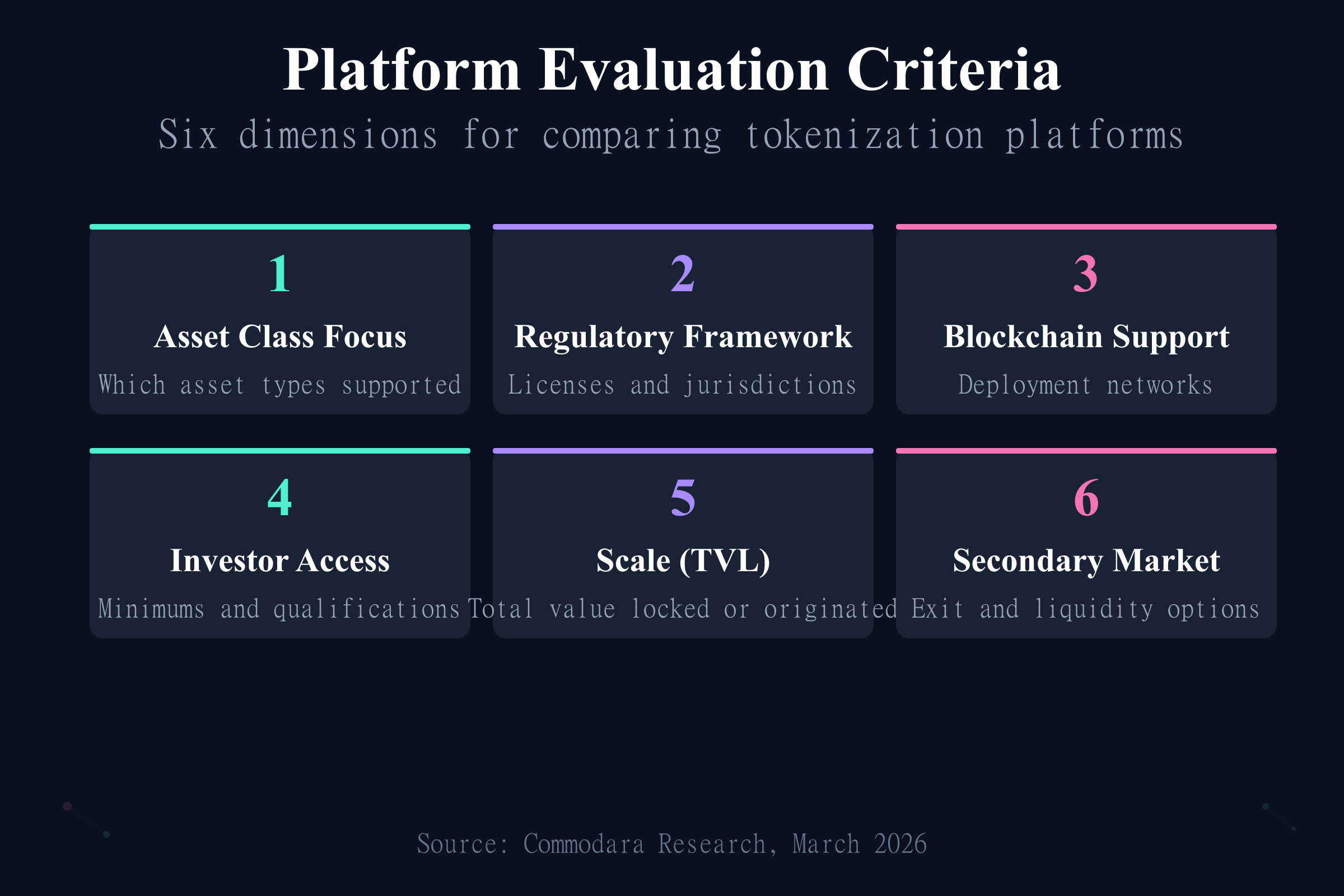
This comparison evaluates each platform across six dimensions. First, asset class focus: which types of assets does the platform specialize in? Second, regulatory framework: what licenses and registrations does the platform hold, and in which jurisdictions? Third, blockchain support: which networks can tokens be deployed on? Fourth, investor access: what are the minimum investments and investor qualification requirements? Fifth, total value locked or originated: what is the platform’s current scale? Sixth, secondary market support: how can investors exit their positions?
Securitize: The Institutional Standard
Securitize has established itself as the dominant tokenization platform for institutional-grade digital securities. It is the infrastructure behind BlackRock’s $2.5 billion BUIDL fund, and it powers tokenized offerings from KKR, Hamilton Lane, and other major asset managers. The full Securitize platform review covers its architecture in depth, but the key points for this comparison are its regulatory breadth, its institutional client base, and its end-to-end capabilities.
Securitize holds SEC registration as a transfer agent and operates a FINRA-registered alternative trading system (ATS) through Securitize Markets. This regulatory infrastructure means that tokens issued on Securitize can be legally offered to US investors under Regulation D and Regulation S, and can be traded on a regulated secondary market without requiring a separate exchange relationship. No other tokenization platform in this comparison holds equivalent US regulatory registrations.
Strengths and Limitations
Securitize’s primary strength is its regulatory positioning and institutional credibility. When BlackRock chose Securitize for BUIDL, it validated the platform as the institutional standard for tokenized fund products. The platform supports multiple blockchains including Ethereum, Polygon, Avalanche, and Aptos, giving issuers flexibility in their deployment decisions. Its end-to-end stack covers investor onboarding, KYC/AML verification, token issuance, cap table management, distribution processing, and secondary trading through its ATS.
The primary limitation of Securitize is its institutional focus. The platform is designed for asset managers, fund sponsors, and enterprise issuers. Minimum deal sizes are substantial, and the onboarding process is designed for organizations with legal counsel and compliance teams. For a retail-focused project or a smaller asset owner looking to tokenize a single property, Securitize’s infrastructure may be more than what is needed, both in capability and in cost.
Ondo Finance: Tokenized Yield at Scale
Ondo Finance has built the largest tokenized treasury product suite in the market. Its OUSG (US Government Bond Fund) and USDY (US Dollar Yield) products collectively manage over $1.4 billion in total value locked. The comprehensive Ondo Finance review details each product, but in the context of this tokenization platforms comparison, Ondo stands out for its focus on yield products, its broad blockchain distribution, and its innovative approach to investor access.
Unlike Securitize, which is primarily a platform for other issuers to build on, Ondo Finance is both the platform and the product issuer. Ondo creates its own tokenized treasury products, manages the underlying portfolios, and distributes the tokens across multiple blockchains. This vertically integrated model gives Ondo full control over the product experience but means that third-party issuers cannot use Ondo’s infrastructure to launch their own tokenized products.
Strengths and Limitations
Ondo’s primary strength is product accessibility. USDY is available to non-US investors with a minimum investment of approximately $500, making it one of the most accessible institutional-grade tokenized yield products on the market. USDY operates on seven or more blockchain networks, providing investors with flexibility in how they hold and use the token. Ondo has also integrated with multiple DeFi protocols, allowing USDY to be used as collateral for lending and borrowing on platforms like Aave and Morpho.
The limitation is Ondo’s narrow asset class focus. The platform currently offers only tokenized treasury and yield products. Asset owners looking to tokenize real estate, private credit, or commodities cannot use Ondo’s infrastructure. Additionally, OUSG requires accredited investor status and a higher minimum than USDY, creating a two-tier access model that can be confusing for investors navigating the product suite for the first time.
Centrifuge: Real-World Asset Origination
Centrifuge is a decentralized tokenization platform focused on bringing real-world credit assets on-chain. Unlike Securitize and Ondo, which operate with centralized governance and institutional compliance structures, Centrifuge uses a decentralized protocol model where asset originators can create their own pools and issue tokens backed by real-world collateral. The platform has facilitated over $600 million in total financed value across trade finance, real estate debt, and structured credit.
Centrifuge’s architecture is built around the concept of asset pools. An originator creates a pool on the Centrifuge protocol, deposits real-world assets as collateral, and issues tokens that represent claims on the pool’s cash flows. The protocol uses a tranching structure with senior and junior tranches, allowing investors to choose their risk-return profile. MakerDAO, the protocol behind the DAI stablecoin, has been one of Centrifuge’s largest liquidity providers, allocating hundreds of millions in DAI to Centrifuge pools.
Strengths and Limitations
Centrifuge’s primary strength is its open protocol model. Any originator can create a pool and issue tokens without requiring Centrifuge’s direct involvement in the issuance process. This permissionless approach enables a wider variety of asset types and originators than the institutional gatekeeping model used by Securitize. The tranching structure provides sophisticated risk allocation that appeals to institutional DeFi participants.
The limitations are significant for traditional institutional users. Centrifuge’s decentralized model means that compliance is handled at the pool level by each individual originator, not by the platform itself. The quality of underwriting, the strength of legal structures, and the reliability of servicing vary from pool to pool. Several Centrifuge pools have experienced defaults, highlighting the credit risk inherent in the platform’s open model. For institutional investors accustomed to platform-level compliance guarantees, Centrifuge requires substantially more due diligence per investment.
Maple Finance: Institutional Private Credit
Maple Finance has carved out a distinctive position among tokenization platforms by focusing specifically on institutional private credit. The platform connects qualified institutional borrowers with on-chain lenders through structured lending pools. The Maple Finance platform review covers its product suite in detail. In this comparison, Maple stands out for its credit underwriting capabilities, its yield profile, and its institutional borrower network.
Maple’s flagship products, SyrupUSDC and SyrupUSDT, offer yields in the range of 8% to 15% by lending to institutional borrowers including market makers, trading firms, and fintech companies. Unlike Centrifuge’s open origination model, Maple conducts its own credit assessments and manages borrower relationships through a centralized underwriting team. This approach gives Maple more control over credit quality but limits the diversity of assets available on the platform.
Strengths and Limitations
Maple’s primary strength is its yield profile and credit quality management. The centralized underwriting model means that Maple’s team evaluates every borrower before they receive capital, applying institutional credit assessment standards to on-chain lending. This approach has resulted in lower default rates compared to fully decentralized lending protocols. The yields offered by Maple’s products significantly exceed what tokenized treasuries provide, making the platform attractive to investors with higher risk tolerance seeking above-market returns.
The limitations include concentration risk and the platform’s narrow asset class. Maple’s lending is primarily directed toward crypto-native institutional borrowers, which creates correlation with the broader crypto market. During the 2022 market downturn, Maple experienced significant defaults from borrowers including Orthogonal Trading and Auros Global. While the platform has since reformed its underwriting processes and reduced exposure to these borrower types, the episode demonstrates the credit risk inherent in on-chain private lending. Investors should evaluate Maple’s current borrower composition and underwriting standards before allocating capital.
Tokenization Platforms Head-to-Head Comparison
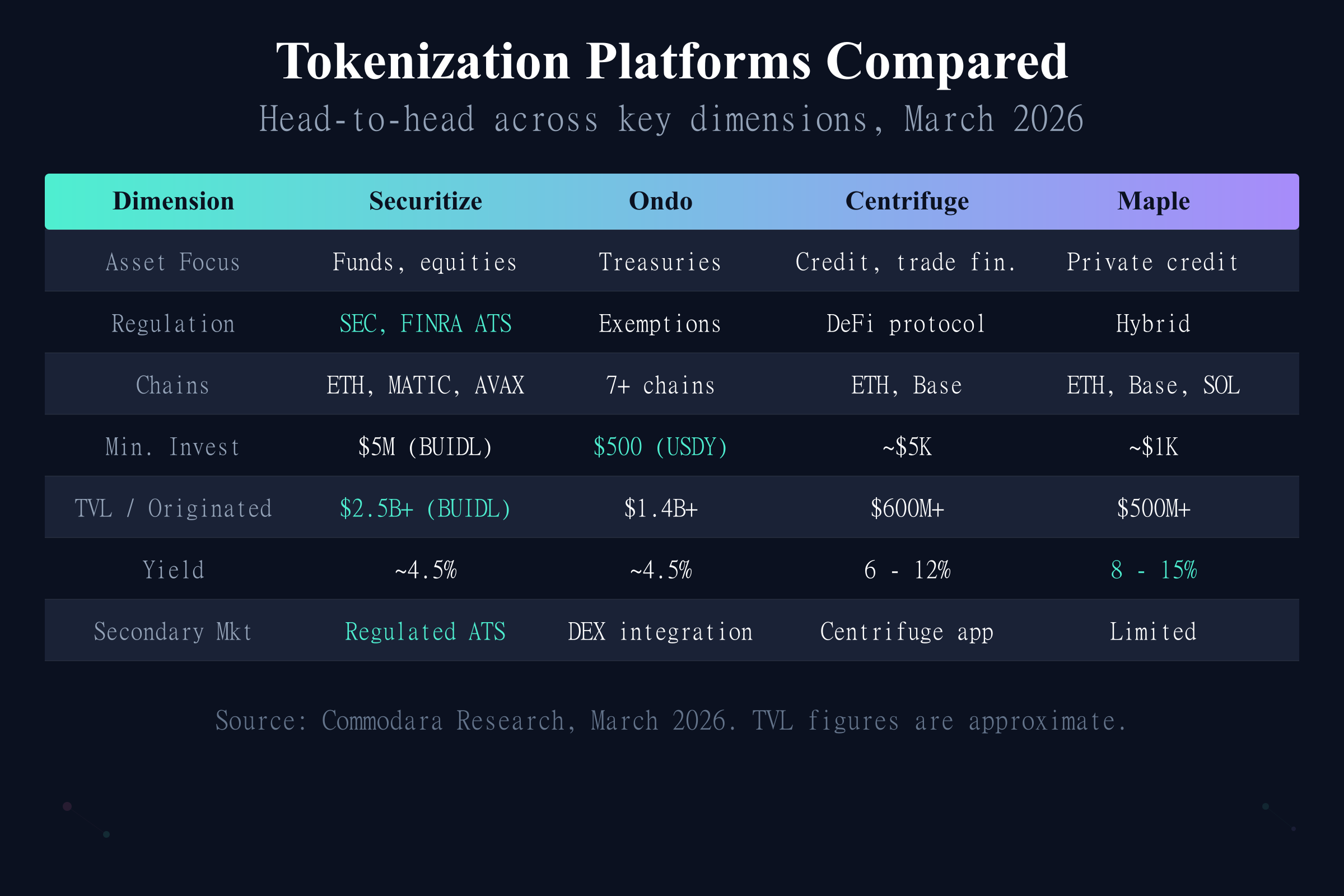
Comparing these four tokenization platforms side by side reveals that each serves a fundamentally different use case. There is no single best platform; the right choice depends entirely on the user’s role, asset class, regulatory requirements, and investment objectives.
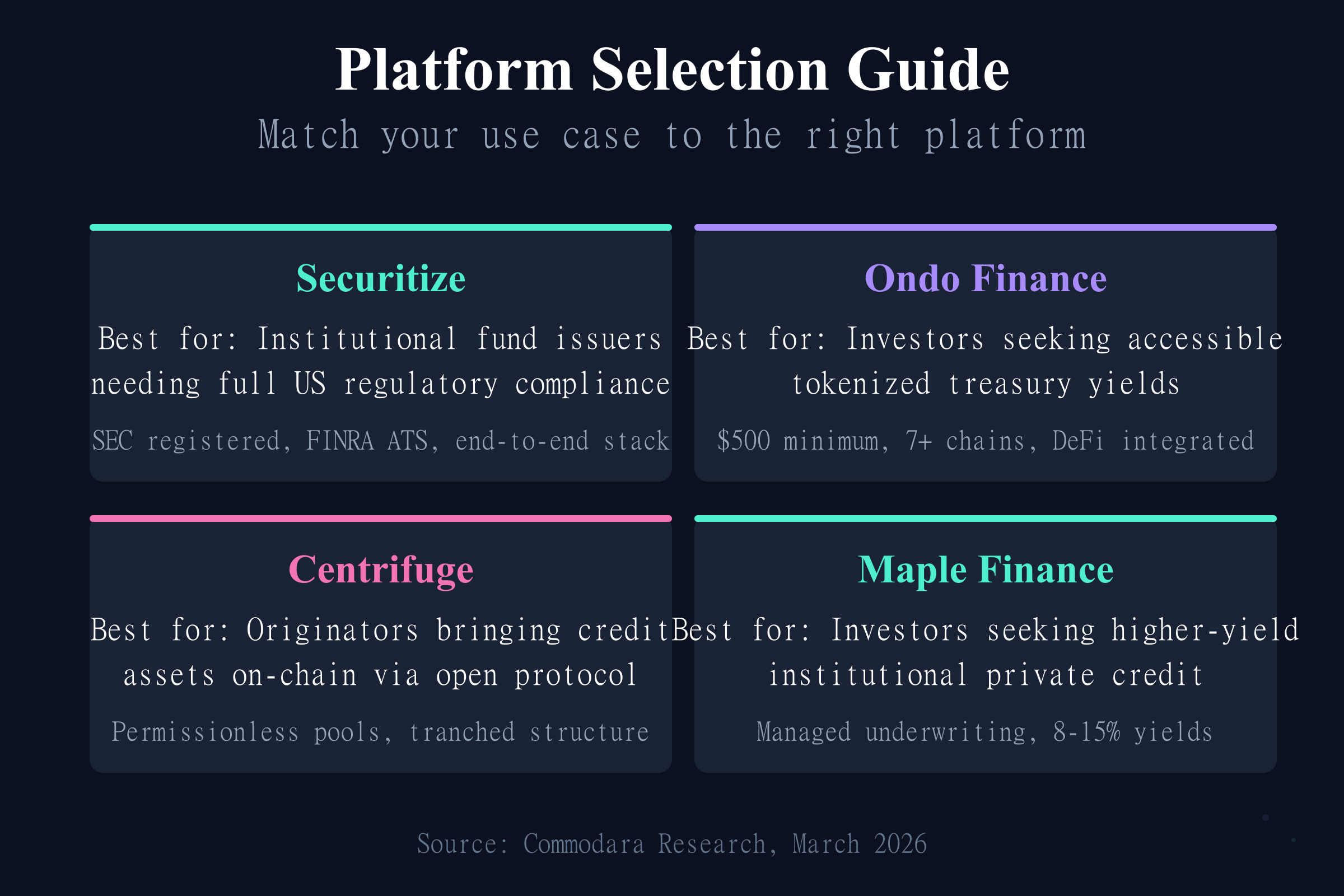
Securitize is the clear choice for institutional asset managers looking to tokenize funds and structured products with full US regulatory compliance. Ondo Finance is the leader for investors seeking accessible tokenized yield products backed by US government debt. Centrifuge serves originators who want to bring diverse credit assets on-chain through a decentralized, permissionless protocol. Maple Finance is positioned for investors seeking institutional-grade private credit yields through a managed lending platform.
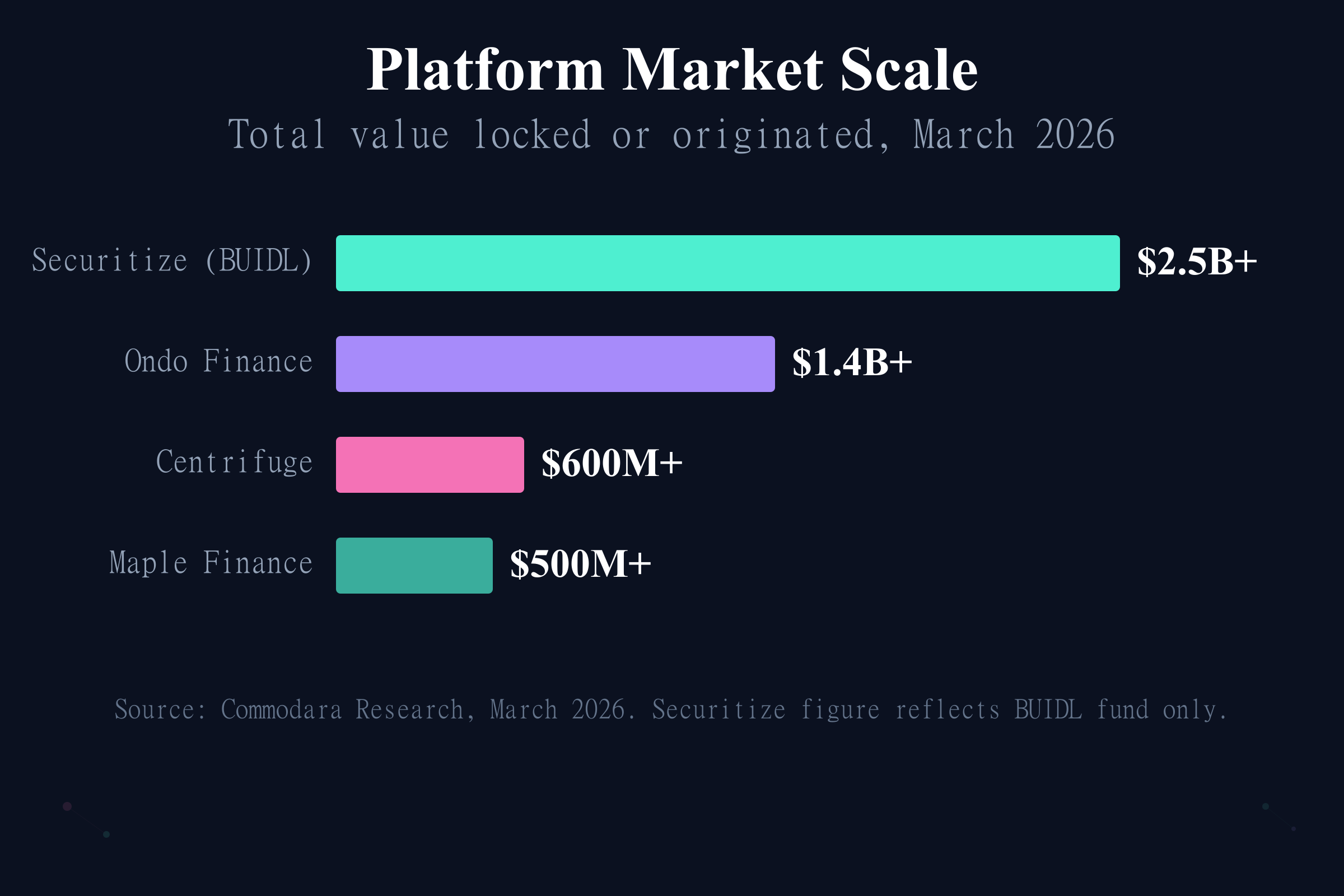
The competitive dynamics between these tokenization platforms are evolving rapidly. Securitize is expanding its product range and chain support. Ondo is exploring asset classes beyond treasuries. Centrifuge is improving its institutional compliance capabilities. Maple is diversifying its borrower base. The tokenization infrastructure comparison that holds true today may shift significantly over the next twelve months as each platform expands its capabilities and addressable market.
How to Choose the Right Tokenization Platform
The selection process for tokenization platforms should begin with a clear assessment of your specific requirements across four dimensions.
For Asset Owners and Issuers
If you are an asset owner looking to tokenize a specific asset, your primary consideration is which platform supports your asset class with the regulatory framework required for your target investor base. Real estate and fund tokenization with US investor access points strongly toward Securitize. Credit assets originated by smaller firms may find Centrifuge’s open protocol model more accessible. Private credit originators with institutional borrowers should evaluate Maple’s lending infrastructure.
The Commodara Tokenization Readiness Tool can help you assess your specific situation, including asset type, target jurisdiction, investor base, and timeline, and identify which platform aligns best with your requirements. For organizations with complex tokenization needs that span multiple asset classes or jurisdictions, a paid consultation with Commodara’s advisory team provides tailored platform selection guidance.
For Investors
If you are an investor looking to access tokenized products, your choice of platform is largely determined by the asset class and yield profile you are seeking. Tokenized treasuries with low minimums and broad chain access point toward Ondo Finance. Higher-yield private credit with institutional underwriting points toward Maple Finance. Diversified real-world credit exposure with tranche selection points toward Centrifuge. Direct investment in tokenized institutional funds with regulated secondary trading points toward Securitize.
Diversification across multiple tokenization platforms is a prudent strategy. Each platform carries its own operational risk, smart contract risk, and regulatory risk. Spreading investments across Ondo for treasuries, Maple for credit yield, and a Securitize-issued fund for institutional exposure reduces the impact of any single platform failure on your overall portfolio.
Platform Risk Assessment
Beyond features and asset class support, evaluating tokenization platforms requires assessing operational and regulatory risk. Key questions include: Is the platform’s smart contract infrastructure independently audited? What regulatory licenses does the platform hold, and are they sufficient for your jurisdiction? What happens to your tokens if the platform ceases operations? Does the platform have a track record of reliable distributions and transparent reporting?
No tokenization platform is risk-free. Even the most established platforms carry smart contract risk, regulatory risk, and operational risk. The goal is not to eliminate risk but to understand it clearly and ensure that the platform’s risk profile aligns with your tolerance and investment objectives.
Frequently Asked Questions
What are the best tokenization platforms in 2026?
The best tokenization platforms 2026 depend on your use case. Securitize leads for institutional fund tokenization with full US regulatory compliance. Ondo Finance leads for accessible tokenized treasury products. Centrifuge leads for decentralized credit asset origination. Maple Finance leads for institutional private credit yields.
How do Securitize and Ondo Finance compare?
Securitize vs Ondo reflects a platform-versus-product distinction. Securitize is infrastructure that other issuers build on, while Ondo creates and manages its own tokenized treasury products. Securitize offers broader asset class support and a regulated secondary market. Ondo offers lower minimums and wider blockchain distribution for its yield products.
Which tokenization platform has the lowest minimum investment?
Ondo Finance’s USDY has the lowest minimum among institutional-grade tokenization platforms at approximately $500 for non-US investors. Franklin Templeton’s BENJI, issued through its own infrastructure, offers an even lower minimum of approximately $20. Securitize-issued products like BUIDL require $5 million minimum through accredited investor access.
Are tokenization platforms regulated?
Regulatory status varies significantly between tokenization platforms. Securitize holds SEC transfer agent registration and operates a FINRA-registered ATS. Ondo Finance operates under regulatory exemptions for its specific products. Centrifuge and Maple Finance operate primarily as DeFi protocols with varying levels of regulatory compliance depending on jurisdiction.
Can I use multiple tokenization platforms at the same time?
Yes, and diversifying across multiple tokenization platforms is a recommended strategy. Each platform carries its own risks and offers different asset classes. An investor might use Ondo for treasury yield, Maple for private credit, and Securitize for institutional fund access, spreading both platform risk and asset class exposure.
The Bottom Line
Tokenization platforms are the infrastructure backbone of the tokenized asset market, and the differences between them are significant. Securitize, Ondo Finance, Centrifuge, and Maple Finance each solve different problems for different users. There is no universal best choice; the right platform depends on whether you are an asset owner seeking to tokenize, an investor seeking yield, or an institution evaluating infrastructure partners.
The tokenization infrastructure comparison in this article reflects the market as it stands in March 2026. The competitive landscape is evolving rapidly as platforms expand their capabilities, enter new jurisdictions, and pursue new asset classes. Staying informed about these developments is essential for anyone building on or investing through tokenization platforms.
For asset owners evaluating their tokenization options, the Commodara Tokenization Readiness Tool provides a structured assessment that identifies which platform best fits your specific requirements. Subscribe to the Commodara newsletter for ongoing coverage of the platforms, protocols, and infrastructure shaping the tokenized economy.