
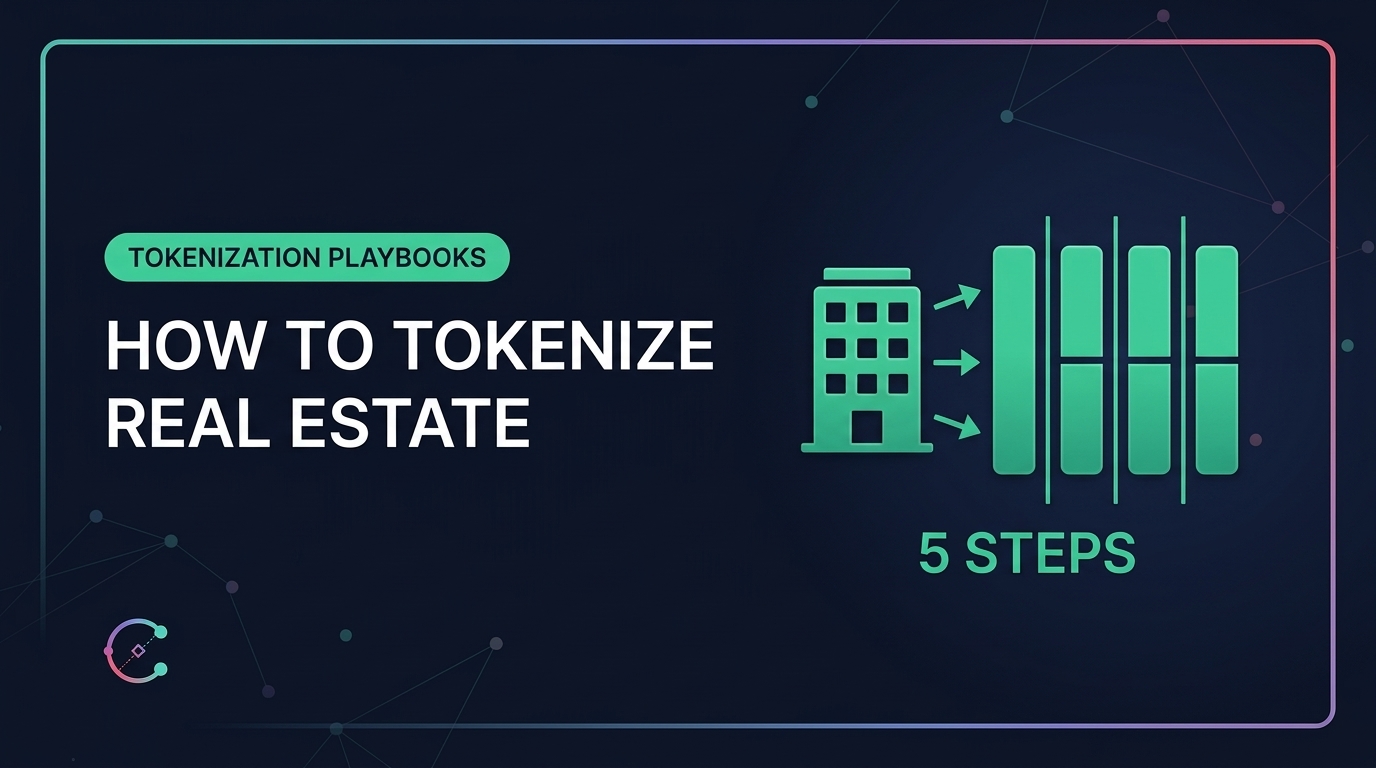
How to Tokenize Real Estate: A Step-by-Step Framework for 2026
To tokenize real estate in 2026, you need a clear legal structure, a compliant issuance platform, and a distribution strategy, and most projects that fail skip at least one of these. The concept is straightforward: divide ownership of a property or portfolio into digital tokens on a blockchain, enabling fractional investment, faster settlement, and programmable distribution of rental income. The execution, however, involves legal, technical, and commercial decisions that determine whether a project attracts capital or stalls before launch.
This playbook provides a complete framework for asset owners, real estate developers, and fund managers who are evaluating whether and how to tokenize real estate assets. It covers every stage from initial assessment through legal structuring, platform selection, token issuance, investor distribution, and ongoing management. By the end, you will have a practical roadmap for bringing a real estate asset on-chain in a way that is legally compliant, operationally sound, and commercially viable.
Table of Contents
This guide begins with an assessment of why tokenizing real estate makes sense and when it does not. It then walks through the legal structuring process, platform selection, token design and issuance, investor distribution strategy, and ongoing management requirements. The final sections cover costs and timelines and a readiness checklist for evaluating your own project.
Why Tokenize Real Estate? The Case for On-Chain Property
The global real estate market represents over $300 trillion in asset value, yet the vast majority of this value is locked in illiquid, high-minimum investment structures that exclude most of the world’s investors. When you tokenize real estate, you convert property ownership into digital tokens that can be divided into small fractions, traded on secondary markets, and settled in minutes rather than months. This structural transformation addresses three fundamental limitations of traditional real estate investment.
First, tokenization enables fractional ownership at scales that were previously impossible. A $10 million commercial property can be divided into 100,000 tokens at $100 each, allowing retail investors to access an asset class that traditionally required six-figure minimums. Platforms like RealT and Lofty have already demonstrated this model with thousands of investors holding fractional positions in rental properties across the United States. The Dubai real estate tokenization market has also attracted significant institutional attention, demonstrating global demand for tokenized property investment.
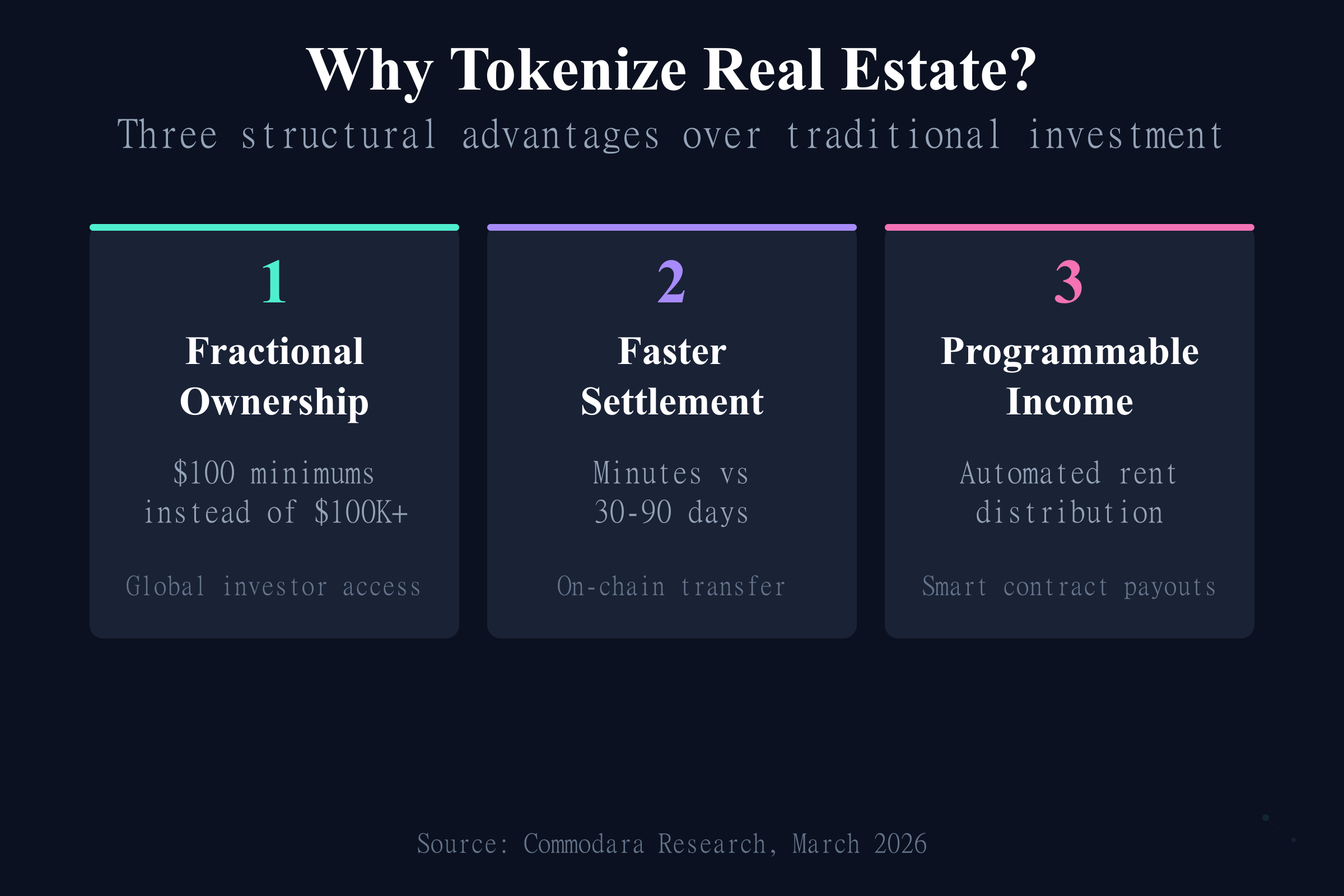
Second, tokenization improves liquidity. Traditional real estate transactions take 30 to 90 days to close and involve substantial transaction costs. Tokenized real estate can be traded on secondary markets in minutes, although actual secondary market liquidity for most tokenized properties remains limited in 2026. The liquidity improvement is structural, even if the current market has not yet achieved the trading volumes that would make tokenized real estate as liquid as public REITs.
Third, tokenization enables programmable income distribution. Rental income, interest payments, and capital gains can be distributed automatically through smart contracts on a predetermined schedule, eliminating the manual processing and delays that characterize traditional property fund administration. This automation reduces operational costs and provides investors with more predictable, transparent cash flow delivery.
When Tokenization Does Not Make Sense
Not every real estate asset should be tokenized. Small properties with values under $1 million may not generate enough investor interest to justify the legal and technical costs of tokenization, which can range from $50,000 to $200,000 for a compliant issuance. Properties with complex ownership structures, unresolved liens, or unclear title history are poor candidates because the legal clean-up required before tokenization can exceed the benefits. Assets in jurisdictions without clear regulatory frameworks for digital securities add compliance uncertainty that can deter institutional investors.
The decision to tokenize real estate should be driven by a clear commercial rationale: either you need access to a broader investor base than traditional fundraising provides, you want to offer liquidity to investors who would otherwise be locked into illiquid positions, or you want to reduce the operational overhead of fund administration through smart contract automation. If none of these apply, traditional real estate investment structures may be more appropriate.
Step 1: Legal Structuring for Tokenized Real Estate
The legal structure is the foundation of every tokenized real estate project. Getting this wrong can result in regulatory enforcement, investor lawsuits, or an inability to distribute the tokens legally. The structure must accomplish three things: it must hold the property in a legally recognized entity, it must define the rights that token holders receive, and it must comply with securities regulations in every jurisdiction where tokens will be sold.
The SPV Model
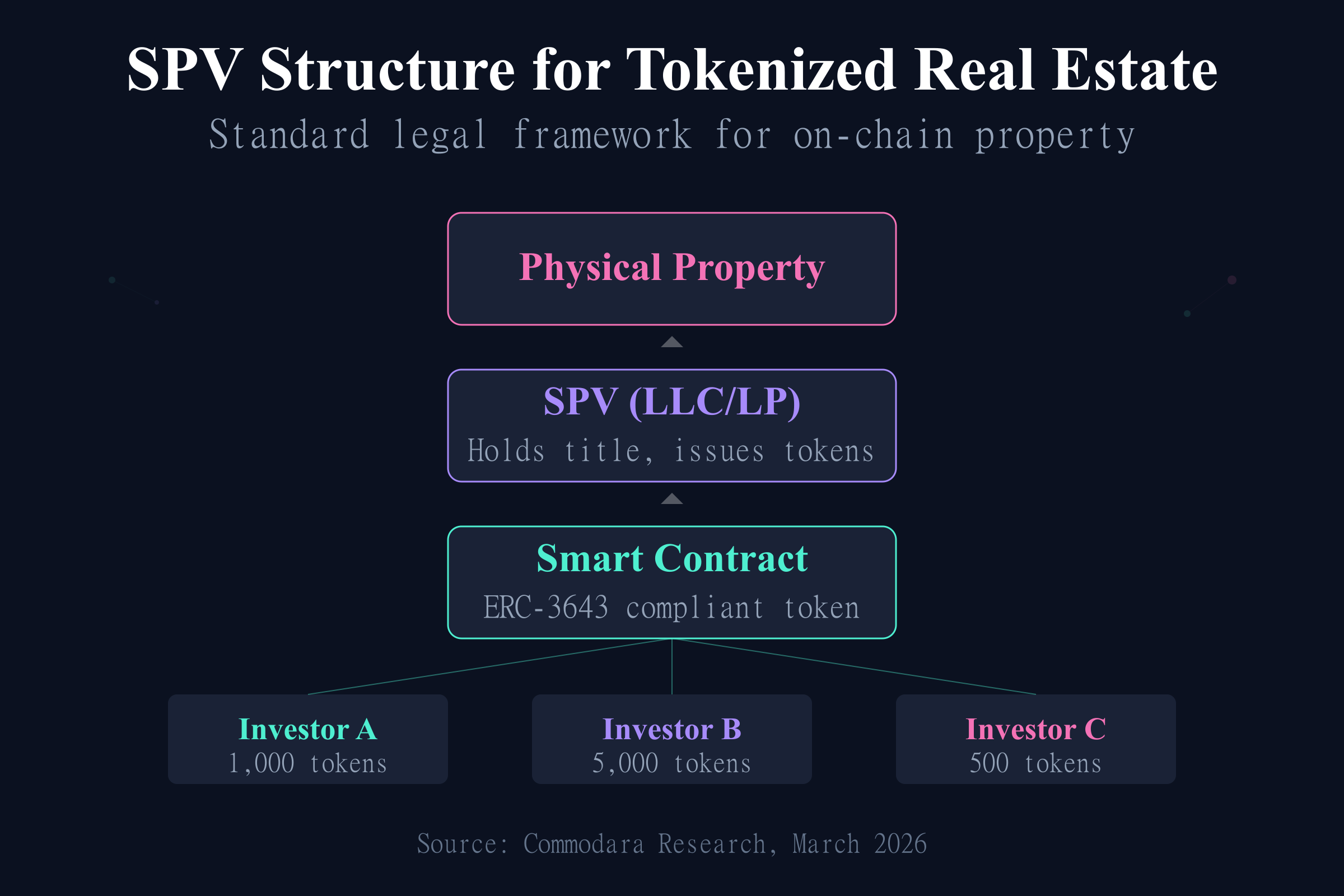
The standard approach to tokenize real estate is to place the property in a special purpose vehicle, typically a limited liability company or a limited partnership. The SPV holds title to the property and issues tokens that represent shares or membership interests in the vehicle. This structure isolates the property from the asset owner’s other obligations and provides a clean legal framework for defining investor rights.
The SPV is typically organized in a jurisdiction that provides favorable treatment for digital securities. Delaware LLCs are the most common choice for US-based properties due to their flexible operating agreement provisions and established case law. For international properties, Cayman Islands exempted companies, British Virgin Islands business companies, and Singapore variable capital companies are popular choices depending on the target investor base and regulatory requirements.
Securities Law Compliance
In virtually every jurisdiction, tokens that represent ownership in real estate are classified as securities. In the United States, this means the issuance must comply with SEC registration requirements or qualify for an exemption. The most commonly used exemptions for tokenized real estate are Regulation D (for accredited investors), Regulation S (for non-US investors), and Regulation A+ (for offerings up to $75 million that are open to non-accredited investors).
Regulation D, Rule 506(c) is the most frequently used exemption because it allows issuers to broadly market the offering while limiting sales to accredited investors. This approach aligns well with the digital distribution model that tokenization enables. Regulation A+ is more expensive to set up, requiring SEC qualification, but it opens the offering to retail investors, which can significantly expand the potential investor base for a tokenized property investment project.
International compliance adds additional layers. If you plan to sell tokens to European investors, MiCA and national securities regulations apply. Asian jurisdictions each have their own frameworks. The legal cost of multi-jurisdictional compliance is one of the primary reasons that most tokenized real estate projects start with a single-jurisdiction offering and expand geographically over time.
Step 2: Choosing a Tokenization Platform
The platform you select to tokenize real estate determines the technical capabilities, compliance infrastructure, and investor experience of your project. Platform selection is one of the most consequential decisions in the tokenization process, and it should be evaluated across several dimensions.
Platform Categories
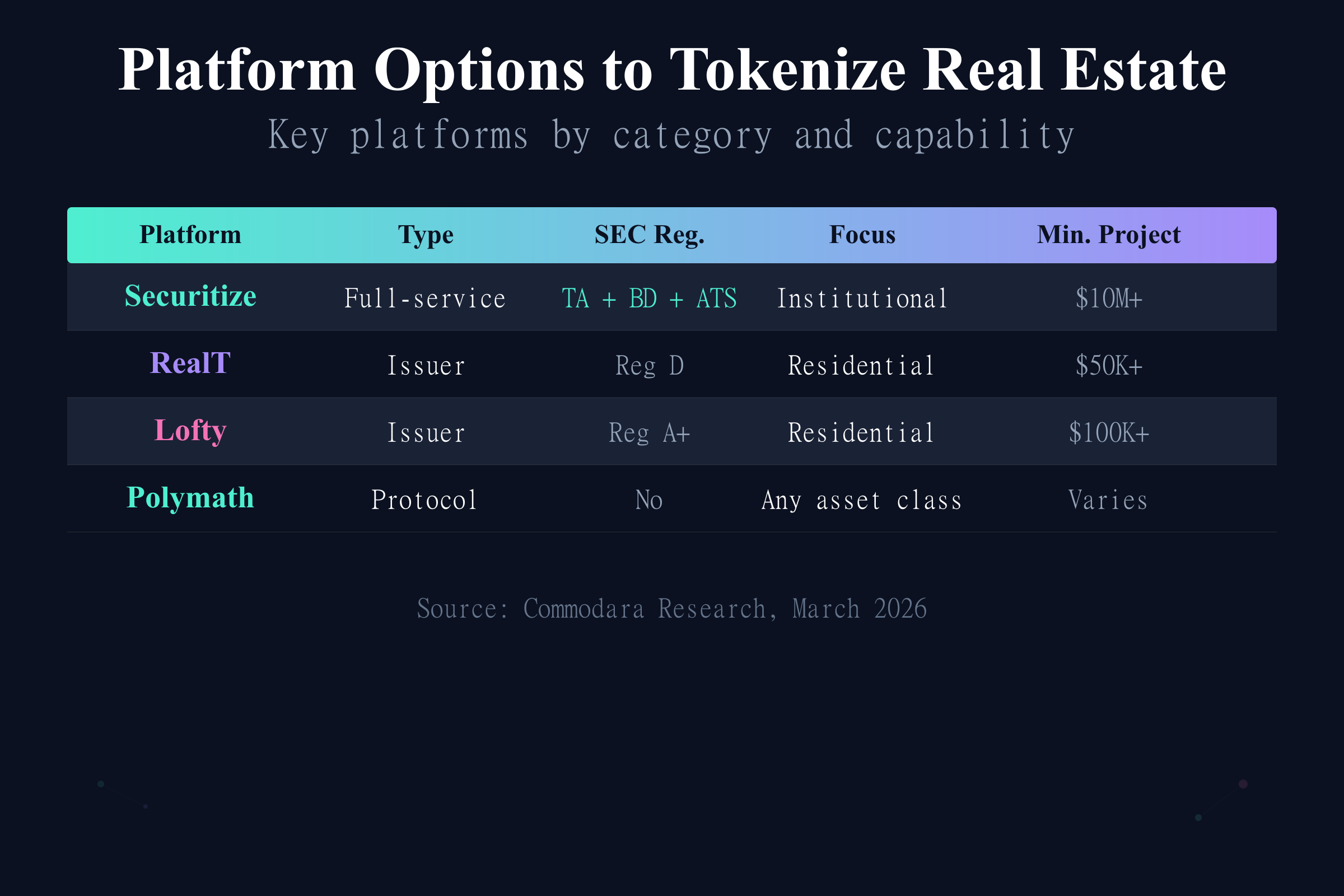
Three categories of platforms serve the real estate tokenization market. Full-service platforms like Securitize and Polymath handle everything from legal structuring through token issuance, investor management, and secondary market trading. These platforms charge higher fees but provide a turnkey solution that reduces the number of vendors an issuer must coordinate. Issuance-focused platforms handle token creation and smart contract deployment but leave investor management and secondary trading to other providers. White-label solutions provide the technology for issuers who want to build their own branded tokenization platform.
For most asset owners looking to tokenize real estate for the first time, a full-service platform is the appropriate choice. The coordination required to manage separate vendors for legal structuring, token issuance, KYC/AML, and secondary market access adds complexity and cost that a single-platform solution eliminates. As you gain experience and scale your tokenization activities, building a more modular vendor stack may become advantageous.
Key Selection Criteria
When evaluating platforms, prioritize regulatory licensing, blockchain support, investor management capabilities, secondary market access, and cost structure. A platform’s regulatory registrations determine what it can legally do. Blockchain support determines where your tokens will live and what DeFi integrations are available. Investor management capabilities determine how efficiently you can onboard investors and process distributions. Secondary market access determines whether your investors will have liquidity options after purchase.
Cost is an important factor but should not be the primary driver. A platform that charges lower fees but lacks proper regulatory licensing or investor management infrastructure will create problems that far exceed the savings. The Commodara Tokenization Readiness Tool can help you evaluate which platform category and specific providers align with your project’s requirements and scale.
Step 3: Token Design and Issuance
Token design determines what rights token holders receive, how the token interacts with compliance requirements, and how income distribution and governance work. These decisions must be made in coordination with legal counsel because the token design directly affects the securities classification and the regulatory requirements that apply.
Token Economics
The fundamental token design question is how many tokens to create and at what price per token. A $10 million property could be represented by 10,000 tokens at $1,000 each (targeting institutional investors) or 1,000,000 tokens at $10 each (targeting retail investors). The token price affects the minimum investment size, the potential size of the investor base, and the administrative complexity of managing a large number of small holders.
Most successful projects to tokenize real estate set token prices between $50 and $500 for retail-facing offerings and between $1,000 and $10,000 for institutional offerings. The total number of tokens should be large enough to provide meaningful fractionalization but small enough to maintain administrative manageability. Platform capabilities also factor in: some platforms handle thousands of token holders efficiently, while others are better suited for smaller investor counts.
Smart Contract Design
The smart contract is the technical implementation of the token’s rules. For real estate tokenization in 2026, the smart contract must implement several critical functions. Transfer restrictions ensure that tokens can only be held by investors who have completed KYC/AML verification and meet the applicable investor qualification requirements. Distribution logic automates the payment of rental income to token holders on a predetermined schedule. Compliance hooks allow the issuer to freeze transfers, force transfers (for legal compliance), or pause the token in response to regulatory requirements.
The ERC-3643 standard (formerly known as T-REX) has emerged as the most widely adopted token standard for tokenized securities, including tokenized property investment products. This standard provides built-in compliance functionality that is specifically designed for regulated securities, including identity-linked transfer restrictions and modular compliance rules. Most full-service tokenization platforms support ERC-3643 or a proprietary equivalent.
Step 4: Investor Distribution Strategy
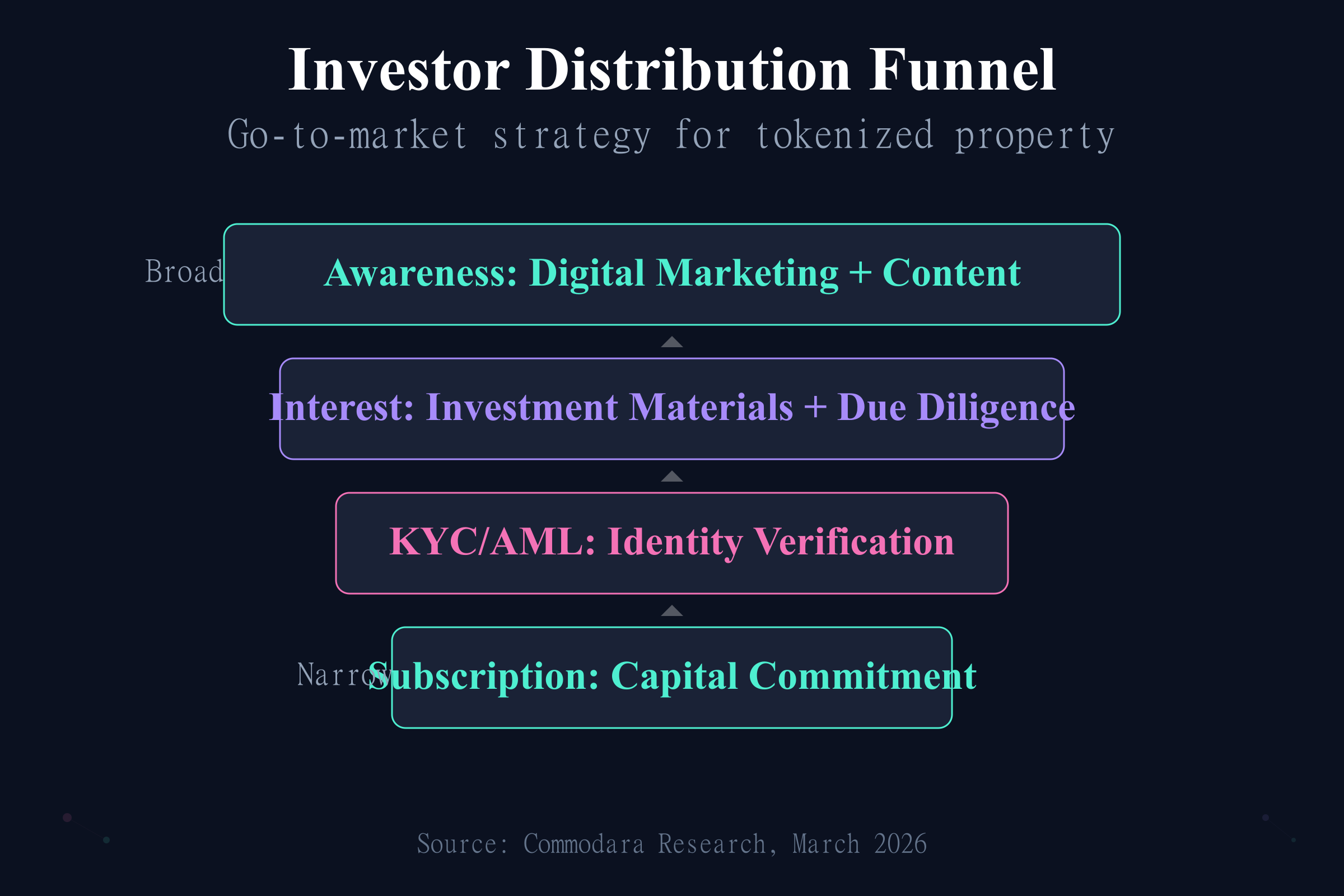
Creating tokens is only half the challenge. Distributing them to investors requires a go-to-market strategy that reaches the right audience, communicates the investment thesis, and converts interest into capital commitments. The distribution strategy for tokenized real estate differs from traditional real estate fundraising in important ways.
Digital-First Distribution
Tokenized real estate offerings can leverage digital marketing channels that traditional private placements cannot. Because Regulation D Rule 506(c) allows general solicitation for accredited investor offerings, issuers can use social media, content marketing, email campaigns, and online advertising to reach potential investors. This is a significant advantage over traditional 506(b) offerings, which prohibit general solicitation and rely on pre-existing relationships.
The digital distribution model also enables global reach for Regulation S offerings targeting non-US investors. A tokenized property in Miami can attract investors from Singapore, Dubai, London, and Sao Paulo through a single online platform. This global investor base is one of the primary commercial advantages of tokenization and a key reason why developers choose to tokenize real estate rather than raise capital through traditional channels.
Institutional vs Retail Distribution
The distribution strategy depends heavily on whether the offering targets institutional investors, retail investors, or both. Institutional distribution requires direct outreach to family offices, fund managers, and wealth advisors who can evaluate the investment on behalf of their clients. Retail distribution requires a compelling online presence, clear investment materials, and a frictionless onboarding process that converts website visitors into funded investors.
Many successful real estate tokenization 2026 projects use a hybrid approach: they raise an initial anchor allocation from institutional investors to establish credibility, then open the offering to retail investors through digital channels. The institutional participation provides a signal of quality that accelerates retail adoption and helps overcome the trust deficit that new tokenized offerings face in the market.
Step 5: Ongoing Management and Income Distribution
After issuance, the work continues. Tokenized real estate requires ongoing management of both the physical property and the digital token infrastructure. The property must be maintained, tenants must be managed, and rental income must be collected and distributed. The token infrastructure must be maintained, investor records must be kept current, and regulatory reporting must be completed on schedule.
Automated Distribution via Smart Contracts
One of the primary operational advantages of tokenized real estate is automated income distribution. Smart contracts can be programmed to distribute rental income to all token holders proportionally on a monthly, quarterly, or custom schedule. The distribution is triggered automatically, with stablecoin payments flowing directly to each holder’s wallet without manual processing. This automation reduces administrative costs and eliminates the payment delays that are common in traditional property fund structures.
The distribution process typically works as follows: the property manager collects rental income and converts it to USDC or another stablecoin. The stablecoins are deposited into the distribution smart contract. The contract calculates each holder’s proportional share based on their token balance and distributes payments simultaneously to all holders. The entire process can be completed in minutes, compared to the days or weeks required for traditional wire-based distributions.
Reporting and Compliance
Ongoing regulatory compliance requirements vary by jurisdiction and offering type. In the US, Regulation D offerings require Form D filings and annual updates. Regulation A+ offerings require ongoing SEC reporting including semi-annual and annual financial statements. All offerings require maintaining accurate investor records, processing transfer requests in compliance with securities law, and providing tax documentation (K-1s or 1099s depending on the entity structure) to investors annually.
The tokenization platform handles most of these compliance functions, but the issuer retains ultimate responsibility for regulatory compliance. Asset owners who tokenize real estate should budget for ongoing legal and compliance costs of $20,000 to $50,000 annually, depending on the complexity of the offering and the number of jurisdictions involved.
Costs and Timeline for Real Estate Tokenization
Understanding the full cost structure is essential for evaluating whether tokenization makes commercial sense for a specific property or portfolio. The costs fall into three categories: initial setup, ongoing operations, and platform fees.
Initial setup costs for a compliant tokenized real estate offering typically range from $75,000 to $250,000. Legal structuring and securities compliance represent the largest component at $30,000 to $100,000, depending on the complexity of the structure and the number of jurisdictions. Platform setup fees range from $10,000 to $50,000. Smart contract development and auditing costs $15,000 to $40,000. Marketing and investor materials add $10,000 to $30,000. These costs make tokenization impractical for properties valued under approximately $2 million, where the setup costs represent too large a percentage of the asset value.
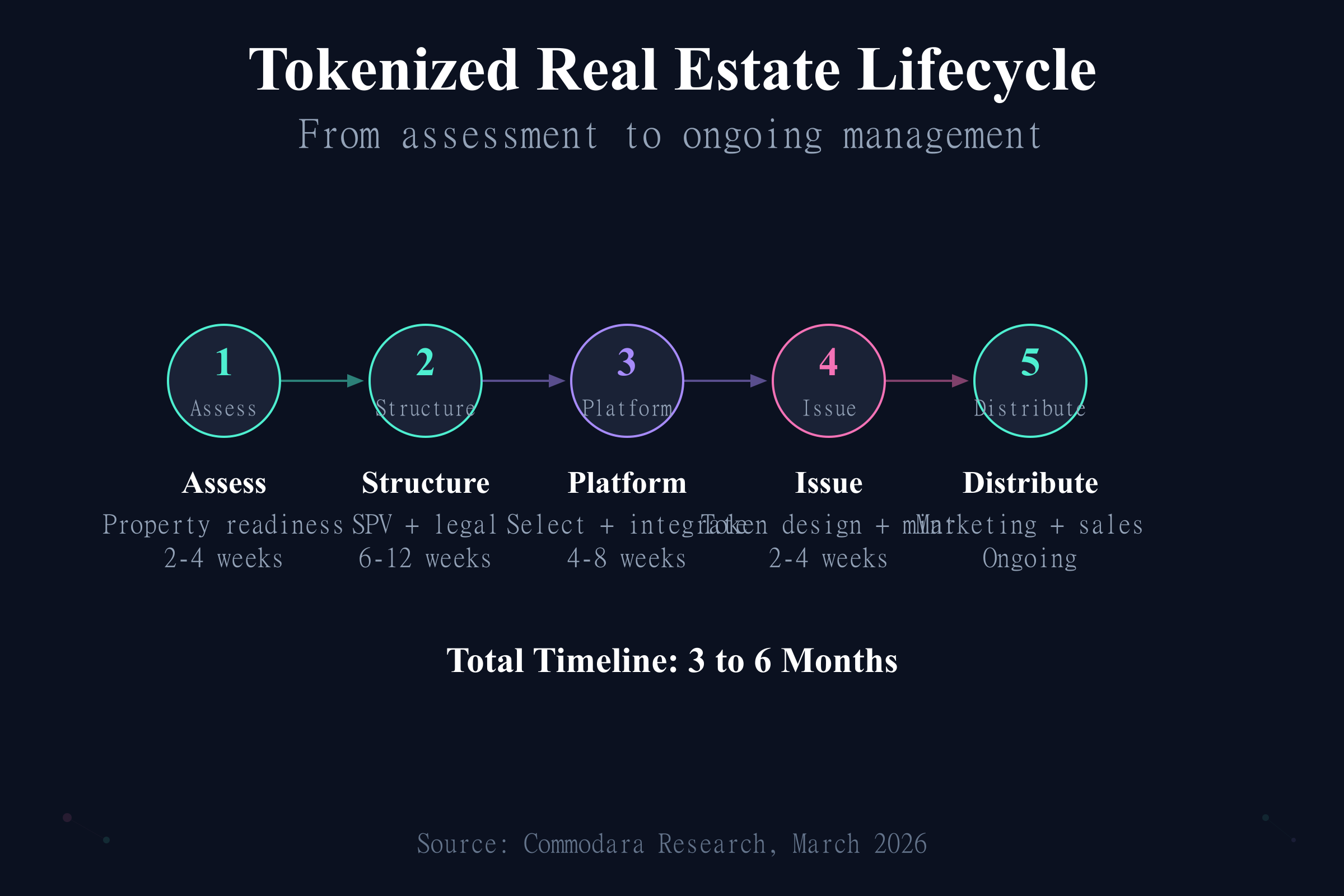
The timeline from initial assessment to token issuance typically runs 3 to 6 months. Legal structuring takes 6 to 12 weeks. Platform integration and smart contract development take 4 to 8 weeks. Regulatory filing and approval (if applicable) takes 2 to 4 weeks for Regulation D or 3 to 6 months for Regulation A+. Marketing and investor onboarding run concurrently with the later stages of the technical setup.
Ongoing costs include platform fees (typically 0.25% to 1.0% of assets under management annually), property management fees (standard real estate rates), legal and compliance costs ($20,000 to $50,000 annually), and smart contract maintenance. These ongoing costs should be factored into the project’s financial model alongside the traditional costs of property ownership and management.
Readiness Checklist: Is Your Property Ready to Tokenize?
Before committing capital to a tokenization project, evaluate your readiness across these critical dimensions. Each factor affects the feasibility, cost, and timeline of your project.
Property readiness is the first consideration. The asset should have clear title with no unresolved liens or encumbrances. Financial performance history of at least 12 months strengthens the investment case. The property should generate stable, documentable income that can be distributed to token holders. Properties with complex ownership structures or ongoing litigation are poor candidates for tokenization until those issues are resolved.
Legal readiness requires access to securities counsel experienced in digital asset offerings. The issuer must be prepared to establish an SPV, draft offering documents, and file required regulatory paperwork. If the offering will target multiple jurisdictions, multi-jurisdictional legal counsel is necessary.
Commercial readiness means having a clear investor thesis and a realistic distribution strategy. The property must offer returns that are competitive with alternative investments available to your target investor base. The issuer must be prepared to invest in marketing and investor relations to support the offering. For a comprehensive assessment of your readiness across all dimensions, use the Commodara Tokenization Readiness Tool to identify strengths and gaps before you commit to a tokenization project. For personalized guidance, consider booking a strategy consultation with the Commodara team.
For broader context on how real estate fits within the overall tokenized asset market, see our comprehensive guide to tokenized real world assets.
Frequently Asked Questions
How much does it cost to tokenize real estate?
Initial setup costs range from $75,000 to $250,000 depending on legal complexity, platform fees, and the number of jurisdictions. Ongoing costs include platform fees of 0.25% to 1.0% of AUM annually, plus legal and compliance costs of $20,000 to $50,000 per year.
How long does it take to tokenize a property?
The typical timeline from initial assessment to token issuance is 3 to 6 months. Legal structuring takes 6 to 12 weeks, platform integration takes 4 to 8 weeks, and regulatory filing takes 2 to 4 weeks for Regulation D or 3 to 6 months for Regulation A+.
Do I need accredited investors to tokenize real estate?
Under Regulation D Rule 506(c), yes, only accredited investors can participate. Under Regulation A+, non-accredited investors can also participate, but the offering requires SEC qualification which adds cost and time. Regulation S allows sales to non-US investors regardless of accreditation status.
What legal structure is used to tokenize real estate?
The standard structure places the property in a special purpose vehicle, typically a Delaware LLC or an offshore entity. The SPV holds the property and issues tokens representing membership interests or shares. This structure isolates the property legally and defines token holder rights.
Can tokenized real estate be traded on secondary markets?
Yes, tokenized real estate can be traded on regulated secondary markets like Securitize Markets and tZERO. However, secondary market liquidity for most tokenized properties remains limited in 2026. Investors should expect to hold positions for medium to long-term periods rather than trading actively.
The Bottom Line
The process to tokenize real estate is no longer experimental. The legal frameworks, technology platforms, and investor demand are all in place for compliant, scalable real estate tokenization in 2026. The projects that succeed are those that approach tokenization as a structured process rather than a technology experiment: they get the legal structure right, choose the right platform, design tokens that align with their target investor base, and execute a distribution strategy that converts interest into capital.
The projects that fail typically skip the legal structuring, underestimate the distribution challenge, or select platforms based on cost rather than compliance capability. Real estate tokenization 2026 rewards thorough preparation and penalizes shortcuts.
For asset owners who are ready to evaluate whether tokenization makes sense for their portfolio, the framework in this guide provides the roadmap. The tokenized real estate market is growing, institutional acceptance is increasing, and the infrastructure to support compliant issuance is mature. The question is no longer whether to tokenize real estate, but how to do it well. Subscribe to the Commodara newsletter for ongoing coverage of tokenization strategies, platform developments, and market intelligence for asset owners navigating the tokenized economy.