
Tokenized Gold in 2026: PAXG vs XAUT vs KAU and the $5.9B Market
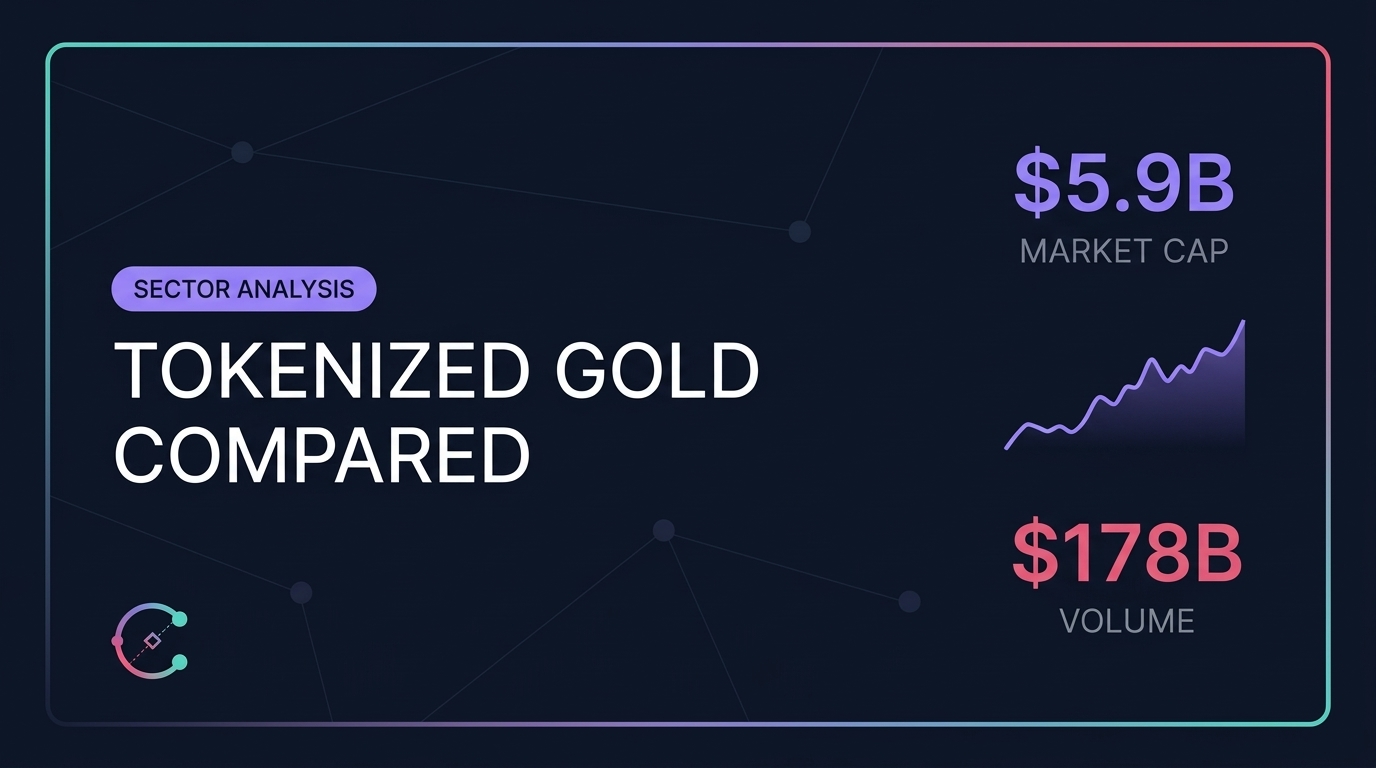
Tokenized gold has reached $5.9 billion in market capitalization in 2026, with annual trading volume of $178 billion making it the second largest gold investment product globally by volume. What was once a niche crypto experiment has become a legitimate channel for gold exposure, attracting investors who want the price performance of physical gold with the speed, divisibility, and composability of blockchain-based assets. Three products dominate the market: Paxos Gold (PAXG), Tether Gold (XAUT), and Kinesis Gold (KAU), each with a distinct custody model, fee structure, and regulatory profile.
This article provides a comprehensive analysis of the tokenized gold market in 2026, comparing the three leading products head to head, explaining how gold on blockchain works, evaluating the risks, and guiding investors through the process of selecting the right tokenized gold product for their portfolio. For retail investors seeking inflation protection and institutional allocators evaluating digital commodity exposure, this is the definitive comparison.
Table of Contents
This guide begins with how tokenized gold works and why investors choose it over traditional alternatives. It then delivers a head-to-head comparison of PAXG, XAUT, and KAU across custody, fees, and access. The following sections cover the $5.9 billion market landscape, how to buy tokenized gold, the risks and considerations, and frequently asked questions.
How Tokenized Gold Works
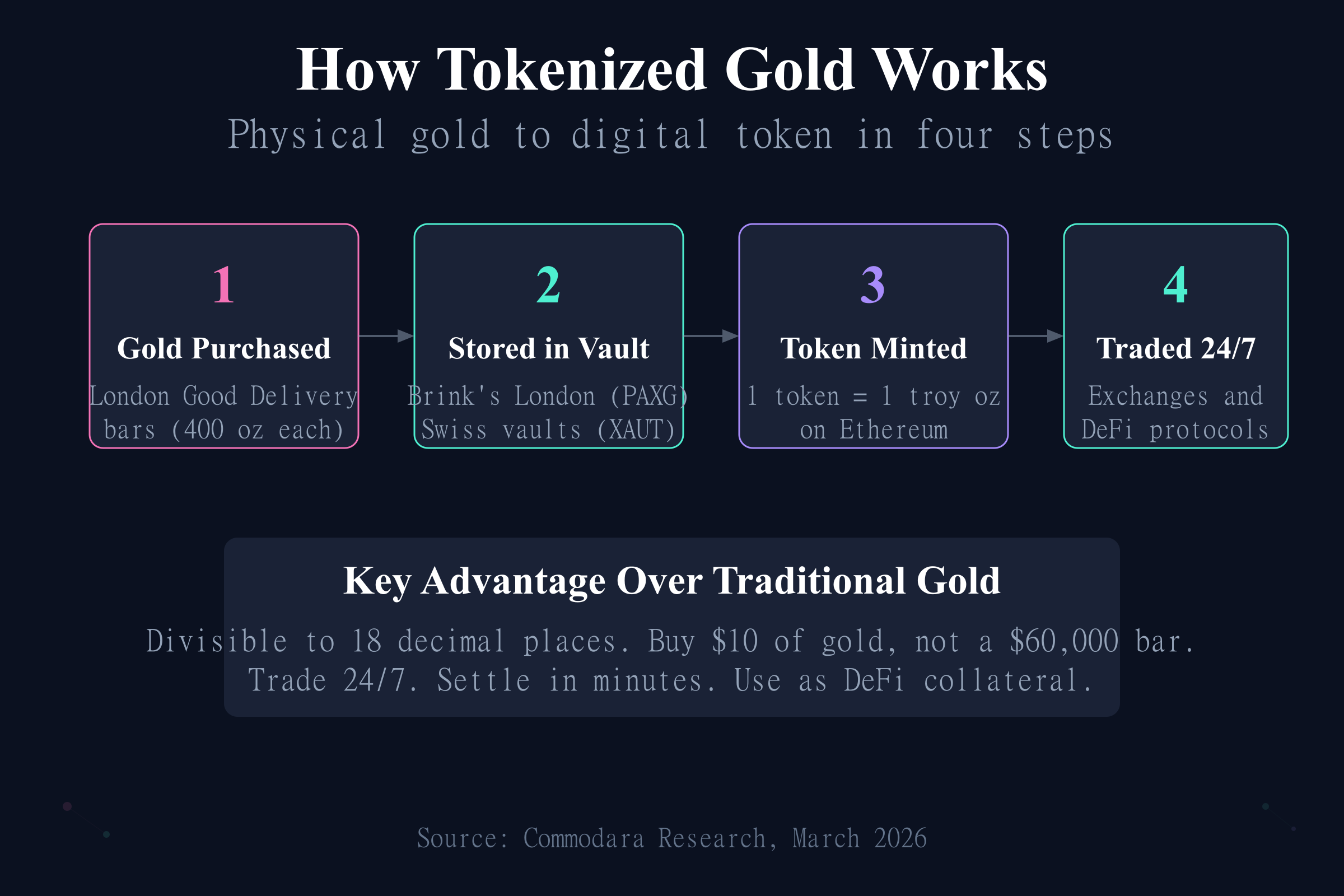
Tokenized gold is a digital token on a blockchain where each token represents ownership of a specific quantity of physical gold stored in a regulated vault. The gold is real, audited, and insured. The token is a digital claim on that gold, transferable in seconds and divisible to fractions of a gram. When you hold a tokenized gold token, you own gold. The blockchain simply replaces the paper certificate or brokerage account entry that traditionally records your ownership.
The standard unit for tokenized gold products is one troy ounce per token. With gold trading above $3,000 per ounce in 2026, one PAXG or XAUT token is worth over $3,000. However, these tokens can be subdivided to 18 decimal places on Ethereum, meaning an investor can purchase a fraction of a token for as little as a few dollars. This divisibility is one of the key advantages of gold on blockchain over physical gold bars or coins, which cannot be easily divided.
The custody model is what gives tokenized gold its value. Each token must be backed by an equivalent quantity of physical gold held in a secure vault. The gold must be regularly audited by an independent third party to verify that the total supply of tokens matches the total quantity of gold in storage. If the custody chain breaks, if the gold is not there, if the audits are unreliable, the token’s value proposition collapses. This is why the choice of tokenized gold product is primarily a choice about which custody and audit model you trust.
Why Choose Tokenized Gold Over Traditional Gold Investments?
Investors choose tokenized gold over traditional alternatives for five reasons. First, accessibility: you can buy tokenized gold 24/7 on any day of the year, with no broker, no vault, and no minimum purchase beyond a few dollars. Second, speed: transfers settle in minutes on the blockchain rather than days through traditional gold dealers. Third, divisibility: you can own $10 worth of gold rather than needing to purchase an entire bar or coin. Fourth, composability: tokenized gold can be used as collateral in DeFi lending protocols, earning yield on an asset that traditionally generates none. Fifth, portability: your gold travels with your wallet, across borders, without shipping costs or customs declarations.
Traditional gold investment products each have limitations that tokenized gold addresses. Physical gold requires storage and insurance costs. Gold ETFs like GLD charge management fees of 0.40% annually and trade only during market hours. Gold futures require margin accounts and expire on fixed dates. Tokenized gold combines the direct ownership of physical gold with the trading convenience of an ETF and the fractional access of a savings plan, all on infrastructure that operates continuously.
PAXG vs XAUT vs KAU: Head-to-Head Comparison
The tokenized gold comparison between the three leading products reveals meaningful differences in custody, regulation, fees, and chain support that should inform every investor’s selection decision.
Paxos Gold (PAXG)
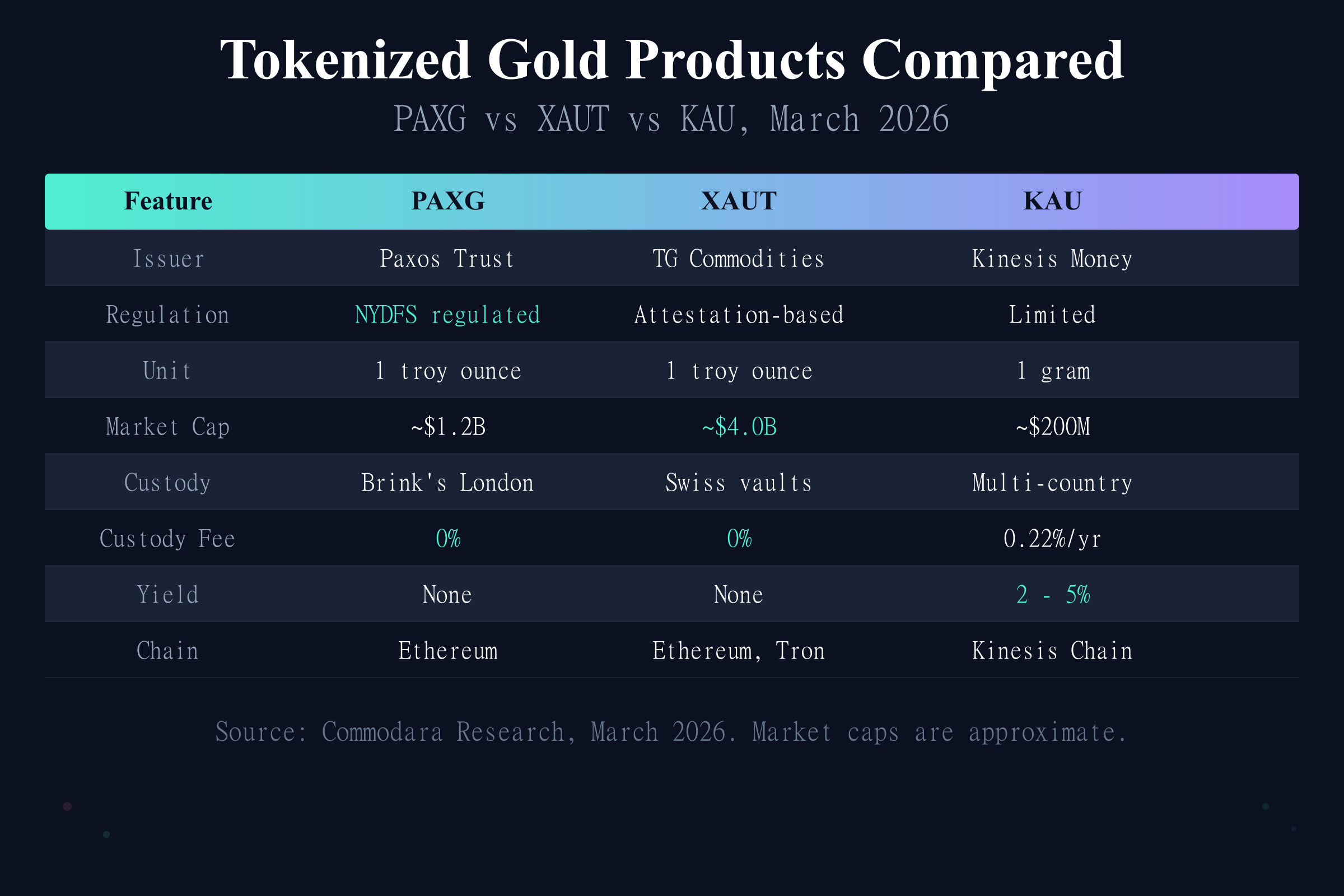
Paxos Gold is the most regulated tokenized gold product on the market. Issued by Paxos Trust Company, a New York-regulated trust company supervised by the New York State Department of Financial Services (NYDFS), PAXG benefits from the same regulatory oversight that governs traditional financial institutions. Each PAXG token represents one fine troy ounce of a London Good Delivery gold bar stored in Brink’s vaults in London. The gold allocation is published monthly, and holders can look up the specific serial number of the gold bar associated with their tokens through the Paxos website.
PAXG operates on Ethereum and has a market capitalization of approximately $1.2 billion in 2026. The token charges no custody fees, meaning holders pay nothing to store their gold allocation over time. Transaction fees on creation and redemption are tiered based on volume, starting at 0.02% for amounts above $75,000. For retail investors, the primary cost is the Ethereum gas fee for on-chain transactions and any spread charged by the exchange where they purchase PAXG.
Tether Gold (XAUT)
Tether Gold is the largest tokenized gold product by market capitalization, exceeding $4 billion in 2026. Each XAUT token represents ownership of one fine troy ounce of gold stored in Swiss vaults. XAUT is issued by TG Commodities Limited, a company in the Tether group, and the gold is held in secure vaults in Switzerland. Like PAXG, holders can verify the specific gold bar associated with their tokens.
The key difference in the PAXG vs XAUT 2026 comparison is regulatory framework. While Paxos operates under NYDFS supervision, Tether’s regulatory status is less conventional. Tether has faced scrutiny over the years regarding reserve attestations for its stablecoin products, and while XAUT’s gold reserves have been attested by independent parties, the company does not operate under the same type of banking supervision as Paxos. For investors who prioritize regulatory oversight, this distinction matters. For investors who prioritize market capitalization and liquidity, XAUT’s larger size provides deeper trading pools and tighter spreads.
Kinesis Gold (KAU)
Kinesis Gold takes a different approach to tokenized gold by adding a yield mechanism. Each KAU token represents one gram of gold (not one ounce, which is a key distinction) stored in vaults in Australia, Singapore, and other locations. The Kinesis ecosystem generates yield for KAU holders through transaction fees collected across the Kinesis exchange and payment network. This yield, typically in the range of 2% to 5% annually, is distributed to KAU holders as additional gold.
The yield mechanism distinguishes Kinesis from PAXG and XAUT, which generate no passive income for holders. However, the yield comes from the Kinesis ecosystem’s transaction volume, which means it is variable and dependent on the platform’s commercial success. KAU’s market capitalization is significantly smaller than PAXG or XAUT, resulting in lower liquidity. The gram-based denomination also means that one KAU token is worth approximately $95 to $100 at current gold prices, making it more accessible per-token than ounce-based products but with less institutional standardization.
The $5.9 Billion Tokenized Gold Market
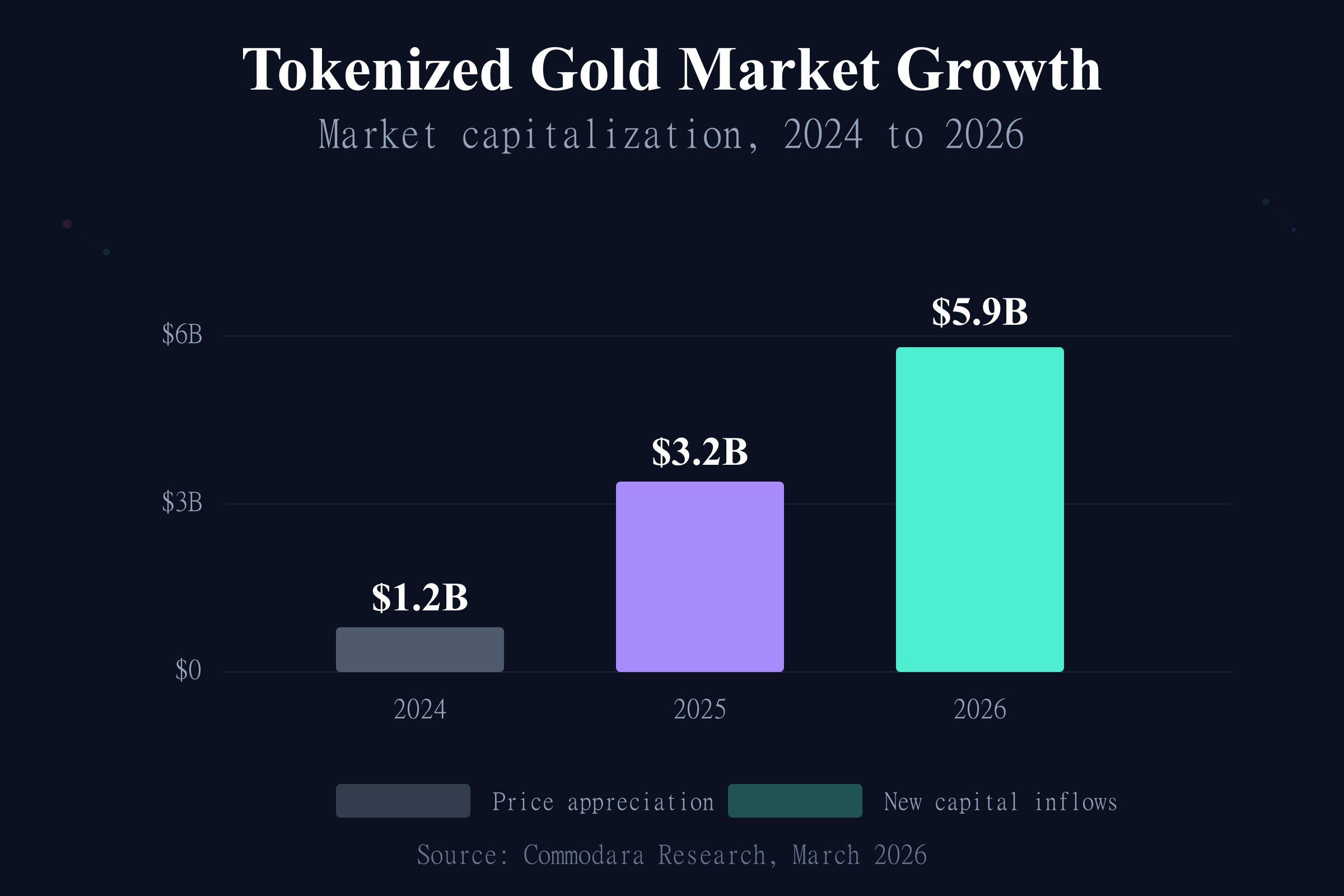
The tokenized gold market has grown from approximately $1.2 billion in early 2024 to $5.9 billion by March 2026. This growth has been driven by two reinforcing factors: rising gold prices, which increased the value of existing tokens, and net new capital inflows from investors choosing gold on blockchain over traditional gold products.
Gold prices crossed $3,000 per ounce for the first time in 2025 and have sustained levels above that threshold into 2026, driven by central bank buying, geopolitical uncertainty, and inflation concerns. Each dollar increase in the gold price automatically increases the market capitalization of every tokenized gold token, since each token represents a fixed quantity of physical gold. This price appreciation accounts for roughly 40% of the market cap growth, with net new token minting accounting for the remaining 60%.
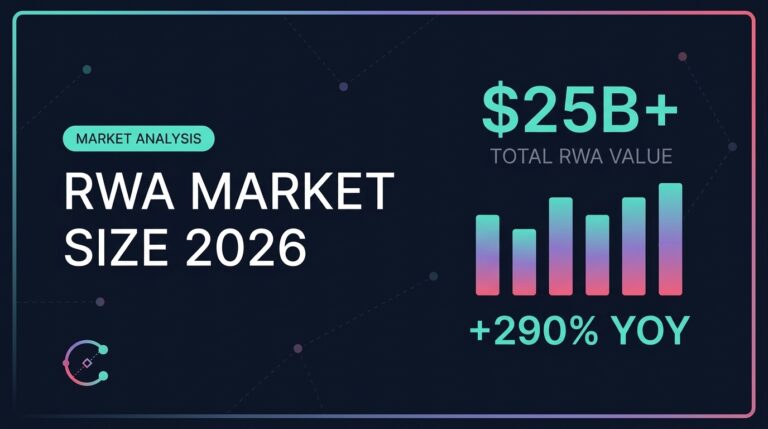
The $178 billion in annual trading volume positions tokenized gold as the second-largest gold investment product globally by volume, behind only the SPDR Gold Shares ETF (GLD). This trading volume reflects both speculative trading on crypto exchanges and genuine portfolio allocation by investors using tokenized gold as a store of value and inflation hedge. The RWA market size 2026 data shows tokenized gold as the third-largest tokenized asset class after private credit and treasuries.
Where Tokenized Gold Trades
Tokenized gold products trade on both centralized exchanges and decentralized platforms. On centralized exchanges, Coinbase, Binance, Kraken, and Bybit offer PAXG and XAUT trading pairs against USD, USDT, and BTC. These exchanges provide the deepest liquidity pools and tightest spreads for most retail investors. On decentralized exchanges, Uniswap and Curve host liquidity pools for PAXG on Ethereum, enabling trading without a centralized intermediary.
The choice between centralized and decentralized venues depends on the investor’s priorities. Centralized exchanges offer better liquidity, fiat on-ramps, and customer support. Decentralized exchanges offer self-custody and privacy but with potentially wider spreads and the need to manage gas costs. The detailed PAXG vs XAUT comparison covers exchange availability and liquidity depth for each product.
How to Buy Tokenized Gold
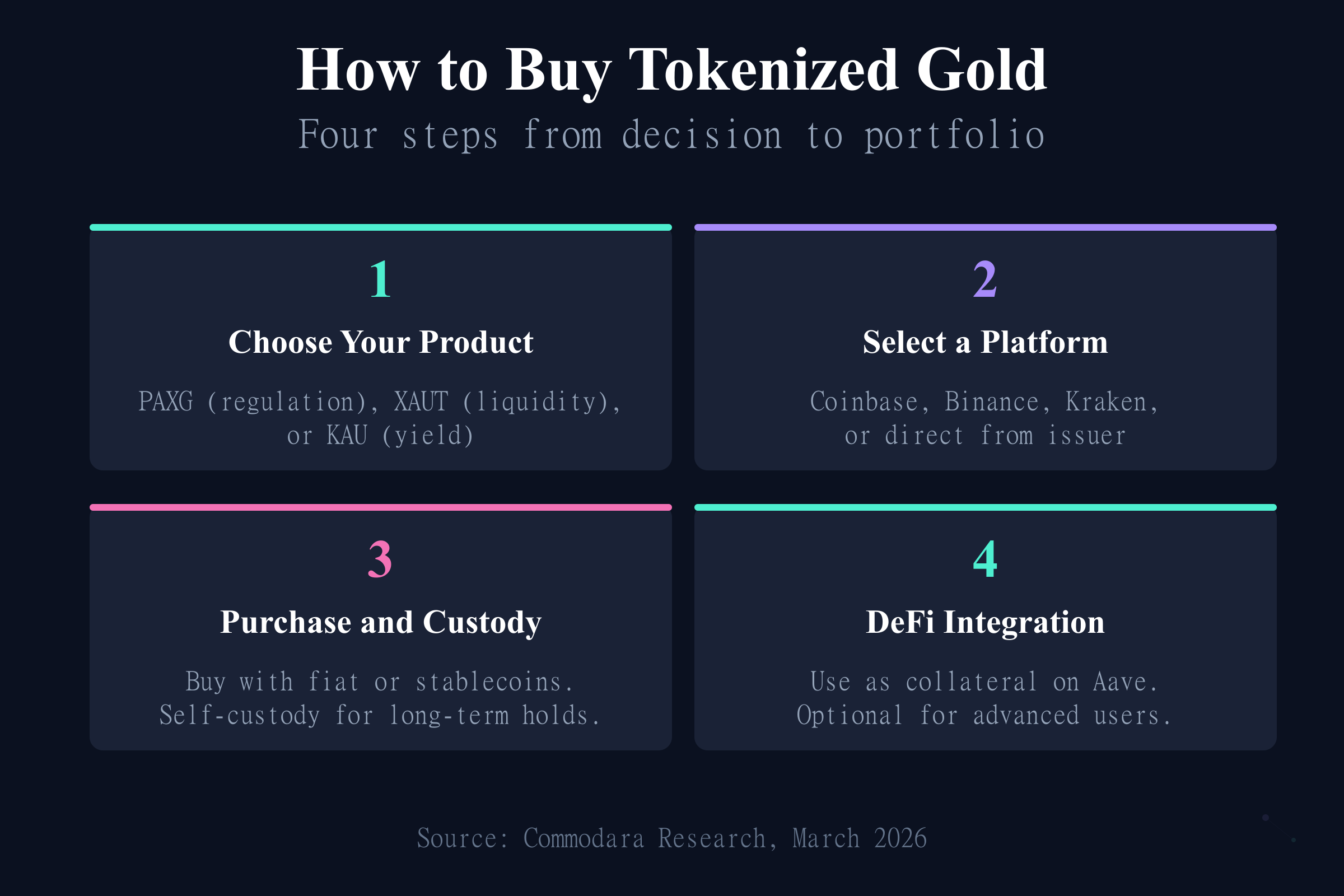
Purchasing tokenized gold follows the same basic process regardless of which product you choose, with some variation based on the platform.
Step 1: Choose Your Product
Select between PAXG, XAUT, or KAU based on your priorities. If regulatory oversight is your primary concern, PAXG is the strongest choice. If you want the deepest liquidity and largest market, XAUT is the leader. If earning yield on your gold holdings appeals to you, KAU offers a unique proposition. Most investors who are new to the category start with PAXG or XAUT due to their simplicity, ounce-based denomination, and broad exchange availability.
Step 2: Select a Platform
You can buy tokenized gold on centralized exchanges like Coinbase, Binance, or Kraken using fiat currency or stablecoins. Alternatively, you can purchase directly from the issuer: Paxos for PAXG or through Kinesis for KAU. Direct purchase from the issuer typically involves lower fees for large amounts but may require more extensive KYC verification. The guide to buying tokenized assets provides detailed platform recommendations across all tokenized product categories.
Step 3: Purchase and Custody
Once you have selected a platform, purchasing is straightforward. Fund your account with fiat currency or transfer stablecoins, place a market or limit order for the amount of tokenized gold you want to buy, and the tokens will appear in your exchange account or wallet. For long-term holders, transferring tokens to a self-custody wallet like MetaMask or a hardware wallet like Ledger provides additional security beyond what exchange custody offers.
Step 4: Consider DeFi Integration
One advantage of tokenized gold over traditional gold investments is composability with DeFi protocols. PAXG can be deposited as collateral on lending platforms like Aave, allowing holders to borrow stablecoins against their gold position without selling. This enables investors to maintain gold exposure while accessing liquidity for other investments. However, DeFi integration introduces smart contract risk that does not exist with simple buy-and-hold strategies. Investors should only use DeFi with tokenized gold if they understand the protocols and risks involved.
Risks and Considerations
Tokenized gold carries risks that are distinct from both physical gold ownership and traditional gold investment products. Investors should evaluate these carefully before allocating capital.
Custody and Counterparty Risk
The fundamental risk in tokenized gold is custody: is the physical gold actually there? Each product addresses this through attestations and audits, but the quality and frequency of these verifications vary. Paxos publishes monthly attestations from an independent accounting firm. Tether provides periodic attestations for XAUT reserves. If the gold backing is insufficient or the custodian fails, token holders could face losses. This counterparty risk is the primary difference between owning tokenized gold and owning physical gold in your own possession.
Regulatory Risk
The regulatory treatment of tokenized gold varies by jurisdiction and could change. While PAXG benefits from NYDFS regulation, the broader regulatory landscape for tokenized commodities is still evolving. Changes in regulation could affect the availability, transferability, or tax treatment of tokenized gold products in specific markets.
Smart Contract and Technical Risk
Tokenized gold tokens exist as smart contracts on blockchains, primarily Ethereum. Smart contracts can contain vulnerabilities, and blockchain transactions are irreversible. Sending tokens to the wrong address means permanent loss. Network congestion on Ethereum can result in high transaction fees during periods of heavy usage. These technical risks do not exist with physical gold or gold ETFs.
Price Premium and Discount Risk
Tokenized gold tokens can trade at a premium or discount to the spot price of gold, depending on supply and demand dynamics on the exchanges where they trade. During periods of high demand, PAXG and XAUT may trade slightly above the gold spot price. During sell-offs, they may trade below. These deviations are typically small (less than 1%) but can widen during market stress. The arbitrage mechanism of creating and redeeming tokens with the issuer keeps prices anchored to the gold spot price over time, but short-term deviations can affect investors who need to sell at a specific price.
Frequently Asked Questions
What is tokenized gold?
Tokenized gold is a digital token on a blockchain that represents ownership of physical gold stored in a regulated vault. Each token typically corresponds to one troy ounce of gold, though Kinesis Gold uses a gram-based denomination. The gold is real, audited, and the token serves as your proof of ownership.
Is tokenized gold backed by real gold?
Yes. Leading tokenized gold products including PAXG and XAUT are backed 1:1 by physical gold stored in secure vaults in London and Switzerland. The backing is verified through periodic independent attestations. Holders can look up the specific gold bar serial numbers associated with their tokens.
What is the difference between PAXG and XAUT?
PAXG is issued by NYDFS-regulated Paxos Trust Company with gold in London Brink’s vaults. XAUT is issued by Tether’s TG Commodities with gold in Swiss vaults. XAUT has larger market capitalization and deeper liquidity. PAXG has stronger regulatory oversight. Both represent one troy ounce of gold per token.
Can I earn yield on tokenized gold?
Kinesis Gold (KAU) offers a yield mechanism of 2% to 5% annually from transaction fees. PAXG and XAUT do not generate passive yield, but PAXG can be deposited as collateral on DeFi lending platforms like Aave to borrow stablecoins against your gold position.
How do I buy tokenized gold?
You can buy tokenized gold on major exchanges like Coinbase, Binance, and Kraken using fiat currency or stablecoins. Select PAXG for regulated exposure, XAUT for maximum liquidity, or KAU for yield. Transfer to a self-custody wallet for long-term storage security.
The Bottom Line
Tokenized gold has matured from a crypto curiosity into a $5.9 billion market that rivals traditional gold investment products in trading volume. The three leading products, PAXG, XAUT, and KAU, each serve different investor priorities: regulation, liquidity, and yield respectively. For investors seeking gold exposure through blockchain rails, the choice between these products is clear once you identify which attributes matter most to your investment strategy.
The tokenized gold market’s growth reflects a broader trend: investors are increasingly comfortable accessing traditional asset classes through blockchain infrastructure. Gold is one of the oldest stores of value in human history, and its availability as a tokenized, fractional, 24/7 tradeable digital asset represents a meaningful evolution in how this asset class is accessed and owned.
The infrastructure being built around tokenized gold, from custody and audit standards to DeFi integration and cross-chain availability, will continue to improve as the market scales. Subscribe to the Commodara newsletter for ongoing coverage of the tokenized gold market, product developments, and the broader tokenized commodity landscape.