
Tokenized Treasuries Compared: BUIDL vs OUSG vs BENJI vs USDY in 2026
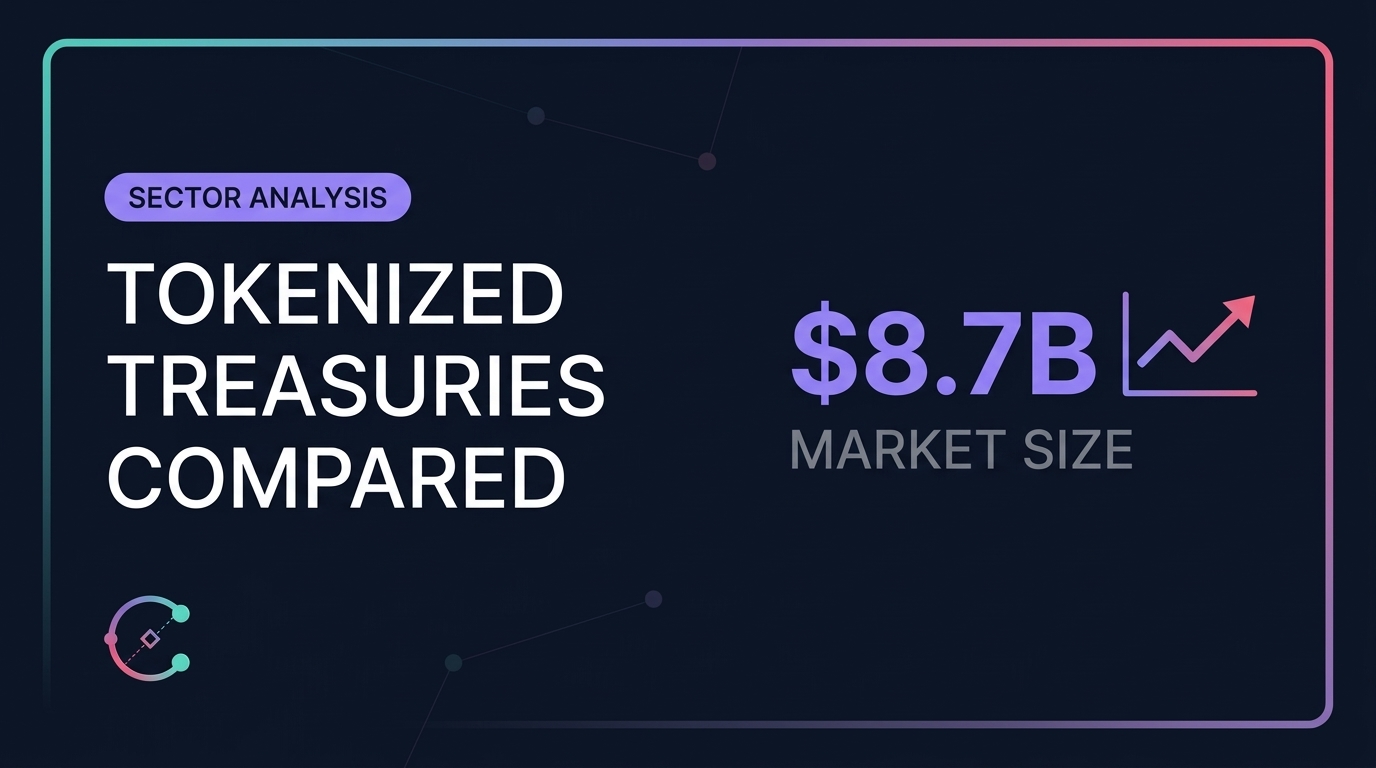
Tokenized treasuries have become the largest category in the RWA market at $8.7 billion, and choosing between products like BUIDL, OUSG, BENJI, and USDY requires understanding their distinct structures. These four products dominate the sector, but they differ significantly in minimum investment requirements, investor eligibility, chain availability, yield mechanics, and DeFi composability. What looks like a uniform asset class on the surface is actually a diverse product landscape where each option serves a different investor profile.
This comparison breaks down every dimension that matters for an informed allocation decision. Whether you are a retail investor exploring your first tokenized treasury fund position or an institutional allocator evaluating on-chain yield products for a portfolio, this guide provides the data, context, and analysis you need to choose the right product for your situation.
Table of Contents
This guide begins with an overview of the tokenized treasuries market and why it matters. It then provides detailed profiles of BUIDL, OUSG, BENJI, and USDY, followed by a head-to-head comparison across every key dimension. The final sections cover yield analysis, product-specific risks, and a decision framework for choosing the right product.
The Tokenized Treasuries Market in 2026
Tokenized treasuries represent on-chain versions of US government debt, primarily short-term Treasury bills and notes with maturities under one year. The sector has grown from less than $1 billion in early 2024 to $8.7 billion by March 2026, making it the largest single category within the broader tokenized real world assets market. This growth has been driven by institutional demand for on-chain yield products that combine the safety of government-backed debt with the settlement efficiency and composability of blockchain infrastructure.
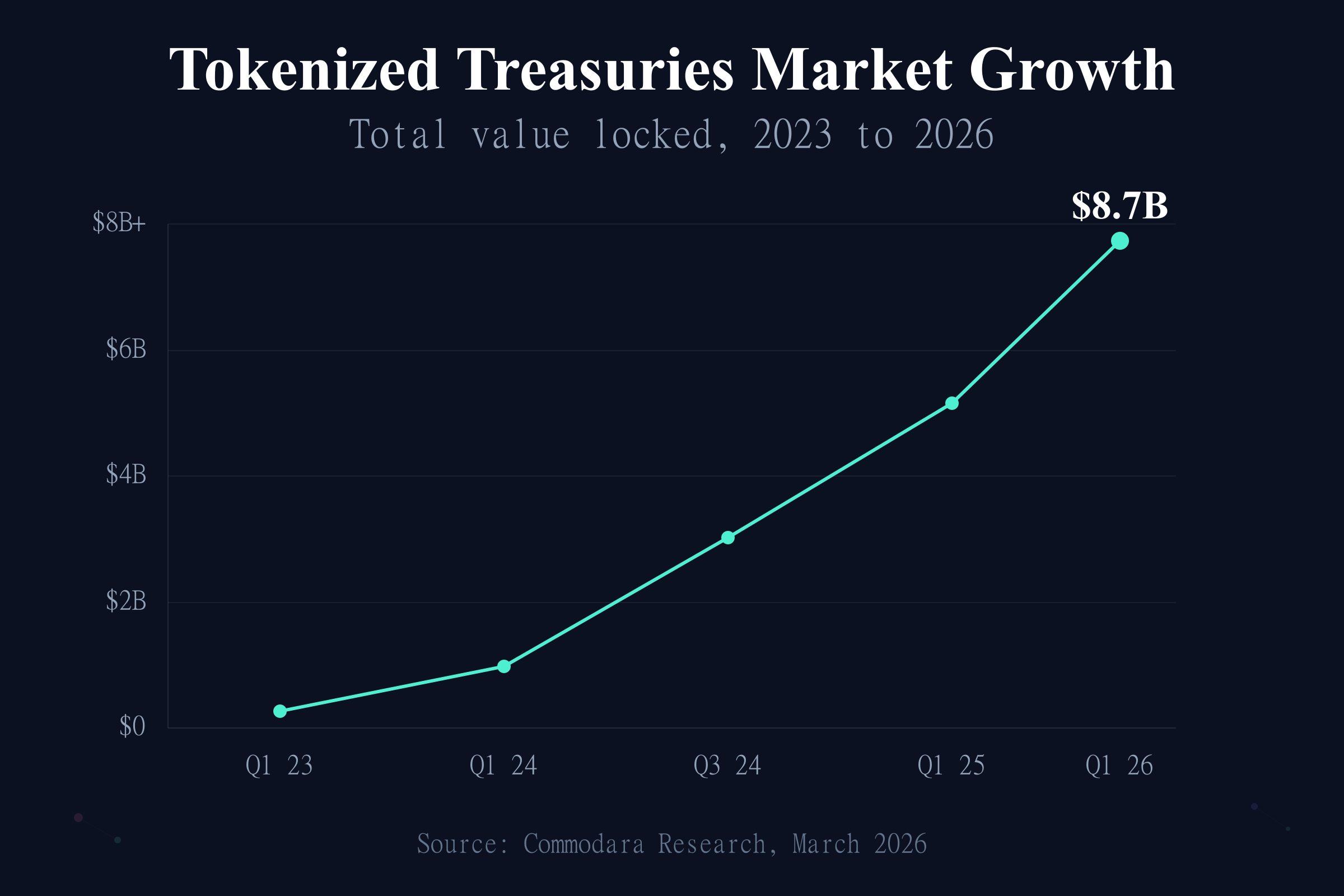
The appeal of tokenized treasuries is straightforward. Traditional Treasury products settle in one to two business days, require brokerage accounts, and cannot be used as collateral in decentralized finance protocols. Tokenized treasuries settle in minutes, can be held in digital wallets, and integrate with DeFi lending platforms, automated strategies, and cross-chain settlement systems. For investors who already operate on-chain, tokenized treasuries offer a way to earn government-backed yield without moving capital off-chain.
The institutional adoption of tokenization by BlackRock, JPMorgan, and DTCC has been concentrated heavily in the treasury sector, which validates the product category and provides confidence for both retail and institutional participants. Understanding the differences between the leading products is essential for anyone allocating capital to this rapidly growing market segment.
Product Profiles: The Four Leading Tokenized Treasury Products
BlackRock BUIDL
BUIDL, the BlackRock USD Institutional Digital Liquidity Fund, is the largest tokenized treasury product at $2.5 billion in total value locked. The fund is managed by BlackRock, the world’s largest asset manager with over $10 trillion in assets under management. Securitize serves as the tokenization platform, transfer agent, and placement agent for the fund. The underlying assets are short-term US Treasury securities, and Bank of New York Mellon provides custody.
BUIDL is designed exclusively for institutional investors. The minimum investment is $5 million, and investors must qualify as qualified purchasers under US securities law. The fund operates on Ethereum, Polygon, Avalanche, Optimism, and Aptos. BUIDL distributes yield through daily share price accrual, meaning the token price increases each day to reflect accumulated Treasury interest. The current annualized yield is approximately 4.5%, net of a 0.20% management fee.
The institutional pedigree of BUIDL is unmatched in the tokenized treasuries market. No other product carries the brand weight of BlackRock, the custody of BNY Mellon, and the regulatory infrastructure of Securitize. For institutional allocators, these credentials reduce the due diligence burden and make internal compliance approval significantly easier.
Ondo OUSG
Ondo Finance’s OUSG is a tokenized treasury fund that holds short-term US Treasury securities primarily through BlackRock’s iShares Short Treasury Bond ETF (SHV). OUSG has approximately $800 million in total value locked and is available to qualified purchasers with a minimum investment of $5,000, making it significantly more accessible than BUIDL for institutional investors who do not meet the $5 million threshold.
OUSG operates exclusively on Ethereum. Like BUIDL, it uses an accumulating token model where the share price increases daily to reflect accrued yield. The current annualized yield is approximately 4.5%, net of Ondo Finance’s 0.15% management fee. Subscriptions and redemptions are processed on a T+1 basis during business days. OUSG requires KYC verification and qualified purchaser status, which limits it to sophisticated investors.
The key advantage of OUSG within the tokenized treasuries landscape is its lower minimum investment compared to BUIDL combined with a comparable yield and institutional-grade fund structure. For investors who qualify as qualified purchasers but do not meet BUIDL’s $5 million minimum, OUSG fills an important gap in the market.
Franklin Templeton BENJI
BENJI is Franklin Templeton’s tokenized treasury product, formally known as the Franklin OnChain US Government Money Fund. It represents shares in a registered mutual fund that invests in US government securities and is one of the longest-running tokenized treasury products, having launched in 2021 on the Stellar blockchain before expanding to Polygon. The fund has approximately $700 million in total value locked.
BENJI stands out in the tokenized treasuries market for its exceptionally low minimum investment of just $20, making it the most accessible institutional-quality tokenized treasury product available. The fund is registered with the SEC as a mutual fund, which provides investor protections that are not available with unregistered fund structures. The current annualized yield is approximately 4.3%, slightly below BUIDL and OUSG due to a higher expense ratio.
The trade-off with BENJI is limited DeFi composability. The token operates primarily within Franklin Templeton’s own ecosystem and is not widely integrated with DeFi lending protocols or decentralized exchanges. For investors who prioritize regulatory protection and low minimums over DeFi functionality, BENJI is a compelling choice. For those who want to use their tokenized treasuries position as collateral or within broader on-chain strategies, other products offer more flexibility.
Ondo USDY
USDY is Ondo Finance’s yield-bearing stablecoin alternative, backed by short-term US Treasuries and bank deposits. Unlike OUSG, which is restricted to qualified purchasers, USDY is available to non-US investors with a minimum purchase of just $500. This accessibility has made USDY one of the most widely distributed tokenized treasuries products in the market, with approximately $600 million in total value locked across seven or more blockchain networks.
USDY operates on Ethereum, Solana, Polygon, Mantle, Aptos, Sui, and additional chains, giving it the broadest multi-chain availability of any tokenized treasury product. The token accrues yield daily, with the price increasing to reflect accumulated interest. The current annualized yield is approximately 4.5%, net of a 0.15% management fee. USDY has been integrated as collateral on multiple DeFi lending protocols, making it the most DeFi-composable product in the comparison.
The primary limitation of USDY is that it is not available to US investors. Ondo Finance excludes US persons from USDY as a regulatory compliance measure. For the global non-US investor base, however, USDY offers a combination of low minimums, high yield, multi-chain availability, and DeFi composability that no other tokenized treasuries product matches.
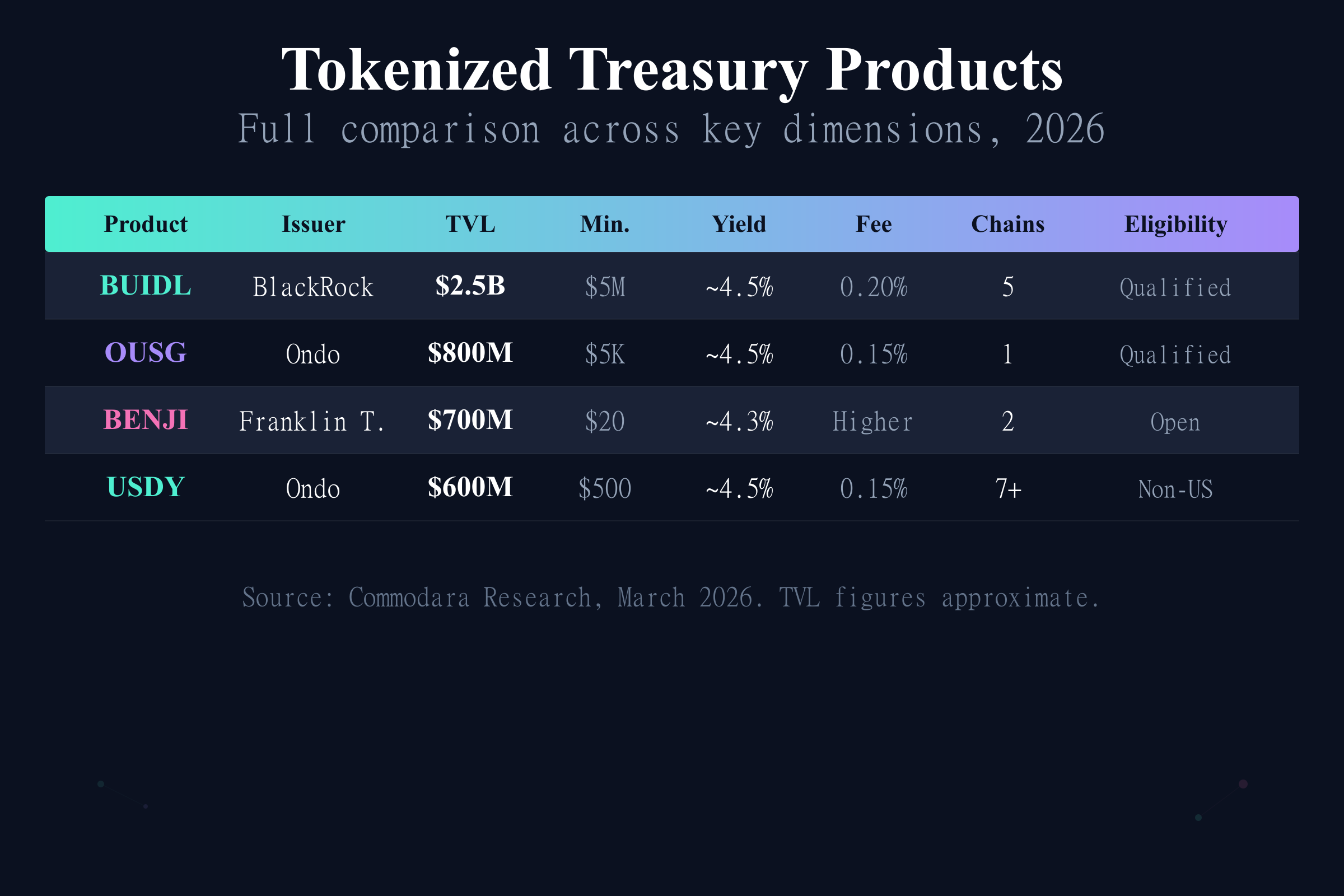
Head-to-Head Comparison: BUIDL vs OUSG vs BENJI vs USDY
Comparing these four tokenized treasuries products side by side reveals distinct positioning for each. No single product dominates across every dimension; the best choice depends entirely on the investor’s profile, jurisdiction, and intended use case.
Minimum Investment and Accessibility
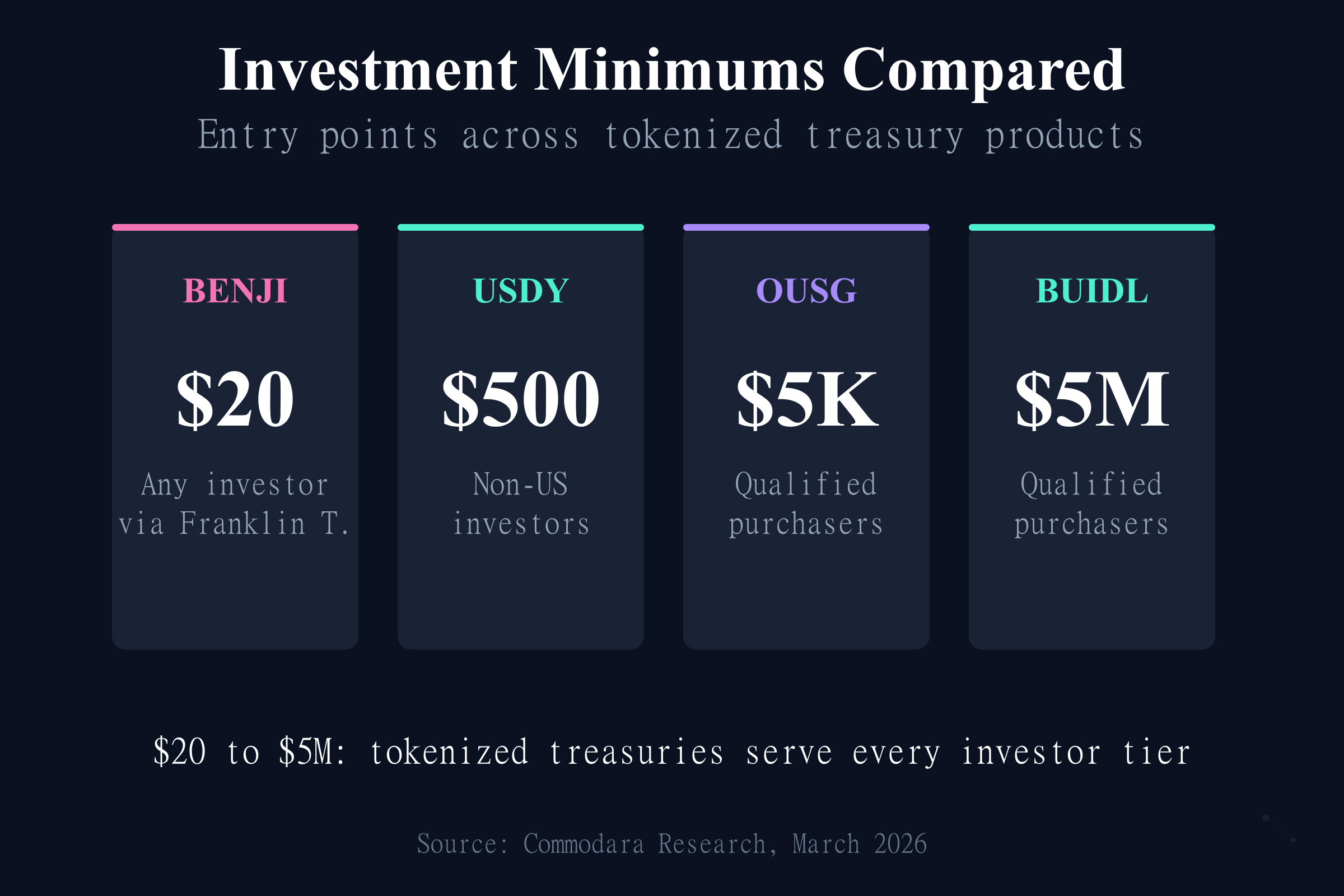
The range of minimum investments across these four products spans from $20 to $5 million, which illustrates how diverse the tokenized treasuries market has become. BENJI’s $20 minimum makes it accessible to virtually any investor. USDY’s $500 minimum serves retail investors outside the US. OUSG’s $5,000 minimum targets the lower end of the institutional market. BUIDL’s $5 million minimum is reserved for the largest institutional allocators.
Investor eligibility further differentiates the products. BUIDL and OUSG require qualified purchaser status under US law. BENJI is open to any investor through Franklin Templeton’s platform. USDY is open to non-US investors only. These eligibility requirements are not arbitrary; they reflect the legal structures and regulatory frameworks under which each product operates.
Yield Comparison
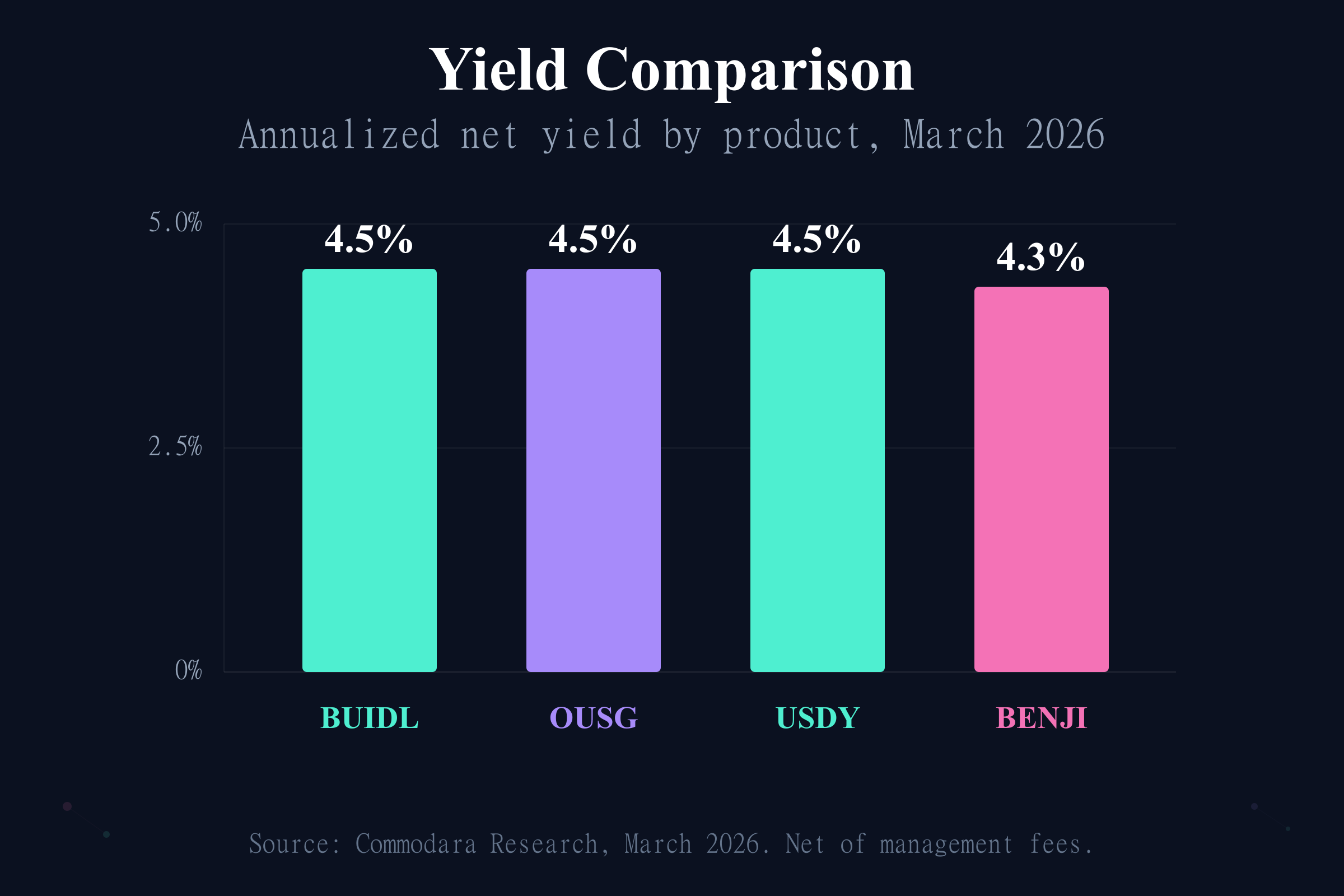
Yield across the four tokenized treasuries products is remarkably similar because all four hold comparable underlying assets: short-term US Treasury securities. BUIDL yields approximately 4.5% with a 0.20% fee. OUSG yields approximately 4.5% with a 0.15% fee. USDY yields approximately 4.5% with a 0.15% fee. BENJI yields approximately 4.3% with a slightly higher expense ratio typical of registered mutual funds.
The yield differences are marginal, typically less than 20 basis points between products. For most investors, yield should not be the primary differentiating factor when selecting a tokenized treasury fund product. The differences in access requirements, chain availability, and DeFi composability are far more consequential for the overall investment experience.
Chain Availability and DeFi Composability
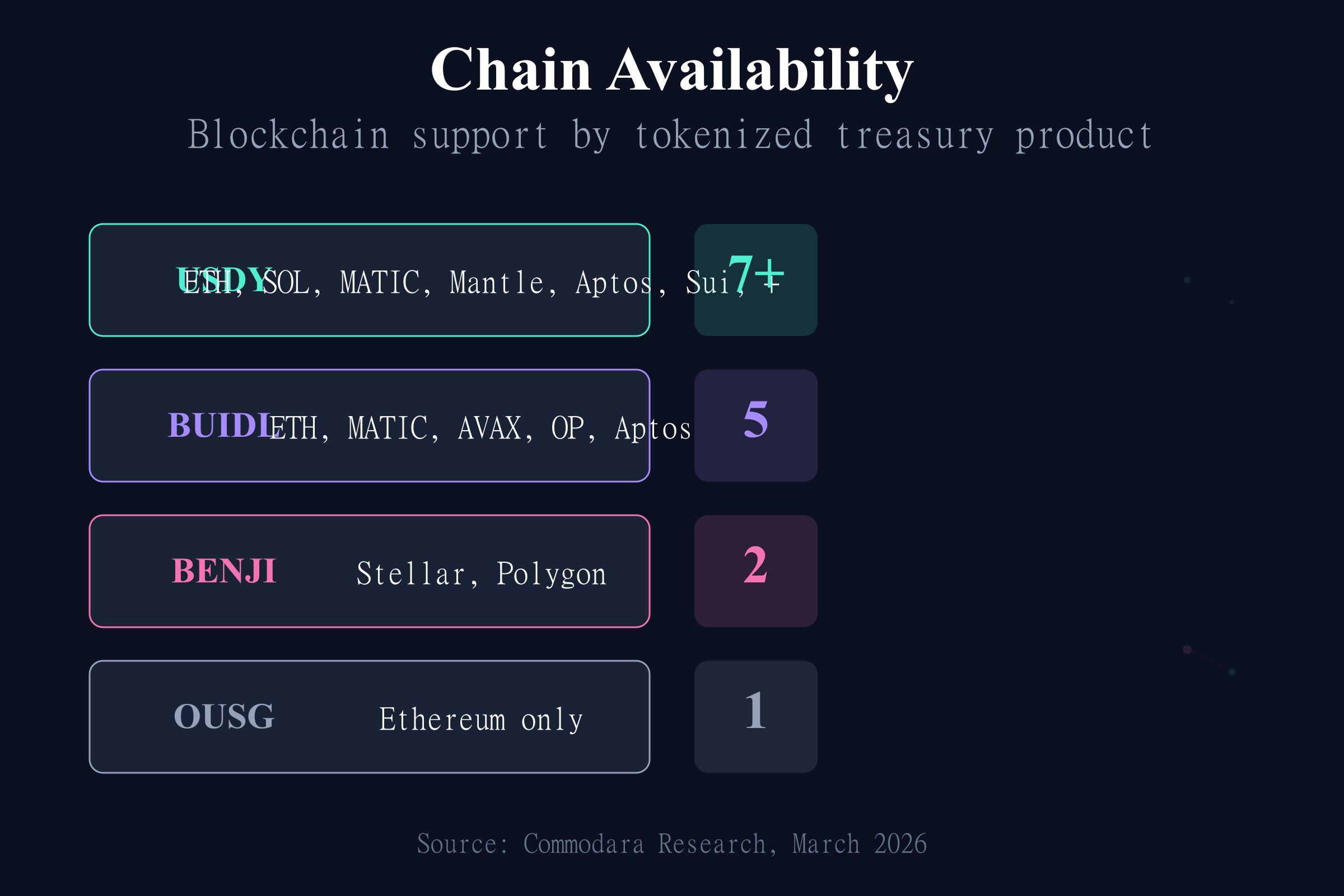
Chain availability varies dramatically across products and is one of the most important differentiators for investors who plan to use their tokenized treasuries within broader on-chain strategies. USDY leads with availability on seven or more chains. BUIDL operates on five chains. BENJI is limited to Stellar and Polygon. OUSG operates exclusively on Ethereum.
DeFi composability, meaning the ability to use the token as collateral, trade it on decentralized exchanges, or integrate it into automated strategies, also varies significantly. USDY has the most DeFi integrations, serving as accepted collateral on multiple lending protocols. BUIDL has emerging DeFi integrations through its multi-chain deployment. OUSG has limited DeFi composability. BENJI has minimal DeFi integration, operating primarily within Franklin Templeton’s own ecosystem.
For investors who view tokenized treasuries primarily as a yield-bearing parking spot for idle capital, chain availability matters less. For investors who want to actively use their treasury position within DeFi strategies, collateral frameworks, or cross-chain operations, this dimension is the most important factor in product selection.
Legal Structure and Investor Protection
The legal structures behind these products differ in ways that affect investor protection. BENJI is the only product in this comparison that is registered with the SEC as a mutual fund, which provides the highest level of regulatory protection, including mandatory disclosure, independent board oversight, and specific redemption rights. BUIDL operates as a BVI limited company under Regulation D exemptions. OUSG is structured as a Cayman Islands exempted company. USDY is structured as a tokenized note.
These structural differences do not necessarily make one product safer than another, but they do affect the legal remedies available to investors in the event of problems. SEC-registered funds like BENJI provide specific statutory protections. Unregistered fund structures like BUIDL and OUSG rely on contractual protections and the regulatory oversight of their service providers. Investors should understand which legal framework governs their investment and what protections that framework provides.
Yield Analysis: What Drives Returns in Tokenized Treasuries
All four tokenized treasuries products generate yield from the same source: the interest paid on short-term US Treasury securities. The yield on these underlying assets is determined by the federal funds rate and broader monetary policy, which means the returns on tokenized treasuries products move in lockstep with the interest rate environment. When the Federal Reserve raises rates, yields on tokenized treasuries increase. When rates are cut, yields decline.
The management fees charged by each product reduce the gross yield by a small amount. OUSG and USDY charge 0.15% annually. BUIDL charges 0.20%. BENJI’s expense ratio is slightly higher as a registered mutual fund. These differences are meaningful over large allocations and long holding periods but are relatively minor for most investors. The net yield across all four products falls within a narrow band of approximately 4.3% to 4.5% as of March 2026.
One important distinction is how yield is delivered. BUIDL, OUSG, and USDY all use an accumulating token model where the token price increases daily. BENJI distributes yield as additional shares. This difference has tax implications in some jurisdictions: accumulating tokens may defer taxable events until the token is sold, while share distributions may create taxable events at the time of distribution. Investors should consult a tax advisor regarding the implications in their specific jurisdiction.
Product-Specific Risks to Evaluate
While all four tokenized treasuries products share the same underlying credit quality, since they all hold US government-backed debt, each product carries distinct operational and structural risks that investors should evaluate.
Smart Contract Risk
All four products depend on smart contracts for token issuance, transfers, and compliance enforcement. BUIDL uses Securitize’s DS Protocol, which has been audited but retains upgrade authority with the Securitize team. OUSG and USDY use Ondo Finance’s smart contracts, which have been audited by Code4rena and other firms. BENJI uses Franklin Templeton’s proprietary smart contracts on Stellar and Polygon. A vulnerability in any of these contracts could disrupt transfers, freeze assets, or create other operational issues.
Counterparty Risk
Each product involves different counterparty relationships. BUIDL depends on BlackRock as fund manager, Securitize as platform operator, and BNY Mellon as custodian. OUSG depends on Ondo Finance as issuer and the SHV ETF as the underlying investment vehicle. BENJI depends on Franklin Templeton as both fund manager and technology provider. USDY depends on Ondo Finance and its banking partners. The failure or operational disruption of any key counterparty could affect the product.
Liquidity Risk
Redemption processes and timelines differ across products. BUIDL offers same-day redemption through Circle’s USDC conversion facility. OUSG processes redemptions on a T+1 basis. BENJI processes redemptions according to mutual fund settlement conventions. USDY can be traded on secondary markets or redeemed through Ondo Finance. The ease with which you can exit a position is an important consideration, particularly for investors who may need to access their capital on short notice.
Which Tokenized Treasury Product Should You Choose?
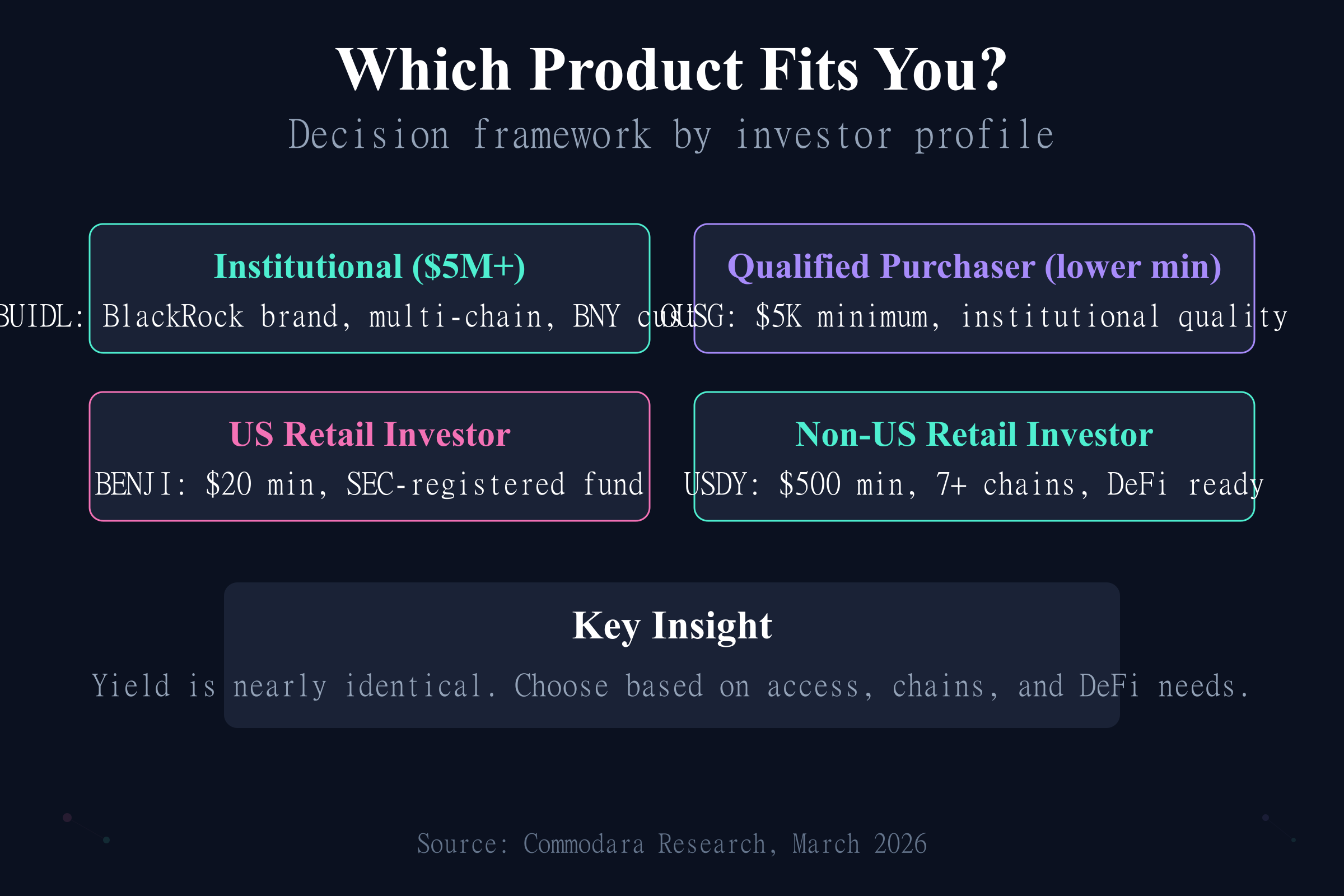
The right choice depends on your investor profile. Here is a decision framework based on the most common investor scenarios.
For Institutional Investors with $5M+
BUIDL is the natural choice for large institutional allocators. The BlackRock brand, BNY Mellon custody, Securitize infrastructure, and multi-chain availability provide the strongest institutional-grade package in the tokenized treasuries market. The $5 million minimum is standard for institutional products and aligns with the allocation sizes that compliance teams and investment committees typically evaluate.
For Qualified Purchasers with Smaller Allocations
OUSG serves investors who qualify as qualified purchasers but want to start with a smaller allocation. The $5,000 minimum allows investors to build a position incrementally. The yield and underlying asset quality are comparable to BUIDL, and the Ondo Finance platform has a strong track record in the tokenized treasuries space.
For US Retail Investors
BENJI is the only option in this comparison that is accessible to US retail investors without qualified purchaser status. The $20 minimum and SEC-registered mutual fund structure make it the most protected and accessible product. The trade-off is limited DeFi composability and slightly lower yield, but for investors who prioritize regulatory protection and simplicity, BENJI is the best tokenized treasury fund choice.
For Non-US Retail Investors
USDY is the clear leader for non-US retail investors. The $500 minimum, multi-chain availability, DeFi composability, and competitive yield make it the most versatile product in the comparison. If you are a non-US investor who wants to earn Treasury yield while maintaining the ability to use your position across DeFi protocols, USDY is the strongest option available in the tokenized treasuries market.
For a step-by-step guide on purchasing any of these products, see our comprehensive guide on how to buy tokenized assets in 2026.
Frequently Asked Questions
What are tokenized treasuries?
Tokenized treasuries are blockchain-based tokens that represent ownership of US Treasury securities, primarily short-term bills and notes. They allow investors to earn government-backed yield on-chain with faster settlement, digital wallet custody, and potential DeFi composability compared to traditional Treasury products.
Which tokenized treasury product has the highest yield?
Yields across BUIDL, OUSG, and USDY are approximately equal at 4.5% annualized, reflecting the same underlying short-term Treasury rates minus management fees of 0.15% to 0.20%. BENJI yields slightly less at approximately 4.3% due to a higher expense ratio as a registered mutual fund.
Can US investors buy tokenized treasuries?
US qualified purchasers can invest in BUIDL (minimum $5M) and OUSG (minimum $5K). US retail investors can access BENJI (minimum $20) through Franklin Templeton. USDY is not available to US persons. Each product has different eligibility requirements based on its legal structure.
Are tokenized treasuries safe?
The underlying assets, US Treasury securities, carry minimal credit risk. However, tokenized treasuries introduce additional layers of risk including smart contract vulnerabilities, counterparty exposure to issuers and custodians, and regulatory uncertainty. BENJI offers the highest regulatory protection as an SEC-registered mutual fund.
What is the difference between BUIDL and OUSG?
BUIDL is issued by BlackRock with a $5M minimum and operates on five chains. OUSG is issued by Ondo Finance with a $5K minimum and operates on Ethereum only. Both yield approximately 4.5% from short-term Treasuries. BUIDL offers broader chain availability and stronger brand recognition; OUSG offers a lower entry point.
The Bottom Line
Tokenized treasuries have matured from an experimental concept into a $8.7 billion market with distinct products serving every investor segment. BUIDL leads in institutional scale and brand credibility. OUSG provides institutional-quality exposure at lower minimums. BENJI offers the strongest regulatory protection and the lowest barrier to entry. USDY delivers the broadest accessibility and DeFi composability for the global non-US investor base.
The yield differences between these products are marginal. The real differentiators are access requirements, chain availability, DeFi integration, and legal structure. Investors who understand these dimensions can select the product that best aligns with their profile, jurisdiction, and investment objectives.
As the tokenized treasuries market continues to grow and new products enter the space, the competitive dynamics will intensify. Subscribe to the Commodara newsletter for ongoing coverage of tokenized treasury products, yield movements, and the platforms that power this rapidly expanding market.