
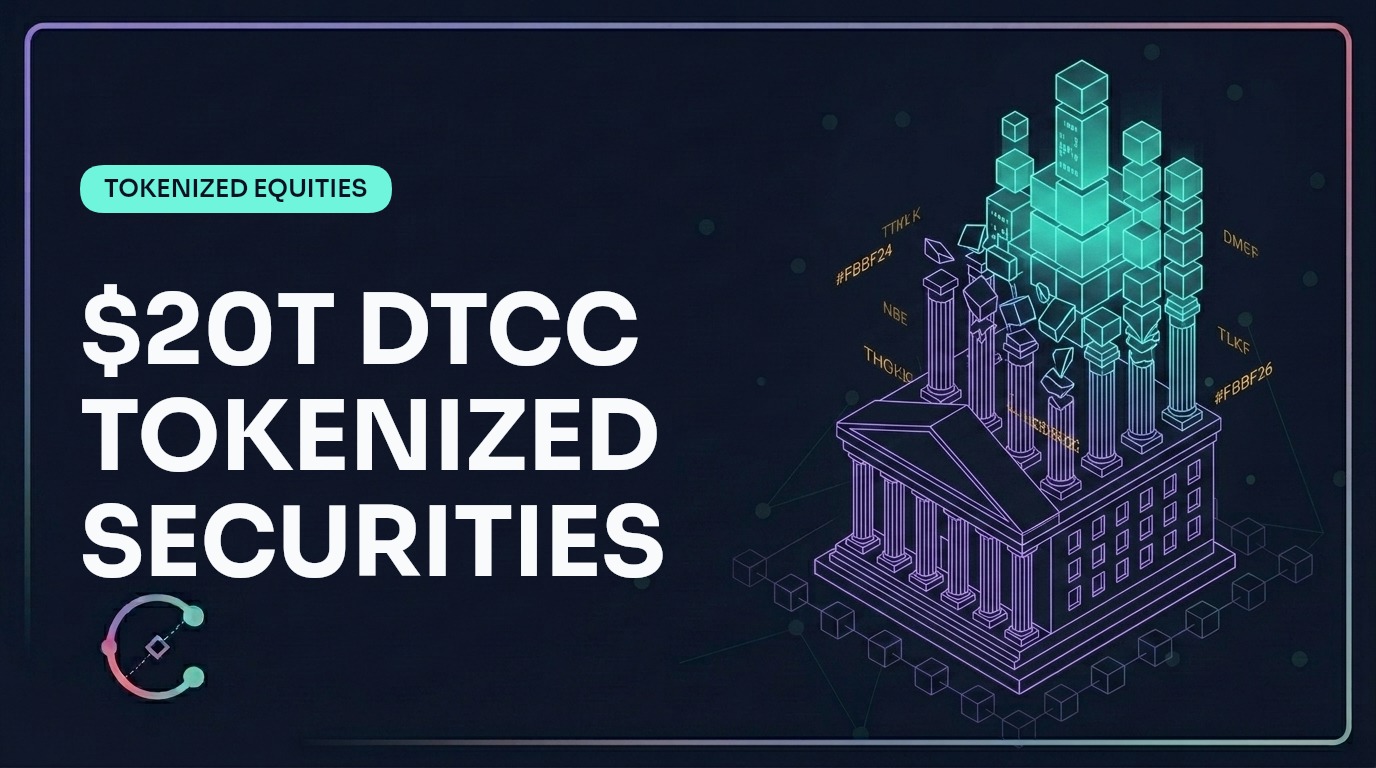
$20T DTCC Tests Tokenized Securities Platform In July
Key Points
- DTCC will begin testing its tokenized securities platform in July with a broader rollout targeted for October, with CEO Frank La Salla saying the clearinghouse needs high-performance layer-1 blockchains to support the project.
- DTCC processes roughly $20 trillion in Treasury and corporate securities trades each day and millions of dividend payments, the volume base it now intends to move onchain through tokenization.
- La Salla called tokenized collateral and real-time dollar liquidity blockchain’s likely first major institutional use case, while flagging scalability, liquidity fragmentation, and lost netting efficiencies as material hurdles.
DTCC is working with several high-performance layer-1 blockchains to bring millions of dividend payments, tender offers, and other corporate actions onchain, with DTCC CEO Frank La Salla telling Consensus 2026 in Miami on Wednesday that the firm needs “high-performance L1s” to support its daily volume. The clearinghouse, which processes roughly $20 trillion in Treasury and corporate securities trades each day, will begin testing its tokenized securities platform in July with a broader rollout targeted for October.
The $20T DTCC L1 Search
DTCC CEO Frank La Salla said the firm is working with several high-performance layer-1 blockchain networks to improve how dividend payments, tender offers, and other post-trade events get processed in tokenized markets.
“We are working with some very good L1s right now, who are focused on the ability to process at faster rates, have higher resiliency,” La Salla said at Consensus 2026 in Miami.
The current bottleneck is that most blockchain networks take days to process corporate actions, a latency profile that is incompatible with the daily-cadence DTCC runs.
“We process millions of dividend payments a day to feed to the industry,” La Salla said. “We need high-performance L1s to do that.”
The clearinghouse this week confirmed the tokenized securities platform begins testing in July, with broader rollout targeted for October.
The platform is the production end-state for nearly a decade of blockchain exploration at DTCC, with La Salla saying the technology only became commercially meaningful as real-world institutional use cases emerged in the past few years.
The $20T Tokenized Corporate Actions Numbers
DTCC sits at the center of U.S. capital markets infrastructure and processes roughly $20 trillion in Treasury and corporate securities trades each day.
The firm also handles millions of dividend payments daily, the corporate-action category that represents the highest-cadence operational workload moving toward onchain processing.
La Salla said tokenized collateral and real-time dollar liquidity could be blockchain’s first major institutional use case, with the structural advantage that tokenized collateral can move outside U.S. market hours.
He described a scenario where firms in Asia could access U.S. dollar liquidity on a Sunday in New York by posting tokenized collateral onchain in real time, calling the configuration “incredibly powerful.”
The October rollout window aligns with the broader institutional tokenization timeline that BlackRock, Franklin Templeton, and Securitize have been signaling across treasury and equity products in 2026.
The reframe matters: this is not a story about whether DTCC will tokenize, but about which layer-1 networks win the corporate-actions mandate at the center of U.S. capital markets.
The DTCC Scalability Reaction
La Salla cautioned that blockchain systems still face material hurdles around scalability, liquidity fragmentation, and risk management before they can host DTCC’s full operational load.
The netting challenge is the structural one: traditional market infrastructure compresses massive trading activity into smaller settlement obligations, reducing capital requirements across the system.
“Blockchain is decentralized,” La Salla said. “Many of the efficiencies that we get in our industry are through concentration of liquidity.”
The implication is that the tokenized securities platform will need to replicate netting at the protocol layer or settle for higher capital requirements during the transition window.
That trade-off is the same one Bullish flagged this week in its $4.2 billion Equiniti acquisition, where regulated transfer-agent rails sit alongside the blockchain stack rather than under it.
The pattern across both moves is that incumbents are absorbing tokenization into existing infrastructure rather than rebuilding from scratch, a configuration that reduces execution risk but pushes the netting and liquidity solutions into hybrid architectures.
Issuers evaluating their own tokenized securities platform integration can estimate the cost of tokenizing institutional assets against the DTCC platform timeline as the corporate-actions reference point.
Whether the July testing window holds and the October rollout sticks depends on which L1 networks DTCC selects and how quickly the netting and liquidity-fragmentation issues compress to acceptable risk thresholds.
For a deeper breakdown of how regulated tokenization custody is reshaping institutional capital, read Commodara’s coverage of Securitize’s FINRA broker-dealer custody approval.