
Why Tokenized Private Credit Is the True RWA Story – The $14 Billion Quiet RWA Giant
The $14 Billion Quiet Giant: Private Credit, The Real RWA Tokenization Story No One’s Talking About
Everyone’s watching tokenized Treasuries.
BlackRock’s BUIDL fund crossed $2.5 billion. NYSE announced 24/7 trading. The headlines write themselves.
But while the spotlight stays on government bonds, the largest segment of the entire RWA market has been growing quietly in the background. Private credit now accounts for 58% of all tokenized real world assets, dwarfing Treasuries, real estate, and commodities combined.
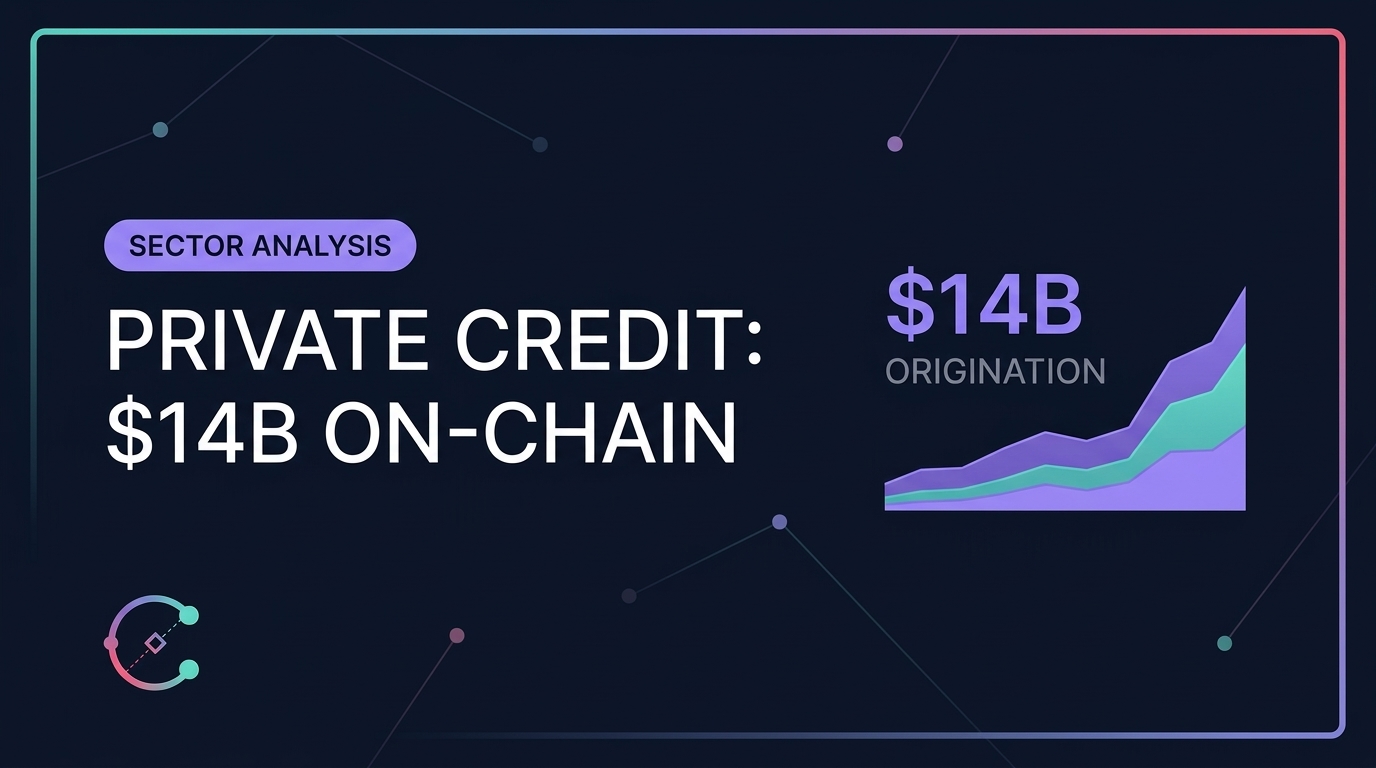
The numbers tell the story: over $14 billion in active tokenized private credit, with cumulative originations exceeding $33 billion. And two weeks ago, Apollo Global Management, the $940 billion asset manager, made its biggest DeFi move yet, signing a cooperation agreement to acquire up to 9% of lending protocol Morpho.
This isn’t a sideshow. This is the main event.
Table of Contents
What Is Tokenized Private Credit?
Private credit is lending that happens outside traditional banks. Think corporate loans, invoice financing, real estate debt, equipment leasing, trade finance. It’s a $3 trillion industry that PwC estimates could grow to $31 trillion in total addressable market.
Traditionally, this market has been slow, manual, opaque, and nearly impossible for most investors to access. Minimum investments often start at $1 million or more. Settlement takes days. Reporting is inconsistent. Liquidity is virtually nonexistent.
Tokenization changes all of that.
When private credit is tokenized, the loan or debt instrument gets represented as a digital token on a blockchain. Smart contracts automate interest payments, enforce compliance, and create transparent records of every transaction. A $10 million corporate loan can be fractionalized into thousands of tokens, each representing a slice of the debt and its yield.
The result: yields of 8-12% that were previously only available to institutional investors can now reach a much broader audience, with faster settlement and transparent reporting.
The Market Leaders
Three protocols dominate the tokenized private credit landscape. Each takes a different approach to bringing this traditionally opaque market on-chain.
Figure is the quiet giant. With over $10 billion in active loans on its books, Figure has lent more than $15 billion since inception, serving over 200,000 households across 49 U.S. states.
Their focus is Home Equity Lines of Credit (HELOCs), securitized and tokenized for investors seeking yield backed by real estate collateral. Figure alone accounts for roughly 70% of the entire tokenized private credit market.
Centrifuge pioneered the model of tokenizing invoices and real-world receivables. Small and medium enterprises can tokenize their assets as collateral to borrow stablecoins from decentralized pools, cutting out traditional banking intermediaries.
Their Tinlake pools have become a staple for DeFi investors seeking diversified exposure to global credit markets. Centrifuge’s COO recently predicted that RWA total value locked could exceed $100 billion by the end of 2026.
Maple Finance brings institutional-grade corporate lending on-chain. Pool delegates perform due diligence and credit analysis, creating a transparent environment where every loan and repayment is visible on the ledger.
CEO Sidney Powell has been vocal that private credit, not Treasuries, will be the real tokenization breakout story. In January, Maple launched syrupUSDC on Coinbase’s Base network, targeting an Aave V3 listing to expand distribution.
Goldfinch focuses on emerging markets where capital access is restricted. The protocol enables lending without crypto-native collateral, using a network of backers who evaluate borrower creditworthiness based on off-chain performance. This model has been particularly successful for providing liquidity to fintech companies and lending businesses in developing regions.
Why Apollo’s Move Changes Everything
On February 13, 2026, Apollo Global Management announced a cooperation agreement with Morpho, the DeFi lending protocol. As CoinDesk reported, under the deal Apollo can acquire up to 90 million MORPHO tokens over 48 months, representing approximately 9% of total supply.
This isn’t a speculative bet. This is infrastructure positioning.
Apollo manages $940 billion in assets. Their core business is private credit and real estate finance. They see Morpho’s on-chain lending infrastructure as a bridge to tokenized real world asset lending at scale.
The deal includes ownership caps and transfer restrictions, signaling institutional discipline rather than speculative enthusiasm. Apollo will work with Morpho to support on-chain lending markets, potentially integrating blockchain-based credit rails into their broader platform.
Apollo’s credit strategies are already being tokenized through third parties. Securitize issues ACRED, a token providing exposure to the Apollo Diversified Credit Fund. Anemoy offers ACRDX, tracking Apollo’s global credit strategies. The Morpho partnership suggests Apollo is now building the infrastructure itself, not just using someone else’s.
This follows Apollo’s 2025 partnership with Coinbase to develop stablecoin credit strategies and a “seven-figure” investment in blockchain project Plume. The pattern is clear: one of the world’s largest credit managers is systematically building its on-chain capabilities.
The Institutional Wave
Apollo isn’t alone. The past 90 days have seen an acceleration of institutional activity in tokenized credit.
Coinbase integrated Morpho’s infrastructure to support over $960 million in active crypto-backed loans, with $1.7 billion in collateral primarily backed by Ethereum and Bitcoin. Bitwise Asset Management launched its first on-chain vault on Morpho in January 2026, offering USDC deposits with yields up to 6%, marking Bitwise’s first move into non-custodial DeFi yield strategies.
Hamilton Lane, the $920 billion alternative investment manager, created a tokenized feeder fund for its Senior Credit Opportunities Fund (SCOPE). While SCOPE requires a $2 million minimum, the tokenized feeder drops the barrier to $20,000.
Securitize reported 841% revenue growth for the nine months ending September 2025 and is going public via SPAC merger at a $1.25 billion valuation. The firm has tokenized over $4 billion in assets.
BlackRock’s BUIDL fund, while technically a Treasury product, is increasingly being used as collateral in DeFi protocols, creating a bridge between tokenized government debt and private credit markets.
Why Private Credit, Not Treasuries?
Tokenized Treasuries get the headlines because they’re simple to understand. Government bonds are safe, liquid, and familiar. But private credit is where tokenization solves real problems.
Opacity is the first pain point. Traditional private credit markets are notoriously opaque. On-chain credit creates transparent, auditable records of every loan, payment, and default.
Illiquidity is the second. Private credit instruments typically have no secondary market. Tokenization enables fractional ownership and the potential for secondary trading.
Access barriers are the third. Minimum investments of $1 million or more exclude most investors. Tokenized feeder funds can drop minimums to $10,000 or less.
Settlement friction is the fourth. Traditional private credit settlement takes days. On-chain settlement can happen in minutes.
The Yield Advantage
In a world of compressed spreads, tokenized private credit offers yields that traditional markets struggle to match.
Current yields on major tokenized credit platforms range from 8-12% on the borrower side. For investors, returns vary based on risk tranche, ranging from senior secured positions yielding 6-8% to junior tranches offering 12%+ with higher risk.
Compare this to tokenized Treasuries yielding 4-5% or traditional money market funds. The spread explains why private credit dominates the RWA market by value despite receiving less attention.
The trade-off is real: higher yields come with higher risk. Private credit carries default risk, and the tokenized versions are still developing the track records needed to assess long-term performance.
The 2026 Outlook
Industry insiders are making bold predictions for tokenized private credit. Centrifuge COO Jürgen Blumberg predicts RWA TVL will exceed $100 billion by the end of 2026, driven partly by crypto volatility pushing investors toward real yield. Centrifuge CEO Bhaji Illuminati forecasts that over 50% of the top 50 asset managers will have tokenization strategies by year-end.
The fixed income market represents $130 trillion in outstanding debt globally. Even capturing a tiny fraction of that represents massive growth from today’s $14 billion.
The Bottom Line
While everyone watches tokenized Treasuries, private credit has quietly become the largest RWA segment at $14 billion, representing 58% of the market.
Figure dominates with $10 billion in active loans, primarily HELOCs. Apollo’s Morpho deal signals institutional infrastructure building, not just capital allocation. Yields of 8-12% dwarf tokenized Treasury returns of 4-5%. Liquidity, legal clarity, and regulatory frameworks remain the key challenges. And 2026 predictions suggest $100 billion+ in RWA TVL is achievable.
The institutions building tokenized private credit infrastructure today are positioning for a market that could grow 10x in the next few years. The question for everyone else: are you paying attention to the right part of the RWA story?
Welcome to Commodara, your edge in real world assets.
If this opened your eyes to the real story behind the RWA market, share it with someone who’s only watching Treasuries. And if you’re new here, this is where we track the moves that matter in the tokenized economy.
Frequently Asked Questions
What is tokenized private credit?
Tokenized private credit represents loans and debt instruments issued outside traditional banks, recorded as digital tokens on a blockchain. These include corporate loans, invoice financing, real estate debt, and trade finance. Smart contracts automate interest payments and compliance, while fractionalization allows broader investor access to yields of 8-12% that were previously restricted to institutional investors with $1M+ minimums.
How big is the tokenized private credit market?
Tokenized private credit accounts for over $14 billion in active value, representing 58% of the total RWA tokenization market. Cumulative originations exceed $33 billion. Figure leads with $10 billion in active loans (primarily HELOCs), followed by Centrifuge, Maple Finance, and Goldfinch serving different segments of the global credit market.
Why did Apollo invest in Morpho?
Apollo Global Management ($940B AUM) signed a cooperation agreement with DeFi lending protocol Morpho in February 2026, with the option to acquire up to 90 million MORPHO tokens (9% of total supply) over 48 months. The deal positions Apollo to build on-chain lending infrastructure rather than just tokenize existing strategies through third parties, signaling a shift from passive tokenization to active infrastructure development.
Why does tokenized private credit offer higher yields than Treasuries?
Tokenized Treasuries yield 4-5% because they represent low-risk government debt. Tokenized private credit yields 8-12% because it involves corporate and consumer lending with higher risk profiles. Senior secured positions typically yield 6-8% while junior tranches offer 12%+ with greater default exposure. The yield premium compensates investors for credit risk, illiquidity, and the developing track record of on-chain credit platforms.
What are the risks of tokenized private credit?
The primary risks include default risk on underlying loans, limited secondary market liquidity (though improving), evolving regulatory frameworks across jurisdictions, and the relatively short track record of on-chain credit platforms. Unlike tokenized Treasuries backed by government debt, private credit instruments carry borrower-specific risk that requires due diligence and credit analysis, which protocols like Maple address through dedicated pool delegates.