

Tokenization Talent Gap: Why Hiring Is the Biggest Bottleneck in RWA
The tokenization talent gap is now the binding constraint on how fast the RWA market can grow, with Q1 2026 adding only 2,167 new Web3 positions while hybrid roles command 30 to 50 percent salary premiums. The capital is available, the technology works, and the regulatory frameworks are arriving. What is missing is people who understand both securities law and smart contracts well enough to build in between them.
This constraint gets far less attention than regulation or liquidity, yet it shapes the pace of the entire sector. This analysis explains what the tokenization talent gap actually is, which roles are hardest to fill, what the salary data shows, why the shortage exists, and how firms are responding.
Table of Contents
This analysis opens with why the tokenization talent gap is a genuine bottleneck rather than a hiring complaint. It then identifies the specific roles that go unfilled, examines the salary premiums the shortage has produced, explains the structural reasons the gap exists, and closes with how firms are responding, including the role AI now plays, followed by the most common questions and the bottom line.
Why the Tokenization Talent Gap Is a Real Bottleneck
Tokenization sits at the intersection of two fields that have almost no overlap in their traditional talent pools. Securities law, fund administration, and compliance produce professionals who rarely touch code. Blockchain engineering produces professionals who rarely read an offering memorandum. Tokenization requires people fluent in both.
That combination is rare because nothing in the traditional career path produces it. A securities lawyer does not become a smart contract auditor through normal progression, and a protocol engineer does not accidentally learn transfer agent obligations. The overlap has to be built deliberately, and building it takes years that the market has not had.
The consequence is a queue. Projects that could launch are waiting for a compliance lead who understands on-chain transfer restrictions, or an engineer who can implement a permissioned token without breaking the securities framework around it. Capital is not the constraint, and neither is demand. Staffing is, and the tokenization talent gap converts directly into delayed launches.
Regulation compounds the problem. Every jurisdiction that publishes a tokenization framework creates demand for people who understand that specific framework and can implement it on-chain. Regulatory progress, which the sector treats as unambiguously good news, therefore increases the size of the shortage in the short run even as it improves the long-run outlook.
Which Roles Go Unfilled
The shortage is not uniform. It concentrates in a handful of hybrid roles where two skill sets must coexist in one person.
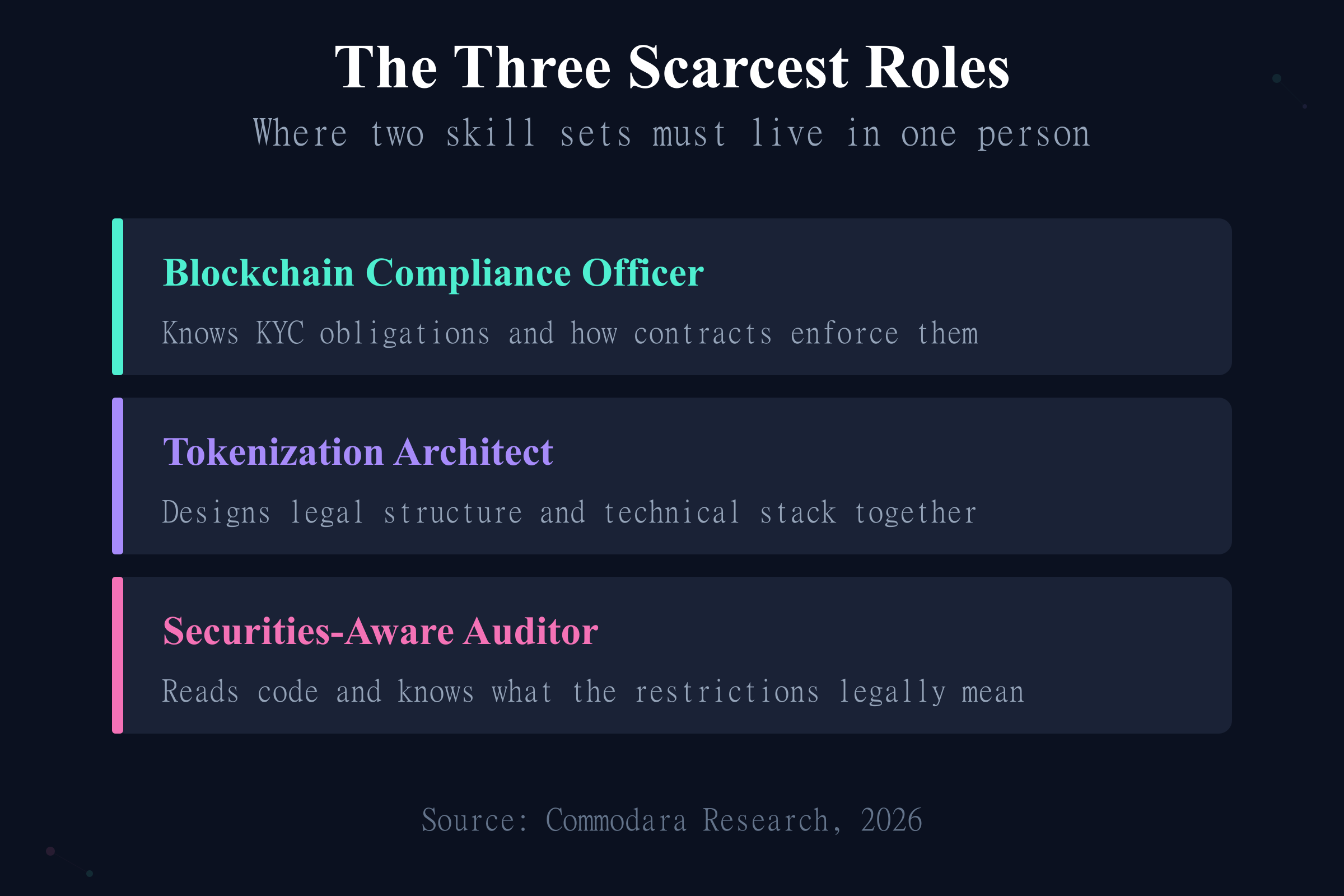
Blockchain compliance officers are the scarcest. These are professionals who understand KYC and AML obligations as covered in our guide to KYC and AML for tokenized assets, and who can also read how those obligations are enforced in a smart contract. Every regulated issuer needs one, and there are not enough to go around.
Tokenization architects are the second scarcity. This role designs the legal and technical structure together, deciding how an SPV, a token standard, a transfer agent, and a custody arrangement fit into one coherent system. It requires seniority in finance and fluency in blockchain, a combination that typically takes a decade to accumulate.
Smart contract auditors with securities knowledge are the third. General smart contract auditing is a mature discipline, but auditing a contract that must enforce regulatory transfer restrictions requires understanding what those restrictions legally mean. A technically perfect contract that permits a non-compliant transfer is a failure, and spotting that requires legal context.
Beneath these three sits a wider set of roles that are merely difficult rather than nearly impossible: transfer agents comfortable with on-chain registers, fund administrators who can handle tokenized share classes, and operations staff who understand wallet infrastructure. These are trainable within months rather than years, which is why most firms attack the shortage from this end first.
What the Salary Data Shows
Scarcity shows up in compensation, and the tokenization talent gap has produced clear premiums for hybrid skills.
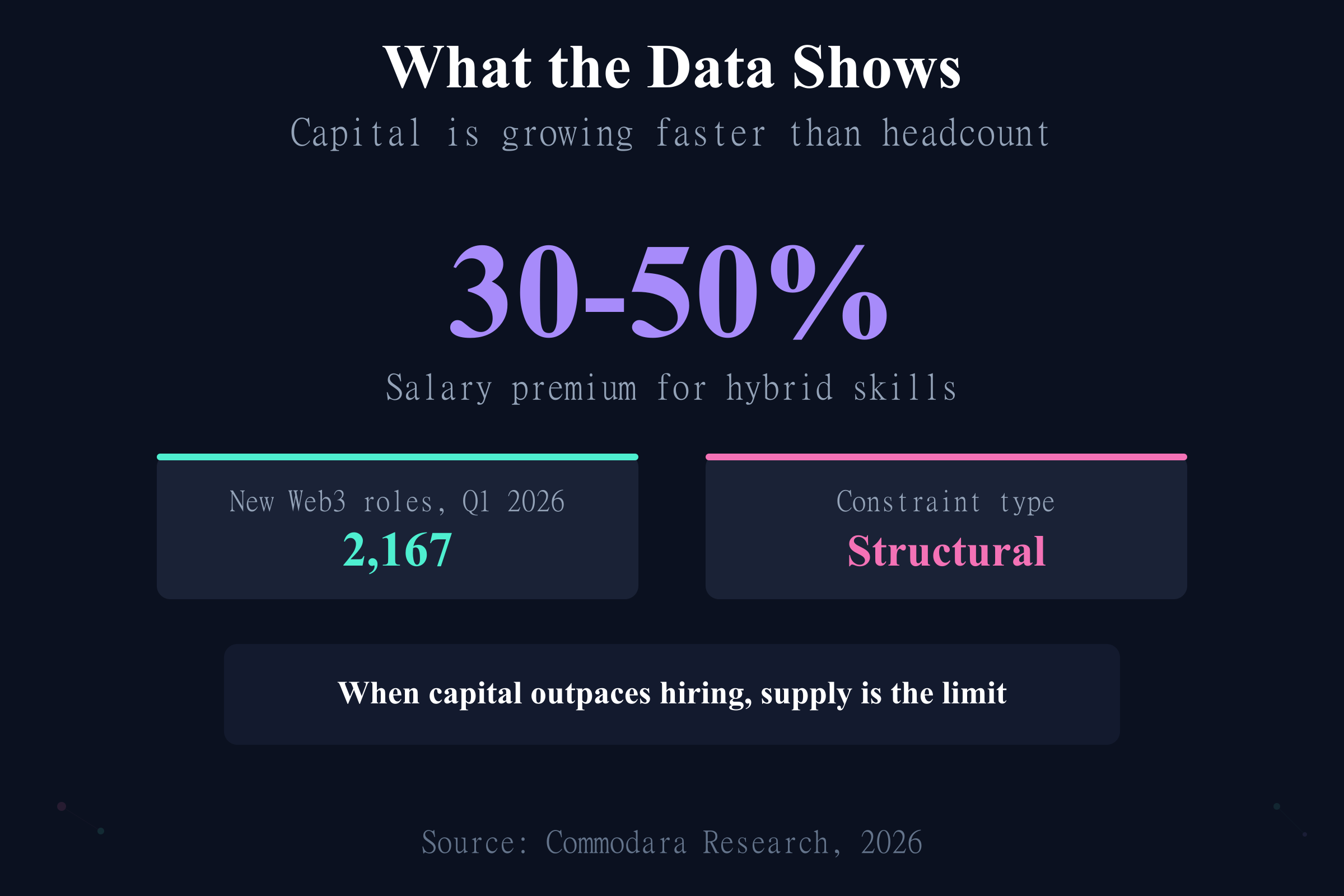
Roles that combine regulatory and technical expertise command premiums in the range of 30 to 50 percent over single-discipline equivalents. A compliance officer who can work on-chain earns materially more than one who cannot; an engineer who understands securities constraints earns more than one who only ships code. The market is pricing the intersection, not either component.
The hiring volume data tells the other half of the story. Employment research from firms including Gate and workforce trackers such as CoinLaw has documented that new position creation across the sector remains modest relative to capital inflows. Roughly 2,167 new Web3 positions in a quarter is not a large number for an industry attracting billions in institutional commitments.
That mismatch is the clearest evidence of a structural gap rather than a cyclical one. When capital grows faster than headcount, the constraint is not budget. It is the supply of people qualified to be hired.
The imbalance is easier to see against market growth. As our analysis of the tokenized asset market shows, assets under management have expanded far faster than the workforce servicing them. A sector that grows its asset base several times over while adding roles in the low thousands per quarter is running an increasingly thin operational layer beneath a widening pile of capital.
Why the Gap Exists
Three structural factors explain why the tokenization talent gap has persisted rather than closing on its own.
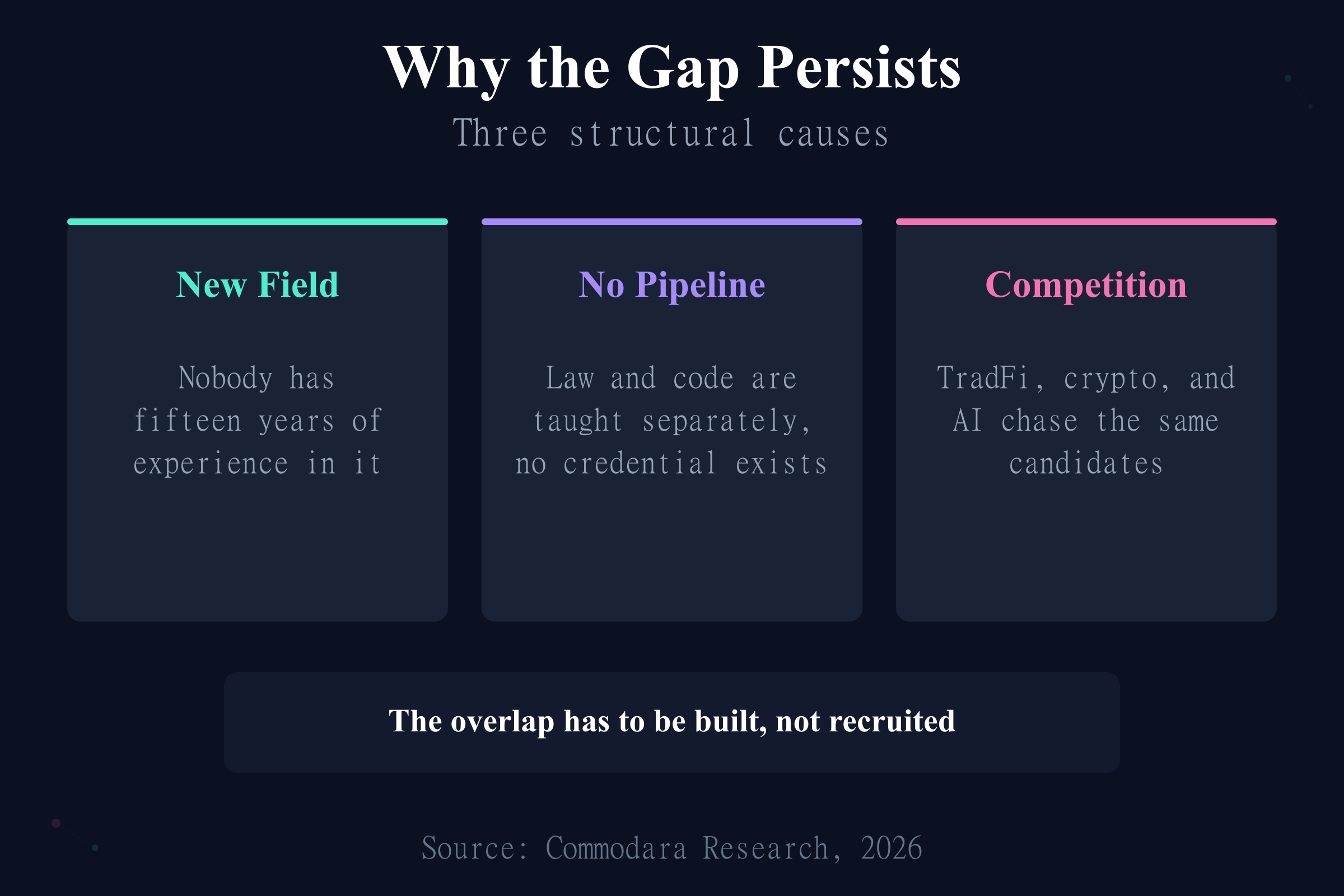
The first is that the field is genuinely new. Tokenization at institutional scale is only a few years old, so nobody has fifteen years of experience in it. Senior roles are filled by people converting from adjacent fields, which takes time and produces uneven results.
The second is that training pipelines do not exist. Universities teach securities law and computer science separately, and professional certifications for tokenization are nascent. There is no standard credential an employer can screen for, so hiring becomes slow and judgment-heavy, which further restricts throughput.
The third is competition from adjacent industries. The same people who could work in tokenization are sought by traditional finance, general crypto, and increasingly by AI companies, all of which can pay well and offer clearer career paths. Tokenization competes for talent against sectors with more established reputations.
There is also a reputational lag. Many experienced finance professionals still associate blockchain with the retail speculation cycles of previous years rather than with regulated securities infrastructure. That perception makes senior candidates hesitant to move, even when the work is closer to fund structuring than to anything they associate with crypto, and it slows exactly the conversions the sector needs most.
How Firms Are Responding
The firms making progress are the ones that stopped waiting for perfect candidates to appear.
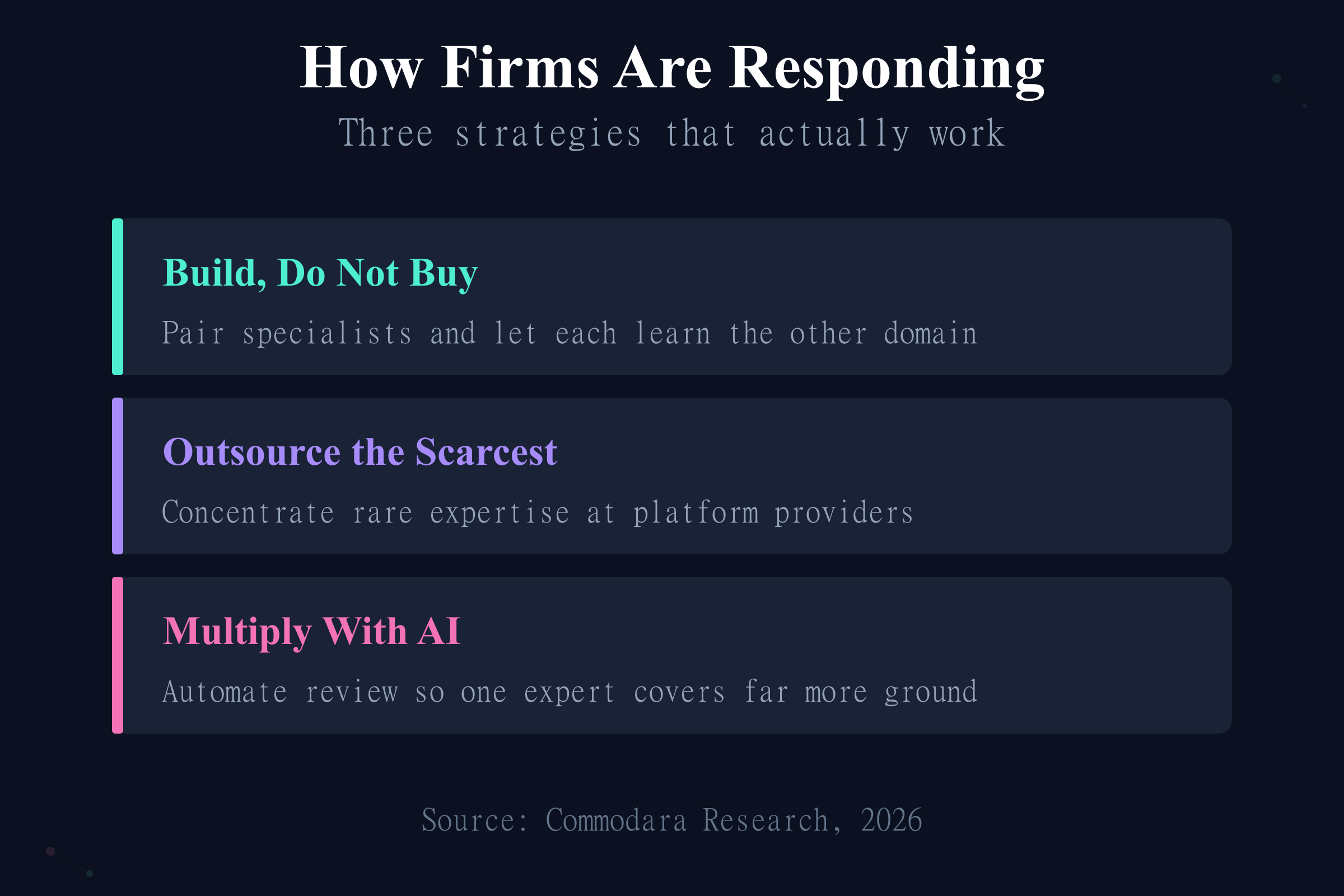
The dominant strategy is building rather than buying. Firms hire strong single-discipline professionals and train them into the intersection, pairing a securities lawyer with an engineer and giving both time to learn the other’s domain. It is slower than hiring a ready-made expert, but ready-made experts largely do not exist.
The second strategy is outsourcing the scarcest functions. Rather than each issuer employing a tokenization architect, many rely on platforms that supply the expertise as part of the service, an approach visible across the providers in our comparison of the leading tokenization platforms. Concentrating scarce talent at infrastructure providers is more efficient than spreading it thinly across every issuer.
The third is AI. Automated tools now handle document review, compliance checks, contract analysis, and monitoring tasks that previously consumed specialist hours. This does not replace the hybrid expert, but it raises how much one expert can cover, which effectively multiplies scarce capacity. For teams assessing what they can realistically execute in-house, it is worth using a structured process to assess your tokenization readiness before committing to a hiring plan.
A fourth response, less discussed, is redesigning the work itself. Some firms have split the hybrid role into a defined pair, a legal owner and a technical owner with a shared mandate and joint accountability, rather than searching for one person who can do both. It sacrifices some speed of decision-making but makes the role fillable from talent pools that actually exist today.
None of these responses is a quick fix, and firms that treat hiring as something to solve after the strategy is set tend to discover the constraint late. The teams moving fastest are the ones that scoped their tokenization plans around the capability they could realistically assemble, rather than around what the technology theoretically permits.
Frequently Asked Questions
What is the tokenization talent gap?
The tokenization talent gap is the shortage of professionals who combine financial and regulatory expertise with blockchain technical skills. Because tokenization sits between securities law and smart contract engineering, it requires hybrid capability that traditional career paths rarely produce, which constrains how quickly projects can launch.
Which tokenization roles are hardest to fill?
Blockchain compliance officers, tokenization architects, and smart contract auditors with securities knowledge are the scarcest. Each requires fluency in both a regulated financial discipline and blockchain implementation, a combination that typically takes years to build and cannot be hired quickly.
How much do tokenization professionals earn?
Roles combining regulatory and technical expertise command premiums in the range of 30 to 50 percent over single-discipline equivalents. The market prices the intersection of skills rather than either component alone, which is a direct reflection of how few people hold both.
Why has the talent gap not closed on its own?
Three reasons: the field is new so nobody has deep experience in it, training pipelines and standard credentials do not yet exist, and adjacent industries including traditional finance, crypto, and AI compete for the same people with clearer career paths and comparable pay.
Can AI solve the tokenization talent gap?
AI reduces the pressure rather than removing it. Automated document review, compliance checking, and monitoring let one specialist cover far more ground, effectively multiplying scarce capacity. It does not replace the judgment of a hybrid expert, but it changes how many of them a firm needs.
The Bottom Line
The tokenization talent gap is the constraint the sector talks about least and encounters most. Regulation is arriving, capital is committed, and the infrastructure works, but projects still stall waiting for people who can operate across the boundary between securities law and blockchain engineering.
The gap will close, though not quickly. It closes as people convert from adjacent fields, as training and credentials mature, as platforms concentrate scarce expertise, and as AI raises the leverage of each specialist. None of these is fast, which is why hiring will shape sector growth rates for several more years.
For firms building in this market, the practical implication is to treat staffing as a strategic constraint rather than an operational detail. Subscribe to the Commodara newsletter for ongoing analysis of the workforce, infrastructure, and market forces shaping the tokenization talent gap.