
AI Agents in Tokenization: The New Buyer Class for RWA Markets
AI agents tokenization demand is emerging as a structurally new buyer class, one that cannot open bank accounts, cannot access traditional funds, and can only hold yield through tokenized instruments. Every previous expansion of the investor base added more humans. This one adds software that holds capital, earns yield, and settles payments without a person in the loop.
The significance is easy to underestimate because the current volumes are small. This analysis explains why AI agents tokenization needs are structurally different, what agents can and cannot buy, why tokenized Treasuries are their natural instrument, and what issuers would have to build to serve them.
Table of Contents
This analysis opens with why AI agents represent a genuinely new buyer class rather than an extension of existing demand. It then explains why traditional finance excludes them, what they can and cannot buy today, and why tokenized Treasuries have become the default instrument. The closing sections cover what issuers must build to serve machine buyers and the risks involved, followed by the most common questions and the bottom line.
Why AI Agents Tokenization Demand Is Structurally New
An autonomous agent managing capital has requirements no human investor has. It operates continuously rather than during business hours, transacts in amounts that may be fractions of a cent, and needs to verify outcomes programmatically rather than by reading a statement. It also has no legal personality of its own.
That last point is the structural one. A human investor, however small, can be identified, verified, and granted an account. An agent cannot, because the entire apparatus of financial access assumes a legal person behind the request. Agents are therefore not underserved by traditional finance in the way retail investors once were; they are categorically excluded from it.
This is what makes the demand structurally new rather than incremental. Previous market expansions lowered barriers so more people could participate. AI agents tokenization demand does not come from lowering a barrier at all, because no amount of reduced minimums or simplified onboarding makes a bank account available to software. The exclusion is definitional, and tokenized instruments are the only current workaround.
The scale question is genuinely open. Autonomous settlement today is measured in tens of millions of dollars, which is negligible against a tokenized market in the tens of billions. What makes AI agents tokenization worth watching is not the current number but the direction: every additional agent deployed to manage capital adds a buyer that has no alternative venue, and the number of deployed agents is growing quickly across enterprise software.
Why Traditional Finance Cannot Serve Them
The exclusion has three specific causes, each rooted in how financial access is designed.
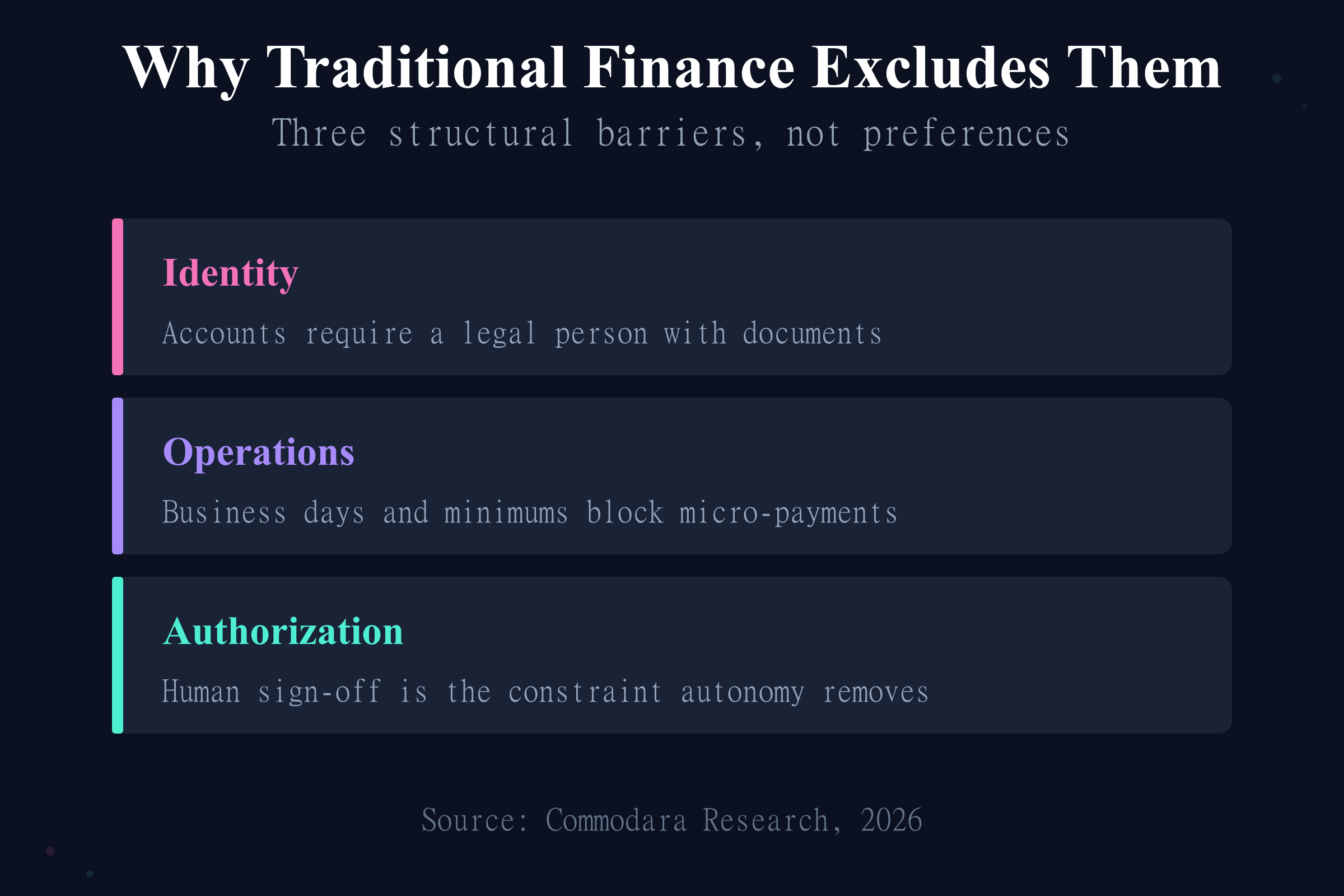
The first is identity. Opening an account requires identity verification of a legal person, with documentation, beneficial ownership disclosure, and ongoing obligations. An agent has none of these, and the frameworks described in our guide to KYC and AML for tokenized assets were written on the assumption that a human or a company sits behind every wallet.
The second is operational. Traditional settlement runs on business days and batch cycles, with minimum transaction sizes that make micro-payments uneconomic. An agent that needs to settle a fraction of a cent at three in the morning has no traditional mechanism available, regardless of whether it could pass an identity check.
The third is authorization. Financial systems require a human to approve consequential actions, which is precisely the constraint autonomy is designed to remove. A system that requires a person to sign off on every transaction cannot serve an agent whose value depends on operating without one.
What Agents Can and Cannot Buy
Not every tokenized asset is accessible to an autonomous buyer, and the dividing line is compliance rather than technology.
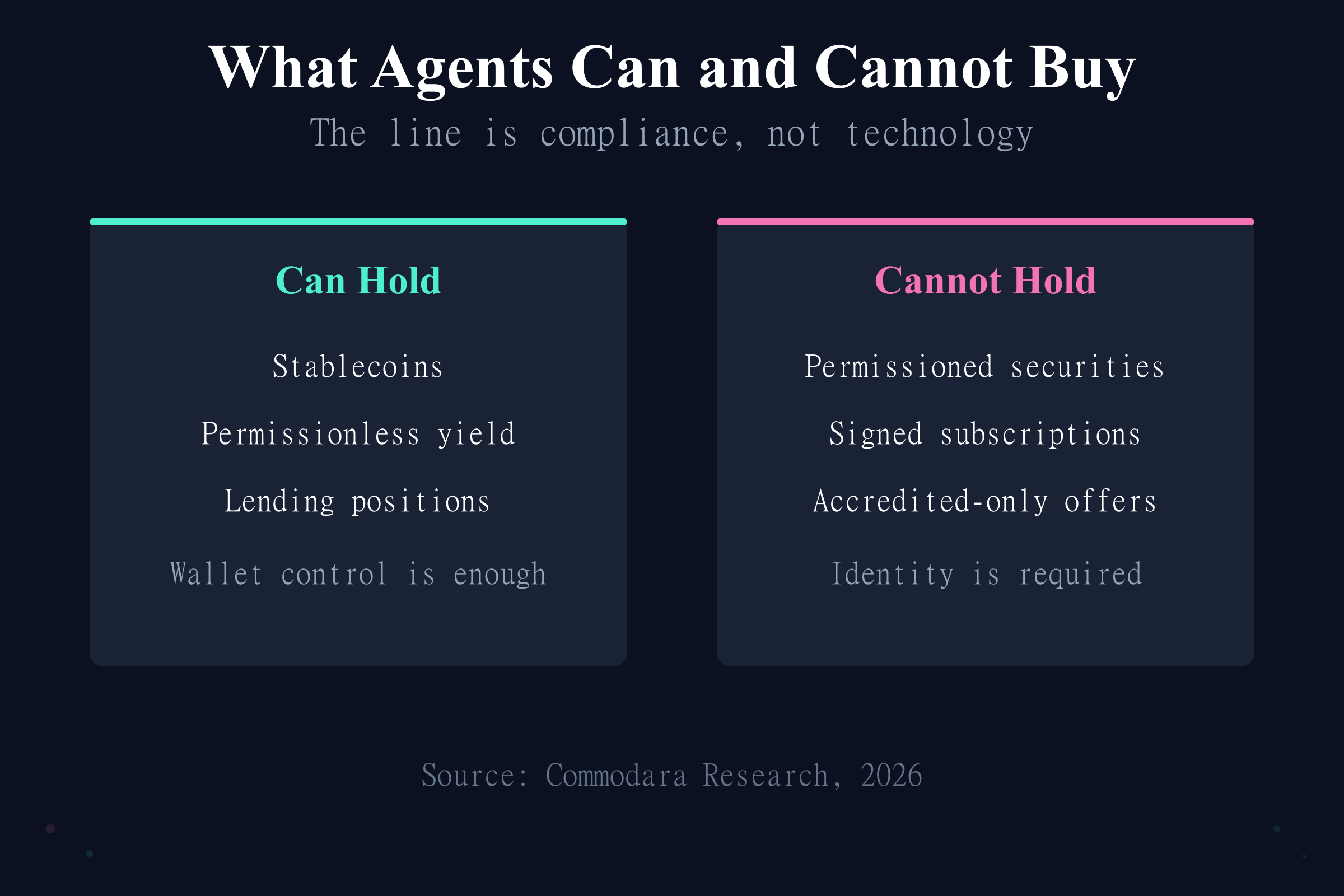
Agents can hold permissionless tokenized instruments: stablecoins, and tokenized yield products available without individual whitelisting. They can supply liquidity, lend, borrow against collateral, and settle payments, because none of these require a counterparty to verify who they are beyond controlling a wallet.
Agents cannot buy permissioned securities that restrict transfers to whitelisted addresses tied to verified identities, which covers most regulated tokenized offerings. They cannot complete subscription processes requiring signed documents, and they cannot satisfy accreditation requirements. The tokenized assets with the strongest legal protections are, by design, the ones agents cannot access.
This creates an odd inversion. The instruments best suited to machine buyers are the least regulated ones, while the carefully structured products described in our guide to tokenization structures are closed to them. Any issuer wanting to serve this demand has to solve that tension rather than ignore it.
The practical consequence is that agent capital currently concentrates in the least protected corner of the tokenized market. That is a poor outcome for everyone: agents bear more risk than necessary, and the issuers with the strongest structures see none of the demand. Resolving it is less about technology than about whether compliance frameworks can recognize a verified principal acting through software.
Why Tokenized Treasuries Are the Default
Among the instruments agents can access, tokenized Treasuries have become the natural home for machine-held capital.
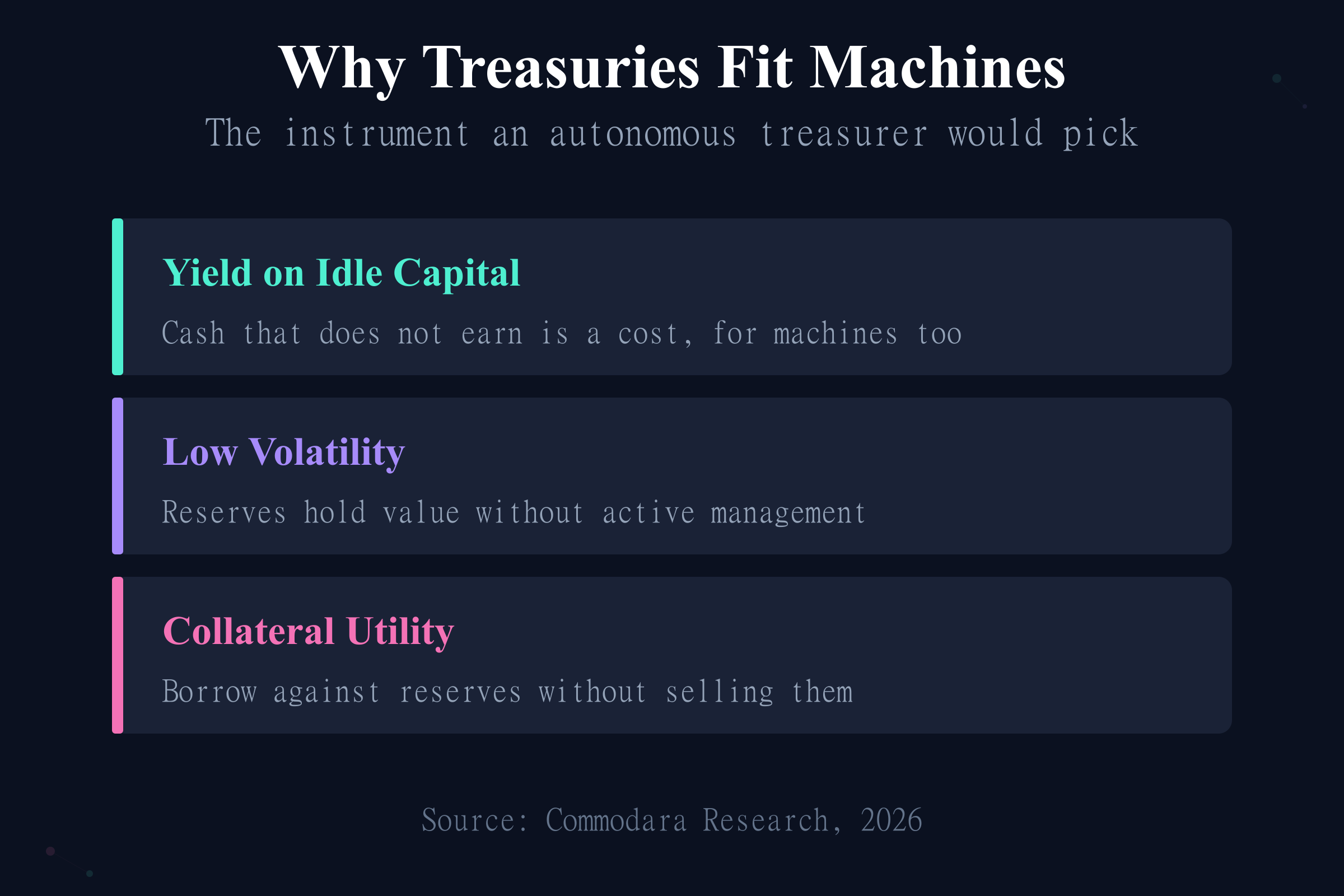
The logic mirrors why they dominate on-chain collateral. An agent holding idle capital faces the same problem as any treasurer: cash that does not earn is a cost. Tokenized Treasuries offer the risk-free rate with low volatility and redemption liquidity, which is exactly the profile a system managing working capital should hold. Our comparison of the leading tokenized Treasury funds covers the main options.
Their role as collateral reinforces this. As described in our analysis of RWA DeFi collateral, tokenized Treasuries are accepted across lending markets, so an agent can hold yield-bearing reserves and borrow against them without liquidating. For an autonomous system, that combination of yield, stability, and collateral utility is difficult to replicate with any other instrument.
What Issuers Would Have to Build
Serving machine buyers requires infrastructure most tokenized offerings do not currently have.
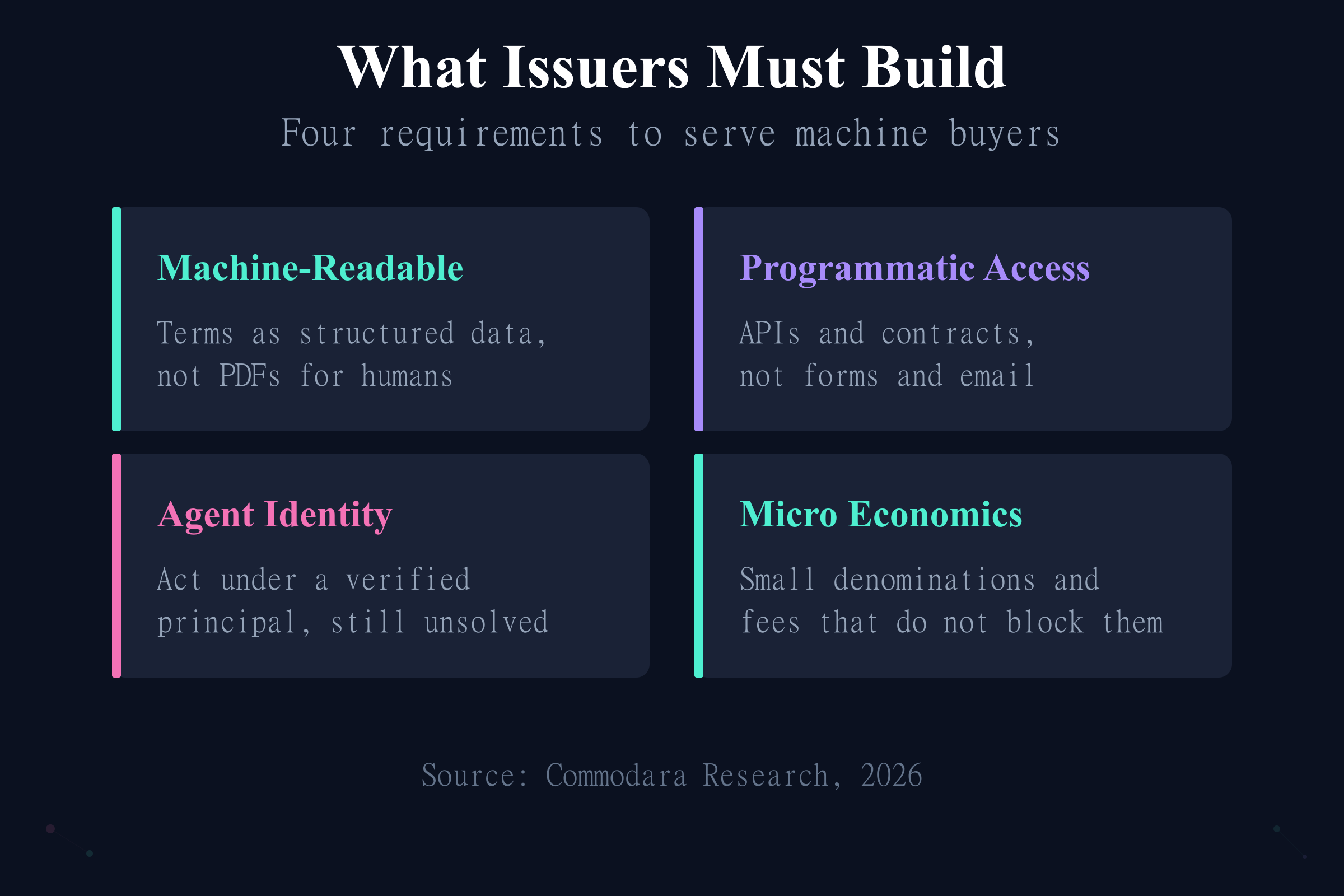
The first requirement is machine-readable everything. Terms, yields, redemption conditions, and risk disclosures need to exist as structured data an agent can parse, not as PDFs written for humans. An agent cannot evaluate an offering memorandum, so an offering that exists only in prose is invisible to it.
The second is programmatic access. Subscription, redemption, and reporting need API and smart contract interfaces rather than forms and email. The third is agent-compatible identity, which is the genuinely unsolved piece. Emerging standards for on-chain agent identity and delegated authority aim to let an agent act under a verified principal’s authorization, giving compliance systems something to check without requiring the agent itself to be a legal person. Standards work in this area is published through the Ethereum improvement proposal process, where agent identity and delegated authority specifications are being drafted.
None of this is speculative engineering. Each requirement is a known gap with an obvious solution, and the reason they remain unbuilt is that the demand has not yet justified the work. That calculation changes as agent-held capital grows, which is why some issuers are building ahead of the demand rather than waiting for it.
The fourth is economic compatibility: micro-denominations, continuous availability, and fee structures that do not make small automated transactions uneconomic. Issuers weighing whether this is worth building can estimate the cost of tokenizing and maintaining an asset against the size of the demand they expect.
The Risks of a Machine Buyer Base
A buyer class that acts without human judgment introduces risks worth stating plainly.
Correlated behavior is the largest. Agents running similar strategies on similar data will act simultaneously, turning a modest price move into a coordinated rush in either direction. Human markets have diversity of opinion and reaction speed as natural dampeners, and a market dominated by automated participants loses both.
Accountability is the second. When an agent makes a loss-making or non-compliant transaction, responsibility sits somewhere between the operator, the developer, and the counterparty that accepted it, and no framework yet resolves this cleanly. The third is that automated demand can look like organic growth. An issuer seeing volume from agents should understand that this capital has no loyalty, no relationship, and will leave the moment the yield differential inverts.
Coverage of the agent economy from outlets such as CoinDesk has tracked both the enthusiasm and the early failures, and the pattern is familiar: capability arrives before governance, and the gap between them is where losses happen. Treating AI agents tokenization as an infrastructure question rather than a growth story is the more useful frame for anyone building into it.
Frequently Asked Questions
What is AI agents tokenization?
AI agents tokenization refers to autonomous software systems holding and transacting in tokenized assets. Because agents cannot open bank accounts or pass identity checks as legal persons, tokenized instruments are the only financial products they can currently access, hold for yield, and settle with directly.
Why can’t AI agents use traditional finance?
Three reasons: identity verification requires a legal person with documentation an agent does not have; settlement runs on business days with minimums that make micro-transactions uneconomic; and financial systems require human approval for consequential actions, which is the exact constraint autonomy removes.
What tokenized assets can AI agents actually buy?
Agents can hold permissionless instruments such as stablecoins and tokenized yield products that do not require individual whitelisting, and can lend, borrow, and settle. They cannot buy permissioned securities restricted to verified whitelisted addresses, which covers most regulated tokenized offerings.
Why do AI agents hold tokenized Treasuries?
Because idle capital is a cost. Tokenized Treasuries offer the risk-free rate with low volatility and redemption liquidity, and they are widely accepted as collateral, so an agent can earn yield on reserves and borrow against them without selling. No other accessible instrument combines those properties.
What must issuers build to serve agent buyers?
Machine-readable terms and disclosures as structured data, programmatic subscription and redemption interfaces, agent-compatible identity allowing action under a verified principal’s authorization, and economics supporting micro-denominations and continuous availability without prohibitive fees.
The Bottom Line
AI agents tokenization demand is small today and structurally significant regardless. This is the first buyer class in modern finance that traditional infrastructure cannot serve at any price, which means tokenized instruments are not a better option for them but the only option.
For issuers, the question is whether to build for a buyer that cannot read a document, cannot sign a subscription agreement, and cannot be identified in the way every existing compliance framework expects. Those are real engineering and legal problems, and the identity piece in particular is genuinely unsolved rather than merely unbuilt.
The risks deserve equal weight: correlated automated behavior, unresolved accountability, and capital with no loyalty. Whether AI agents tokenization becomes a meaningful market or stays a niche depends on how those are handled. Subscribe to the Commodara newsletter for ongoing analysis of the agent economy and the tokenized instruments it depends on.