
Wall Street Tokenization: How NYSE, Securitize, and BlackRock Are Building the Rails
Wall Street tokenization shifted from conference talking points to production infrastructure in early 2026, with NYSE, Securitize, and BlackRock committing real capital to on-chain rails. The largest asset manager in the world now runs a tokenized fund measured in billions of dollars, the exchange group behind the New York Stock Exchange is building toward tokenized securities trading, and the platform that connects issuers to investors settles regulated assets on public blockchains every day.
This is no longer a thesis about where finance might go. It is a map of who is building, what is already live, and where the gaps still sit. This article breaks down the Wall Street tokenization stack layer by layer, from asset issuance to final settlement, and explains what institutional decision-makers and industry builders should watch as these rails move from pilot to permanent.
Table of Contents
This analysis opens with what Wall Street tokenization actually means and the four-layer structure beneath it. It then profiles the institutions building each layer: BlackRock at the asset level, Securitize across tokenization and transfer agency, NYSE and ICE at the exchange, and DTCC in settlement. The closing sections cover what is already live versus what comes next, a set of frequently asked questions, and the bottom line for institutional decision-makers.
What Wall Street Tokenization Actually Means
Wall Street tokenization refers to the migration of traditional financial assets, including money market funds, treasuries, private credit, and equities, onto blockchain rails operated under existing securities law. It is a separate phenomenon from the retail crypto market, because every layer is engineered to satisfy the custody, compliance, and reporting obligations that regulated institutions cannot waive.
The tokenized real world asset market, excluding stablecoins, surpassed 30 billion dollars in value entering 2026, with tokenized treasuries alone accounting for roughly 7 billion. Those figures are still small against the hundreds of trillions of dollars in global securities, which is exactly why the institutions building the rails treat this moment as an early land grab rather than a settled market.
The appeal for institutions is operational before it is ideological. On-chain rails allow near-instant settlement, programmable compliance, and collateral that can move between venues without waiting for a traditional clearing cycle. Those efficiencies free up capital and reduce counterparty risk, which is why treasury desks and fund administrators are among the earliest adopters rather than trading desks chasing returns.
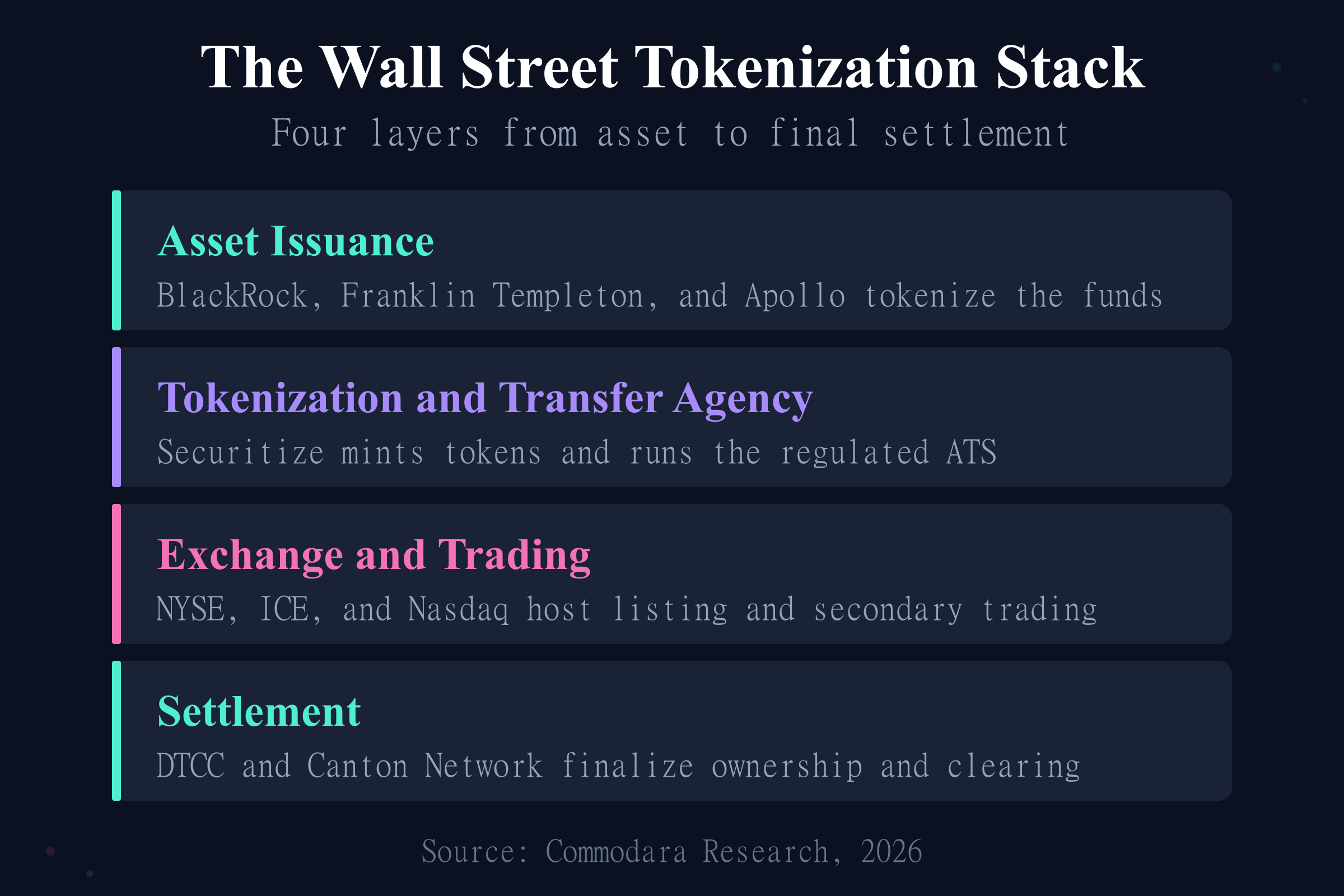
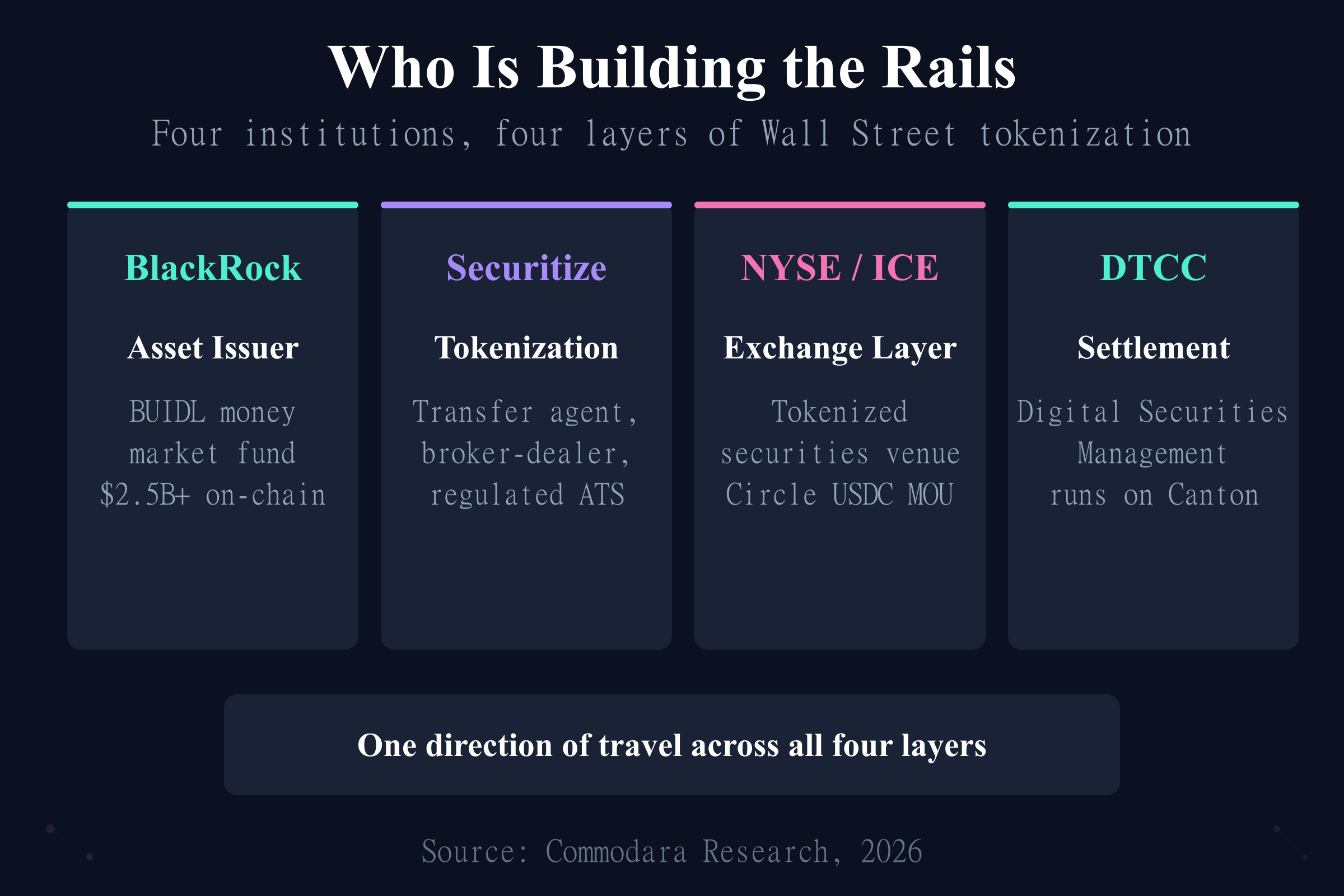
To see who is doing what, it helps to separate Wall Street tokenization into four distinct layers. The asset issuers decide which products get tokenized. The infrastructure platforms mint and administer the tokens. The venues provide a place for tokenized securities to trade. The settlement systems finalize ownership and clear the trade. BlackRock, Securitize, NYSE, and DTCC map almost cleanly onto those four layers, which is what makes their combined activity so telling.
BlackRock’s Tokenization Strategy and the BUIDL Fund
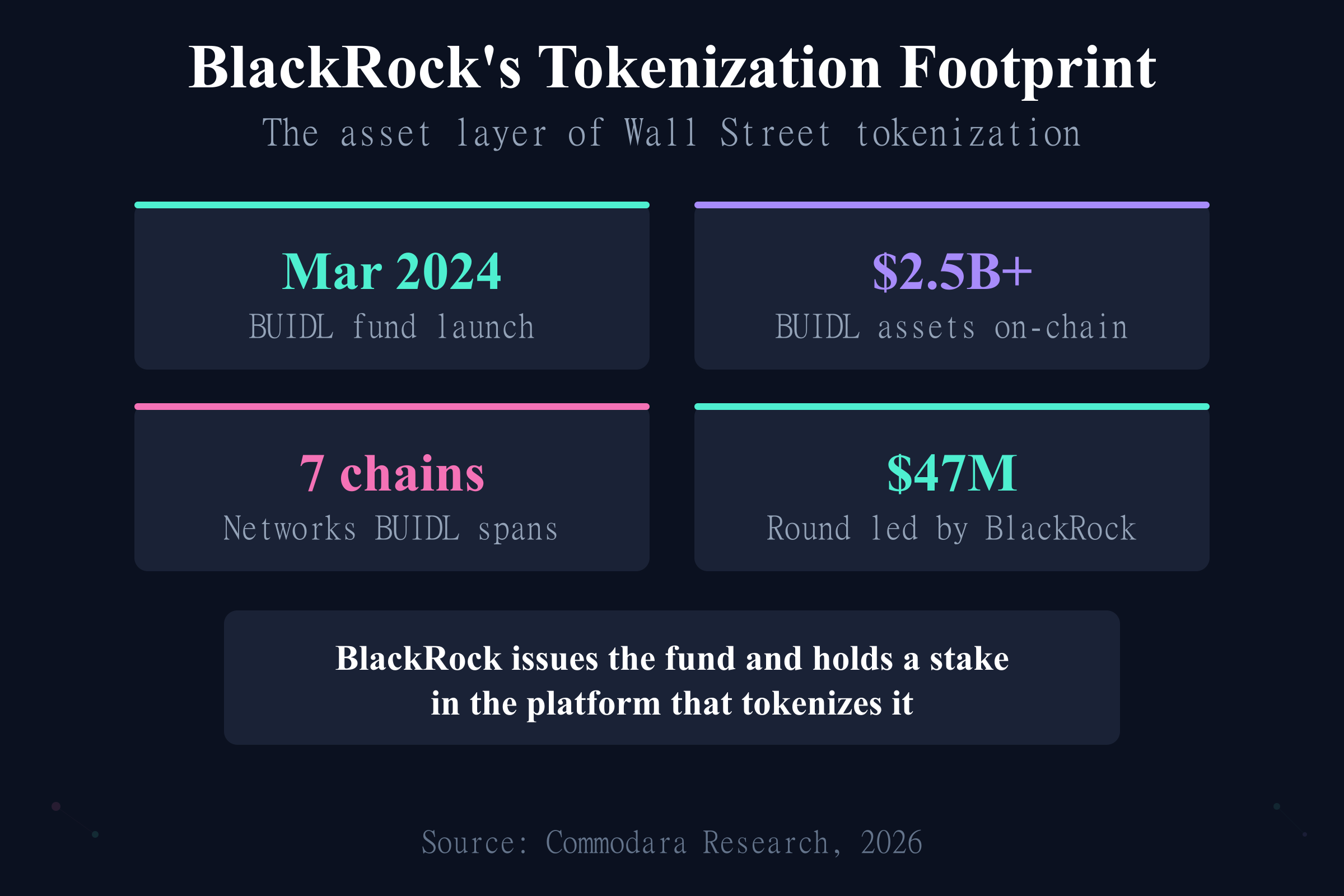
BlackRock sits at the asset layer, and its BUIDL fund is the clearest signal of intent in the entire market. The BlackRock USD Institutional Digital Liquidity Fund launched in March 2024 as a tokenized money market fund holding cash, US Treasury bills, and repurchase agreements, with each share represented by an on-chain token.
BUIDL grew into the largest tokenized treasury product on the market, holding more than 2.5 billion dollars by 2026 and expanding across seven blockchains, including Ethereum, Solana, and several layer-two networks. That reach matters because it lets the fund serve as a reserve asset for other on-chain products rather than sitting in isolation.
Chief executive Larry Fink has repeatedly framed tokenization as the next generation for markets, arguing that exchange-traded funds were one step and tokenized securities are the next. BlackRock’s role in Wall Street tokenization is not limited to issuing a fund. In 2024 the firm led a 47 million dollar funding round in Securitize, the platform that tokenizes BUIDL, taking both an equity stake and a board seat. The asset manager did not just tokenize a product. It bought into the infrastructure underneath it.
The reserve-asset role is the part most observers underestimate. Because BUIDL holds short-term US government debt and settles on-chain, other issuers use it as the yield-bearing cash layer inside stablecoins, lending protocols, and tokenized funds. A single BlackRock product has quietly become foundational plumbing for the wider tokenized economy, which deepens the firm’s influence well beyond its own balance sheet.
Securitize and the Infrastructure Behind the Rails
If BlackRock decides what to tokenize, Securitize is the company that actually does it. Registered with the SEC as a transfer agent and operating both a broker-dealer and an alternative trading system, Securitize occupies the layer where regulation and blockchain meet. It mints the tokens, maintains the official register of ownership, and provides a compliant venue for those tokens to change hands.
The client list reads like a directory of traditional finance. Beyond BlackRock BUIDL, Securitize has tokenized funds for Apollo, Hamilton Lane, VanEck, and KKR, bringing private credit, private equity, and treasury strategies on-chain. Our breakdown of Securitize tokenization infrastructure covers how the transfer agent model turns a blockchain token into a legally recognized security.
The most important recent development is regulatory rather than technical. As Securitize secured broader authority to custody and settle tokenized securities inside a regulated broker-dealer, it closed one of the last gaps that kept large institutions on the sidelines. The Wall Street tokenization rails do not work without a party that regulators recognize as the keeper of record, and Securitize has positioned itself as exactly that. You can review the platform directly on the Securitize website.
NYSE, ICE, and the Exchange Layer
The exchange layer of Wall Street tokenization is where the New York Stock Exchange enters. NYSE is owned by Intercontinental Exchange, or ICE, one of the largest exchange operators in the world, and ICE has moved deliberately toward tokenized markets rather than announcing a single flashy launch.
In 2025 ICE signed a memorandum of understanding with Circle to explore using regulated stablecoins, including USDC and the yield-bearing USYC, across its exchanges, clearing houses, and data services. Stablecoins are the cash leg of any tokenized trade, so bringing them into ICE’s plumbing is a prerequisite for tokenized securities settlement at exchange scale.
The strategic logic is straightforward. An exchange earns fees from listing and trading, and tokenized securities need both a venue to list on and a place to trade after issuance. For a deeper view of how the venues are positioning, see our analysis of how NYSE, Nasdaq, and Robinhood are moving stocks on-chain. ICE has published its broader market and digital asset initiatives on the NYSE site, and the direction of travel is clear even where specific products remain in development.
Competition sharpens the timeline. Nasdaq has moved to enable tokenized versions of listed securities, and once one major exchange offers on-chain trading, the others cannot afford to wait. For NYSE and ICE, tokenization is less an experiment than a defense of the listing and trading franchise that generates their core revenue.
DTCC, Canton, and the Settlement Rails
Underneath issuance, tokenization, and trading sits the least visible but most important layer: settlement. The Depository Trust and Clearing Corporation, which settles the overwhelming majority of US securities transactions, has built its Digital Securities Management platform to issue, transfer, and settle tokenized securities on institutional-grade infrastructure.
DTCC runs much of this work on Canton Network, a privacy-enabled blockchain designed for regulated institutions. That choice tells you settlement will not happen on a fully public chain where every position is exposed. Institutions require privacy between counterparties, and Canton was built to provide it. Our explainer on the institutional blockchain settling these trades details how the network keeps transaction data private while preserving atomic settlement.
The presence of DTCC is what separates this cycle from earlier blockchain experiments. When the entity that underpins existing settlement infrastructure builds production tokenization rails, the rest of Wall Street treats the technology as durable rather than speculative. That endorsement is difficult to manufacture and even harder to reverse once capital and operations are committed.
What Is Live and What Comes Next
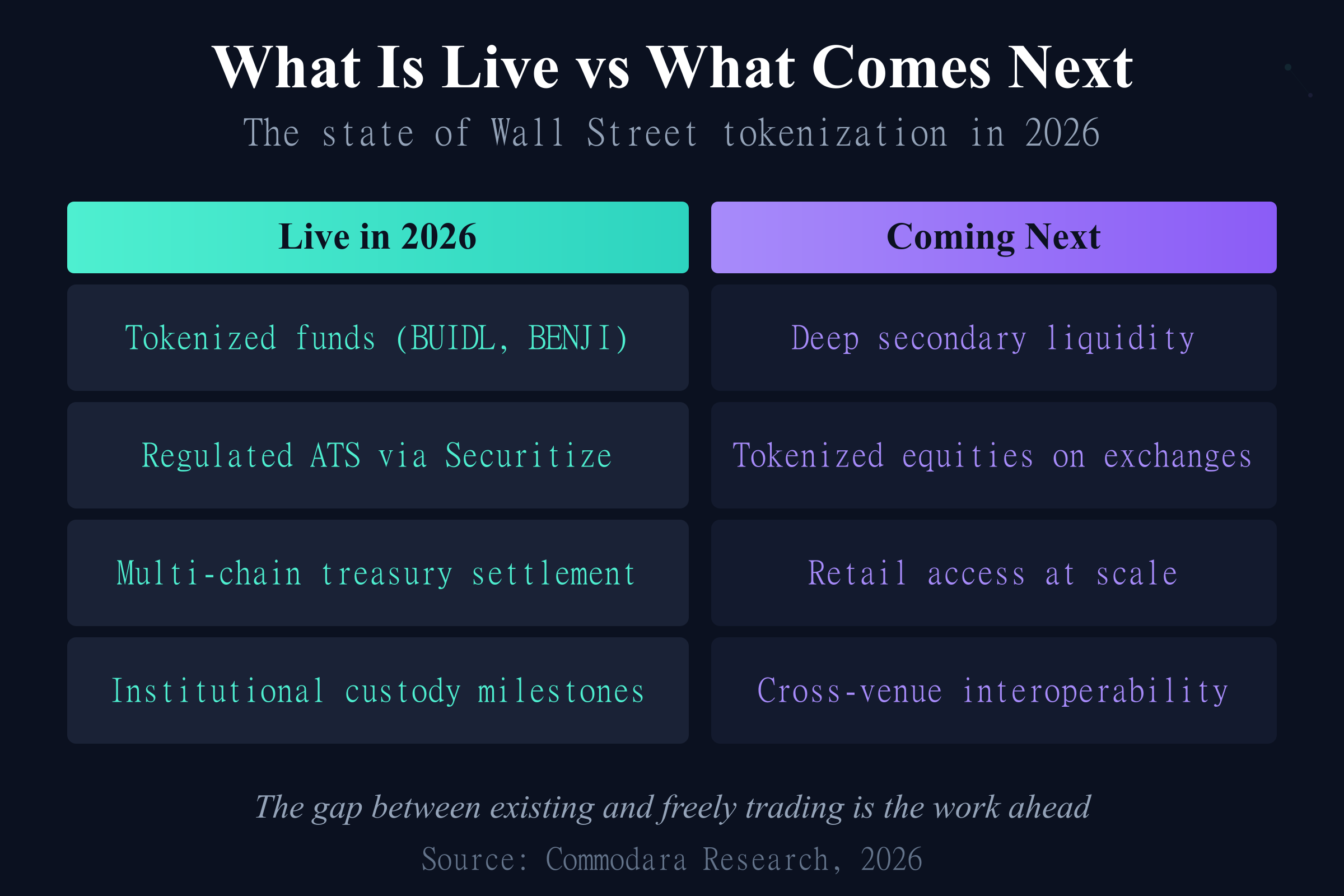
Wall Street tokenization is already live in several concrete forms. Tokenized money market funds like BUIDL and Franklin Templeton’s BENJI move value across chains today. Securitize operates a regulated trading system for tokenized securities. Institutional custody and transfer-agent milestones have cleared, and multi-chain treasury settlement runs daily rather than as a one-off demonstration.
What comes next is harder and more valuable. Deep secondary market liquidity remains thin, tokenized equities on major exchanges are still in development, and retail access at scale depends on regulatory clarity that varies by jurisdiction. The gap between a tokenized asset that exists and one that trades freely is where most of the remaining work sits.
Standards are the quiet battleground. Whoever defines how tokenized assets are issued, identified, and settled will shape the market for a decade, and every institution building today is also arguing for its own approach to become the default. The rails are being poured and the rulebook is being written at the same time.
For asset owners and issuers weighing whether to participate, the practical question is readiness rather than belief. Before committing to a structure or a platform, it is worth taking time to assess your tokenization readiness against the compliance, custody, and distribution requirements these rails demand.
Frequently Asked Questions
What is Wall Street tokenization?
Wall Street tokenization is the process of issuing traditional financial assets, such as money market funds, treasuries, and equities, as blockchain tokens under existing securities regulation. It brings institutional custody, compliance, and settlement on-chain rather than replacing regulated finance with retail crypto.
What is BlackRock’s BUIDL fund?
BUIDL is the BlackRock USD Institutional Digital Liquidity Fund, a tokenized money market fund launched in March 2024. It holds cash, Treasury bills, and repurchase agreements, and grew into the largest tokenized treasury product, exceeding 2.5 billion dollars across seven blockchains by 2026.
How is Securitize involved in Wall Street tokenization?
Securitize is the transfer agent and tokenization platform behind BUIDL and funds from Apollo, Hamilton Lane, and VanEck. It mints tokens, maintains the legal ownership register, and runs a regulated alternative trading system, making it the compliance backbone of the rails.
Is the New York Stock Exchange tokenizing securities?
NYSE parent Intercontinental Exchange is building toward tokenized markets. In 2025 ICE signed an agreement with Circle to explore using regulated stablecoins across its exchanges and clearing houses, a prerequisite for settling tokenized securities at exchange scale.
Where do tokenized securities settle?
Institutional tokenized securities increasingly settle through DTCC’s Digital Securities Management platform, much of which runs on Canton Network. Canton provides privacy between counterparties and atomic settlement, which public blockchains do not offer by default.
The Bottom Line
Wall Street tokenization is no longer a forecast. BlackRock has tokenized a multi-billion-dollar fund and bought into the infrastructure beneath it, Securitize has built the regulated rails that make tokens legally recognized securities, NYSE’s parent is preparing the exchange and settlement plumbing, and DTCC is clearing tokenized assets on institutional blockchains. Four layers, four institutions, one direction of travel.
The open question is not whether the rails get built, but how quickly liquidity, exchange trading, and retail access catch up to the issuance that is already live. Those gaps will define the next phase of Wall Street tokenization, and the institutions that solve them will set the standards everyone else follows.
To track who is building, what goes live, and which rails matter as institutional tokenization scales, subscribe to the Commodara newsletter for ongoing analysis of the infrastructure reshaping global markets.