
IMF Tokenization Report: What the $25 Billion Warning Means for Investors
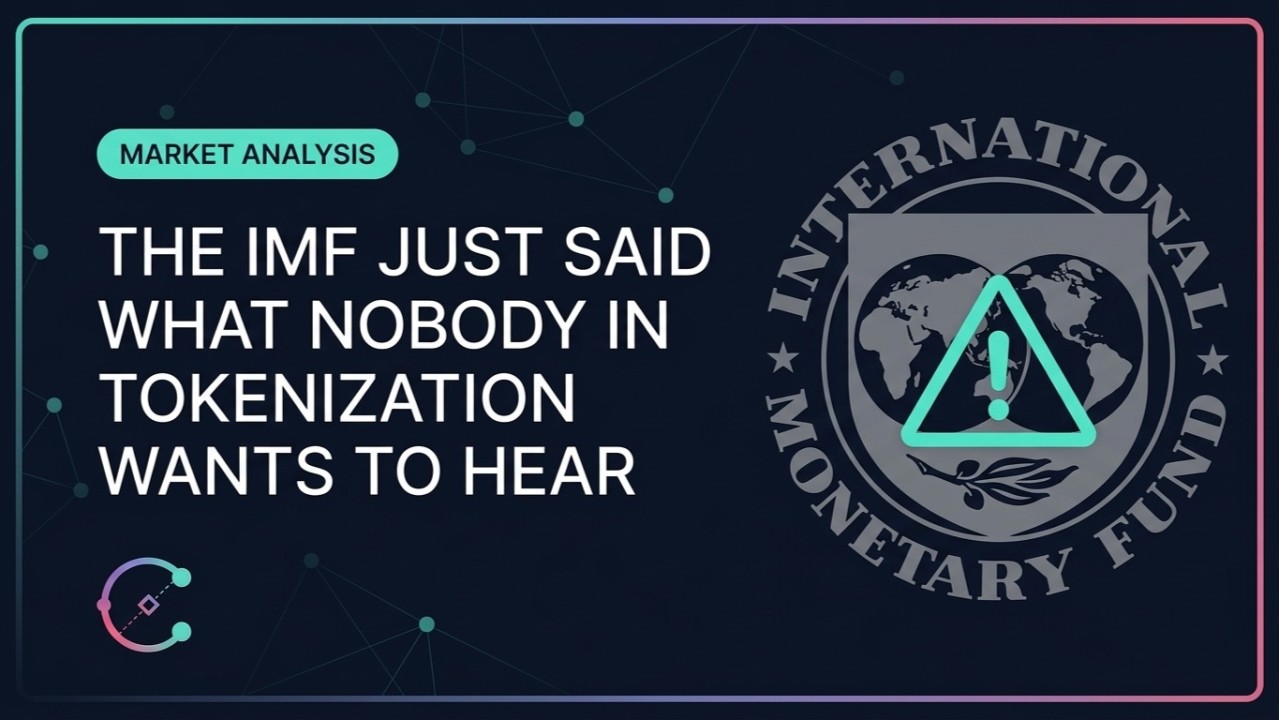
The IMF tokenization report published in April 2026 called tokenized finance a structural overhaul of financial architecture, but the warnings buried inside it deserve more attention than the headline. Behind the measured language of a multilateral institution sits a clear message: the tokenization of real world assets has grown large enough, and interconnected enough, to matter for global financial stability.
For institutional investors, the report is less a verdict and more a map of where the risks concentrate. This analysis breaks down what the IMF tokenization report actually says, the structural shift it describes, the systemic risks it flags, and what the findings mean for anyone allocating capital to tokenized assets in 2026.
Table of Contents
This breakdown opens with what the IMF tokenization report actually says and the structural overhaul thesis at its center. It then examines the systemic risks the report flags, from run risk and liquidity mismatch to interconnectedness, regulatory arbitrage, and monetary spillovers. The closing sections put the market scale in context, translate the findings into practical implications for investors, and answer the most common questions before the bottom line.
What the IMF Tokenization Report Actually Says
The IMF tokenization report frames tokenization not as a passing crypto trend but as a change in the plumbing of finance. It describes the movement of real world assets, including government bonds, money market funds, and private credit, onto programmable ledgers where ownership, settlement, and compliance can be encoded directly into the asset. That framing matters because it signals the IMF now treats tokenization as infrastructure rather than experimentation.
Consistent with its financial stability research, the IMF pairs recognition of the efficiency gains with a warning about concentration and speed. Faster settlement and programmability reduce some risks, but they also remove the friction that traditionally slows a panic. The report’s central tension is that the same features making tokenized finance efficient can make it fragile under stress.
What gives the report weight is its source. When a national regulator raises concerns, markets can dismiss it as local politics. When the IMF, whose mandate is global financial stability, publishes a systemic analysis of tokenized finance, it signals that the technology has crossed from the margins into the core of how policymakers think about risk. That shift in framing is itself part of the story.
For a grounding in how these instruments work before reading the report’s risk analysis, our guide to how tokenized real world assets work covers the mechanics the IMF assumes its readers already understand.
The Structural Overhaul Thesis
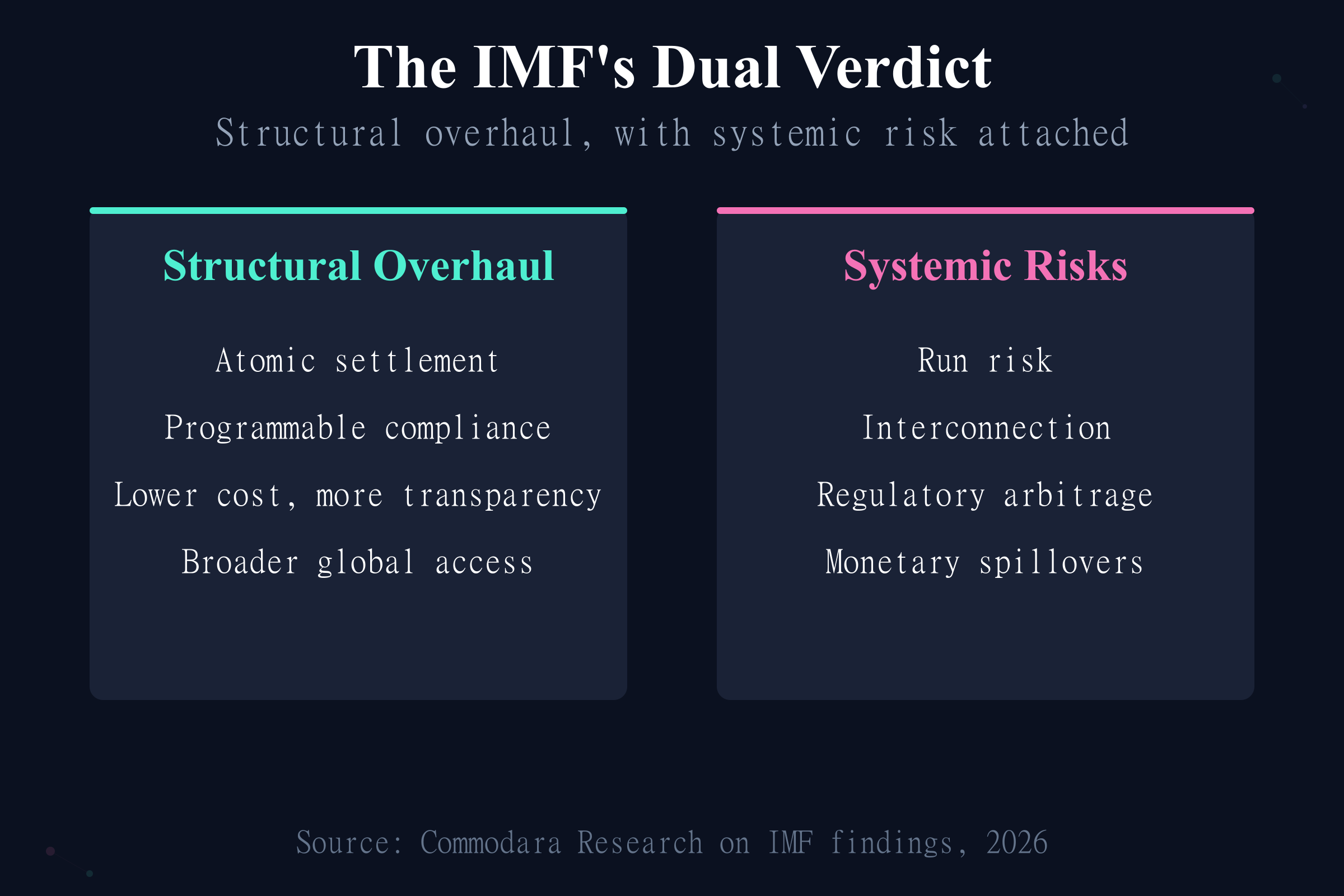
The structural overhaul thesis rests on a simple observation. In traditional finance, ownership records, settlement systems, and compliance checks live in separate silos operated by different intermediaries. Tokenization collapses those functions onto a single ledger, allowing an asset to carry its own rules and settle atomically against payment.
The IMF tokenization report argues that this consolidation is not an incremental upgrade. It changes how quickly value moves, how assets connect to one another, and how easily capital crosses borders. Programmable assets can be pledged as collateral, reused, and moved across venues in seconds, which deepens both efficiency and interconnection.
The report is careful to note that none of this is theoretical. Tokenized Treasuries already settle in minutes, stablecoins already move billions across borders daily, and tokenized funds already plug directly into lending markets. The overhaul is not a forecast the IMF is making. It is a description of infrastructure that is already operating, which is why the institution treats the risk analysis as urgent rather than speculative.
That is the overhaul the report describes: a financial system where the settlement layer, the compliance layer, and the asset itself are fused. The benefits are real, but so is the loss of the buffers that a slower, fragmented system provided almost by accident.
The Systemic Risks the IMF Flagged
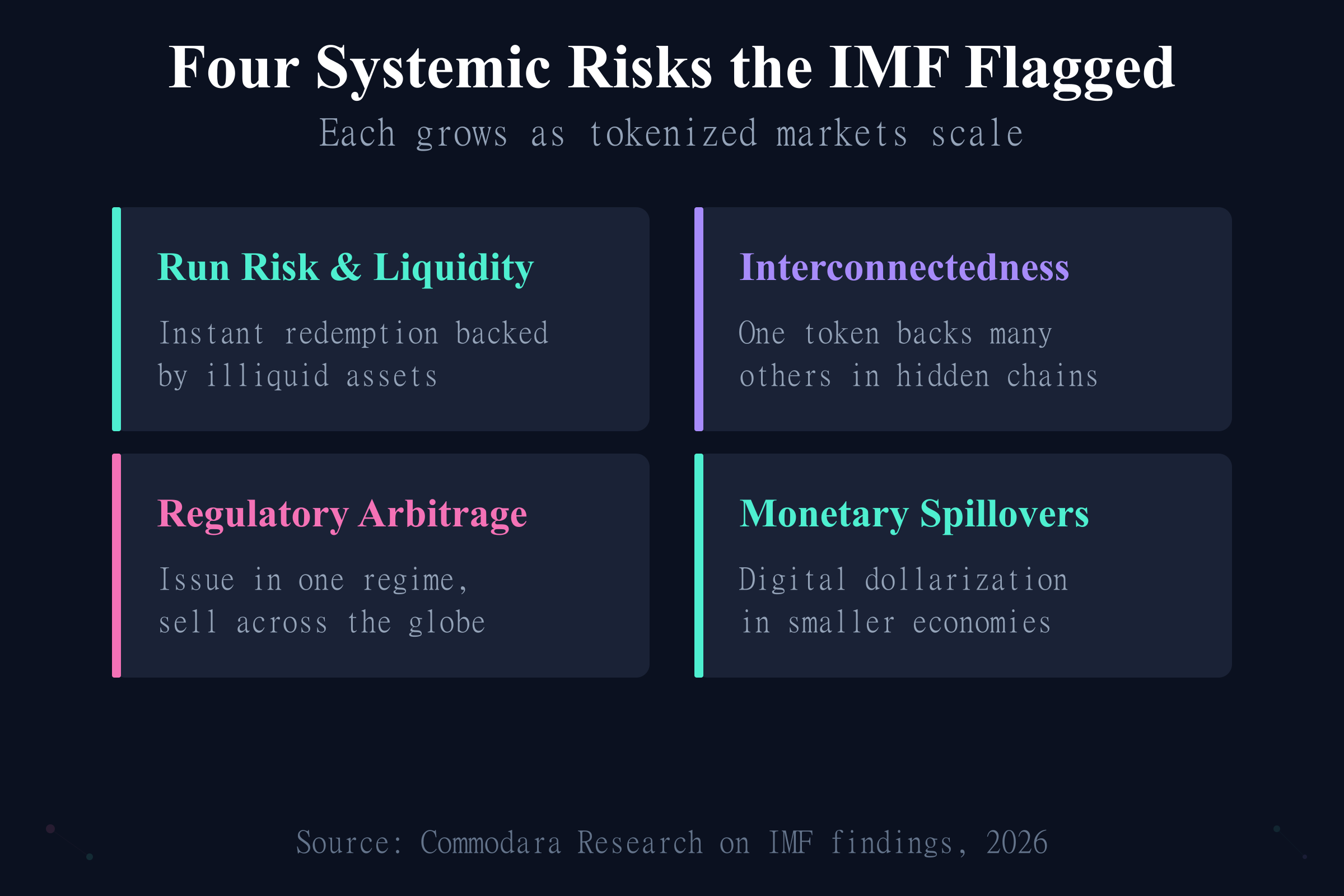
The heart of the IMF tokenization report is its risk analysis. The report groups the concerns into four categories, each of which becomes more serious as the tokenized market grows and links more tightly to traditional finance.
Run Risk and Liquidity Mismatch
Many tokenized products promise instant or near-instant redemption while holding assets that cannot be sold instantly. Tokenized money market funds and private credit vehicles are the clearest examples. In calm markets this mismatch is invisible. Under stress, the ability to redeem on-chain at any hour can turn a slow outflow into a same-day run, forcing fire sales of the underlying assets.
Interconnectedness and Contagion
Tokenized assets increasingly serve as collateral for other on-chain products. A tokenized Treasury fund can back a stablecoin, which backs a lending position, which backs another token. The IMF warns that this layering creates hidden chains of exposure, where the failure of one widely used instrument could cascade through protocols that all relied on it as a reserve.
Regulatory Arbitrage and Oversight Gaps
Because tokenized assets can be issued in one jurisdiction and sold globally, issuers can gravitate toward the lightest-touch regime. The report flags the risk that oversight fragments across borders while the assets themselves move freely. Coordinated frameworks, such as the stablecoin rules introduced under the GENIUS Act stablecoin law, are one response, but the IMF notes that global coverage remains uneven.
Monetary Sovereignty and Cross-Border Flows
Tokenized dollar instruments can be held by anyone with a wallet, anywhere. For smaller economies, this raises the prospect of digital dollarization, where residents move savings into tokenized US assets and weaken domestic monetary control. The report treats cross-border capital flow volatility as one of the least appreciated risks of a tokenized system.
What the $25 Billion Figure Represents
The headline number attached to the IMF tokenization report is roughly 25 billion dollars, the approximate size of the tokenized real world asset market, excluding stablecoins, that the report examined. It is a small figure against global finance, but the IMF’s point is about trajectory, not current scale.
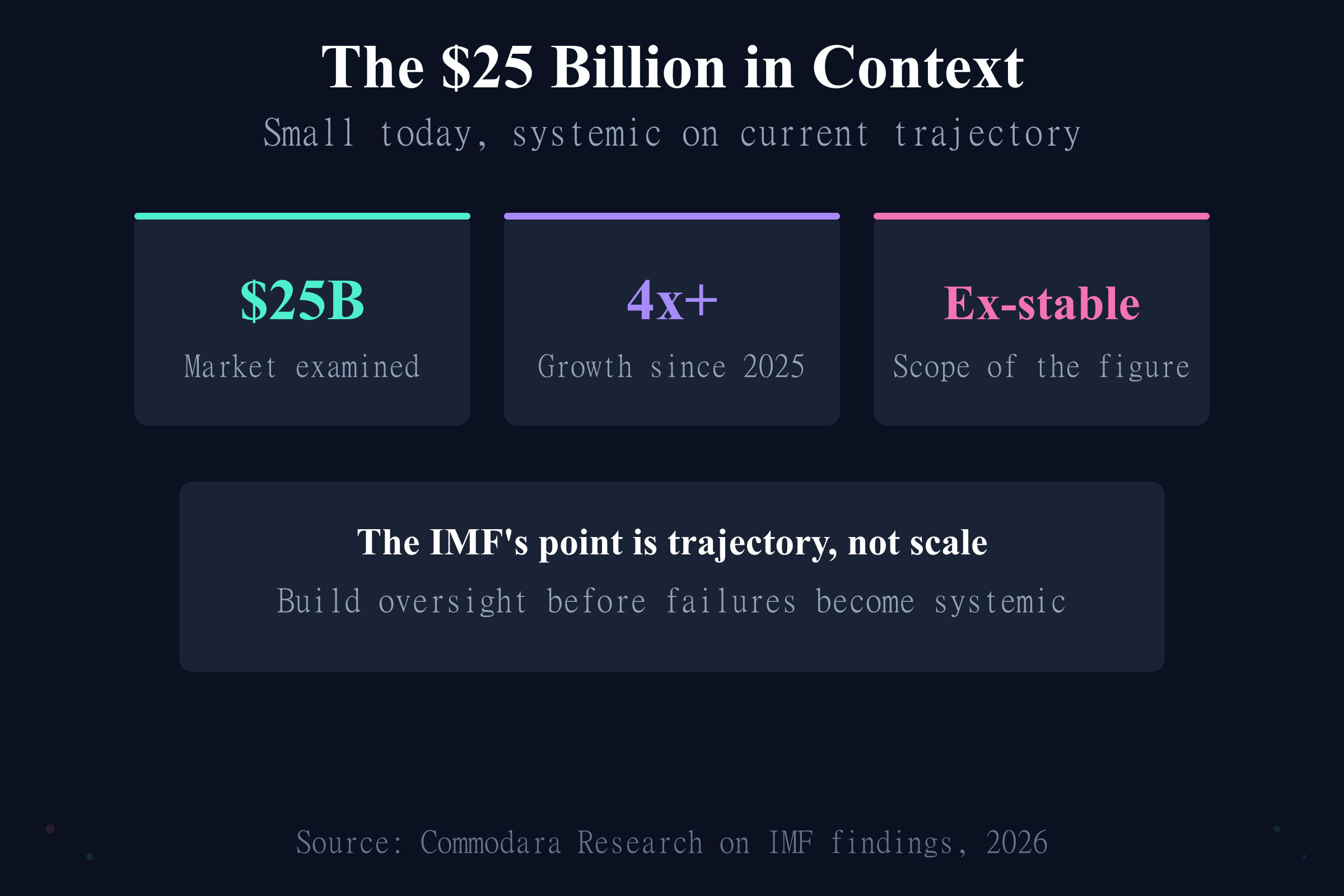
The market has grown several times over in under two years, and the report argues that oversight should be built before the market reaches the size where its failures would be systemic. Waiting until tokenized assets measure in the trillions, the IMF suggests, would repeat the mistake of regulating past crises rather than future ones.
The figure also excludes stablecoins, which alone represent a far larger market. The IMF’s decision to examine tokenized assets separately from stablecoins is deliberate: the two carry different risks, but they increasingly depend on each other, since many tokenized funds settle in stablecoins and many stablecoins hold tokenized Treasuries as reserves. The 25 billion dollars is therefore best read as one visible layer of a much larger and more entangled system.
For a fuller picture of how large the tokenized economy actually is and how fast it is expanding, our analysis of the true scale of the tokenized asset market puts the IMF’s 25 billion dollar reference point in context.
What the IMF Tokenization Report Means for Investors
For investors, the IMF tokenization report is a due diligence checklist disguised as a stability warning. The risks it names map directly onto questions any allocator should ask before buying a tokenized product.
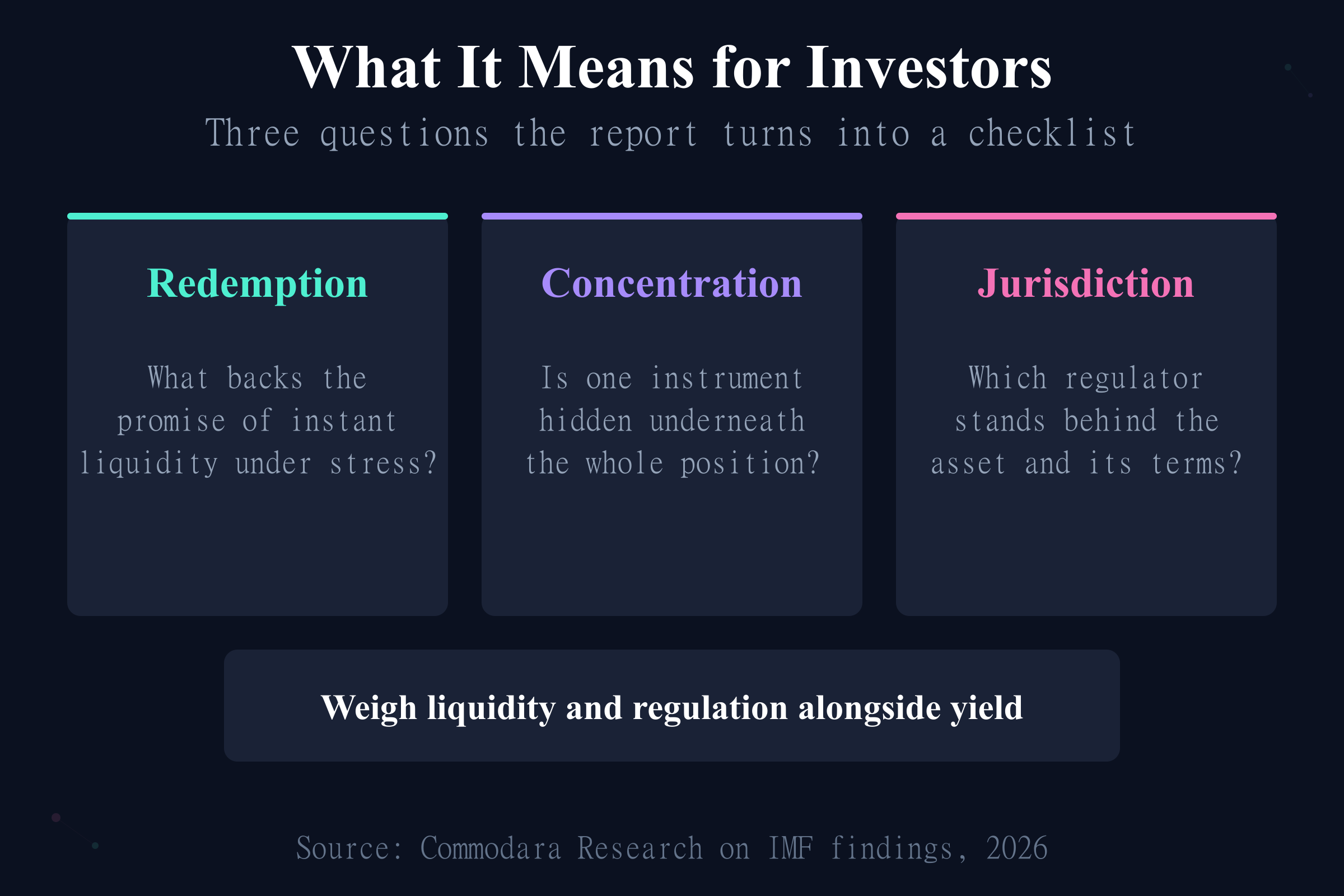
The first question is redemption. If a token promises instant liquidity, an investor should understand what backs that promise and what happens to redemptions when the underlying assets cannot be sold quickly. The second is concentration. If a single tokenized instrument sits underneath much of the on-chain ecosystem, exposure to it may be larger than it appears on a portfolio statement.
The third is jurisdiction. Where an asset is issued determines which regulator stands behind it and which investor protections apply. The report’s warning about regulatory arbitrage is, for investors, a reminder to read the domicile as carefully as the yield. Media coverage from outlets like CoinDesk tracks these regulatory shifts as they unfold across jurisdictions.
A fourth, quieter implication is operational. Tokenized assets depend on smart contracts, custody arrangements, and the continued operation of the issuing platform. The report’s emphasis on interconnection is also a reminder that technical failure at one widely used provider, not just market stress, can propagate through everything built on top of it. Reading the audit history and understanding what happens to a token if its issuer fails is now part of basic diligence.
None of this argues against tokenized assets. It argues for treating them with the same scrutiny applied to any structured product, weighing liquidity terms, counterparty exposure, and regulatory standing alongside the headline return.
Frequently Asked Questions
What is the IMF tokenization report?
The IMF tokenization report is an April 2026 analysis describing the tokenization of real world assets as a structural overhaul of financial architecture. It recognizes efficiency gains while warning that run risk, interconnectedness, regulatory arbitrage, and cross-border flows create new systemic vulnerabilities.
What does the $25 billion warning refer to?
The figure reflects the approximate size of the tokenized real world asset market, excluding stablecoins, that the report examined. The IMF’s concern is not the current scale but the speed of growth, arguing that oversight should be built before the market becomes large enough to be systemic.
What systemic risks does the IMF identify in tokenized finance?
The report highlights four risks: liquidity mismatch and run risk in instant-redemption products, interconnectedness where one instrument backs many others, regulatory arbitrage across jurisdictions, and monetary spillovers from tokenized dollar assets weakening control in smaller economies.
Does the IMF oppose tokenization?
No. The report treats tokenization as a structural improvement to financial infrastructure and acknowledges its efficiency benefits. Its position is that the benefits are real but require proportionate oversight, coordinated across borders, before the market grows large enough for failures to spread widely.
What should investors take from the report?
Investors should scrutinize redemption terms, concentration exposure, and the jurisdiction where a tokenized asset is issued. The IMF tokenization report effectively provides a due diligence framework, reminding allocators to weigh liquidity and regulatory standing alongside yield.
The Bottom Line
The IMF tokenization report is best read not as a warning against tokenized finance but as confirmation that it has arrived. When the world’s leading multilateral financial institution treats tokenization as a structural overhaul worthy of a systemic risk analysis, the debate about whether tokenization matters is effectively over.
What remains is the harder work of building oversight that matches the speed and interconnection the technology introduces. The report’s four risks, run risk, interconnectedness, regulatory arbitrage, and monetary spillovers, will shape the regulatory agenda for tokenized assets over the next several years.
Expect the response to arrive unevenly. Some jurisdictions will move quickly to require disclosure of redemption terms and reserve composition, while others will wait, and that divergence will itself become a factor investors weigh when choosing where a tokenized asset is domiciled.
For investors and institutions, the takeaway is to treat the IMF tokenization report as a lens for evaluating every tokenized allocation. Subscribe to the Commodara newsletter for ongoing analysis of the policy, infrastructure, and market developments shaping the tokenized economy.