
Tokenization Regulation by Country: A Jurisdiction-by-Jurisdiction Map for 2026
Tokenization regulation by country ranges from comprehensive frameworks like MiCA in Europe and VARA in Dubai to legal grey zones where no rules exist at all, and choosing the wrong jurisdiction can cost an issuer years. The token is global by default; the law is not. Where an asset is issued determines which regulator oversees it, which investors can buy it, and whether it can be sold across borders at all.
This guide maps the major tokenization regimes as they stand in 2026, from the fragmented but deep United States to the purpose-built frameworks of the Gulf and Asia. It is a starting point for understanding the landscape, not a substitute for local legal counsel, but it shows why jurisdiction is the first decision any serious tokenization project makes.
Table of Contents
This map opens with why tokenization regulation by country shapes every other decision. It then works through the major regimes in turn: the United States, the European Union, the United Arab Emirates, and the institutional hubs of Singapore, Switzerland, the United Kingdom, and Japan. The closing sections explain how to choose a jurisdiction and answer the most common questions before the bottom line.
Why Tokenization Regulation by Country Matters
Tokenization regulation by country matters because a token does not carry its legal status with it. A tokenized security compliant in one jurisdiction can be an illegal unregistered offering in another. The blockchain is borderless, but the securities law that governs the underlying asset is stubbornly national.
This creates a strategic decision at the very start of any project. Issuers choose a jurisdiction based on which investors they want to reach, how much regulatory certainty they need, and how quickly they want to launch. A permissive, purpose-built regime can take a project to market in months; an ambiguous one can trap it in legal review for years.
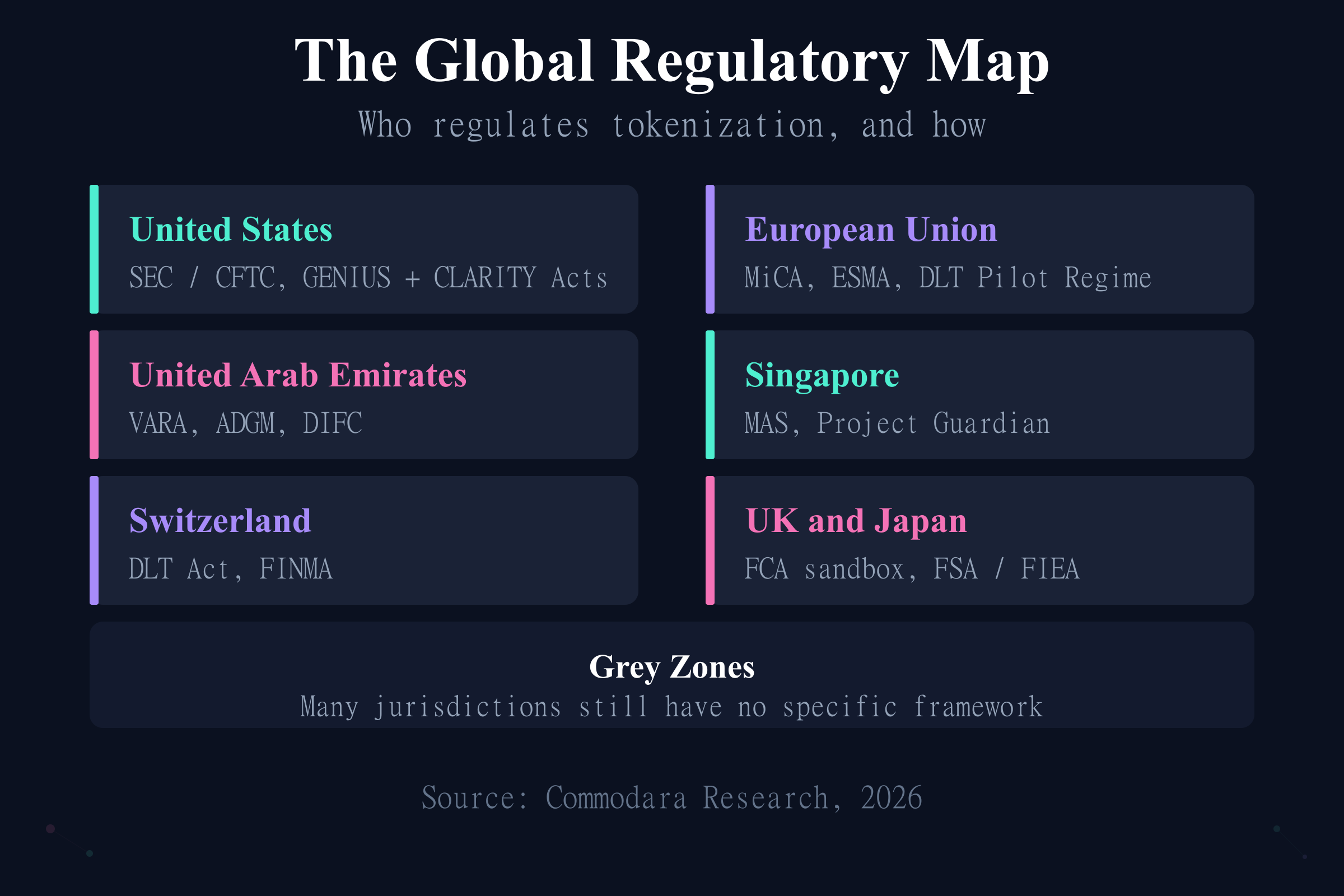
The frameworks below fall roughly into three groups: comprehensive regimes with clear rules, developing regimes still building their frameworks, and grey zones with no specific rules at all. Knowing which group a jurisdiction belongs to is the first filter in any tokenization plan.
The stakes are practical, not abstract. A misjudged jurisdiction can mean an offering has to be unwound, re-papered, or relaunched, each of which burns capital and time. This is why tokenization regulation by country is treated as a first-order design constraint by experienced issuers, not a compliance detail to resolve later.
The United States: Deep Market, Fragmented Rules
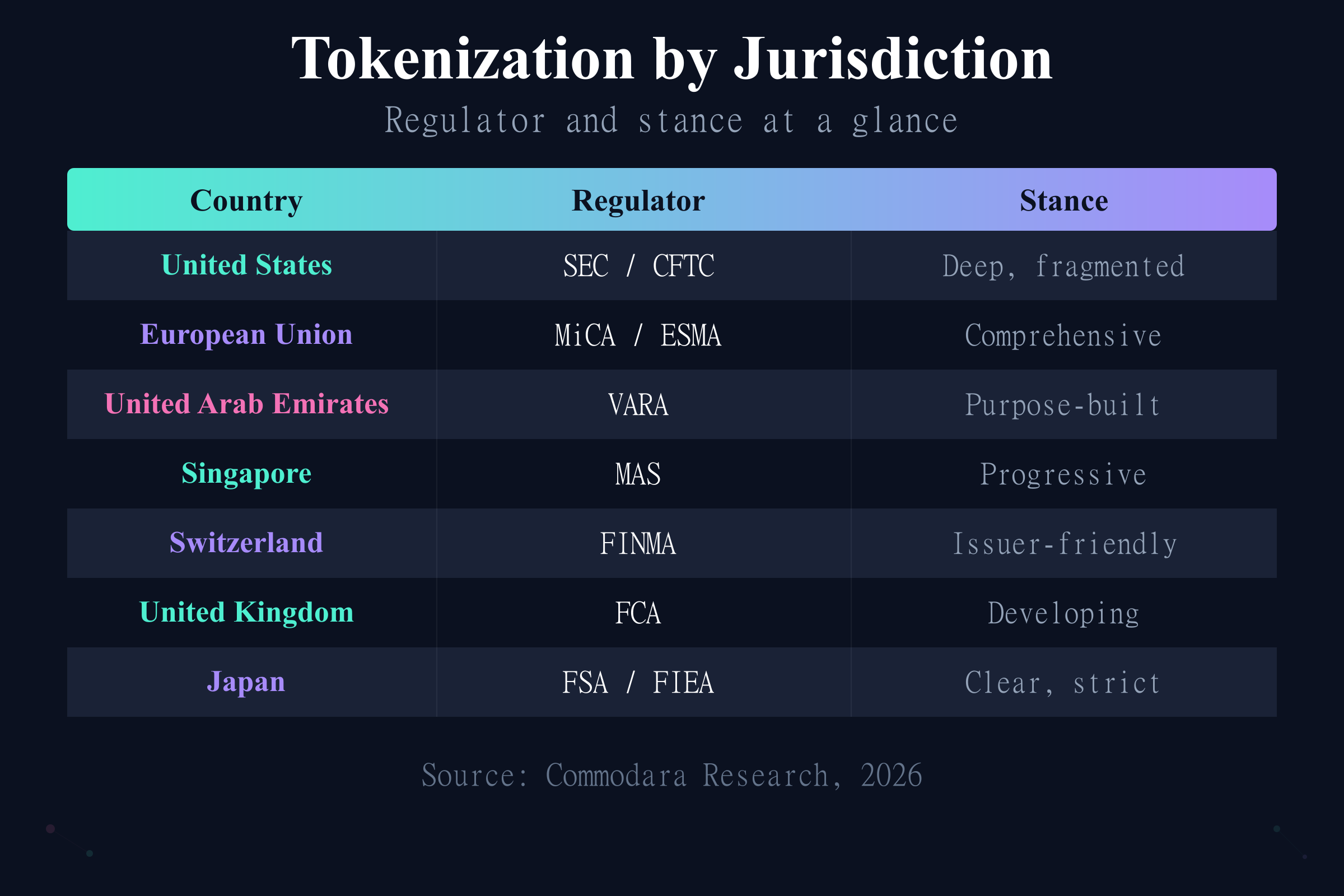
The United States has the deepest capital market in the world and the most fragmented approach to regulating tokenized assets. There is no single tokenization law. Instead, existing securities rules apply, with the SEC treating most tokenized assets as securities and the CFTC overseeing those that qualify as commodities.
Most tokenized offerings in the US rely on established exemptions: Regulation D for private placements to accredited investors, Regulation S for offshore sales, and Regulation A+ for limited public offerings. Two recent laws have added structure. The GENIUS Act created a federal framework for stablecoins, and the CLARITY Act set out how digital assets are classified between the SEC and CFTC. Our guides to the GENIUS Act stablecoin framework and the CLARITY Act digital asset classification cover both in detail.
The result is a market that rewards issuers who can navigate complexity. The rules are strict and enforcement is real, but the depth of US capital and the clarity of the securities framework, once understood, make it a serious venue for tokenization despite the fragmentation.
Within the wider picture of tokenization regulation by country, the United States remains the venue few issuers can ignore. The depth of its capital pools outweighs the friction of its rules for anyone targeting American investors, which is why even projects domiciled elsewhere often build a US-compliant path in parallel.
The European Union: MiCA Sets the Standard
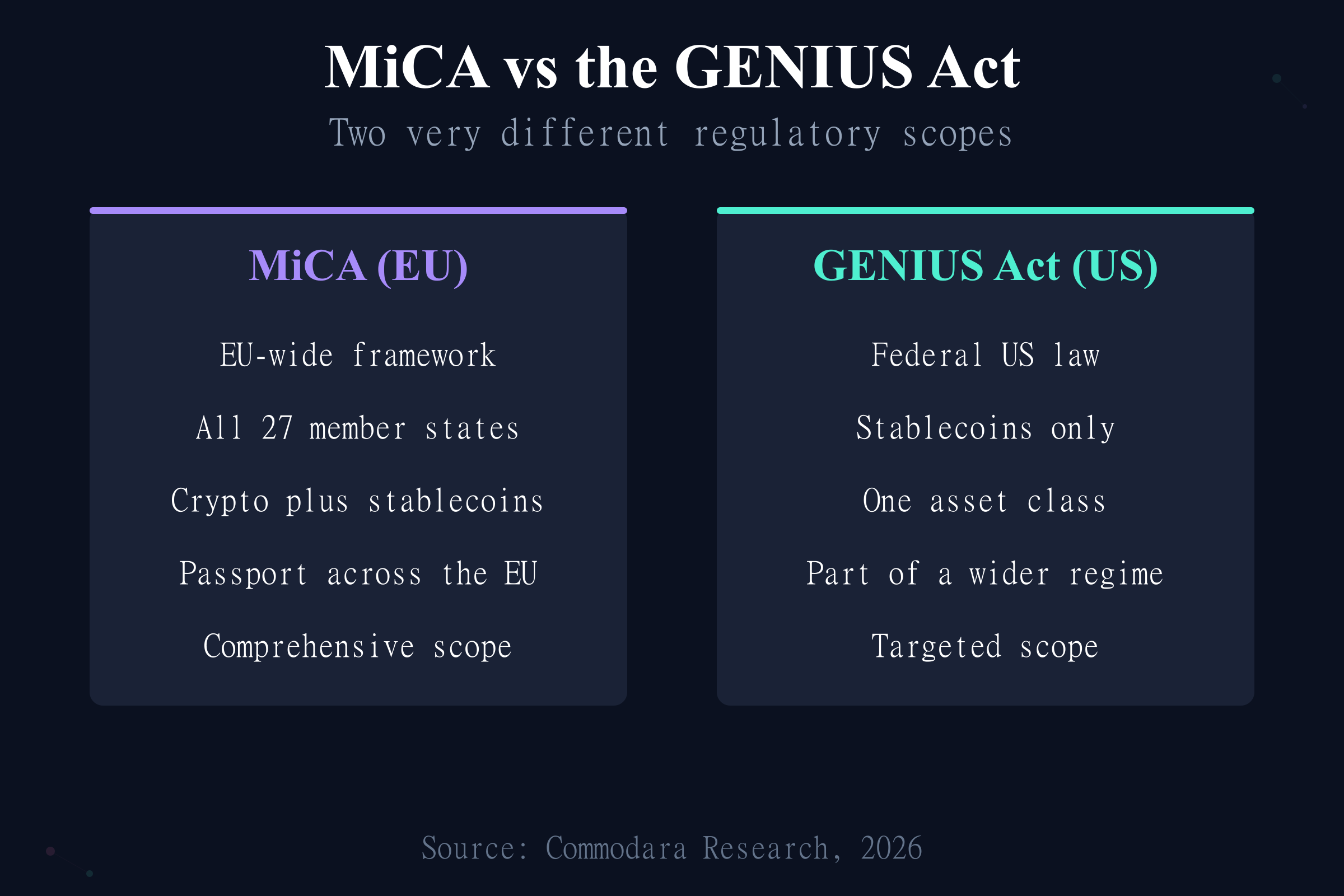
The European Union offers the most comprehensive harmonized framework in the world through the Markets in Crypto-Assets regulation, known as MiCA. Phased in across 2024 and 2025, MiCA gives crypto-assets, including many tokenized instruments, a single rulebook that applies across all 27 member states, with a passport that lets a compliant issuer operate EU-wide.
For tokenized securities specifically, MiCA works alongside existing securities law and the DLT Pilot Regime, which lets firms trade and settle tokenized securities under a supervised sandbox. Oversight sits with national regulators and the European Securities and Markets Authority. Our breakdown of MiCA and what it means for tokenization explains how the pieces fit together, and the ESMA guidance is the primary source for the detail.
MiCA’s strength is certainty. An issuer that meets its requirements gains access to a market of over 400 million people under one framework. The trade-off is rigor: the compliance bar is high, and the regime favors well-resourced issuers over experimental ones.
The United Arab Emirates: VARA and a Purpose-Built Regime
The United Arab Emirates has built one of the most deliberately designed regulatory environments for tokenized assets. Dubai’s Virtual Assets Regulatory Authority, or VARA, is a dedicated regulator for virtual assets with clear licensing categories, while the Abu Dhabi Global Market and the Dubai International Financial Centre operate their own established frameworks for digital securities.
What distinguishes the UAE is that its rules were written for this asset class rather than adapted from older law. VARA sets out specific licence types for issuance, custody, and exchange activity, which gives issuers a clearer path than reinterpreting decades-old securities statutes. The official VARA framework lays out the categories and requirements.
The result has been rapid growth in issuance and infrastructure activity across the Emirates. For issuers who value regulatory certainty and a purpose-built regime, the UAE has become one of the most credible venues in the world, sitting alongside the EU and Switzerland at the clearer end of the spectrum.
The Institutional Hubs: Singapore, Switzerland, the UK, and Japan
Beyond the three largest regimes, a set of institutional hubs has built credible frameworks that attract tokenization projects, each with a distinct character.
Singapore
Singapore regulates tokenized assets through the Monetary Authority of Singapore under existing securities and payments law. Its Project Guardian initiative has run tokenization pilots with major global banks, giving the jurisdiction deep institutional credibility. The stance is cautious but genuinely progressive, favoring well-structured institutional issuance.
Switzerland
Switzerland recognizes tokenized securities in law through its DLT Act, which created ledger-based securities that exist natively on a blockchain without a separate paper record. Overseen by FINMA, and complemented by Liechtenstein’s Token Act next door, Switzerland is among the most issuer-friendly jurisdictions for direct on-chain issuance.
The United Kingdom and Japan
The United Kingdom is developing its regime through the FCA and a Digital Securities Sandbox run with the Bank of England, taking a gradual, principles-based path after Brexit. Japan regulates security tokens under its Financial Instruments and Exchange Act through the Financial Services Agency, supporting an active security token offering market with strict but clear rules.
How to Choose Your Jurisdiction
Choosing where to tokenize comes down to matching a jurisdiction to the project, not chasing the most permissive regime. The right choice depends on three questions: which investors you need to reach, how much regulatory certainty you require, and how the asset itself is treated locally.
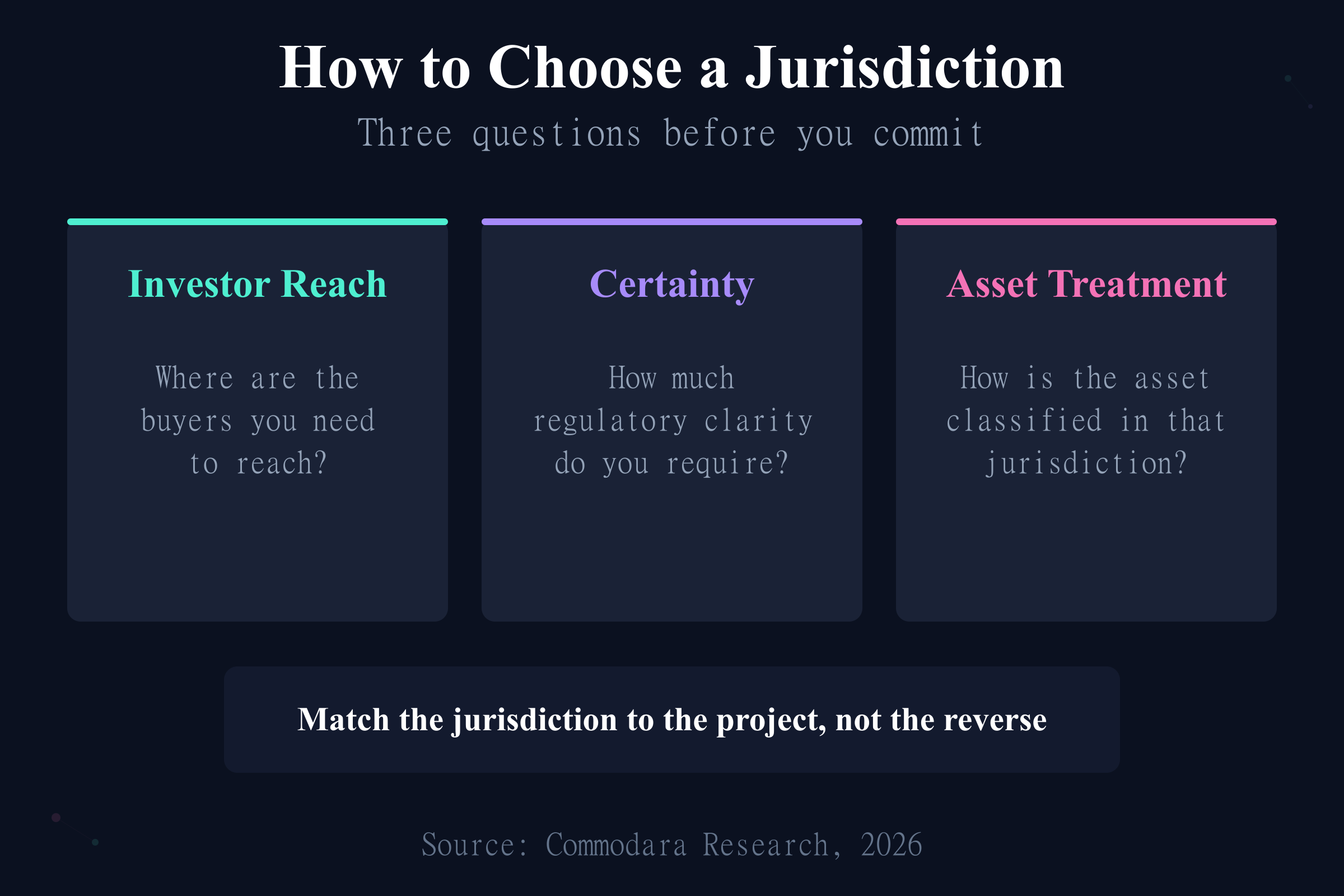
An issuer targeting US institutions has little choice but to navigate the US framework, whatever its complexity. One prioritizing speed and certainty may prefer the UAE, Switzerland, or the EU passport. A project experimenting with a novel structure may find a sandbox regime in the UK or Singapore more accommodating. The comparison that matters is between MiCA, the GENIUS Act regime, and the purpose-built frameworks, weighed against where the buyers actually are.
It also helps to think in tiers rather than picking a single winner. Many serious issuers domicile in one clear regime, then structure a compliant distribution path into others, treating tokenization regulation by country as a set of overlapping markets rather than a single choice. The goal is coverage of the investors that matter, not the theoretically most permissive flag.
Because the wrong jurisdiction can cost years, this is the decision to get right first. To assess which regime fits your asset, investor base, and timeline, the Tokenization Readiness Tool walks through jurisdiction alongside structure and cost in one place.
Frequently Asked Questions
Why does tokenization regulation vary by country?
Tokenization regulation by country varies because securities and financial law is national, while blockchains are global. Each country decides how to classify and oversee tokenized assets, so a token compliant in one jurisdiction can be an unregistered offering in another. There is no single global framework.
Which countries have the clearest tokenization rules?
The European Union through MiCA, the United Arab Emirates through VARA, and Switzerland through its DLT Act offer among the clearest, purpose-built frameworks. Singapore and Japan also provide well-defined regimes. The United States has deep markets but a more fragmented, multi-agency approach.
What is the difference between MiCA and the GENIUS Act?
MiCA is the European Union’s comprehensive framework covering crypto-assets and stablecoins across 27 member states. The GENIUS Act is a United States federal law focused specifically on stablecoins. MiCA is broader in scope, while the GENIUS Act addresses one asset class within the wider US regime.
Can I tokenize in one country and sell globally?
Not freely. The jurisdiction of issuance sets the base rules, but selling into another country usually triggers that country’s securities law as well. Cross-border distribution requires satisfying each target market’s regulations, which is why issuers weigh investor reach when choosing a jurisdiction.
Does the United States have a tokenization law?
The United States has no single tokenization law. It applies existing securities rules through the SEC and CFTC, supplemented by the GENIUS Act for stablecoins and the CLARITY Act for digital asset classification. Most offerings use exemptions like Regulation D and Regulation S.
The Bottom Line
Tokenization regulation by country is the map every issuer must read before writing a line of code. The frameworks range from the comprehensive certainty of MiCA and VARA to the deep but fragmented US market and the developing regimes of the UK and beyond. Each carries a different balance of investor access, regulatory certainty, and speed to market.
The pattern across 2026 is convergence toward clarity. Purpose-built regimes in the EU, the UAE, and Switzerland are setting a standard that other jurisdictions are moving to match, which will gradually narrow the gap between the clear and the grey. For now, the jurisdiction an issuer chooses remains one of the most consequential decisions in the entire tokenization process.
Before committing to a venue, map your asset, investor base, and timeline against the tokenization regulation by country that fits them, and use the Commodara Tokenization Readiness Tool to structure the decision. Getting the jurisdiction right first is what saves the years the wrong one can cost.