
Tokenized Asset Liquidity: Why the $31 Billion Market Still Can’t Trade
Tokenized asset liquidity is the central promise of bringing real world assets on-chain, and in 2026 it remains the central failure, with the vast majority of tokenized products showing negligible secondary market activity. The pitch is seductive: put an illiquid asset on a blockchain and it becomes tradable around the clock. The reality is a $31 billion market where most tokens barely move after issuance.
This gap between promise and practice is the most important unsolved problem in the RWA sector. This analysis explains what tokenized asset liquidity actually means, why the $31 billion market still cannot trade, where genuine liquidity does exist, and what it would take to close the gap.
Table of Contents
This analysis opens with what tokenized asset liquidity actually means and the crucial difference between redemption and secondary liquidity. It then examines the $31 billion liquidity illusion, the specific reasons tokenized assets fail to trade, and the pockets where real liquidity does exist today. The closing sections cover what would fix the problem and answer the most common questions before the bottom line.
What Tokenized Asset Liquidity Actually Means
Tokenized asset liquidity is the ease with which a tokenized asset can be bought or sold without moving its price. It sounds simple, but the term hides a distinction that explains most of the confusion in the market: the difference between redemption liquidity and secondary market liquidity.
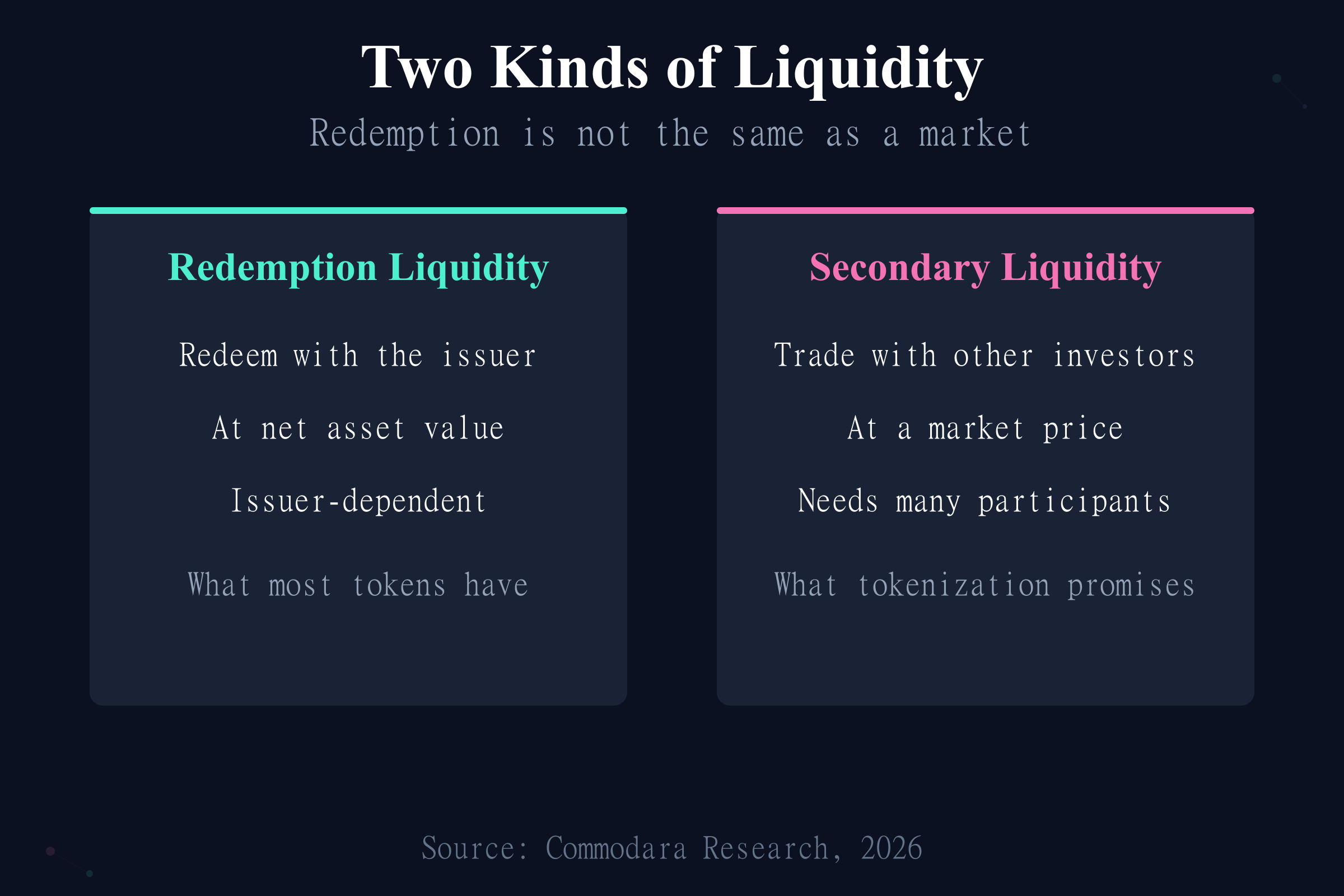
Redemption liquidity is the ability to return a token to its issuer for the underlying value, usually at net asset value. A tokenized Treasury fund that lets you redeem for dollars on demand is liquid in this sense. Secondary market liquidity is different: it is the ability to sell the token to another investor, on a market, at a price that market sets. This is the liquidity tokenization actually promises, and it is the one that is largely missing.
The confusion matters because issuers often market redemption liquidity as if it were secondary liquidity. A token you can redeem with the issuer is not the same as a token with a deep, active market of buyers and sellers. Most tokenized assets in 2026 have the former and lack the latter.
The $31 Billion Liquidity Illusion
The tokenized real world asset market, excluding stablecoins, reached roughly $31 billion in 2026, a figure the sector cites as proof of momentum. Yet the trading data tells a different story. The overwhelming majority of that value sits in tokens that trade rarely, if at all, on any secondary market.
The illusion works because total value locked is easy to measure and secondary volume is not. A market can grow to tens of billions in assets while remaining almost entirely illiquid, because the number counts what has been issued, not what changes hands. For a fuller view of how the sector sizes itself, our analysis of the true scale of the tokenized market separates issuance from genuine activity.
Research from institutions like the Bank for International Settlements on tokenized securities has made the same point: tokenization changes how assets are recorded and settled, but it does not automatically create the demand, participants, and market infrastructure that liquidity requires. The technology is necessary but not sufficient. Trading data compiled by outlets such as The Block repeatedly shows the same divergence between assets issued and assets traded.
This matters for anyone using tokenized market size as a signal. A number that only counts issuance can rise steadily while the market underneath it becomes no easier to trade. Momentum measured in total value locked can coexist with stagnation measured in turnover, and conflating the two is how the illusion sustains itself year after year. It is the single most common misreading of the RWA data.
Why Tokenized Assets Don’t Trade
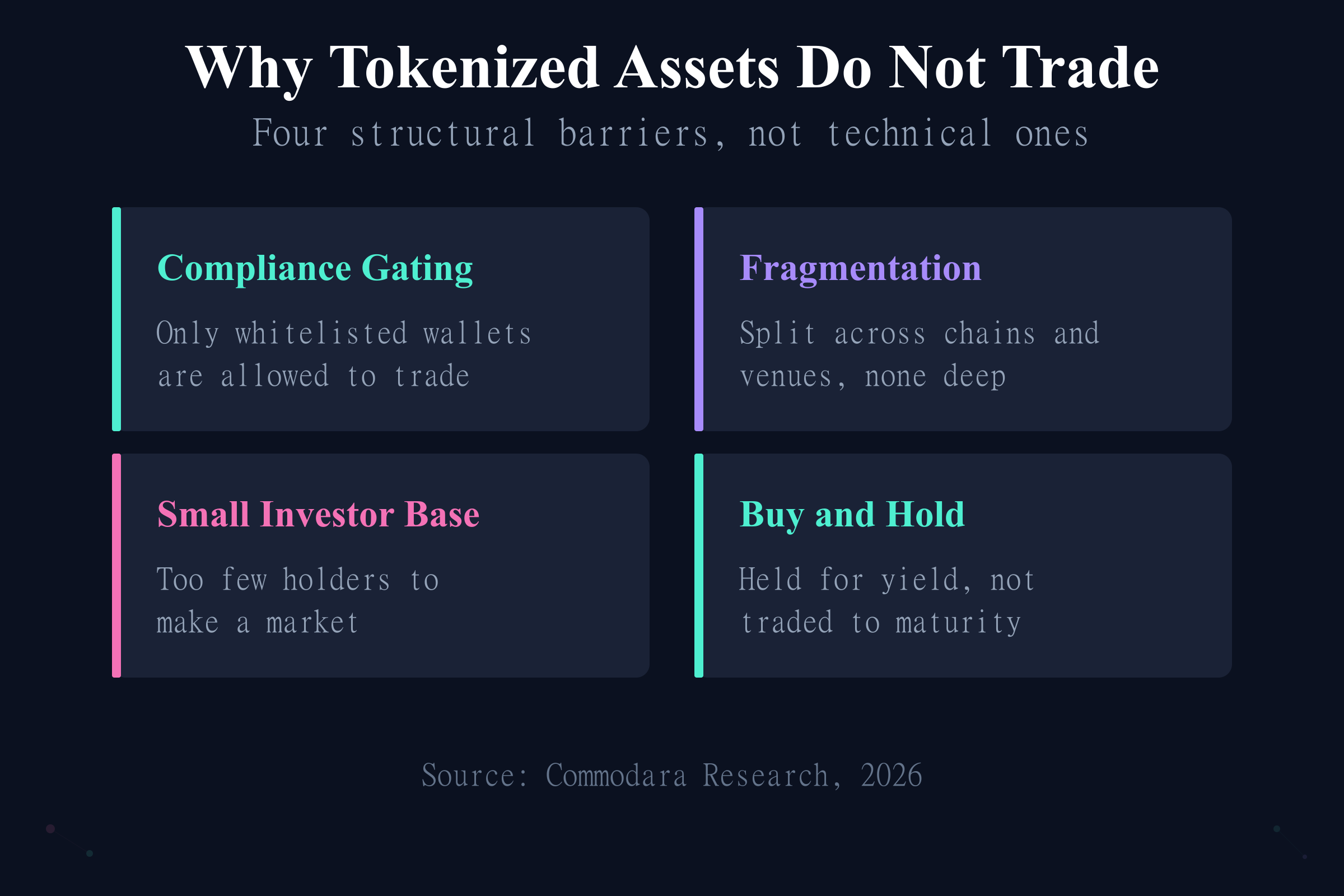
The reasons tokenized assets fail to trade are structural, not technical. The blockchain can settle a trade in seconds, but four barriers keep most tokens from being traded at all.
Compliance and Transfer Restrictions
Most tokenized securities can only move between approved wallets. Transfer restrictions enforce KYC, accreditation, and jurisdiction rules directly in the token, which means a holder cannot simply sell to anyone. Every potential buyer must be whitelisted first. This compliance gating is essential for regulation, but it drastically shrinks the pool of eligible counterparties.
Fragmentation Across Chains and Venues
Tokenized assets are spread across multiple blockchains, platforms, and trading venues, with no shared order book. The same type of asset may exist in a dozen incompatible pools, none deep enough to support real trading. Liquidity that is split across venues is not liquidity at all, because no single market has the depth to absorb a meaningful order.
Small Investor Bases
Many tokenized assets are sold through private placements to a small number of accredited or institutional investors. A market with a handful of holders cannot be liquid, because liquidity requires enough participants with differing views to create continuous buying and selling. Exclusive access and deep liquidity are, in this sense, in tension.
Buy-and-Hold Behavior
Much of the tokenized market is held for yield, not for trading. Investors buy tokenized Treasuries or private credit to earn a return and hold to maturity, so there is little reason to trade in the secondary market. An asset bought to be held does not generate the turnover that makes a market liquid.
These barriers compound. A token that is compliance-gated, fragmented across venues, held by a handful of investors, and bought to be held is not slightly illiquid but almost completely so. Removing any one barrier helps only if the others fall too, which is why isolated fixes have done little to move secondary volumes.
Where Tokenized Asset Liquidity Does Exist
The picture is not uniformly bleak. Genuine liquidity exists in specific corners of the market, and understanding where reveals what liquidity actually requires.
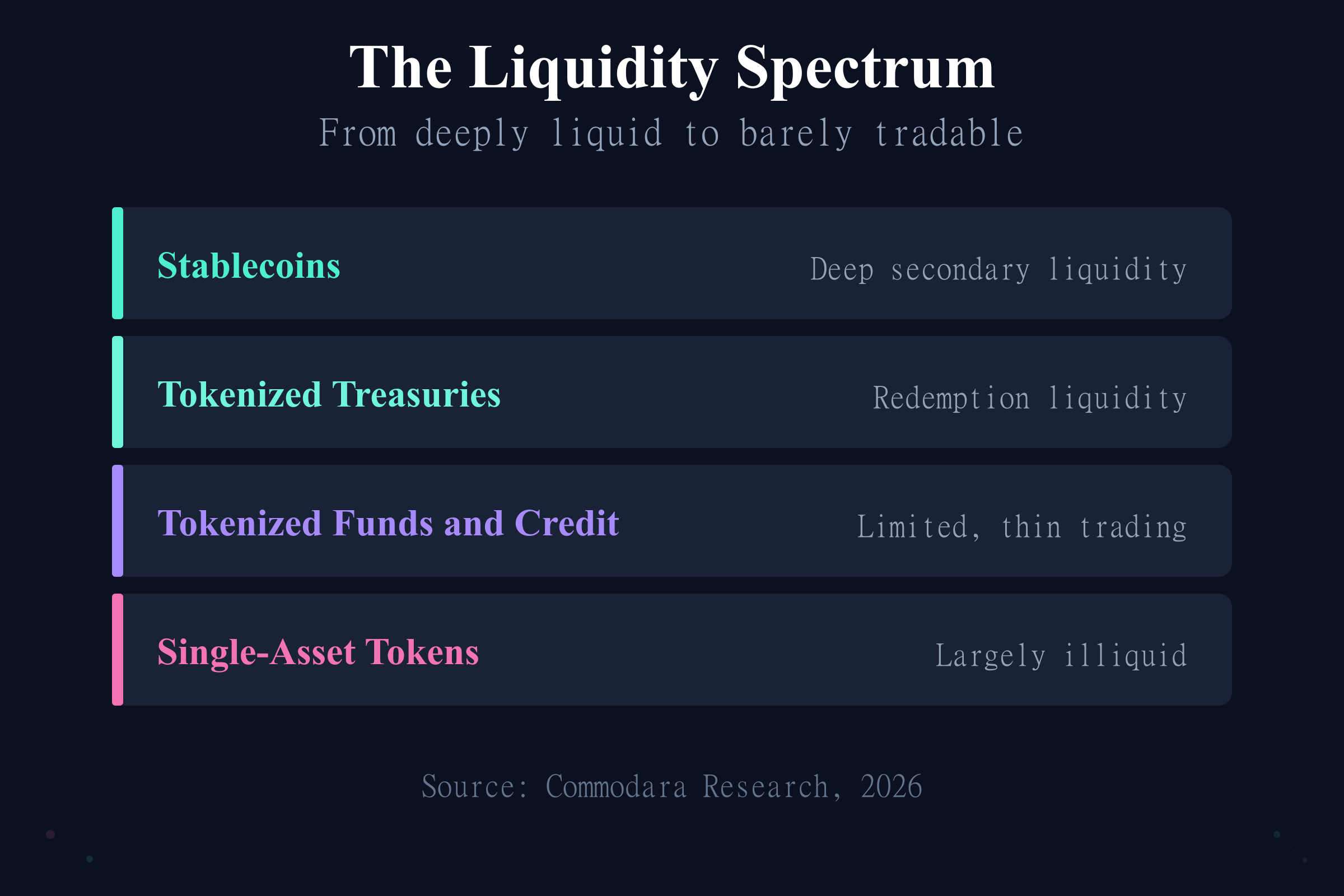
Tokenized Treasuries are the clearest example of working liquidity, though mostly of the redemption kind. Products like those compared in our guide to the leading tokenized Treasury funds offer near-instant redemption with the issuer, which functions as liquidity for holders even without a deep secondary market. The underlying asset, US government debt, is itself among the most liquid in the world.
Redemption liquidity has real limits, though. It depends entirely on the issuer’s ability and willingness to honor redemptions, which can be suspended under stress precisely when holders most want to exit. It also caps out at the size of the underlying reserves, so a rush of redemptions can force the issuer to sell the underlying assets into a falling market. Redemption is a genuine form of liquidity, but it is not the resilient, market-wide liquidity that tokenization advertises.
Stablecoins, though excluded from the $31 billion figure, are the one genuinely liquid tokenized instrument, trading in enormous volumes across every venue. Their liquidity comes from ubiquity, standardization, and a vast base of users who treat them as cash. That combination, not the tokenization itself, is what makes them liquid, and it points directly at what the rest of the market lacks.
What Would Actually Fix Tokenized Asset Liquidity
Fixing tokenized asset liquidity requires building the things tokenization does not provide on its own: shared standards, larger investor bases, and real market infrastructure.
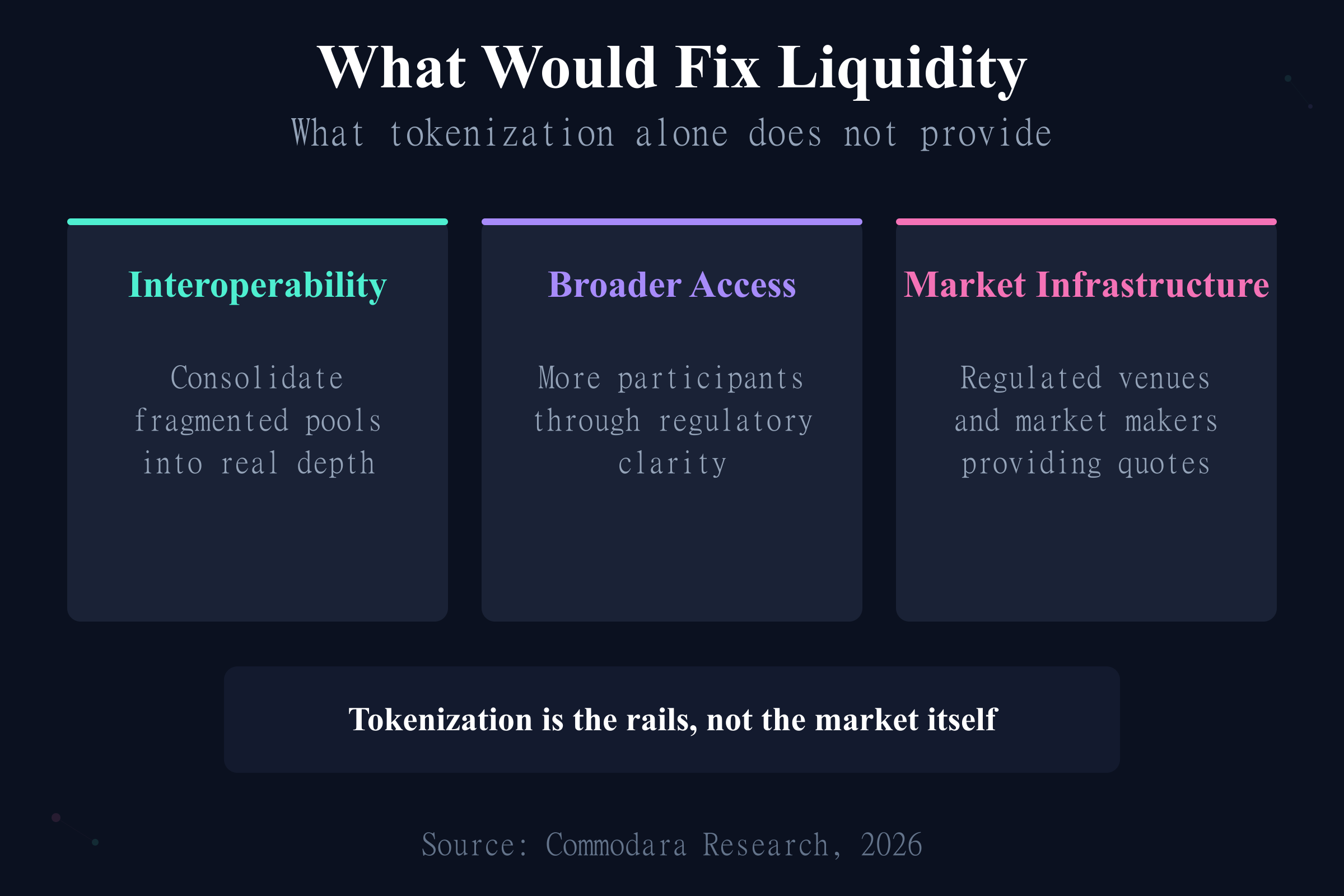
Interoperability is the first requirement. If tokenized assets could move freely across chains and venues under common standards, fragmented pools could consolidate into markets with real depth. The second is a broader investor base, which depends on regulatory clarity that lets more participants hold and trade these assets. The third is dedicated market infrastructure: regulated venues, market makers willing to provide continuous quotes, and the tooling to match compliant buyers and sellers.
None of this is guaranteed, and none of it is free. The economics matter, because supporting a liquid market is a cost that someone has to bear, a point our breakdown of the platforms building this infrastructure examines in detail. You can also estimate what tokenizing and supporting an asset would cost before assuming liquidity will follow issuance.
The question is who bears the cost of building all this. Market makers need incentives to quote continuously, venues need volume to justify listing, and standards need coordination among competitors who would each prefer their own. This is a collective-action problem as much as a technical one, which is why progress has been slower than the technology alone would suggest.
Frequently Asked Questions
What is tokenized asset liquidity?
Tokenized asset liquidity is the ease of buying or selling a tokenized asset without moving its price. It splits into redemption liquidity, redeeming with the issuer at net asset value, and secondary market liquidity, trading with other investors. Most tokenized assets have some redemption liquidity but little secondary market liquidity.
Why don’t tokenized assets trade despite being on a blockchain?
Because the barriers are structural, not technical. Transfer restrictions limit who can buy, assets are fragmented across venues, investor bases are small, and most holders buy for yield and hold to maturity. The blockchain can settle a trade instantly, but these factors mean few trades happen at all.
Is the $31 billion tokenized market actually liquid?
Mostly not. The $31 billion figure measures total value issued, not value that trades. Most tokenized assets show negligible secondary market activity, so the headline number reflects issuance rather than genuine liquidity. Tokenized Treasuries and stablecoins are the main exceptions.
What is the difference between redemption and secondary liquidity?
Redemption liquidity is returning a token to its issuer for the underlying value, usually at net asset value. Secondary liquidity is selling the token to another investor on a market. Tokenization promises the second but usually delivers only the first, which is a narrower and issuer-dependent form of liquidity.
What would improve tokenized asset liquidity?
Three things: interoperability so fragmented pools can consolidate, a broader investor base enabled by regulatory clarity, and real market infrastructure including regulated venues and market makers. Tokenization provides the rails, but liquidity also needs demand, participants, and the tooling to match compliant buyers and sellers.
The Bottom Line
Tokenized asset liquidity is the promise the RWA sector has not yet kept. A $31 billion market sounds like proof of success, but the number measures what has been issued, not what can be traded, and the two are very different things. The blockchain solved settlement; it did not solve liquidity.
The path forward is clear even if the timeline is not. Shared standards, broader access, and real market infrastructure are what turn issuance into genuine tokenized asset liquidity, and the parts of the market that already have them, tokenized Treasuries and stablecoins, show it is achievable. The rest of the market has to build what tokenization alone does not provide.
Understanding where liquidity is real and where it is an illusion is essential for anyone allocating to tokenized assets. Subscribe to the Commodara newsletter for ongoing analysis of the market structure, infrastructure, and data shaping the tokenized economy.