
RWA Perpetual Contracts: What $524 Billion in Volume Actually Means
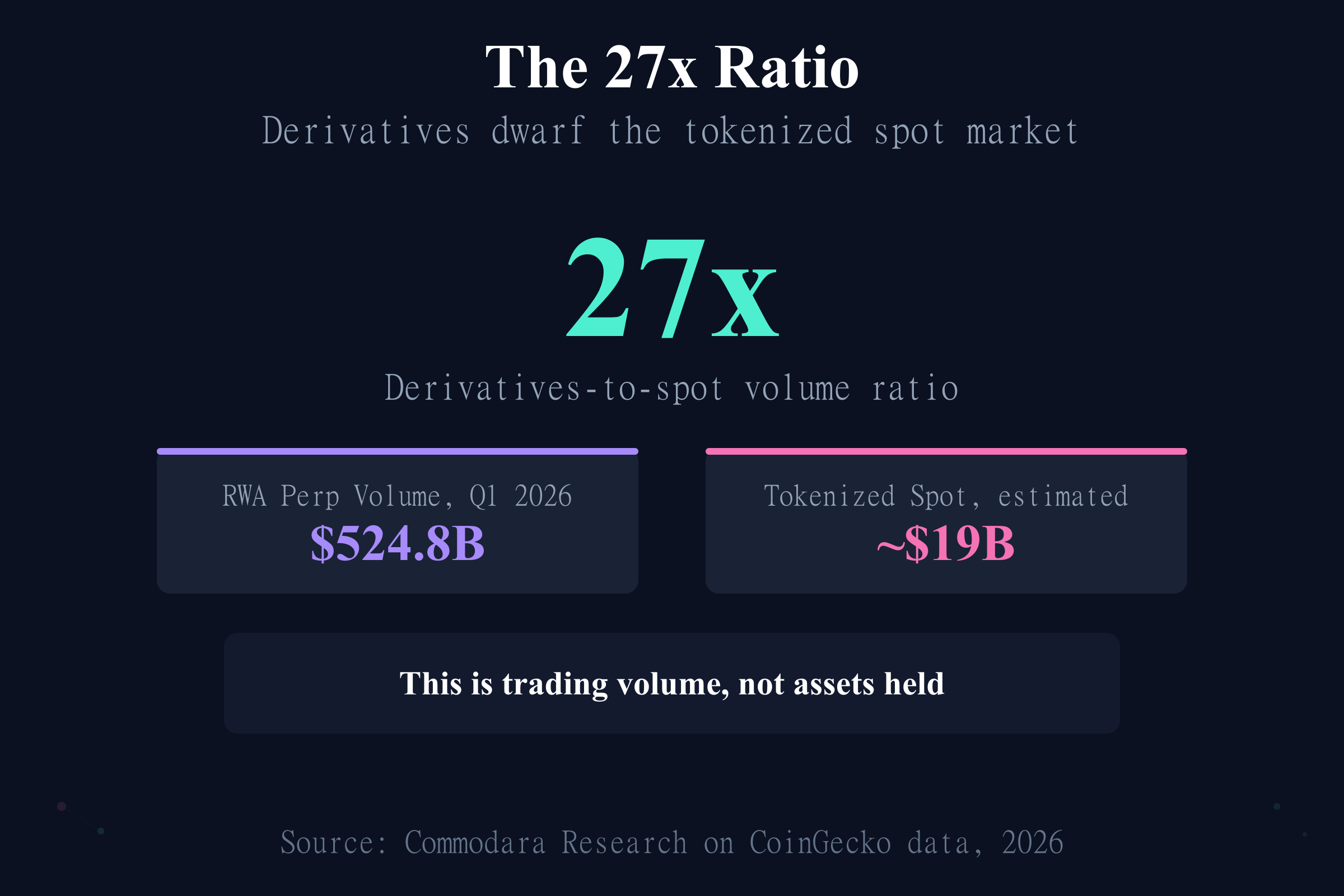
RWA perpetual contracts generated $524.8 billion in trading volume in Q1 2026 alone, making the derivatives layer 27 times larger than the entire tokenized spot market. That single ratio upends the standard story about real world assets on-chain. The narrative focuses on tokenized bonds and funds that investors hold, but the overwhelming majority of actual trading is happening in derivatives that no one holds at all.
This is the part of the tokenized economy that the headline numbers miss. This analysis explains what RWA perpetual contracts are, where the $524 billion figure comes from, why the derivatives layer dwarfs the spot market by 27 times, who is trading and which assets dominate, and what the ratio actually tells us about how the RWA market really works.
Table of Contents
This analysis opens with what RWA perpetual contracts are and how they differ from tokenized spot assets. It then breaks down the $524 billion volume figure and the 27x derivatives-to-spot ratio, explains why perps have come to dominate, and profiles who is trading and which assets lead. The closing sections interpret what the ratio actually means and answer the most common questions before the bottom line.
What Are RWA Perpetual Contracts?
RWA perpetual contracts are derivatives that track the price of a real world asset without expiring and without requiring anyone to hold the underlying asset. A perpetual contract, or perp, lets a trader take a leveraged position on the price of an asset that runs indefinitely, settled continuously through a funding-rate mechanism rather than an expiry date. When the underlying is a real world asset, a stock, a commodity, a currency pair, or an index, the instrument becomes an RWA perpetual contract.
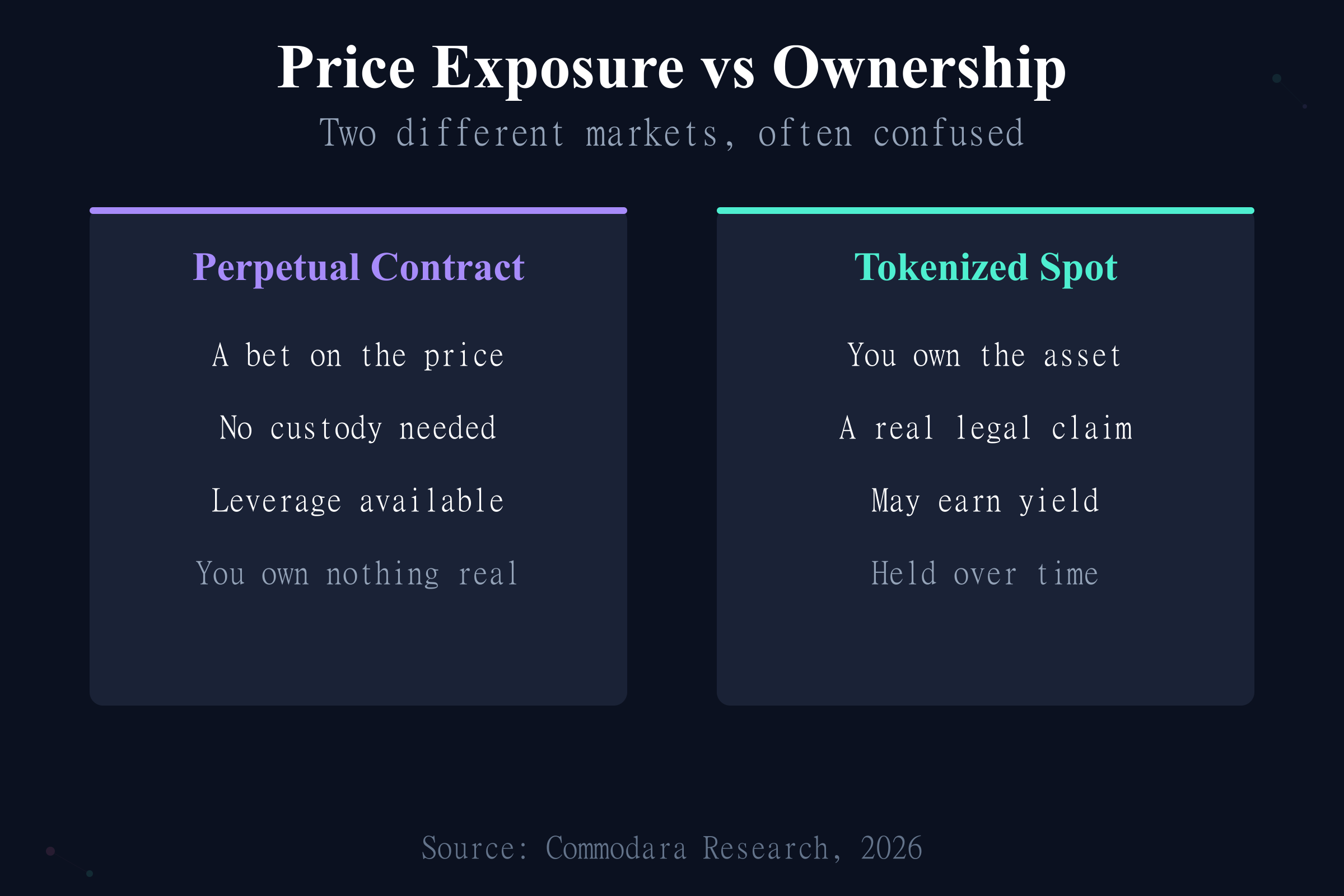
The crucial distinction is between price exposure and ownership. A tokenized Treasury or a tokenized stock is a claim on the actual asset: you own something, and it may pay yield or represent equity. An RWA perpetual contract is a bet on the direction of the price. You own nothing, custody nothing, and hold no claim on the underlying. You simply gain or lose as the price moves.
This difference is why perps and spot serve different users. Spot tokenization is for investors who want to hold an asset for yield or exposure over time. RWA perpetual contracts are for traders who want fast, leveraged, synthetic exposure to a price without the friction of owning the asset. The two coexist, but they are not the same market, and conflating them is the source of much confusion about how large the RWA sector really is.
The $524 Billion Number and the 27x Ratio
The $524.8 billion figure comes from Q1 2026 trading volume across the platforms offering RWA perpetual contracts, as compiled in market research including the CoinGecko RWA report. Set against a tokenized spot market measured in the low tens of billions, the derivatives layer traded roughly 27 times more volume over the same period.
That ratio is less surprising than it first appears. In traditional finance, derivatives markets routinely dwarf the spot markets they reference, often by an order of magnitude or more. The global market for interest-rate and commodity derivatives is many times the size of the underlying cash markets. Seen that way, RWA perpetual contracts are simply reproducing on-chain a pattern that has always defined mature financial markets. For context on the spot side of the equation, our analysis of the true size of the tokenized market shows just how small the holdable market is by comparison.
What is new is how fast it happened. The tokenized spot market took years to reach tens of billions in assets. The RWA perpetual contracts layer reached half a trillion dollars in quarterly volume in a fraction of that time, because a derivative does not require the slow, compliance-heavy machinery of issuing and custodying a real asset. It only requires a reliable price and a venue willing to quote it. Market research such as the CoinGecko RWA report has tracked this divergence quarter after quarter.
Why RWA Perps Dominate the Spot Market
Four advantages explain why RWA perpetual contracts trade so much more than the tokenized assets they reference.
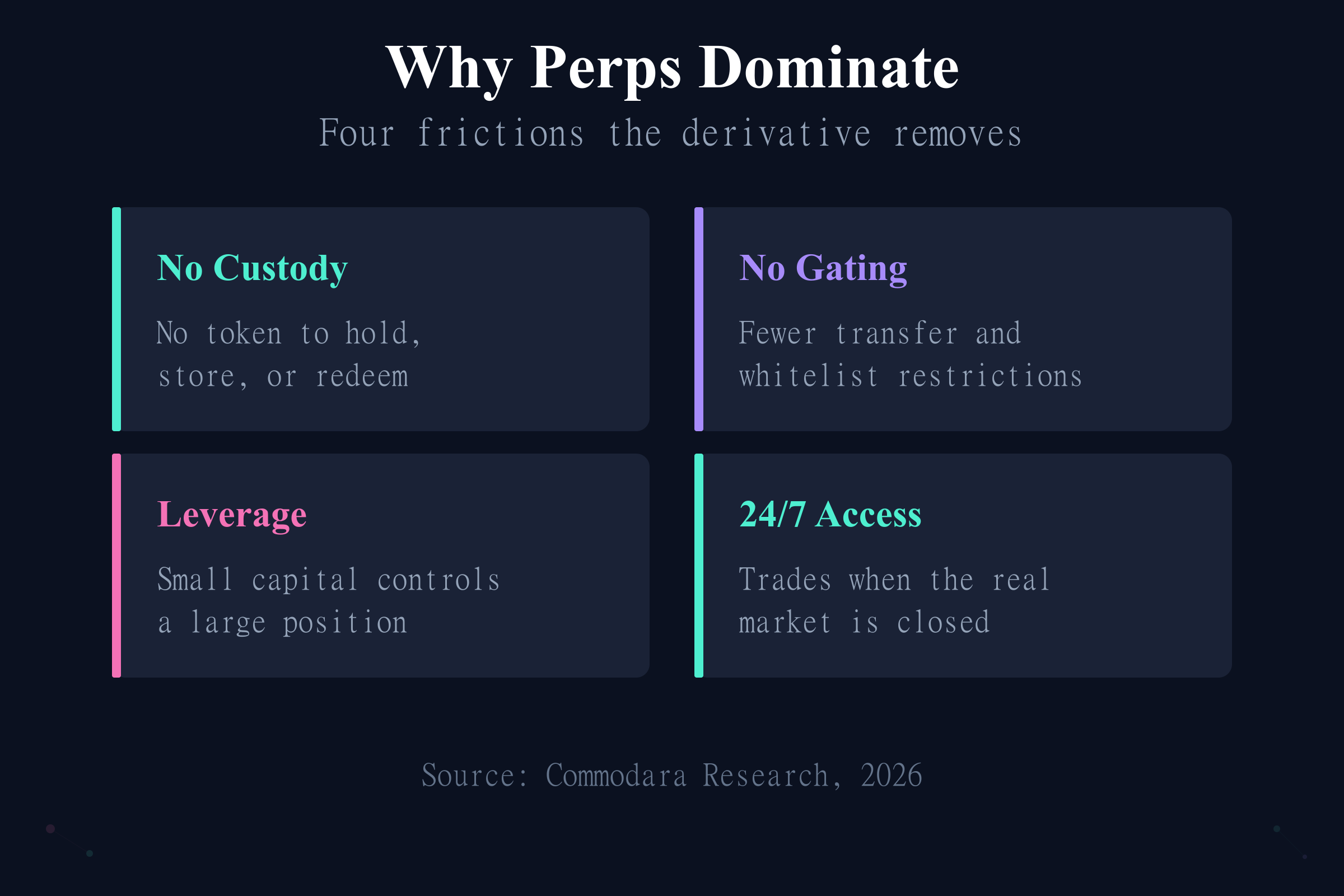
The first is that perps require no custody. A trader gaining exposure to tokenized gold through a perpetual contract never has to hold a tokenized gold token, arrange custody, or worry about redemption. The second is the absence of compliance gating. Where a tokenized security can only move between whitelisted wallets, a perpetual contract on that security’s price often faces far fewer transfer restrictions, dramatically widening the pool of participants who can take a position.
The third advantage is leverage. Perps let traders control a large position with a small amount of capital, which multiplies volume in a way that spot ownership never can. The fourth is availability. RWA perpetual contracts trade around the clock, including when the underlying traditional market, a stock exchange or a bond desk, is closed. A trader who wants exposure to a US equity at midnight can get it through a perp when the actual share cannot trade at all.
Together, these features make perps the path of least resistance for anyone who wants price exposure rather than ownership. The same friction that suppresses tokenized spot liquidity, custody and compliance, is exactly what the derivative removes, which is why the volume gap is so wide.
Who’s Trading and What Assets Dominate
The venues driving RWA perpetual contracts volume are a mix of dominant general-purpose perp exchanges and specialized RWA platforms.
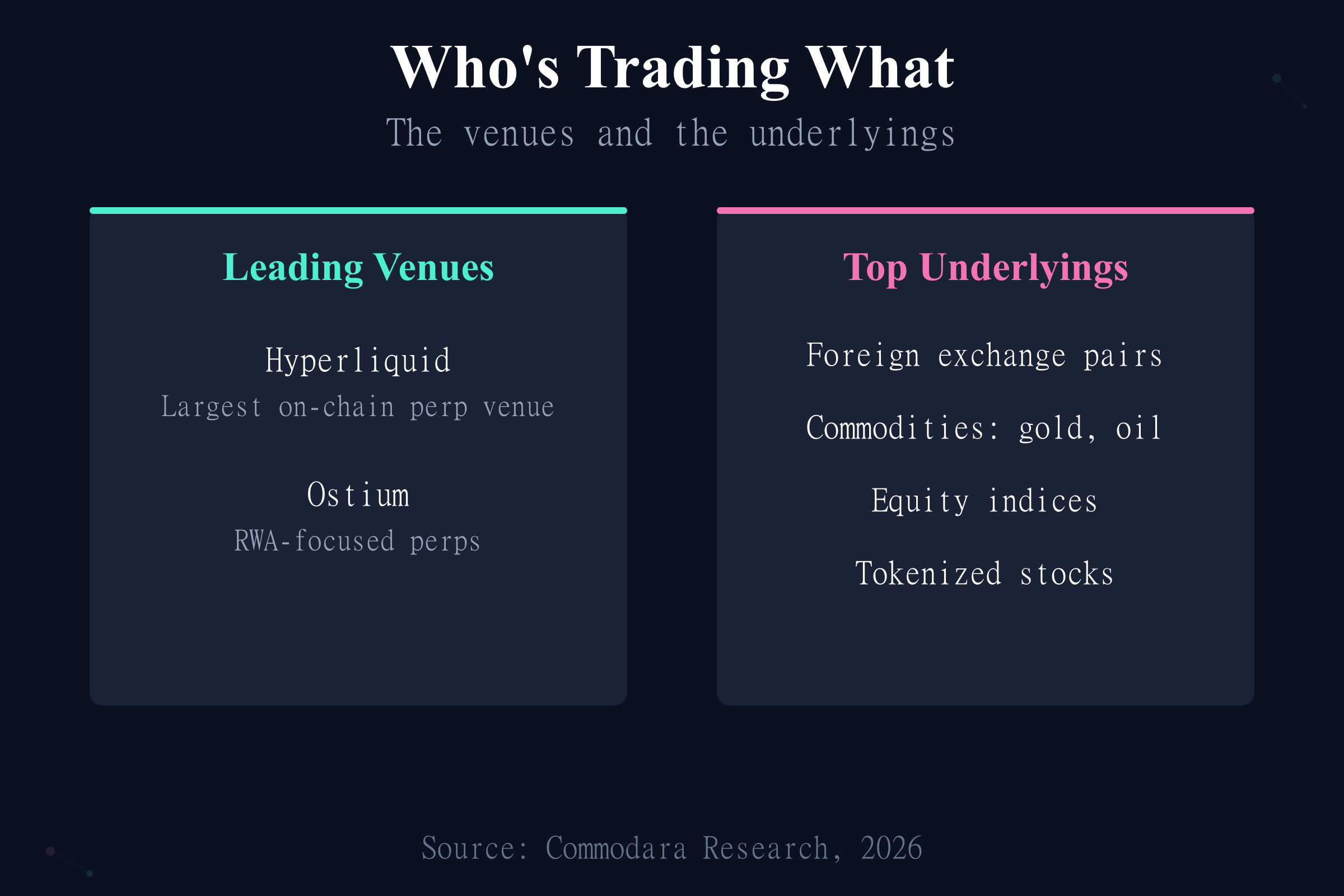
Hyperliquid has become the largest venue for on-chain perpetuals overall, and a meaningful share of its volume comes from RWA-linked contracts. Its order-book model and mechanics are documented on the Hyperliquid platform. Alongside it, specialized venues like Ostium focus specifically on RWA perpetual contracts, offering perps on forex pairs, commodities such as oil and metals, and other real world underlyings that general crypto exchanges historically ignored. The volume is concentrated on a small number of venues, which means the health of the RWA perpetuals market currently depends heavily on a handful of platforms.
On the asset side, the leaders are the classic macro instruments: foreign exchange pairs, commodities like gold and oil, equity indices, and increasingly individual tokenized stocks. These are assets with deep, well-established price feeds and enormous natural trading interest, which is exactly what a perpetual market needs. Tokenized gold, for instance, has a clear reference price and a global audience, making it a natural underlying, as our coverage of the tokenized gold market explains.
What the 27x Ratio Actually Means
The 27x ratio is easy to misread. It is not evidence that the RWA market is 27 times bigger than reported, and it is not proof that real world assets have achieved deep liquidity. It means something more specific: most of the trading activity around real world assets on-chain is speculation on price, not ownership of the asset.
This matters for how the sector is understood. When a headline says RWA trading volumes are surging, much of that surge is perpetual-contract volume that never touches a tokenized asset, funds no real-world issuer, and leaves no one holding a claim on anything real. It is genuine trading activity, but it is synthetic, and it should not be confused with growth in the ownership of tokenized assets. For newcomers trying to tell the two apart, our guides to how tokenized real world assets work and how to actually buy tokenized assets draw the line clearly.
There is also a risk dimension the raw volume hides. Perpetual contracts are leveraged, which means the same features that drive volume, small capital controlling large positions, also drive liquidations when prices move against traders. A booming perp market can mask how much of that activity is short-lived, highly leveraged, and prone to sharp unwinds, none of which builds durable ownership of real world assets.
There is a constructive reading too. A large, liquid derivatives layer can support the spot market by providing price discovery and hedging tools, exactly as it does in traditional finance. If RWA perpetual contracts mature into a reliable hedging venue, they could make holding tokenized spot assets more attractive, not less. The 27x ratio is a sign of an immature market finding its derivatives layer first, which is unusual but not necessarily unhealthy.
Frequently Asked Questions
What are RWA perpetual contracts?
RWA perpetual contracts are derivatives that track the price of a real world asset, such as a stock, commodity, or currency pair, without expiring and without holding the underlying. They give traders leveraged, synthetic price exposure rather than ownership, settled continuously through a funding-rate mechanism rather than at a fixed expiry.
What does the $524 billion figure represent?
It is the reported Q1 2026 trading volume across platforms offering RWA perpetual contracts, roughly 27 times the volume of the tokenized spot market over the same period. The number reflects derivatives activity, not the value of tokenized assets held, so it measures trading rather than ownership.
Why do RWA perps trade more than tokenized spot assets?
Because perps require no custody, face fewer compliance restrictions, offer leverage, and trade around the clock. These features remove the friction that limits tokenized spot liquidity, so traders who want price exposure rather than ownership gravitate to the derivative, multiplying volume far beyond the spot market.
Where are RWA perpetual contracts traded?
Hyperliquid is the largest on-chain perpetuals venue overall, with meaningful RWA-linked volume, while specialized platforms like Ostium focus on RWA perps across forex, commodities, and metals. The dominant underlyings are macro instruments with deep price feeds and broad trading interest.
Does high RWA perp volume mean the market is liquid?
Not in the ownership sense. High perpetual-contract volume reflects speculation on price, not deep liquidity in tokenized assets themselves. A large derivatives layer can aid price discovery and hedging, but it should not be read as growth in the holdable, ownable tokenized market.
The Bottom Line
RWA perpetual contracts are the hidden center of gravity in the tokenized economy. A $524 billion quarter and a 27x lead over spot show that most of the trading interest in real world assets on-chain is in derivatives, not in the tokenized assets themselves. The market found its speculative layer before it built its ownership layer.
This is neither the triumph nor the fraud that the extremes of the debate suggest. It is what an early market looks like when derivatives are easier to build than the underlying spot infrastructure. Whether RWA perpetual contracts end up supporting the tokenized asset market with liquidity and hedging, or simply running alongside it as a parallel arena, will be one of the defining questions of the next few years.
Reading the RWA market accurately means keeping the derivatives layer and the ownership layer separate in your head. Subscribe to the Commodara newsletter for ongoing analysis of the data, venues, and structure shaping the real world asset economy on-chain.