
Tokenized Asset Custody: How Institutions Choose Between Fireblocks, Anchorage, and BitGo
Tokenized asset custody is the infrastructure layer that no institution will bypass, and in 2026 the competitive landscape has consolidated around five providers with fundamentally different architectures. Before a fund allocates a dollar to a tokenized Treasury or a bank settles a tokenized bond, someone has to answer a deceptively simple question: who holds the keys, and what happens if they fail.
Custody is where institutional tokenization succeeds or stalls. This analysis explains what tokenized asset custody actually involves, the technical models behind it, how Fireblocks, Anchorage, BitGo, Coinbase, and Komainu differ, and the criteria institutions use to choose between them.
Table of Contents
This analysis opens with why tokenized asset custody is the gating decision for institutional capital and what makes custody of tokenized assets different from holding crypto. It then explains the technical models behind key management, profiles the five leading providers and how they differ, and closes with the criteria institutions actually use to select a custodian, followed by the most common questions and the bottom line.
Why Tokenized Asset Custody Decides Everything
An institution cannot hold a tokenized security the way an individual holds crypto in a personal wallet. Regulation, fiduciary duty, and internal risk policy all require that client assets sit with a qualified party under auditable controls. Until that condition is met, no capital moves, regardless of how attractive the underlying asset is.
This is why tokenized asset custody is the gating decision rather than a back-office detail. A pension fund evaluating a tokenized Treasury product is not primarily assessing the yield; it is assessing whether the custody arrangement satisfies its regulator, its auditor, and its own investment committee. Custody failure is the risk that ends careers, so it receives disproportionate scrutiny.
The stakes are structural. Unlike a traditional security, where ownership sits in a registrar’s database and can be reconstructed, a tokenized asset controlled by a lost private key can be permanently unrecoverable. That irreversibility is precisely what makes institutional-grade key management non-negotiable, and it is why custody providers have become some of the most heavily funded companies in the tokenization stack.
There is also an operational dimension. Custody is not a one-time integration but an ongoing relationship covering reporting, reconciliation, audit support, and incident response. Institutions evaluate custodians partly on how well they will perform during a bad week, not just how elegant the technology looks during a sales demonstration.
What Makes Custody of Tokenized Assets Different
Custodying a tokenized real world asset is not the same as custodying bitcoin, and conflating the two leads to poor provider selection.
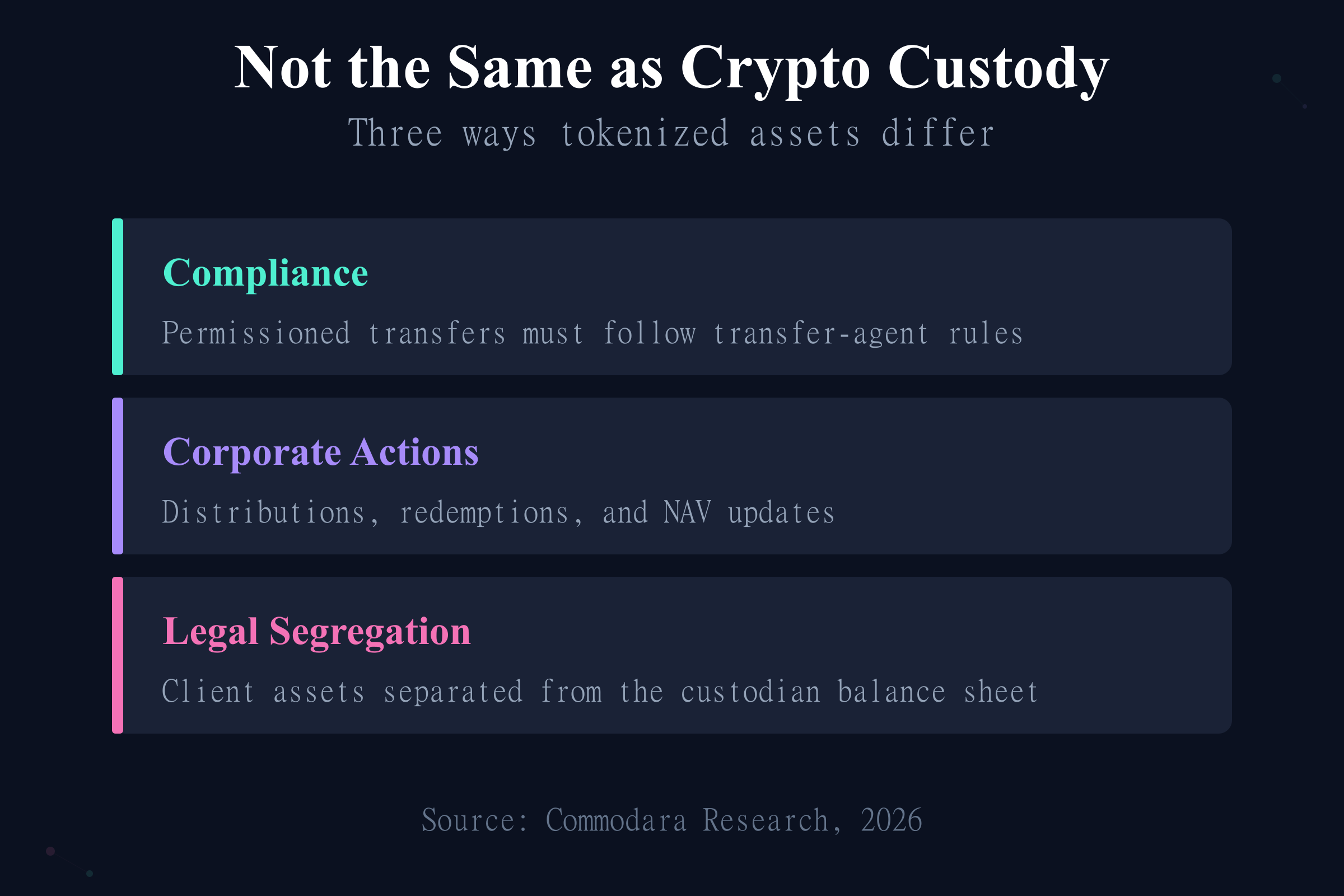
The first difference is compliance. Many tokenized securities are permissioned, meaning transfers are restricted to whitelisted addresses. A custodian must therefore integrate with the issuer’s transfer-agent rules, not merely store a key. The second is corporate actions. Tokenized funds pay distributions, process redemptions, and update net asset values, all of which the custodian must support operationally.
The third difference is legal segregation. Institutions need assurance that their assets are held separately from the custodian’s own balance sheet and would be protected in an insolvency. That requirement pushes toward regulated custodians with a defined legal status rather than pure technology vendors, which is the central fault line running through the provider landscape.
The Technical Models: MPC, HSM, and Qualified Custody
Providers differ first on how they secure and control private keys, and these architectures carry real operational trade-offs.
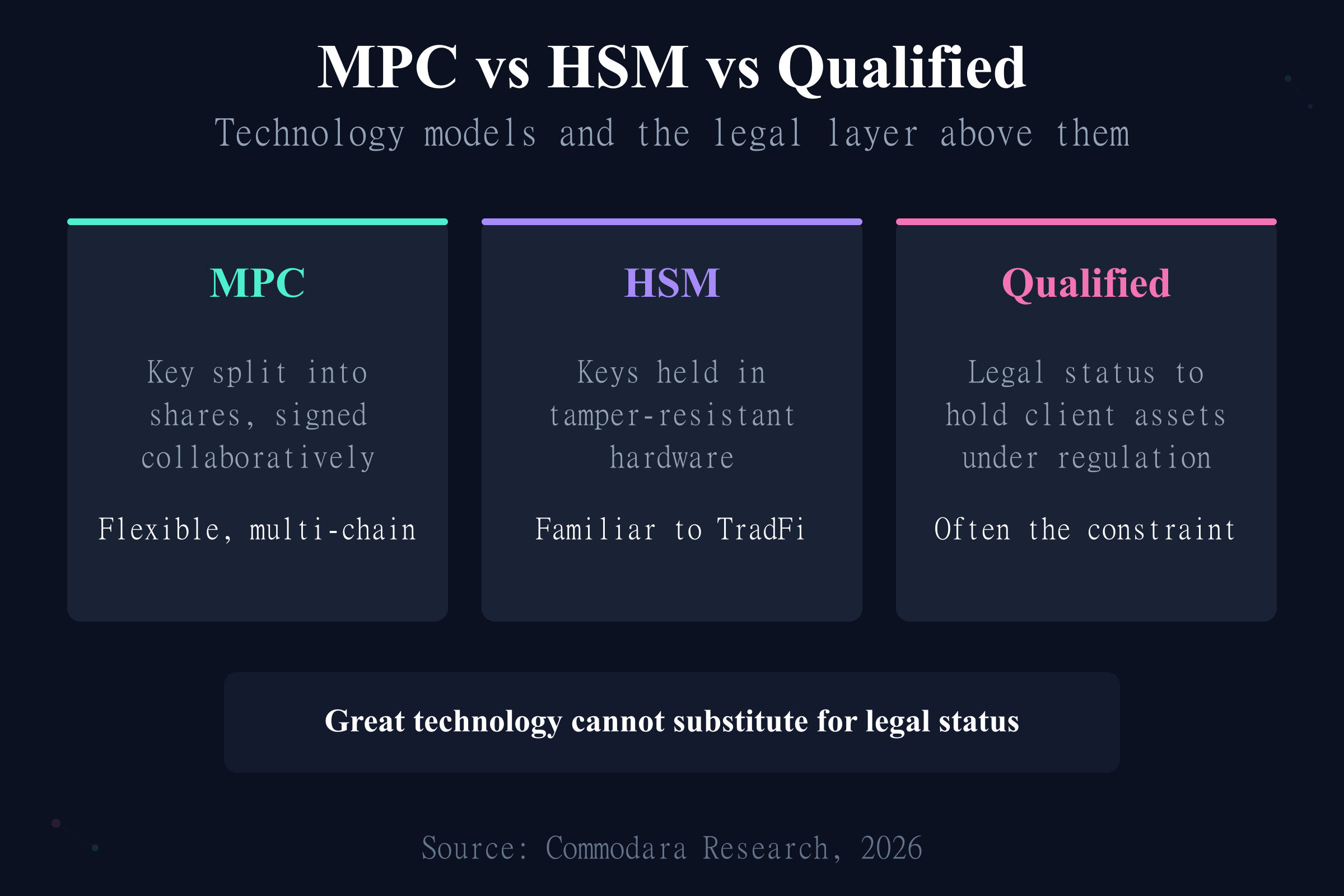
Multi-party computation, or MPC, splits a private key into shares distributed across parties, so no single machine or person ever holds the complete key. Transactions are signed collaboratively. MPC offers flexibility, fast signing, and granular policy control, which suits institutions transacting frequently across many chains.
Hardware security modules, or HSMs, store keys inside tamper-resistant physical devices. This is the model traditional finance already understands, and it offers strong physical assurance, though typically with less flexibility than MPC for high-frequency, multi-chain operations. Many providers now combine both approaches.
Sitting above the technology is the legal question of qualified custody. In the United States, guidance from bodies such as the Office of the Comptroller of the Currency shapes which entities may hold client assets in a regulated capacity. A provider can have excellent technology and still not satisfy an institution that specifically requires a qualified custodian.
The Five Leading Providers Compared
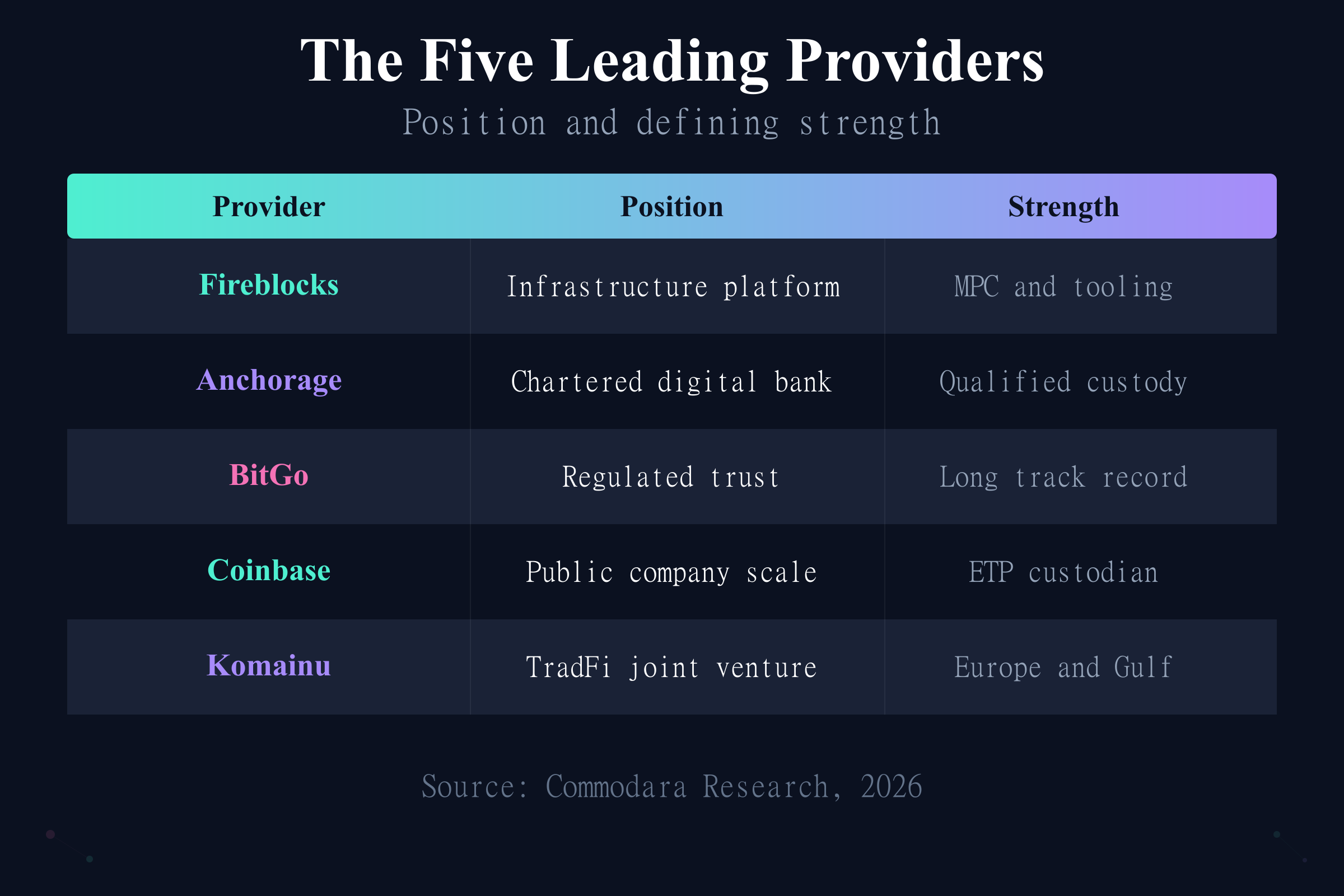
Five providers dominate institutional tokenized asset custody, each occupying a distinct position between technology platform and regulated bank. The differences between them are less about security features, which are broadly comparable, than about legal standing and market focus.
Fireblocks
Fireblocks is the infrastructure platform of choice for institutions that want direct control with enterprise tooling. Built around MPC, it provides key management, policy engines, and connectivity across hundreds of venues and chains, and it powers custody operations for banks, exchanges, and tokenization platforms rather than replacing them. Our deeper look at how Fireblocks supports tokenized assets covers its architecture in detail.
The distinction worth understanding is that Fireblocks is often the technology beneath someone else’s custody offering rather than the custodian of record. Banks and platforms license the infrastructure and remain the regulated party. For institutions that want to control their own keys under their own licence, that model is the point rather than a limitation.
Anchorage Digital
Anchorage Digital occupies a distinctive position as a federally chartered digital asset bank in the United States. That charter allows it to act as a qualified custodian, which matters enormously for regulated funds and advisers with specific custody obligations. Anchorage combines regulated status with institutional-grade technology, making it the natural choice where the legal wrapper is the binding constraint.
That regulated status shapes what Anchorage Digital can offer. Because it operates as a chartered institution rather than a software vendor, it can hold assets in a capacity that satisfies rules many funds and registered advisers must follow. For those institutions the charter is not a marketing feature; it is the reason a conversation can happen at all.
BitGo
BitGo is one of the longest-established institutional custodians, offering regulated trust company services alongside multi-signature and MPC technology. Its depth of experience, insurance arrangements, and broad asset support make it a common choice for funds and exchanges that want a regulated custodian with a long operating record behind it.
Coinbase and Komainu
Coinbase brings the scale and regulatory footprint of a large public company to institutional custody, and its position as custodian for numerous exchange-traded products has made it a default for many large allocators. Komainu, built as a joint venture combining traditional finance and digital asset expertise, targets institutions in Europe and the Middle East that want regulated custody aligned with familiar financial-services structures.
Between them, these five cover most institutional requirements, but they are not interchangeable. A European asset manager, a US registered adviser, and a crypto-native trading firm face different rules and will rationally reach different conclusions from the same provider list. The right answer is local to the institution asking the question.
How Institutions Actually Choose
Selection rarely comes down to technology alone. Institutions weigh four criteria, usually in this order.
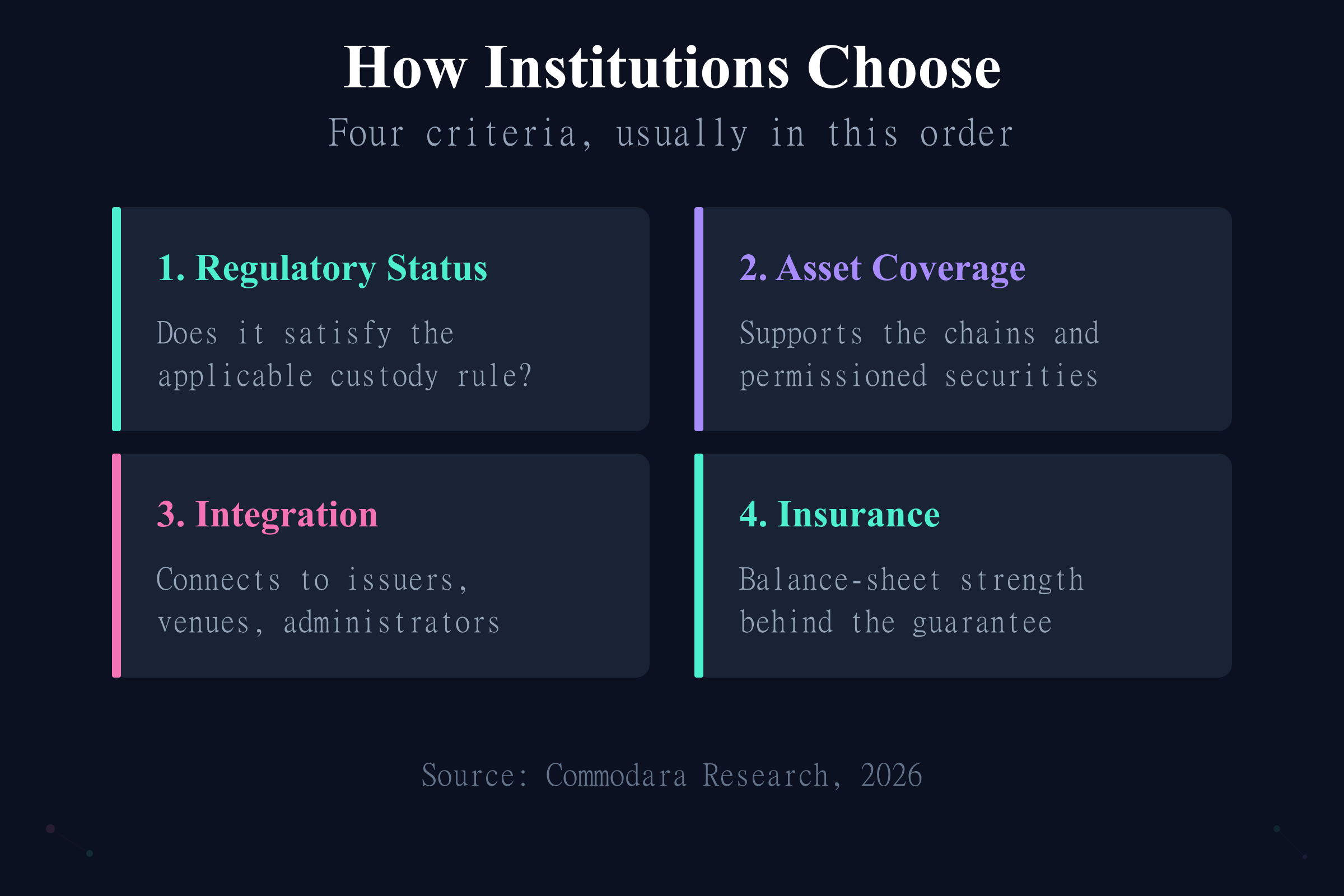
The first is regulatory status: does the provider satisfy the specific custody rule the institution is subject to? This single question eliminates most candidates immediately. The second is asset and chain coverage: can the custodian actually support the tokenized instruments and networks the institution intends to use, including permissioned securities with transfer restrictions?
The third is operational integration: how well the custodian connects to the issuers, trading venues, and fund administrators already in the institution’s workflow. A custodian that cannot integrate with the platforms described in our comparison of the leading tokenization platforms creates friction at every transaction. The fourth is insurance and balance-sheet strength, because the credibility of the guarantee matters as much as the technology behind it.
A practical step many institutions take is running a parallel arrangement, holding assets with more than one custodian to avoid single-provider concentration. This adds cost and operational overhead, but it removes the scenario where one custodian’s failure freezes an entire portfolio. As allocations grow, that redundancy tends to shift from optional to standard practice.
Issuers face the mirror image of this decision. A tokenization platform such as the one profiled in our Securitize platform review must select custody partners its investors will accept, which means custody choice shapes distribution as much as security. Before committing to a structure, it is worth taking time to assess your tokenization readiness across custody, compliance, and jurisdiction together.
Frequently Asked Questions
What is tokenized asset custody?
Tokenized asset custody is the safekeeping and administration of tokenized securities and real world assets on behalf of institutions. It covers private key management, compliance with transfer restrictions, corporate actions such as distributions and redemptions, and the legal segregation of client assets from the custodian’s own balance sheet.
What is the difference between MPC and HSM custody?
MPC splits a private key into shares held by different parties so no single machine ever holds the whole key, offering flexibility and fast multi-chain signing. HSM custody stores keys inside tamper-resistant hardware, a model traditional finance understands well. Many providers now combine both approaches.
Why do institutions need a qualified custodian?
Regulation and fiduciary duty often require that client assets be held by an entity with defined legal status, not simply a technology vendor. A qualified custodian provides that legal wrapper, along with asset segregation and insolvency protection, which is frequently the binding constraint on whether an institution can allocate at all.
Which custody provider is best for tokenized assets?
It depends on the constraint. Fireblocks suits institutions wanting infrastructure and direct control, Anchorage suits those needing a federally chartered qualified custodian, BitGo offers a long-established regulated trust, Coinbase brings scale, and Komainu targets European and Middle Eastern institutions with familiar structures.
Can tokenized assets be self-custodied?
Technically yes, but most institutions cannot. Regulatory requirements, fiduciary duty, and auditor expectations generally require third-party qualified custody for client assets. Self-custody also carries irreversible loss risk, since a tokenized asset controlled by a lost private key may be permanently unrecoverable.
The Bottom Line
Tokenized asset custody is the quiet decision that determines whether institutional capital enters the tokenized market at all. The technology matters, but the legal wrapper around it matters more, which is why the provider landscape has split between infrastructure platforms and regulated custodians rather than converging on a single model.
For institutions, the practical path is to start from the regulatory constraint and work backwards, confirming which providers satisfy the applicable custody rule before evaluating features. For issuers, the calculation runs the other way: choosing custody partners that the intended investor base already trusts removes one of the largest obstacles to distribution.
As tokenized assets grow more complex, custody will keep absorbing responsibilities that once sat with transfer agents and administrators. Subscribe to the Commodara newsletter for ongoing analysis of the custody providers, standards, and infrastructure underpinning tokenized asset custody.