
Cross-Chain Interoperability for RWA: How Tokenized Assets Move Between Blockchains
Cross-chain interoperability RWA infrastructure is the gap that determines whether $31 billion in tokenized assets becomes a unified global market or stays trapped in isolated pools on individual blockchains. A tokenized Treasury issued on one network and a lending protocol running on another may as well exist in different countries if value cannot move safely between them.
This is the least glamorous and most consequential problem in tokenization. This analysis explains what cross-chain interoperability RWA infrastructure actually does, why fragmentation is holding the market back, how Chainlink CCIP, Plume SkyLink, and LayerZero approach the problem differently, and what the risks are.
Table of Contents
This analysis opens with why cross-chain interoperability RWA infrastructure matters and how fragmentation constrains the tokenized market today. It then explains the technical approaches to moving assets between chains, profiles Chainlink CCIP, Plume SkyLink, and LayerZero, and closes with the security risks that make this the hardest problem in the stack, followed by the most common questions and the bottom line.
Why Cross-Chain Interoperability RWA Infrastructure Matters
Tokenized assets are not issued on one blockchain. They are scattered across Ethereum, Solana, Avalanche, Polygon, various layer-two networks, and permissioned institutional chains, each chosen for reasons that made sense to the issuer at the time. The result is a market that is technically on-chain but economically fragmented.
Fragmentation is expensive. A tokenized Treasury fund with holders spread across five networks has five shallow pools rather than one deep one, which suppresses liquidity, widens spreads, and makes price discovery unreliable. This is a direct contributor to the problem examined in our analysis of why tokenized assets still cannot trade, where split venues are one of the four structural barriers.
The stakes rise as institutions arrive. A bank settling tokenized securities cannot accept a system where an asset is stranded because a counterparty operates on a different network. For institutional adoption, moving value between chains has to be as reliable as moving it within one, which is precisely what cross-chain interoperability RWA infrastructure is built to deliver.
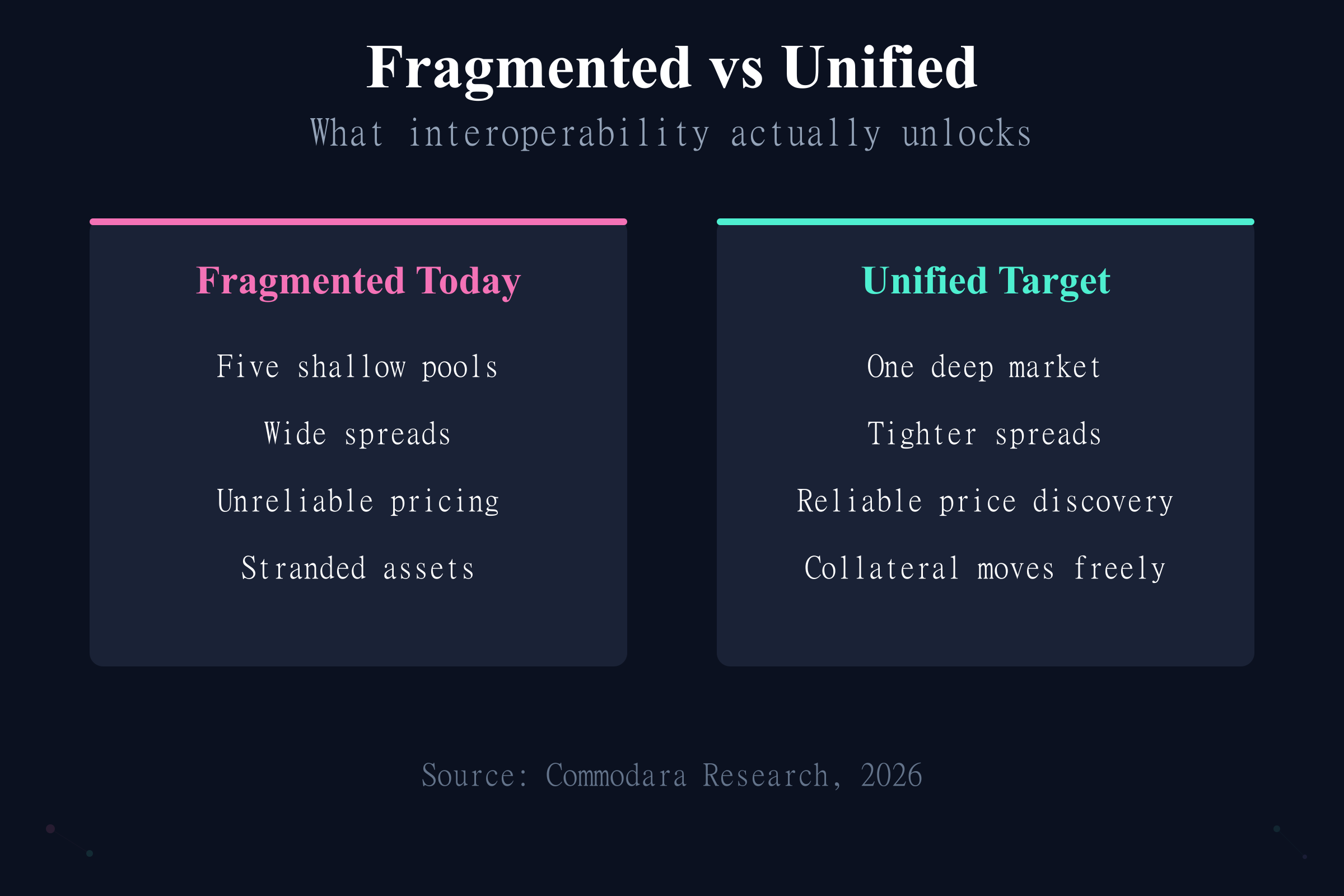
The economic argument is straightforward. Liquidity concentrates value: a single market with many participants prices assets more accurately and absorbs larger orders than several small ones holding the same total. Every additional network an asset is issued on without interoperability makes the market slightly worse, not better, because it divides the same demand across more venues.
How Assets Actually Move Between Chains
There is no single mechanism for moving a tokenized asset between blockchains, and the differences matter enormously for security.

The oldest approach is lock-and-mint bridging. The asset is locked in a contract on the source chain and a representation is minted on the destination chain. It works, but it creates a wrapped asset that is only as good as the bridge holding the original, and bridge contracts have historically been among the most exploited targets in the industry.
A more robust approach is burn-and-mint with a canonical issuer, where the token is destroyed on one chain and reissued natively on another by the issuer itself. Because there is no wrapped derivative, holders always own the real asset. For regulated securities this is generally the preferred model, since the issuer retains control of the register across every network.
The third approach is messaging rather than movement. Instead of relocating the asset, a secure messaging layer transmits instructions and data between chains, allowing a contract on one network to act on information from another. This underpins cross-chain collateral, settlement instructions, and net asset value updates without the asset leaving its home chain.
For regulated assets the choice between these is not merely technical. A securities issuer is responsible for maintaining an accurate register of who owns what. Lock-and-mint bridging creates a second, derivative claim that the issuer does not control, which can put the on-chain representation at odds with the legal record. Burn-and-mint and messaging both avoid that problem, which is why they dominate serious institutional deployments.
The Infrastructure Providers
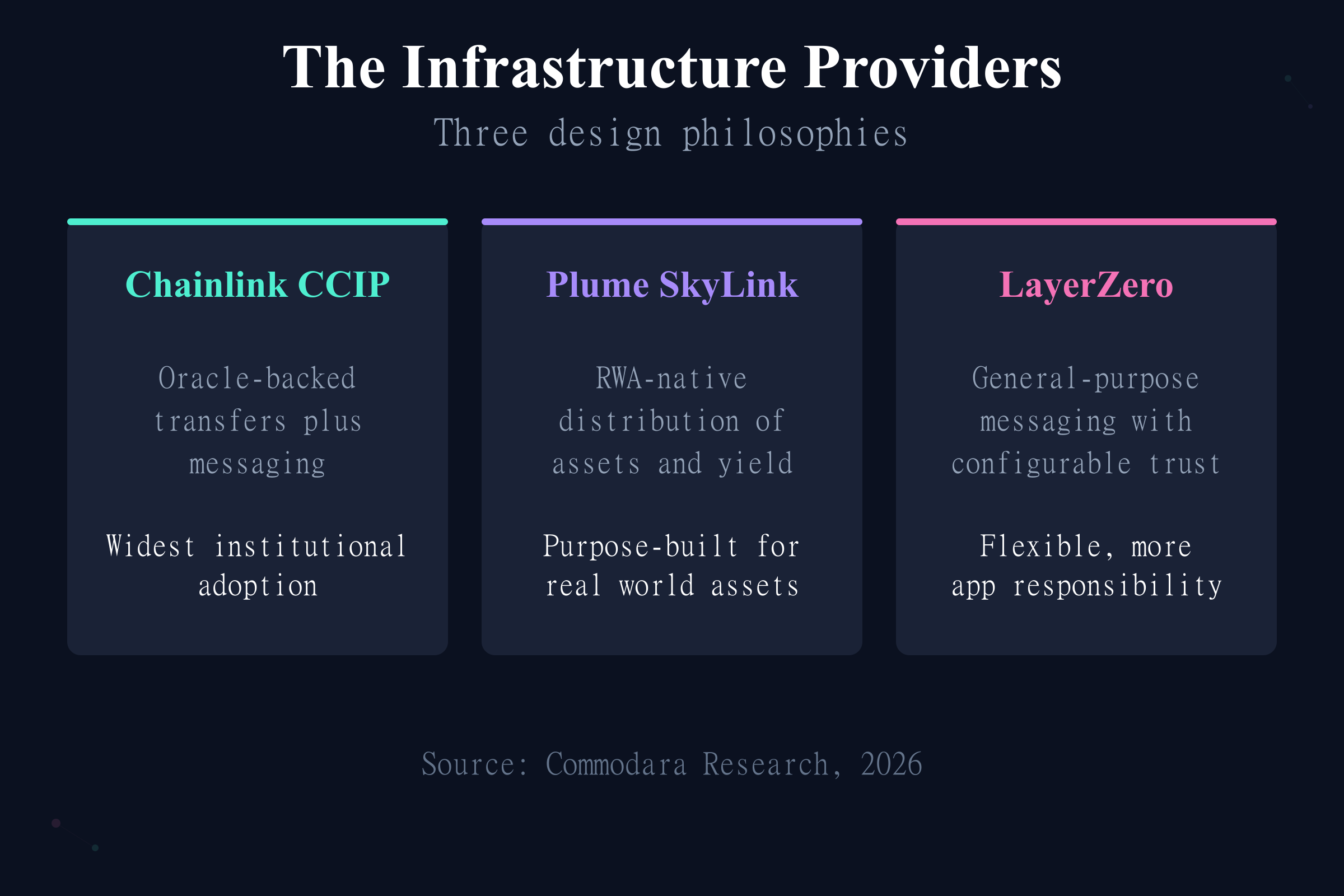
Three approaches dominate the market, each with a different design philosophy.
Chainlink CCIP
Chainlink’s Cross-Chain Interoperability Protocol is the most institutionally adopted option, built around the oracle network that already provides price feeds and proof-of-reserve data across the tokenization stack. CCIP handles both token transfers and arbitrary messaging, with a risk management network designed to halt suspicious activity. Documentation is published by Chainlink, and our breakdown of how Chainlink CCIP powers RWA infrastructure covers the architecture in depth.
Plume SkyLink
Plume approaches the problem from the RWA side rather than the general-purpose side. Built as a network focused specifically on real world assets, its SkyLink system is designed to distribute tokenized yield and assets across multiple chains from an RWA-native base. Details are published by Plume Network. The thesis is that RWA-specific requirements, compliance, transfer restrictions, and yield distribution, are better served by purpose-built infrastructure than by generic bridging.
LayerZero and General Messaging
LayerZero represents the general-purpose messaging model, providing a lightweight protocol that lets applications define their own security assumptions when communicating across chains. Its flexibility has made it widely adopted, and its omnichain token standard allows a single token to exist natively across many networks. For RWA issuers, the trade-off is that flexibility places more responsibility on the application to configure security correctly.
These three are not mutually exclusive, and many issuers use more than one. A tokenized fund might rely on canonical issuance for the asset itself, an oracle network for pricing and reserve attestation, and a messaging layer for settlement instructions to a counterparty. Interoperability in practice is a stack rather than a single vendor decision.
Where Institutional Chains Fit
Public-chain interoperability is only half the picture. A significant share of institutional tokenization settles on permissioned networks that were never designed to connect to public blockchains.
These networks, including the institutional blockchain covered in our explainer on the settlement layer Wall Street is building on, prioritize privacy between counterparties. Connecting them to public chains raises a harder question than technical compatibility: how to move an asset between a system where transactions are private and one where they are visible, without breaking the confidentiality that made the institution adopt it in the first place.
The emerging answer is selective connection. Rather than merging the two worlds, institutions bridge specific flows, such as settlement instructions or collateral confirmations, while keeping the underlying positions on the permissioned network. Custody providers sit at this boundary, which is why the choice covered in our guide to institutional tokenized asset custody increasingly includes multi-chain and cross-chain support as a requirement.
This boundary is where cross-chain interoperability RWA design gets hardest. Public networks optimize for verifiability while permissioned networks optimize for confidentiality, and any connection between them must satisfy both without leaking what one side was built to protect. Mature cross-chain interoperability RWA infrastructure will have to bridge that gap, and it remains genuinely unsolved today.
The Security Problem
Cross-chain infrastructure has been the single largest source of losses in the history of decentralized finance, and that record shapes how institutions evaluate it.
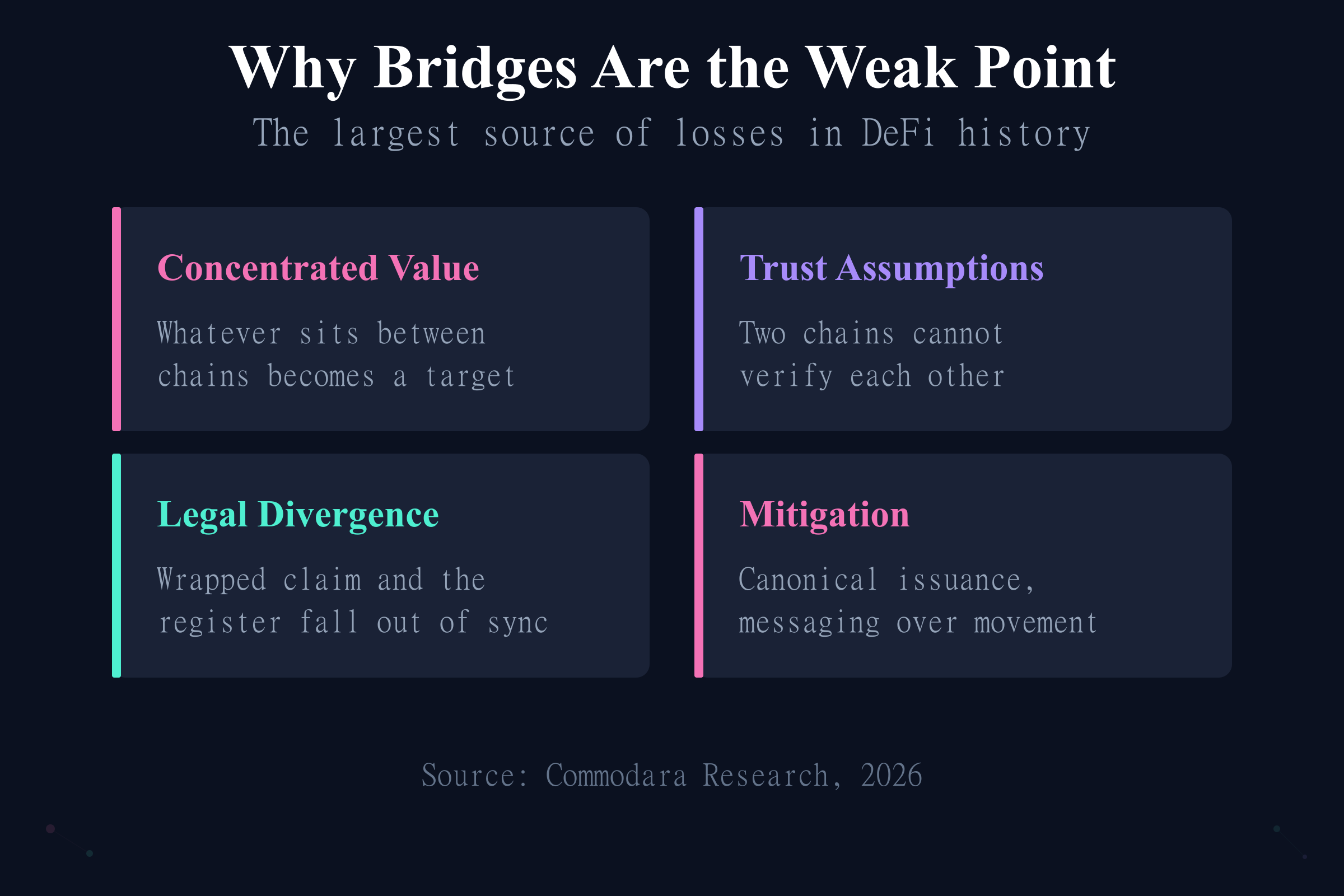
The core difficulty is that a bridge must be trusted by two chains that cannot verify each other directly. Whatever sits in the middle, a validator set, a multisig, an oracle network, becomes a concentrated target holding significant value. Historically, attackers have exploited exactly that concentration rather than the blockchains themselves.
For real world assets the consequences are more serious than for crypto tokens. A compromised bridge holding wrapped tokenized securities creates a legal problem as well as a financial one, because the wrapped claim and the underlying register can fall out of sync. This is the strongest argument for canonical burn-and-mint issuance over wrapped representations, and for messaging models where the asset never leaves its home chain at all.
Institutions therefore assess interoperability providers the way they assess custodians: on the security model, the parties who must be trusted, the track record, and what happens when something goes wrong. Technology alone does not clear that bar.
The mitigations that have emerged are mostly about reducing what has to be trusted. Limiting the value that can cross in a given period, requiring multiple independent attestations before a transfer finalizes, and building circuit breakers that halt activity on anomalous behavior all shrink the blast radius of a failure. None of these eliminates the risk, but together they turn a catastrophic loss into a contained one, which is the realistic goal.
Frequently Asked Questions
What is cross-chain interoperability for RWA?
Cross-chain interoperability RWA infrastructure lets tokenized real world assets and their data move securely between different blockchains. It covers token transfers, secure messaging, and settlement instructions, so a tokenized asset issued on one network can be used, traded, or pledged as collateral on another without fragmenting liquidity.
Why are tokenized assets fragmented across blockchains?
Issuers select networks independently based on cost, speed, compliance, and the audience they want to reach. The result is the same asset class existing in many incompatible pools. Without interoperability, each pool is too shallow to support real trading, which suppresses liquidity across the whole market.
What is the difference between bridging and messaging?
Bridging moves the asset itself, either by locking and minting a wrapped version or by burning and reissuing it natively. Messaging leaves the asset where it is and transmits instructions or data between chains, allowing contracts to act on external information without relocating value.
Is cross-chain infrastructure safe for institutional assets?
It carries real risk. Bridges have been the largest source of losses in decentralized finance because whatever sits between two chains becomes a concentrated target. Institutions mitigate this by preferring canonical issuance over wrapped assets, favoring providers with strong security models, and limiting what actually crosses.
Which provider leads cross-chain interoperability for RWA?
Chainlink CCIP has the widest institutional adoption, leveraging its existing oracle network and risk management layer. Plume SkyLink targets RWA-specific requirements with purpose-built infrastructure, while LayerZero offers flexible general-purpose messaging. The right choice depends on whether compliance features or configurability matters more.
The Bottom Line
Cross-chain interoperability RWA infrastructure decides whether tokenization produces a single global market or a collection of disconnected islands. The assets already exist and the issuance machinery works; what remains is the plumbing that lets value move between networks without introducing a new point of failure.
The direction of travel favors canonical issuance and secure messaging over the wrapped-asset bridges that defined the earlier era. For regulated securities, keeping the issuer in control of the register across every chain is not merely safer, it is often the only model that satisfies the legal requirements attached to the asset.
As institutional and public networks converge, this layer will quietly determine how much of the tokenized economy is actually usable. Subscribe to the Commodara newsletter for ongoing analysis of the protocols and standards shaping cross-chain interoperability RWA infrastructure.