
RWA DeFi Collateral: How Tokenized Treasuries Are Powering On-Chain Lending
RWA DeFi collateral has quietly become one of the largest segments of decentralized finance, with over $2 billion in tokenized Treasuries now backing stablecoin minting, lending protocols, and institutional credit markets. While most of the attention in tokenization goes to issuance, the more consequential shift is happening on the demand side, where real world assets are being put to work as the collateral that DeFi runs on.
This is the point where tokenization stops being a novelty and starts being infrastructure. This analysis explains what RWA DeFi collateral is, why tokenized Treasuries make such effective collateral, which protocols are building with it, and what risks come with wiring real world assets into on-chain lending.
Table of Contents
This analysis opens with what RWA DeFi collateral is and why tokenized Treasuries make ideal collateral. It then profiles the protocols building with it, from Sky and Spark to Aave Horizon and the Treasury issuers, and the oracle infrastructure that makes it work. The closing sections cover the risks of using real world assets as collateral and answer the most common questions before the bottom line.
What Is RWA DeFi Collateral?
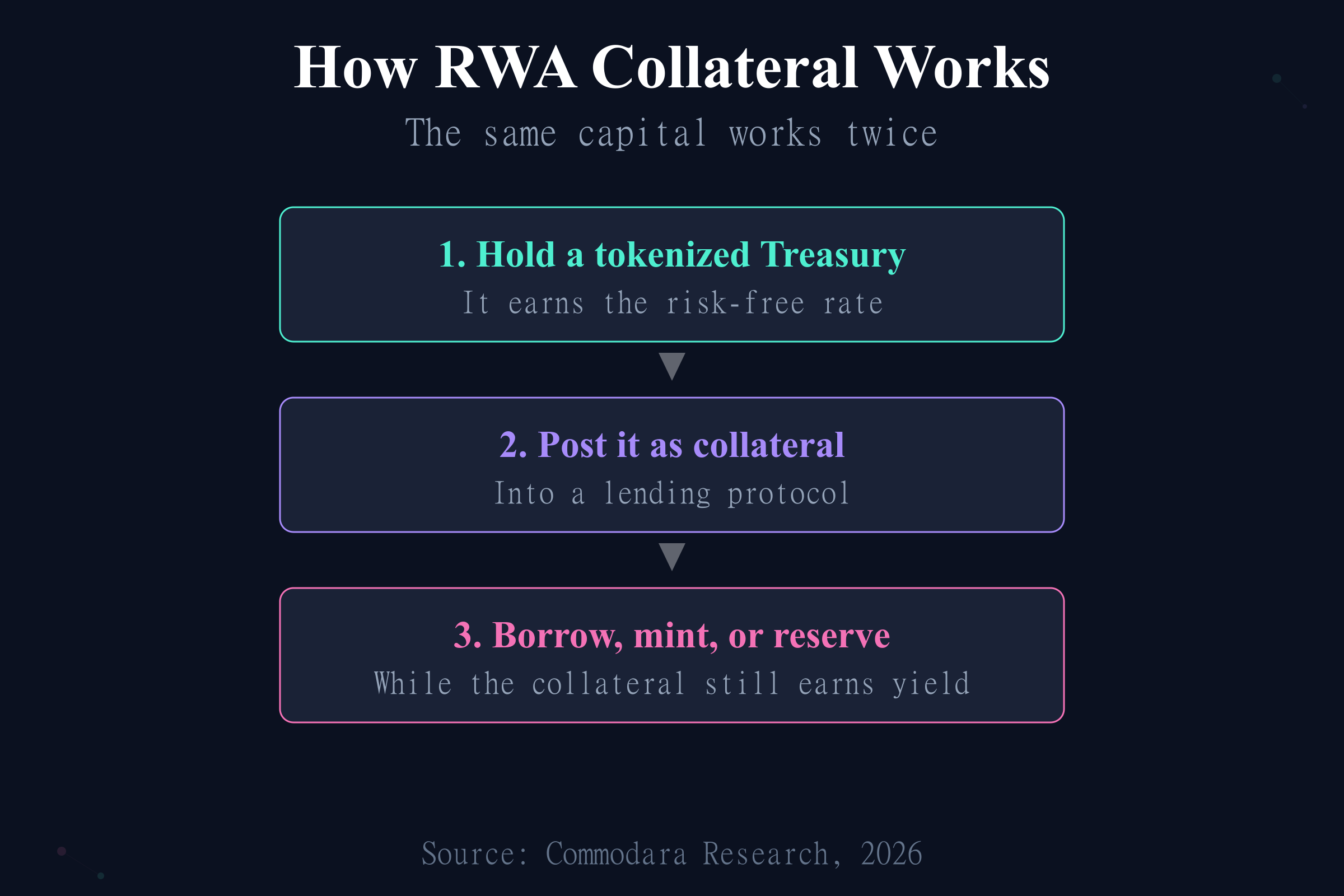
RWA DeFi collateral is the use of tokenized real world assets, most often tokenized US Treasuries, as the backing for on-chain financial activity. Instead of posting a volatile crypto asset like ether to borrow against, a user posts a tokenized Treasury fund that holds government debt and earns a yield. That collateral can back a loan, mint a stablecoin, or serve as a protocol’s reserve.
The mechanism is straightforward but powerful. A tokenized Treasury represents a claim on short-term government debt, so it carries the low volatility and steady yield of the underlying asset. When that token is deposited into a lending protocol, it does two things a crypto asset cannot: it holds its value through market turbulence, and it keeps earning the risk-free rate while it sits as collateral.
This is why RWA DeFi collateral has grown so quickly. It imports the stability and yield of traditional finance into a system that previously had to rely on assets that could lose half their value overnight. The result is collateral that is both safer and productive at the same time.
A concrete example makes it clear. A holder deposits a tokenized money market fund worth $1 million into a lending market, borrows $800,000 in a stablecoin against it, and continues to earn the Treasury yield on the full $1 million the entire time. The borrowed stablecoin can then be deployed elsewhere. The same capital is effectively working in two places at once, which is the efficiency that has drawn serious institutional interest.
Why Tokenized Treasuries Make Ideal Collateral
Tokenized Treasuries have become the collateral of choice for a set of specific reasons, each of which addresses a weakness in crypto-native collateral.
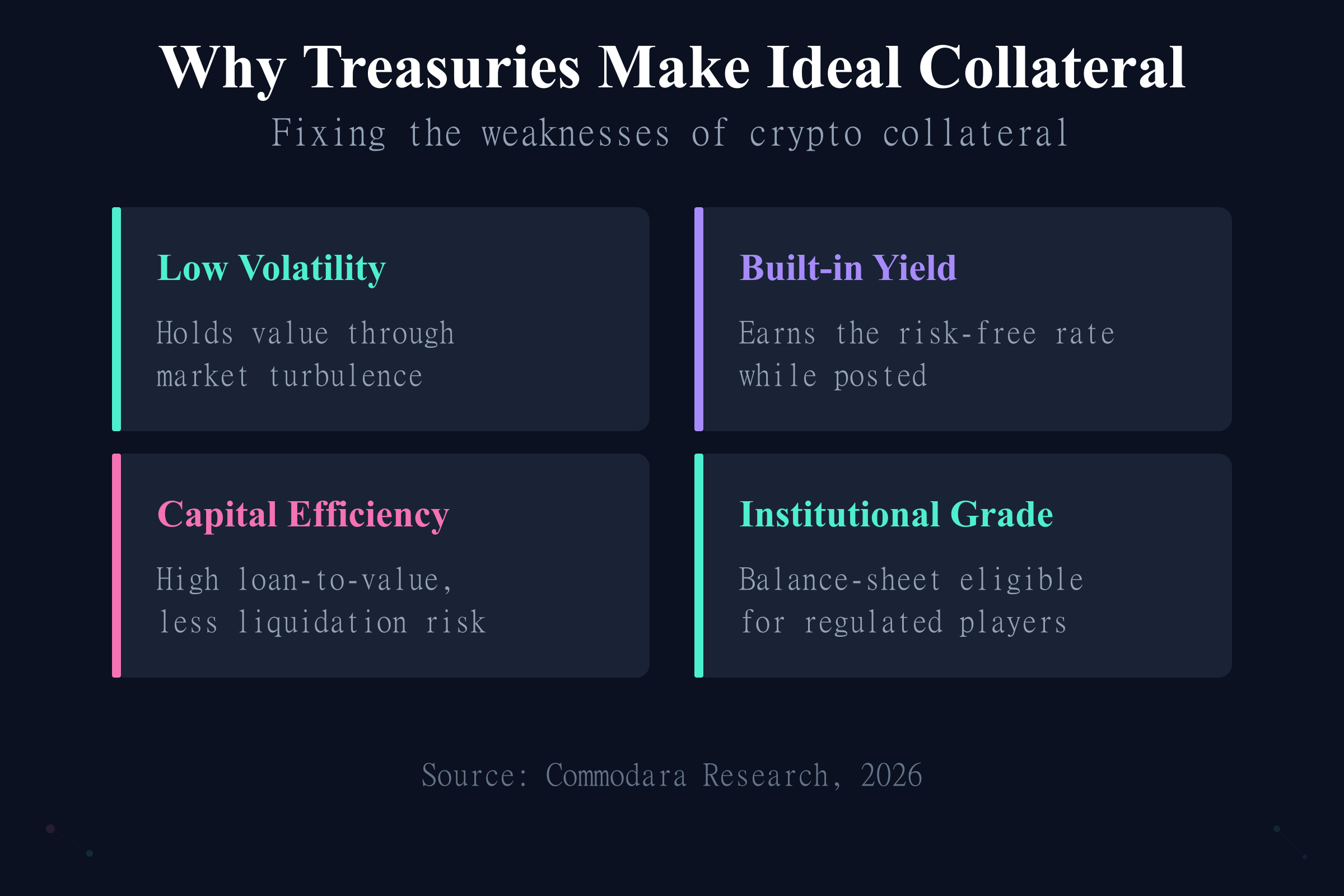
The first is low volatility. Government debt barely moves in price compared with ether or bitcoin, which means a lending protocol can accept it at a high loan-to-value ratio without the constant risk of liquidation. The second is yield. A tokenized Treasury earns the risk-free rate, so collateral that used to sit idle now generates a return, improving capital efficiency for everyone in the system. The tokenized Treasury products compared in our guide to the leading tokenized Treasury funds are the instruments doing most of this work.
The third reason is institutional credibility. Collateral backed by US government debt is something a regulated institution can hold on its balance sheet, which opens DeFi lending to a class of participants that would never post volatile crypto as collateral. Together, these properties turn tokenized Treasuries from a simple yield product into the foundation of a more mature on-chain credit system.
The contrast with crypto collateral is stark. A protocol accepting ether must demand heavy over-collateralization and stand ready to liquidate at any hour, because the collateral can gap down sharply. A tokenized Treasury behaves like the cash-equivalent it represents, so the same protocol can extend more credit against it with far less risk. That difference in behavior, not ideology, is why real world collateral is winning share.
Who Is Building With RWA DeFi Collateral
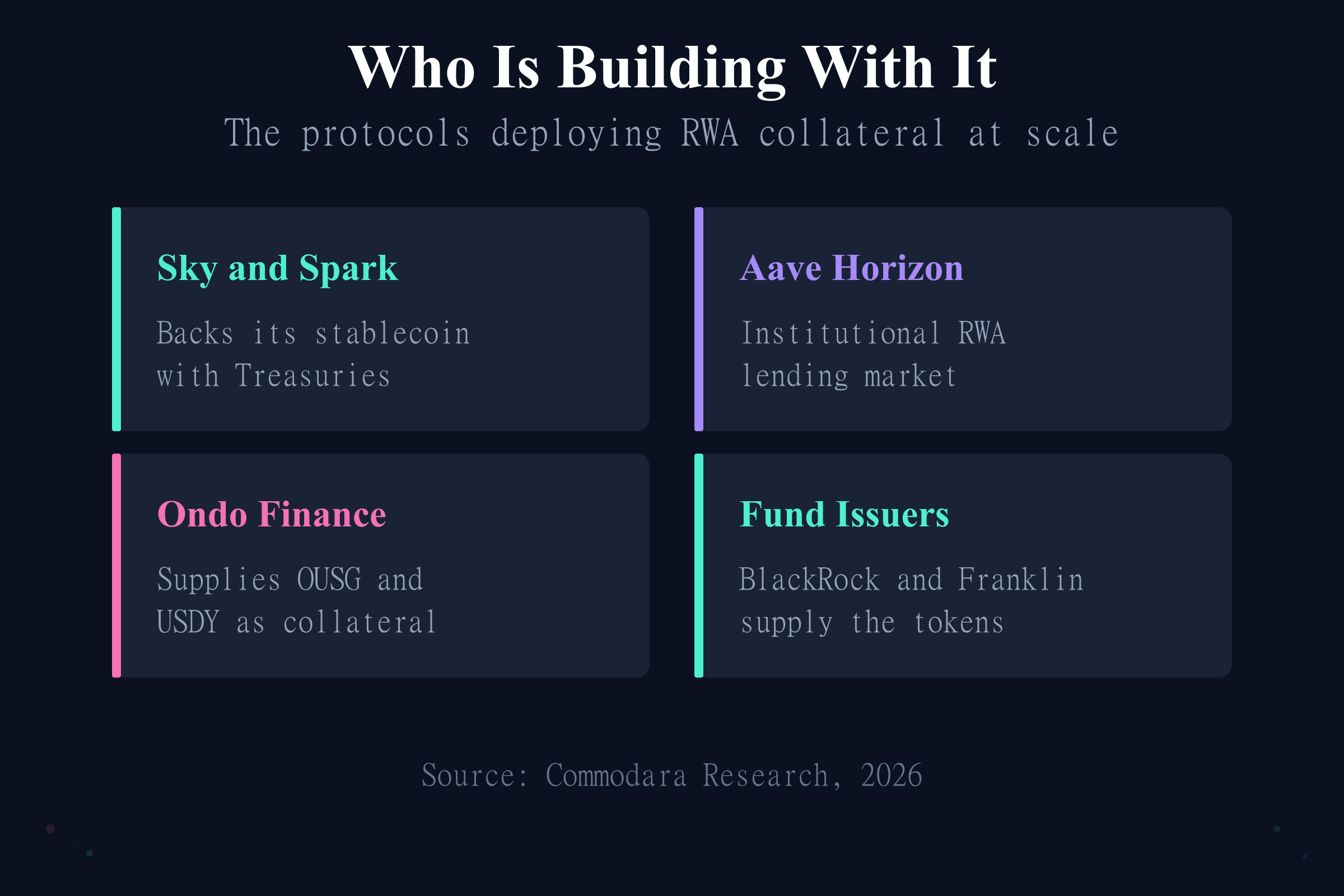
The protocols deploying RWA DeFi collateral at scale are among the largest in decentralized finance, and their activity shows how central this has become. Between them, they account for the bulk of the tokenized Treasuries now locked into on-chain lending.
Sky and Spark
Sky, the protocol formerly known as MakerDAO, has been the largest single force in RWA DeFi collateral. It allocates billions of dollars of the reserves backing its stablecoin into tokenized Treasuries and real world credit, and its Spark lending arm channels capital into tokenized Treasury products across the market. Sky’s governance, conducted openly on the Sky protocol platform, effectively turned a crypto-native stablecoin into one substantially backed by government debt.
Aave Horizon
Aave, the largest lending protocol in DeFi, built Horizon as a dedicated market for institutional RWA collateral. Horizon lets qualified institutions post tokenized funds, including tokenized Treasuries, as collateral to borrow stablecoins, bridging regulated tokenized assets with Aave’s deep liquidity. The Aave Horizon market is one of the clearest signals that RWA collateral is moving from experiment to core product.
Ondo and the Treasury Issuers
The tokenized Treasury issuers are the supply side of this market. Ondo Finance, whose OUSG and USDY products are covered in our Ondo Finance review, along with issuers like BlackRock and Franklin Templeton, produce the tokens that protocols use as collateral. Ondo has integrated its products directly into lending markets, so a tokenized Treasury can be posted as collateral almost as soon as it is minted. The same dynamic is spreading into tokenized private credit, where higher-yield real world debt is starting to serve as collateral too.
The Infrastructure That Makes It Work
RWA DeFi collateral depends on infrastructure that most users never see. A lending protocol accepting a tokenized Treasury needs to know, continuously and reliably, what that token is worth and whether the underlying assets actually exist.
This is the role of oracles. Price and net-asset-value feeds report the value of the collateral to the protocol, and proof-of-reserve systems verify that the tokens are genuinely backed by the assets they claim. Chainlink is the dominant provider here, and our breakdown of Chainlink’s role in RWA infrastructure explains how these feeds and cross-chain messaging hold the system together. Without trustworthy oracles, no protocol could safely accept a real world asset as collateral, because it would have no reliable way to price it or confirm that it exists.
Settlement and compliance tooling matter just as much. Because many tokenized Treasuries restrict transfers to approved addresses, protocols need systems that can hold, value, and, where permitted, liquidate these tokens within the rules the issuer sets. This is why the institutional lending markets are being built as permissioned environments rather than fully open pools, so that the on-chain mechanics and the off-chain legal reality stay aligned.
The Risks of RWA DeFi Collateral
For all its promise, RWA DeFi collateral introduces risks that pure crypto collateral does not. These are the trade-offs of importing real world assets into on-chain systems.
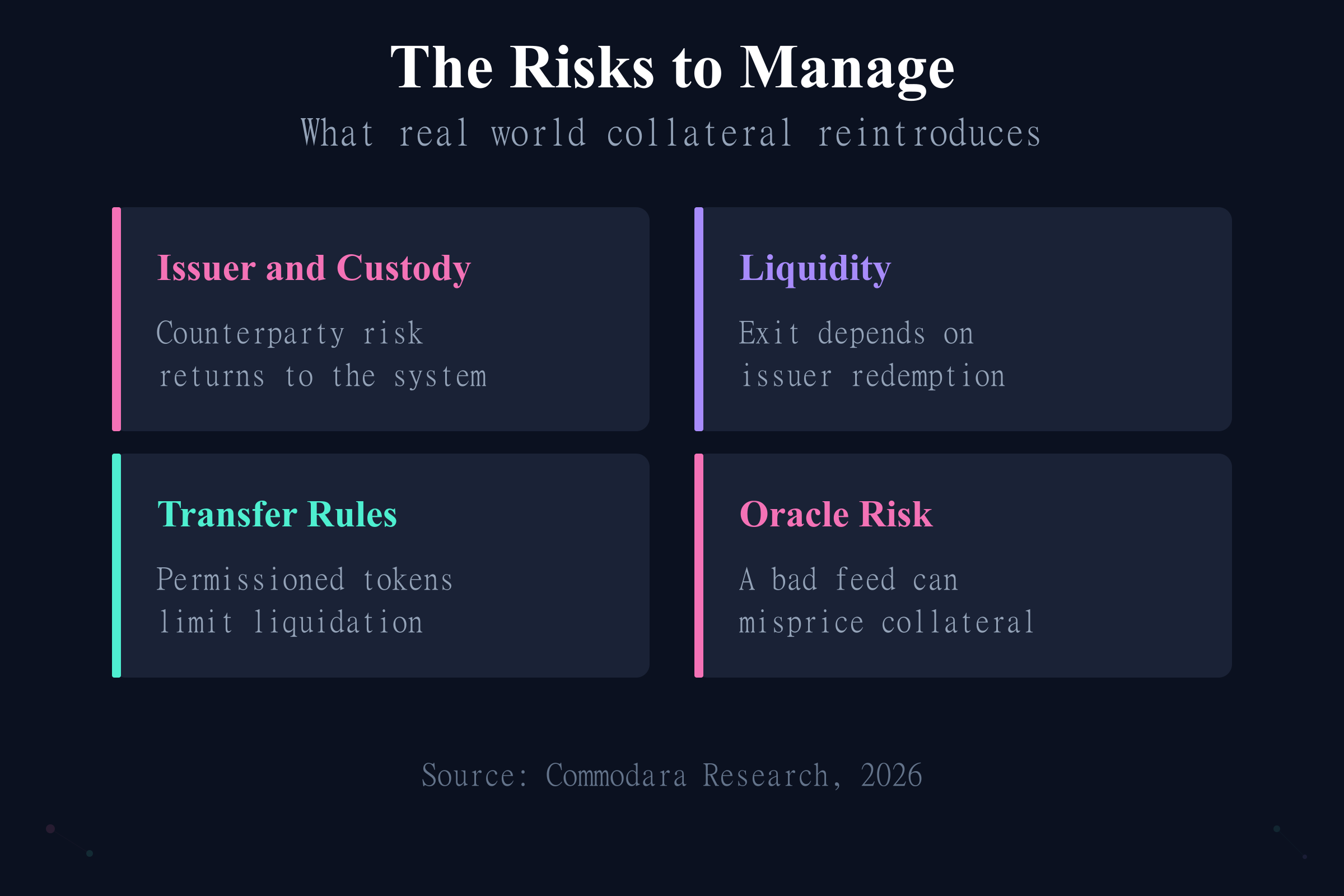
The first is issuer and custody risk. A tokenized Treasury is only as sound as the issuer holding the underlying bonds and the custodian safeguarding them, which reintroduces the counterparty risk that DeFi was designed to remove. The second is liquidity and redemption risk. If a protocol needs to liquidate RWA collateral quickly, it depends on redemption with the issuer, which can be slow or suspended precisely when it is needed most.
The third is regulatory and transfer risk. Many tokenized Treasuries are permissioned, meaning they can only move between approved wallets, which complicates the automatic liquidation that DeFi lending relies on. The fourth is oracle risk: if a price or reserve feed fails or is manipulated, the protocol could accept collateral that is worth less than it reports. None of these risks is disqualifying, but each must be managed for RWA DeFi collateral to scale safely.
The market is responding to these risks rather than ignoring them. Permissioned lending markets, whitelisted liquidators, redundant oracle feeds, and issuers with strong custody and audit practices are all ways the sector is trying to keep the benefits of real world collateral while containing the downsides. The maturity of that risk management, more than the raw growth figure, is what will determine how large this segment can safely become.
Frequently Asked Questions
What is RWA DeFi collateral?
RWA DeFi collateral is the use of tokenized real world assets, most often tokenized US Treasuries, to back on-chain lending, stablecoin minting, and protocol reserves. It replaces volatile crypto collateral with assets that hold their value and earn a yield, making DeFi lending more stable and capital-efficient.
Why are tokenized Treasuries used as collateral?
Tokenized Treasuries offer low volatility, a steady risk-free yield, and institutional credibility. They hold their value through market turbulence, keep earning while posted as collateral, and are acceptable to regulated institutions, which makes them far more efficient collateral than crypto assets like ether.
Which protocols use RWA DeFi collateral?
Sky, formerly MakerDAO, and its Spark lending arm are the largest users, backing their stablecoin with tokenized Treasuries. Aave built Horizon as a dedicated institutional RWA market, and Treasury issuers like Ondo Finance integrate their products directly into lending protocols as collateral.
How is RWA collateral priced on-chain?
Oracles provide price and net-asset-value feeds that report the collateral’s value to the protocol, while proof-of-reserve systems verify the tokens are genuinely backed. Chainlink is the dominant provider, supplying the feeds and cross-chain messaging that let protocols safely accept real world assets as collateral.
What are the risks of RWA DeFi collateral?
The main risks are issuer and custody risk, liquidity and redemption risk, regulatory and transfer restrictions on permissioned tokens, and oracle risk. Each reintroduces a form of counterparty or operational risk that pure crypto collateral avoids, so protocols must manage them carefully as the segment scales.
The Bottom Line
RWA DeFi collateral is where tokenization delivers its clearest real-world value. By bringing the stability and yield of government debt on-chain, tokenized Treasuries have given decentralized finance a form of collateral that is both safer and productive, and the largest protocols in the space have built their strategies around it.
The trend points in one direction. As more real world assets are tokenized and the oracle and compliance infrastructure matures, RWA DeFi collateral is likely to become the default backing for on-chain credit, gradually displacing the volatile crypto collateral that defined DeFi’s first decade. The risks are real, but so is the shift toward institutional-grade collateral.
For institutions and builders, understanding this collateral layer is essential to understanding where DeFi is heading. Subscribe to the Commodara newsletter for ongoing analysis of the assets, protocols, and infrastructure connecting real world value to on-chain finance.