
Tokenized Portfolio Construction: How to Allocate Across RWA Asset Classes
Tokenized portfolio construction is the discipline the RWA market has been missing, with over 4,775 tokenized assets available and almost no framework for how to allocate across them. The industry has spent years building the supply side, issuing tokenized Treasuries, credit, real estate, and commodities, while offering investors almost no guidance on how to combine them into a coherent portfolio.
This is where tokenization has to grow up. This guide provides a practical framework for tokenized portfolio construction: the five RWA asset classes and what each contributes, the three levers of yield, liquidity, and risk, three illustrative model portfolios, and how to build and maintain an allocation over time. None of it is investment advice, but all of it is the structure the market has lacked.
Table of Contents
This guide opens with why tokenized portfolio construction matters and profiles the five RWA asset classes that make up the opportunity set. It then explains the three levers of yield, liquidity, and risk, presents three illustrative model portfolios for different objectives, and covers how to build and maintain an allocation. The closing sections answer the most common questions before the bottom line.
Why Tokenized Portfolio Construction Matters
The tokenized market has an abundance problem. With thousands of tokenized assets now available across every major category, investors face the same challenge that traditional markets solved decades ago: not what to buy, but how to combine holdings into a portfolio that balances return against risk.
Tokenized portfolio construction matters because the RWA asset classes behave very differently from one another. A tokenized Treasury and a tokenized private credit position may both be labelled real world assets, but one is a low-yield cash equivalent and the other is a higher-yield, higher-risk loan. Treating them as interchangeable is how investors end up with portfolios that are far riskier, or far more conservative, than they intended.
There is also a correlation dimension that most tokenized investors overlook. The value of diversification comes not from holding many assets, but from holding assets that do not all move together. Tokenized Treasuries, gold, and equities respond to different forces, so combining them can reduce the swings of the whole portfolio even when each piece is volatile on its own. A pile of ten tokenized credit deals is not a diversified portfolio; it is one bet, repeated.
The discipline is the same one that governs any serious portfolio: diversification, sizing, and matching the allocation to an objective. What is new is applying it to tokenized assets, where the building blocks are on-chain and the data is often better, but the framework has simply not been written down. For a grounding in the assets themselves, our guide to how tokenized real world assets work covers the fundamentals this framework builds on.
The Five RWA Asset Classes
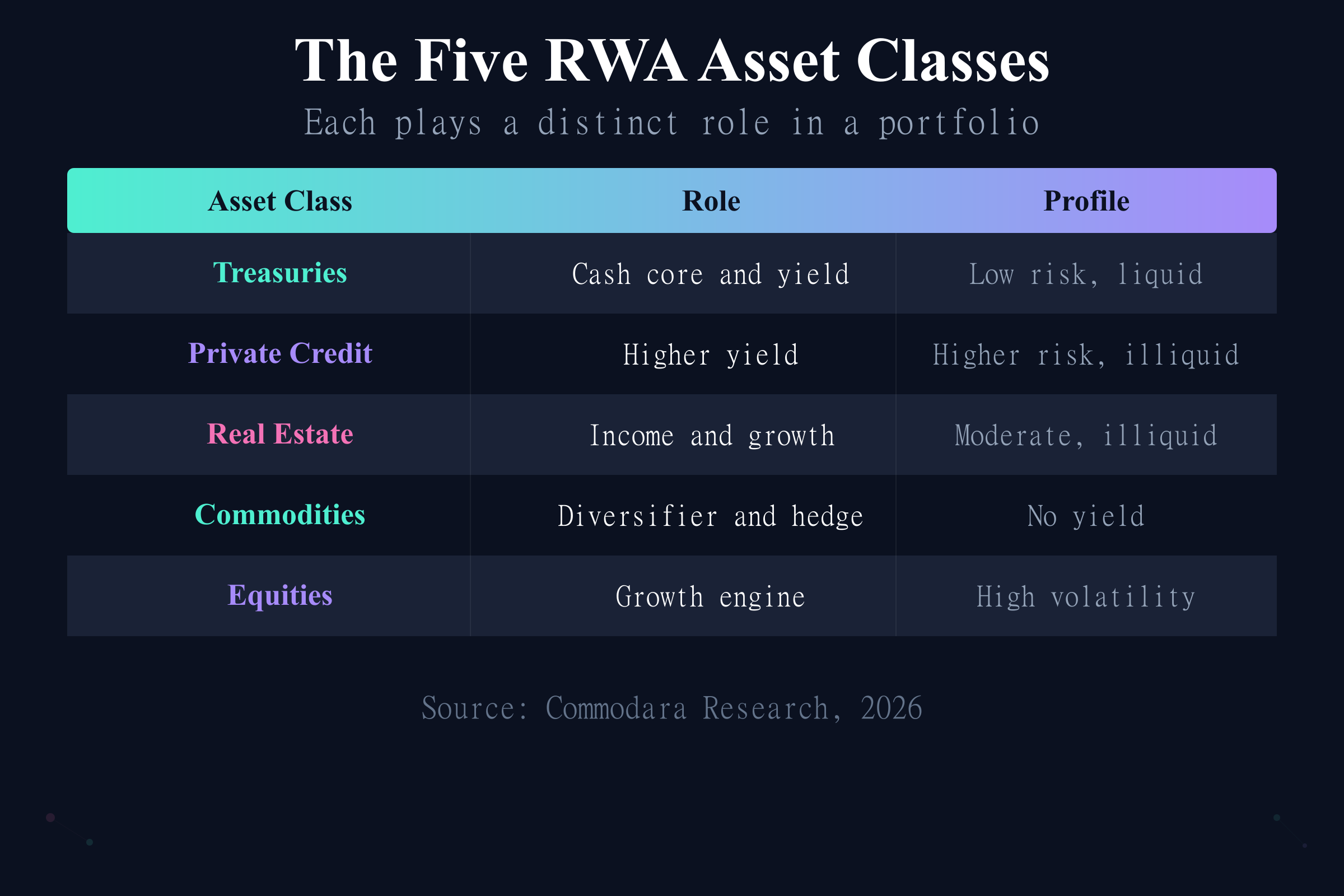
A tokenized portfolio is built from five broad asset classes, each with a distinct role. Understanding what each contributes is the foundation of any allocation.
Tokenized Treasuries
Tokenized Treasuries are the cash-equivalent core of a tokenized portfolio. They hold short-term government debt, earn the risk-free rate, and offer near-instant redemption, which makes them the lowest-risk, most liquid building block. Our comparison of the leading tokenized Treasury funds covers the main options. They provide stability and yield, but little growth.
Tokenized Private Credit
Tokenized private credit offers higher yields, often in the high single digits or above, in exchange for greater risk and less liquidity. These are loans to businesses, packaged on-chain, as covered in our review of tokenized private credit platforms. They add return to a portfolio but introduce credit risk and longer lock-ups, so they suit investors who can tolerate both.
Tokenized Real Estate
Tokenized real estate provides income and potential appreciation, with the trade-off of low liquidity. Fractional ownership of property generates rental yield and exposure to property values, but the underlying asset cannot be sold quickly, so these positions are best sized as long-term holdings rather than tactical trades.
Tokenized Commodities
Tokenized commodities, led by tokenized gold, serve as an inflation hedge and a diversifier. They typically pay no yield, but they move differently from financial assets, which can stabilize a portfolio during market stress. Our coverage of the tokenized gold market explains how these instruments work. Gold is the most established, but other commodities are increasingly available.
Tokenized Equities
Tokenized equities provide growth and exposure to company performance, along with the volatility that comes with it. They are the growth engine of a tokenized portfolio, offering the highest potential return and the highest risk. As tokenized stock trading expands, this class is becoming a larger part of the opportunity set.
The Three Levers: Yield, Liquidity, and Risk
Every tokenized portfolio decision comes down to three levers, and pulling one almost always affects the others.
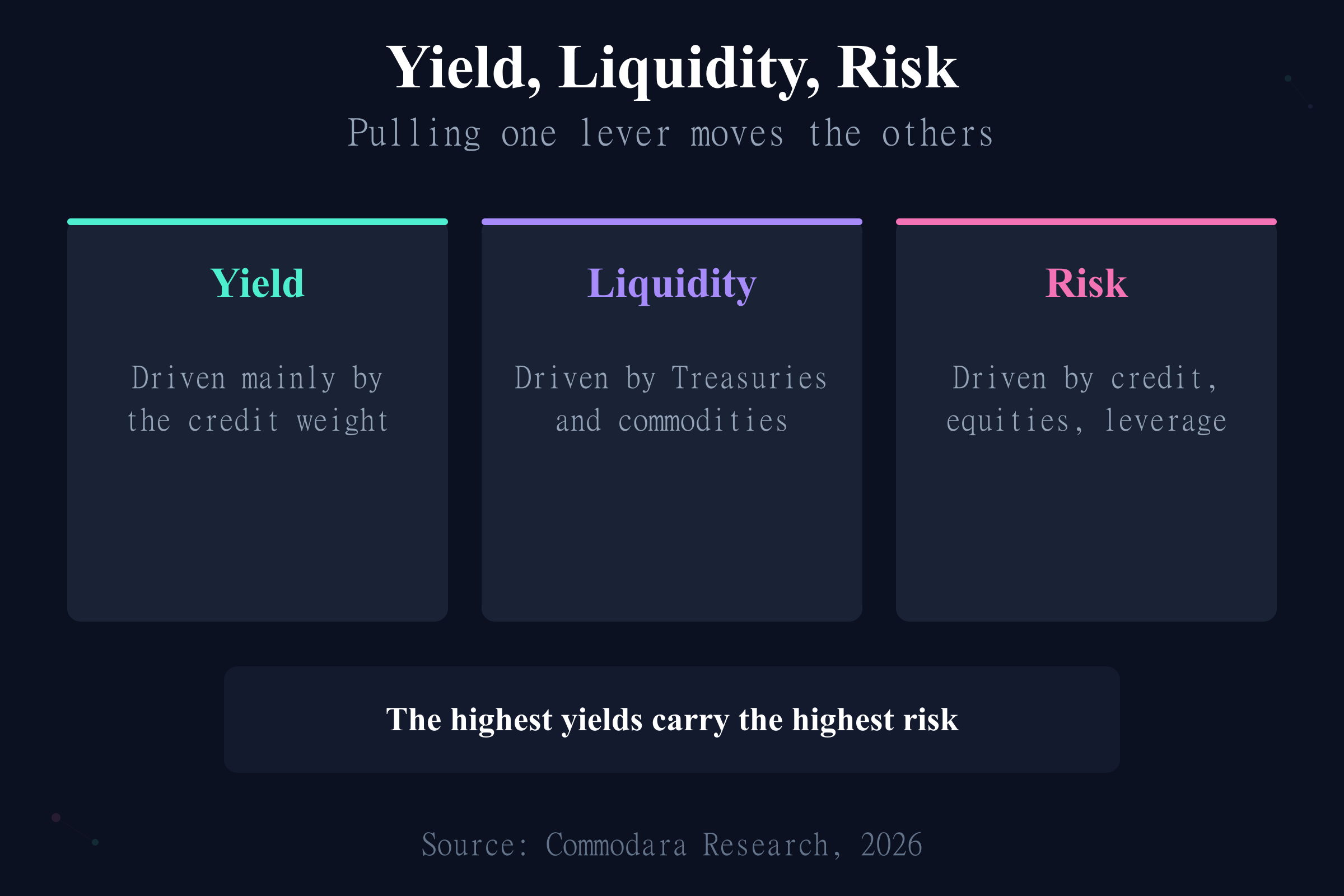
Yield is the return the portfolio generates, driven mainly by the weight in private credit and, to a lesser extent, Treasuries. Liquidity is how quickly the portfolio can be turned back into cash, driven by the weight in Treasuries and commodities versus illiquid real estate and credit. Risk is the potential for loss, driven by exposure to credit, equities, and any leverage in the mix.
The central tension is that the highest-yielding assets, private credit and equities, are also the riskiest and often the least liquid. A portfolio that chases yield sacrifices liquidity and safety; one that prioritizes safety and liquidity accepts lower returns. Tokenized portfolio construction is the art of setting those three dials deliberately, according to an objective, rather than by accident.
A fourth consideration sits behind all three: time horizon. An investor who may need the capital within a year should weight liquidity heavily, because illiquid real estate and locked credit cannot be exited on demand. One investing for a decade can afford to trade liquidity for yield and growth. The levers are not set in the abstract; they are set against how long the money can stay invested.
Three Model Tokenized Portfolios
The following three model portfolios are illustrative frameworks, not investment recommendations, and are meant to show how the levers translate into allocations. Every investor’s situation differs, and a real allocation should be built with professional advice suited to your own circumstances.
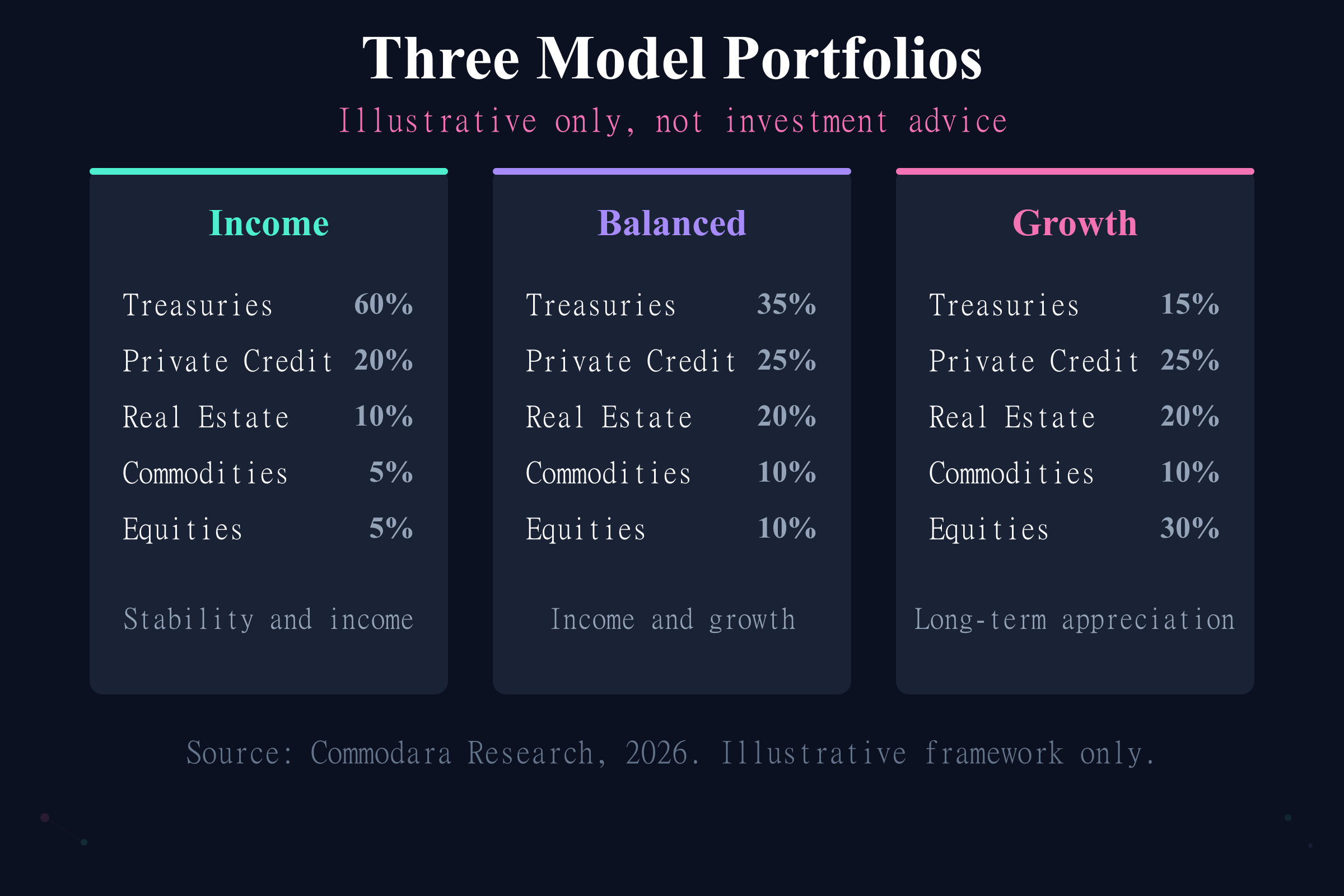
An income-focused portfolio prioritizes stability and yield, weighting heavily toward tokenized Treasuries with a measured allocation to private credit and small positions elsewhere. It accepts lower growth in exchange for capital preservation and steady income, which suits conservative objectives and shorter horizons.
A balanced portfolio spreads exposure more evenly, reducing the Treasury weight to make room for real estate and a larger credit allocation, with modest commodity and equity positions. It aims for a middle path between income and growth, accepting moderate risk and some liquidity constraints in return for a higher expected return.
A growth portfolio tilts toward the return engines, increasing the equity and credit weights and reducing the Treasury anchor, while keeping a commodity position for diversification. It accepts higher volatility and lower liquidity in pursuit of long-term appreciation, suiting investors with a longer horizon and greater risk tolerance.
How to Build and Maintain a Tokenized Portfolio
Constructing the allocation is only the start. A tokenized portfolio requires the same maintenance as any other, with a few on-chain specifics that traditional portfolios do not face.
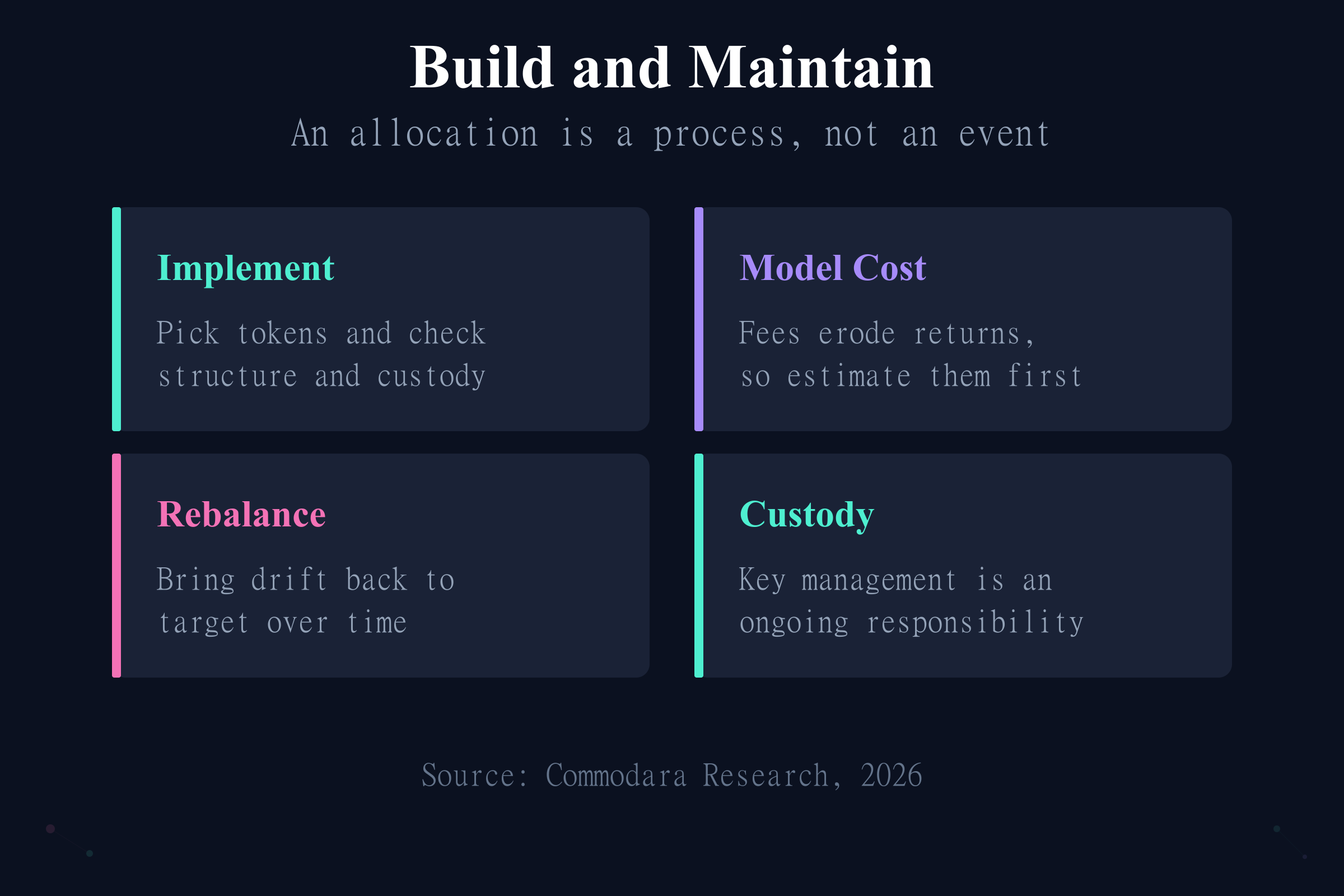
The first task is implementation: selecting specific tokens for each asset class, checking their structure, custody, and compliance, and confirming they fit the intended role. The second is cost. Tokenization and platform fees eat into returns, so it is worth using a tool to estimate the cost of building and holding an on-chain position before committing. The third is rebalancing: as prices move, the allocation drifts from its targets, and periodic rebalancing brings it back, which is harder when some assets are illiquid.
Custody and security run through all of this. A tokenized portfolio lives in wallets and on platforms, so key management, counterparty selection, and monitoring are ongoing responsibilities rather than one-time setup. The institutions building this space, from Morgan Stanley on the wealth side to DTCC on the infrastructure side, are building the tooling that will eventually make this routine.
Finally, review the allocation on a schedule rather than in reaction to headlines. Markets tempt investors to chase whichever tokenized yield is highest this month, which quietly turns a balanced portfolio into a concentrated one. A simple discipline, revisiting the target weights each quarter and rebalancing back toward them, does more for long-term results than any single asset selection.
Frequently Asked Questions
What is tokenized portfolio construction?
Tokenized portfolio construction is the practice of allocating across tokenized real world asset classes, Treasuries, private credit, real estate, commodities, and equities, to balance yield, liquidity, and risk. It applies traditional portfolio discipline to on-chain assets, matching the allocation to an objective rather than holding assets at random.
What asset classes belong in a tokenized portfolio?
The five core classes are tokenized Treasuries for stability and liquidity, tokenized private credit for yield, tokenized real estate for income and appreciation, tokenized commodities like gold for diversification, and tokenized equities for growth. Each plays a distinct role, and a portfolio combines them according to its objective.
How should I allocate across tokenized assets?
Allocation depends on your objective and risk tolerance. Income-focused portfolios weight tokenized Treasuries heavily; growth portfolios tilt toward equities and credit. The model portfolios in this guide are illustrative frameworks, not recommendations, and a real allocation should be built with professional advice.
Are tokenized assets liquid enough to rebalance?
It varies by class. Tokenized Treasuries and commodities are relatively liquid, while tokenized real estate and some private credit are not. This is why liquidity is one of the three levers: an allocation heavy in illiquid assets is harder to rebalance and should be treated as a longer-term commitment.
Is tokenized portfolio construction different from traditional investing?
The principles are the same, diversification, sizing, and matching risk to objective, but the assets are on-chain, the data is often better, and new considerations like custody, smart contract risk, and platform fees apply. Tokenized portfolio construction adapts traditional discipline to these on-chain realities.
The Bottom Line
Tokenized portfolio construction is the framework that turns a pile of tokenized assets into an actual investment strategy. The five asset classes each play a role, the three levers of yield, liquidity, and risk govern every decision, and the right allocation is the one that matches an investor’s objective rather than the market’s latest enthusiasm.
As the tokenized market matures, this discipline will become as standard as it is in traditional finance. The investors who build deliberate, diversified tokenized portfolios will be better positioned than those who accumulate assets one attractive yield at a time. The tools and frameworks are finally catching up to the supply.
None of this is a substitute for professional advice tailored to your situation. Subscribe to the Commodara newsletter for ongoing analysis of the asset classes, allocation frameworks, and infrastructure shaping tokenized portfolio construction.