
Tokenization Costs Breakdown: The Real Economics of Bringing Assets On-Chain
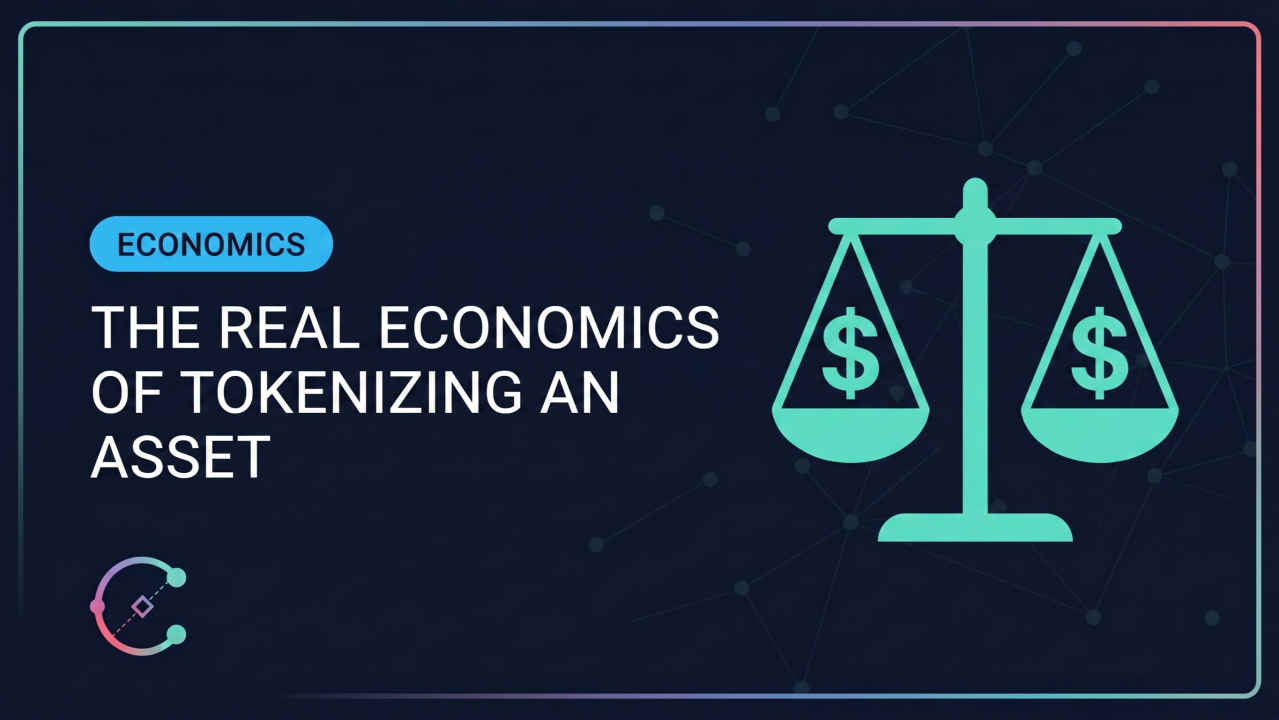
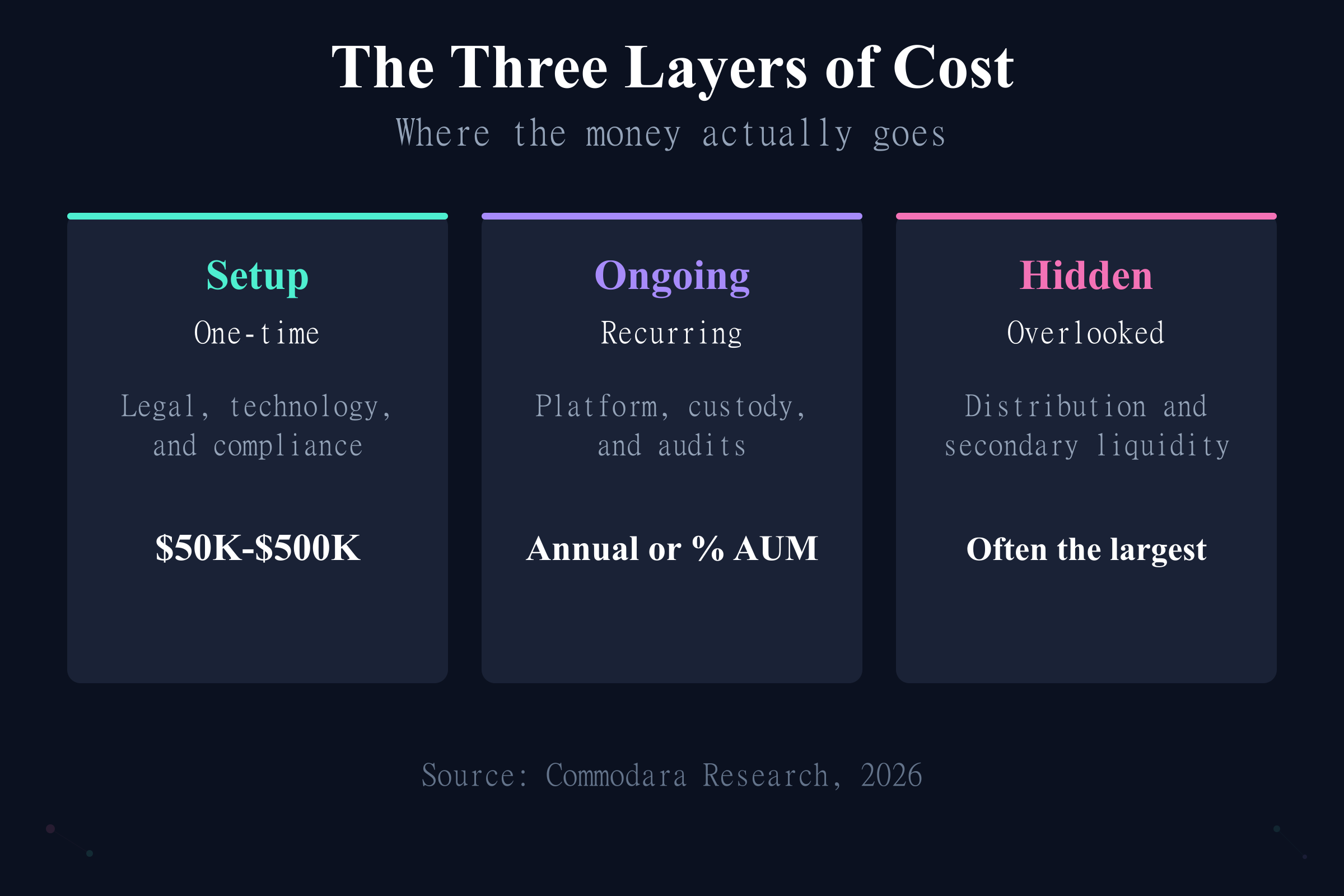
Tokenization costs are the most misunderstood variable in the entire RWA market, with setup expenses ranging from $50,000 to over $500,000 depending on asset class, jurisdiction, and distribution path. The headline promise of tokenization is efficiency, yet the upfront and ongoing economics are where many projects quietly stall before a single token is sold.
The confusion comes from treating tokenization as a technology purchase when it is really a legal, compliance, and distribution exercise with a technology layer on top. This guide breaks down the real economics of bringing an asset on-chain: the setup costs, the recurring costs, the hidden costs most issuers miss, and what pushes the total up or down.
Table of Contents
This breakdown opens with why tokenization costs are so widely misunderstood. It then works through the three layers of the bill: one-time setup costs across legal, technology, and compliance; ongoing costs for platforms, custody, and administration; and the hidden costs of distribution and liquidity that most issuers overlook. The closing sections cover what drives the total up or down, how to budget, and the most common questions before the bottom line.
Why Tokenization Costs Are Misunderstood
Most cost estimates for tokenization circulate as a single number, which is where the confusion begins. Tokenization is not one purchase but a stack of services: legal structuring, entity formation, smart contract development, compliance onboarding, custody, administration, and distribution. Each has its own price, and the mix changes with every asset.
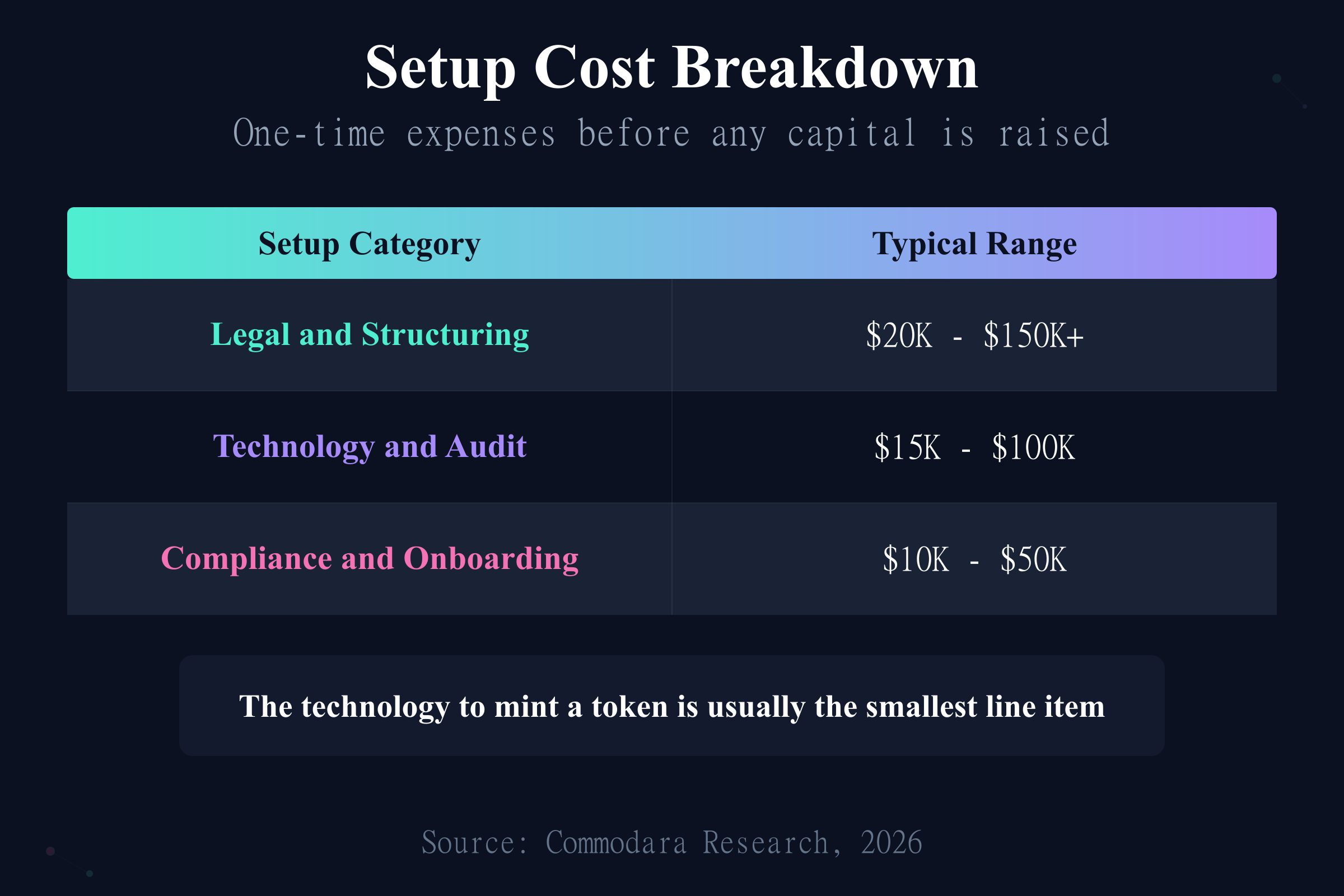
The technology, which gets the most attention, is often the smallest line item. Minting a token is cheap. Giving that token a legally enforceable claim, a compliant investor base, and a market to trade in is where the money goes. Tokenization costs are dominated by law and distribution, not by code. Industry analyses from firms like Deloitte consistently place the legal and operational layers, not the technology, at the center of the economics.
This is why the same asset can cost $50,000 to tokenize in one configuration and half a million in another. A simple debt instrument sold to a handful of qualified investors in a friendly jurisdiction sits at the low end. A fund structure sold to retail across multiple regulated markets sits at the high end. The number is a function of choices, not a fixed price.
Setup Costs: The One-Time Investment
Setup costs are the upfront expenses required to bring an asset on-chain and open it to investors. They are incurred once, before any capital is raised, which makes them the hardest costs to justify and the easiest to underestimate. They fall into three main categories.
Legal and Structuring
Legal work is usually the largest setup cost, typically ranging from $20,000 to $150,000 or more. It covers forming the issuing entity, drafting offering documents, securing securities counsel, and obtaining any legal opinions the structure requires. The choice of tokenization structure is the single biggest driver here, because an SPV, a feeder fund, and a direct issuance each carry very different legal workloads.
Technology and Smart Contracts
Technology costs cover token issuance, smart contract development, and a security audit, generally between $15,000 and $100,000. Issuers using an established platform pay lower development costs but ongoing platform fees; those building custom infrastructure pay more upfront. A professional smart contract audit is not optional, and skipping it to save money is one of the most expensive mistakes an issuer can make.
Compliance and Onboarding
Compliance setup covers KYC and AML infrastructure, investor accreditation checks, and the systems that enforce transfer restrictions on-chain. This typically runs from $10,000 to $50,000 to establish. It is the cost of ensuring that only eligible investors hold the token and that the issuer can prove it, which is a regulatory requirement in most jurisdictions rather than a nice-to-have.
Ongoing Costs: The Recurring Bill
Ongoing costs are the recurring expenses of keeping a tokenized asset live, compliant, and administered. They are easy to overlook during the excitement of issuance, but over a multi-year holding period they often exceed the original setup cost. Most are charged annually or as a percentage of assets under management.
Platform and Transfer Agent Fees
The tokenization platform and transfer agent typically charge either a flat annual fee or a percentage of assets, often in the range of 0.25% to 1% per year. These fees cover maintaining the register of ownership, processing transfers, and keeping the token compliant. For a fund structure, a separate fund administrator handling NAV calculation and reporting adds another recurring line, frequently $20,000 to $100,000 a year.
Custody, Administration, and Audits
Custody of the underlying asset and the private keys carries its own fee, usually a small percentage of the asset value. On top of that sit ongoing audits, proof-of-reserve attestations, and regulatory filings, each of which recurs annually. These costs are the price of the transparency that makes a tokenized asset trustworthy, and cutting them tends to undermine the very thing that gives the token value.
The Hidden Costs Most Issuers Miss
The costs that sink tokenization projects are rarely the ones on the initial budget. They are the costs of getting the token in front of buyers and keeping it tradable, and they are consistently underestimated.
Distribution and Investor Acquisition
Distribution is the largest hidden cost in tokenization, and for many projects it exceeds every setup cost combined. A tokenized asset does not sell itself. Reaching qualified investors, marketing the offering, and converting interest into committed capital takes budget, time, and often a placement partner who takes a percentage. Many issuers spend heavily to tokenize, then discover they have no efficient way to reach buyers.
Liquidity and Secondary Markets
Tokenization is sold on the promise of liquidity, but liquidity is not free. Listing on a regulated trading venue, supporting market makers, and maintaining an active secondary market all carry costs. Without that investment, a tokenized asset trades thinly or not at all, and the liquidity premium the issuer promised investors fails to materialize.
What Drives Tokenization Costs Up or Down
Four variables explain most of the difference in tokenization costs between a $50,000 tokenization and a $500,000 one. Understanding them lets an issuer design toward a budget rather than discovering the cost after the fact.
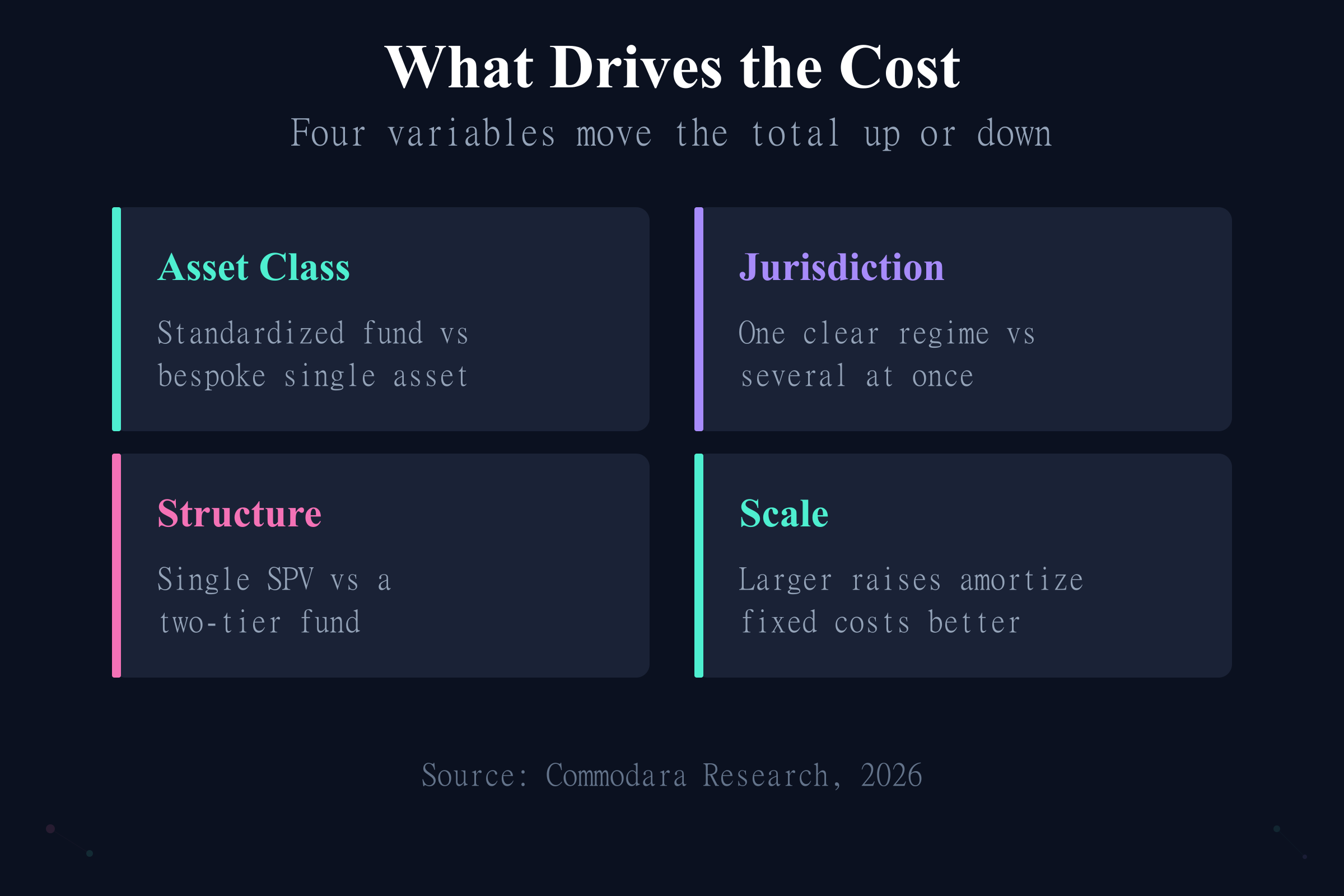
The first is asset class. Tokenizing a Treasury fund is relatively standardized; tokenizing a single building, a piece of art, or a private credit portfolio requires bespoke legal and valuation work that raises costs. The second is jurisdiction. A permissive regime with a clear framework is cheaper than a private placement that must satisfy securities law in several countries at once.
The third is structure. As covered in our guide to SPV formation for tokenization, a single-asset SPV is cheaper to stand up than a two-tier feeder fund with administration at both levels. The fourth is scale. Fixed costs like legal and audit do not shrink for a small raise, so a $2 million offering carries a far higher percentage cost than a $50 million one. Research from the World Economic Forum on digital assets notes that these unit costs fall as shared infrastructure matures and standards settle.
How to Budget for Tokenization
Budgeting for tokenization starts with separating the three layers: what you pay once, what you pay every year, and what you must spend to actually sell and trade the asset. A budget that captures only setup costs is the most common planning error, because the ongoing and distribution costs are where projects run out of money.
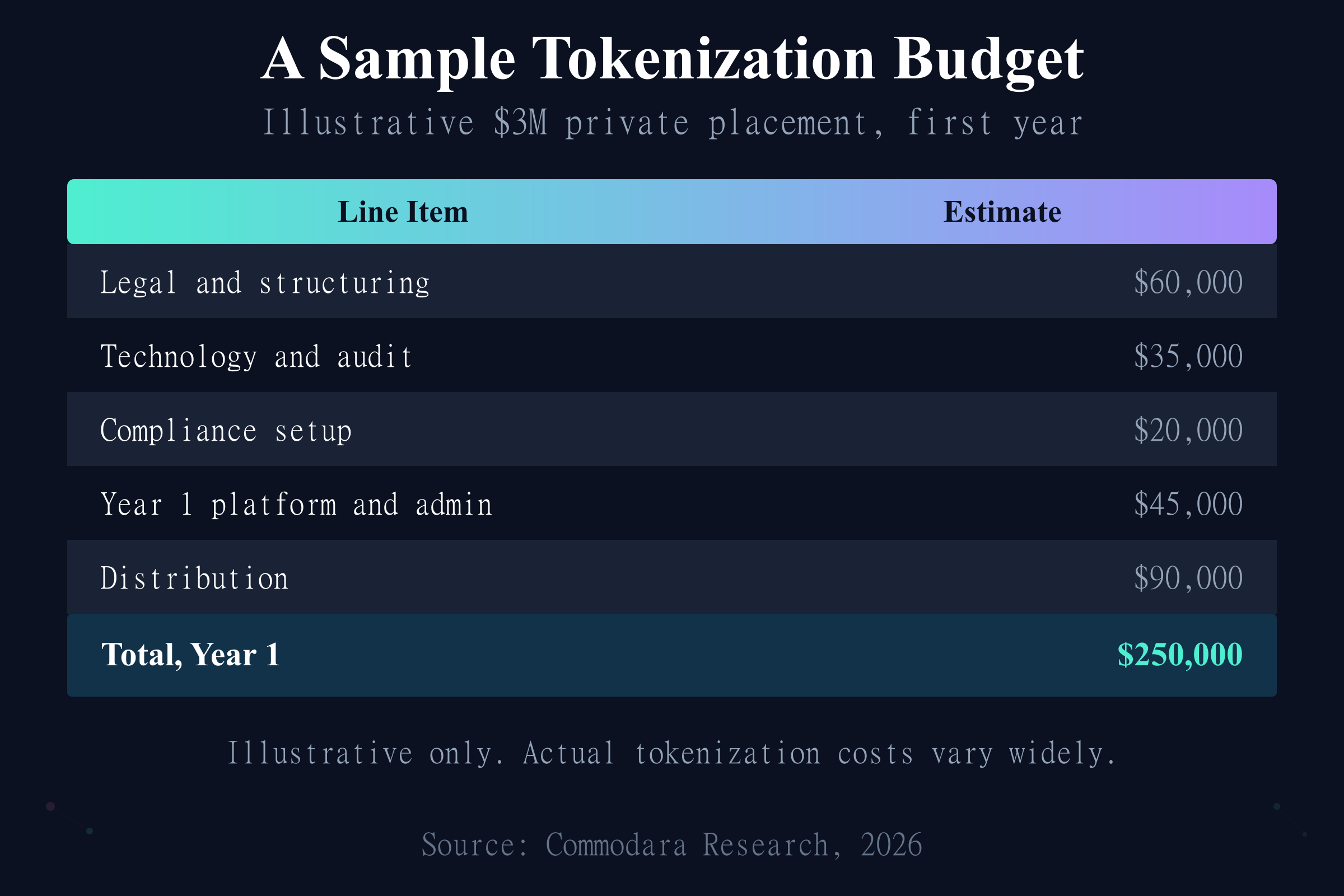
A practical approach is to model the total as a percentage of the raise, then check whether the economics still work. If tokenizing a $3 million asset costs $250,000 across setup, first-year running, and distribution, that is more than 8% before the asset has returned anything, which may or may not be justified. Running those numbers early prevents committing to a structure the raise cannot support. You can estimate the cost of tokenizing your asset across jurisdictions and structures with the Commodara Cost Estimator before you commit.
It also helps to benchmark. Tokenization costs for comparable assets are increasingly visible in public research and platform disclosures, and comparing your projected budget against similar deals quickly reveals whether a quote is reasonable or padded. Treat any tokenization costs that sit far outside the typical range for your asset class as a question to raise, not a number to accept.
For a fuller picture that weighs readiness, structure, and distribution alongside cost, the Tokenization Readiness Tool assesses your specific situation, and a consultation can refine the budget for a particular asset and jurisdiction.
Frequently Asked Questions
How much does it cost to tokenize an asset?
Tokenization costs typically range from $50,000 to over $500,000 in setup, depending on asset class, jurisdiction, and structure. Legal and structuring work is usually the largest line item, while the technology to mint the token is often the smallest. Ongoing and distribution costs are separate and frequently larger over time.
What is the most expensive part of tokenization?
Legal and structuring work is the largest upfront cost, but distribution is the largest overall. Reaching qualified investors and converting them into committed capital often exceeds every setup cost combined. Many issuers budget for the technology and legal work and overlook the cost of actually selling the token.
Are there ongoing costs after tokenizing?
Yes. Ongoing costs include platform and transfer agent fees, custody, fund administration, audits, and regulatory filings, often charged as a percentage of assets or an annual fee. Over a multi-year holding period, these recurring costs frequently exceed the original setup cost.
Why do tokenization costs vary so much?
Four variables drive the range: asset class, jurisdiction, structure, and scale. A standardized asset sold to a few investors in a friendly jurisdiction sits at the low end, while a fund sold to retail across multiple regulated markets sits at the high end. Larger raises also amortize fixed costs more efficiently.
Can tokenization save money versus traditional issuance?
It can, but mainly at scale and over time. Tokenization adds upfront legal and technology costs while reducing some ongoing settlement, administration, and transfer costs. The savings appear when those efficiencies compound over a large asset base, not on a small one-off raise where fixed setup costs dominate.
The Bottom Line
Tokenization costs are neither trivial nor prohibitive; they are a function of the choices an issuer makes about asset, jurisdiction, structure, and distribution. The technology is the cheap part. The law, the compliance, and above all the work of reaching investors are where the real economics live.
The issuers who succeed are the ones who budget for all three layers from the start: the one-time setup, the recurring bill, and the hidden cost of distribution. Treating tokenization as a technology line item rather than a full go-to-market exercise is the fastest way to run out of money before the raise closes.
Before committing, model your tokenization costs across setup, ongoing, and distribution with the Commodara Cost Estimator, then use the Readiness Tool or a consultation to pressure-test the budget against your specific asset and jurisdiction. Understanding the real economics upfront is what separates a tokenization that closes from one that stalls.