

Stablecoin Comparison 2026: USDT vs USDC vs USDS vs USDe for RWA Investors
A stablecoin comparison 2026 reveals four fundamentally different architectures behind what most investors treat as interchangeable dollars, each carrying distinct risk, yield, and regulatory exposure. USDT, USDC, USDS, and USDe all trade at roughly one dollar, but the machinery that holds them there could hardly be more different.
For anyone holding stablecoins as the cash leg of a tokenized portfolio, those differences matter enormously. This stablecoin comparison 2026 breaks down the four leading dollars by what backs them, whether they pay yield, how transparent they are, and which portfolio function each one actually fits.
Table of Contents
This stablecoin comparison 2026 opens with why the differences between stablecoins matter and the four architectures at play. It then examines the fiat-backed giants USDT and USDC, the yield-bearing and synthetic dollars USDS and USDe, and closes by mapping which stablecoin fits each portfolio function, followed by the most common questions and the bottom line.
Why a Stablecoin Comparison 2026 Matters
Stablecoins are the settlement layer of the tokenized economy, the cash that moves between every tokenized asset. Yet most investors treat them as a single, uniform product, assuming a dollar is a dollar regardless of the ticker. A proper stablecoin comparison 2026 shows why that assumption is dangerous.
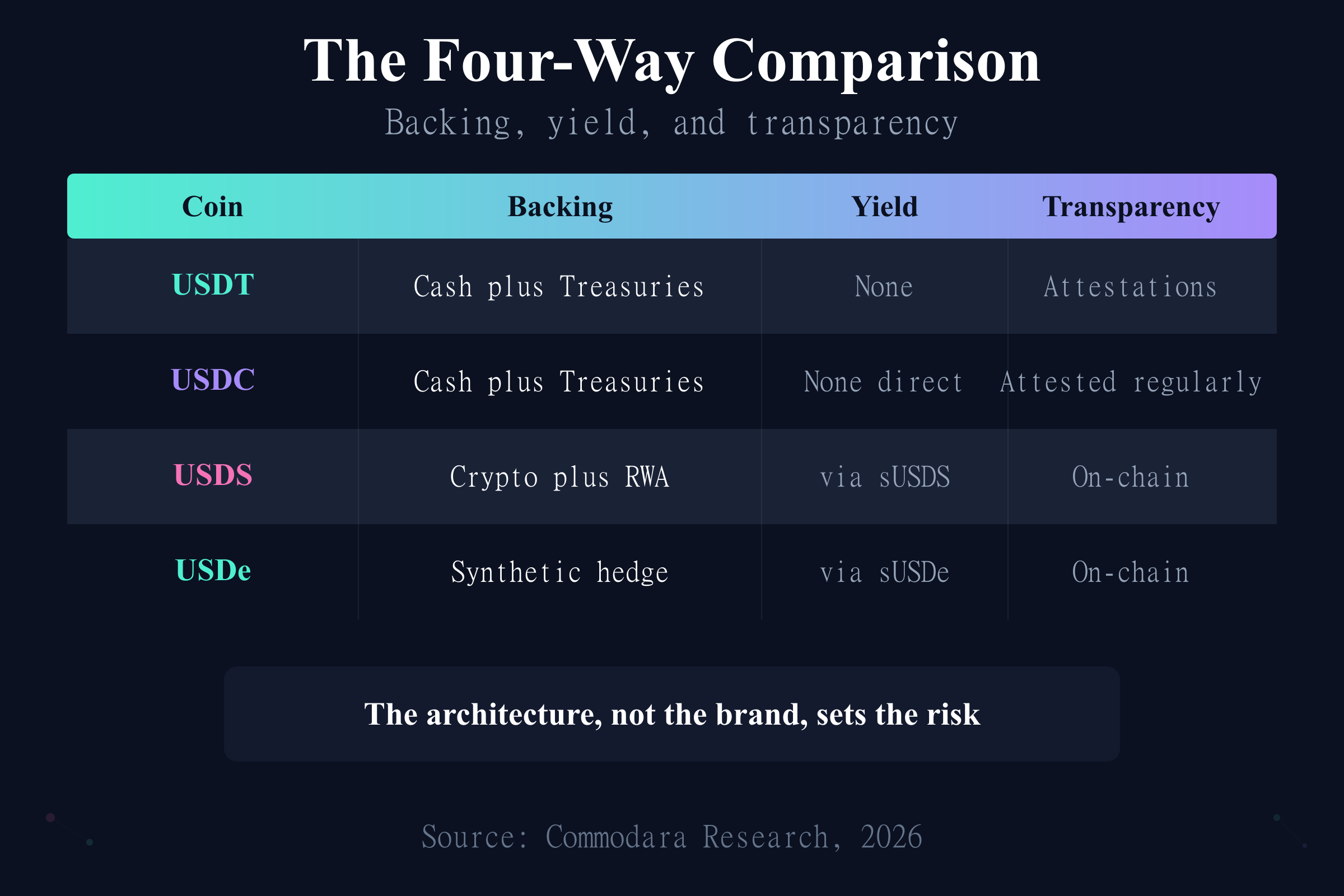
The four leading stablecoins differ on three axes that determine their real risk. The first is what backs them: cash and Treasuries, crypto collateral, or hedged derivative positions. The second is transparency: how clearly, and how often, the issuer proves the reserves exist. The third is yield: whether holding the stablecoin earns a return, and where that return actually comes from.
History supplies the reason this matters. Stablecoins have broken their peg before, and in every case the cause traced back to the reserve model rather than the blockchain. A coin backed by cash at a failing bank, or by collateral that fell faster than it could be liquidated, behaves very differently under stress than one holding short-term government debt. The architecture is the risk.
These differences became more consequential as regulation caught up. The GENIUS Act stablecoin framework set federal rules for how dollar-backed stablecoins must be reserved and disclosed, sharpening the line between compliant fiat-backed coins and the more experimental synthetic dollars. Understanding where each stablecoin sits is now part of basic risk management rather than a technical curiosity.
The Four Stablecoin Architectures
Before comparing individual coins, it helps to see the four architectures they represent, because the architecture, not the brand, is what determines the risk.
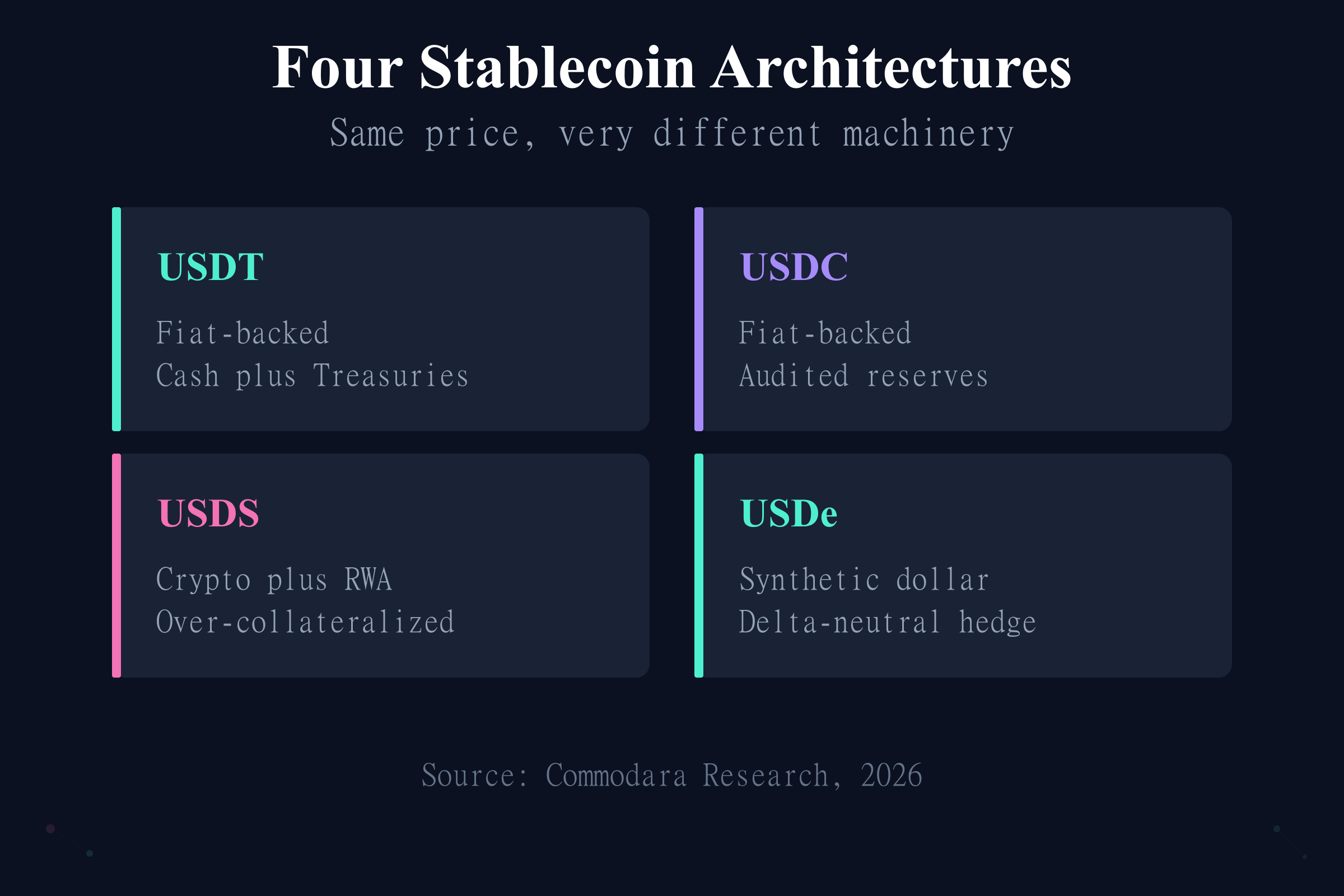
USDT and USDC are fiat-collateralized: each token is backed by cash and short-term US Treasuries held in reserve. USDS is crypto and real-world-asset collateralized, over-collateralized by a mix of digital assets and tokenized Treasuries. USDe is synthetic, holding no fiat reserve at all and instead maintaining its peg through a delta-neutral hedge of crypto positions. Same price, three completely different risk models.
A useful way to think about it: fiat-backed coins export traditional banking risk on-chain, crypto-collateralized coins carry market and liquidation risk, and synthetic coins carry derivatives and counterparty risk. None of these is inherently better than the others, but they fail in different ways and under different conditions, which is exactly why they should not be treated as one product.
Independent research such as the CEX.IO stablecoin research tracks how these reserve models and market shares shift over time. The pattern across 2026 is that fiat-backed coins hold the bulk of the float while yield-bearing alternatives grow faster from a smaller base.
USDT and USDC: The Fiat-Backed Giants
The two largest stablecoins share an architecture but differ sharply in transparency and positioning.
USDT (Tether)
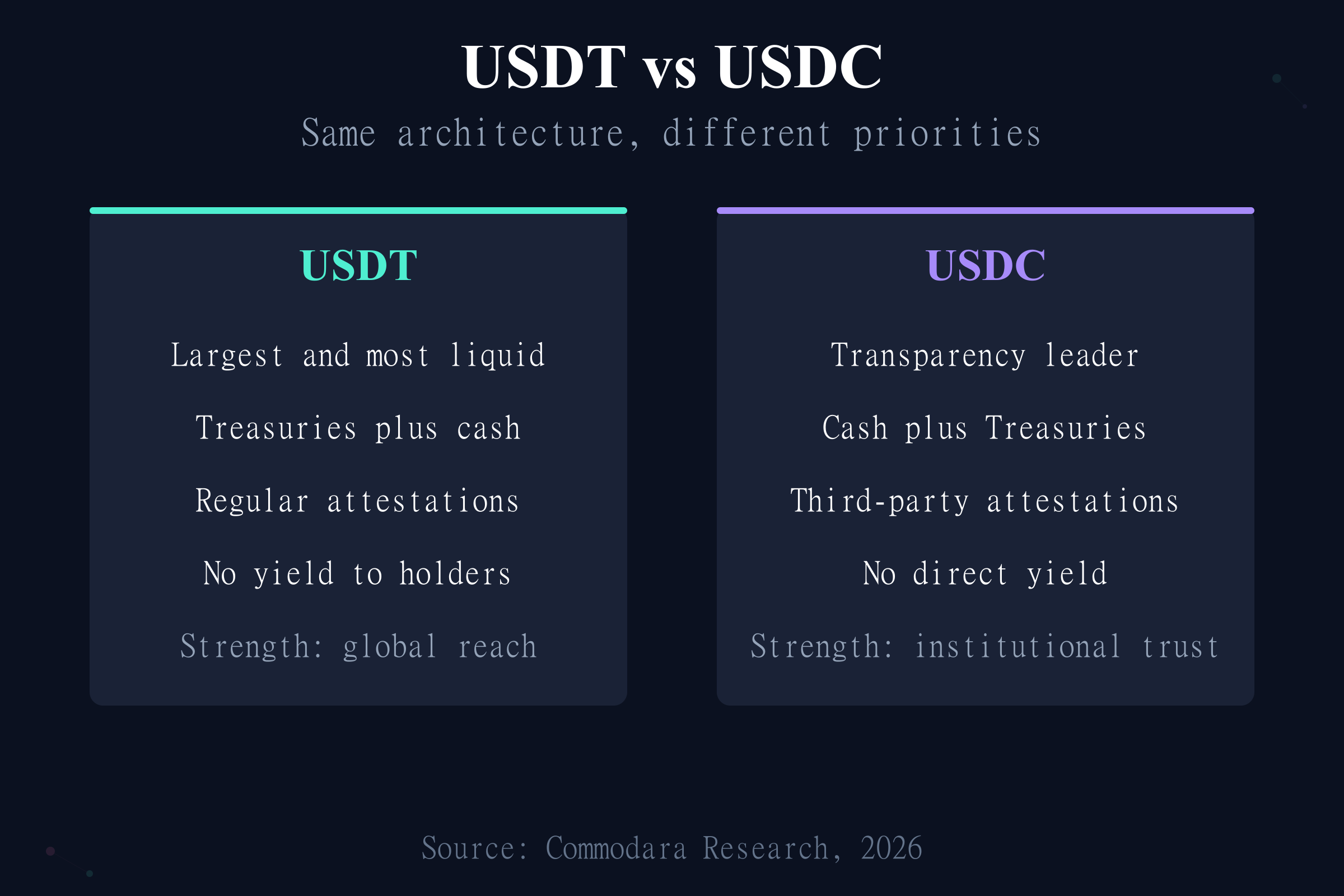
USDT is the largest and most liquid stablecoin in the world, the default trading pair across most of crypto. It is backed primarily by US Treasuries and cash equivalents, and Tether publishes regular attestations of its reserves. Its strengths are unmatched liquidity and global reach; its historical weakness has been transparency, since attestations are less rigorous than full audits. USDT pays no yield to holders.
Scale is the defining feature of USDT. It is the pair most traders quote against, the dollar most widely available on exchanges outside the United States, and the settlement asset for a large share of global crypto volume. For an investor whose priority is entering and exiting positions cheaply at any size, that depth is a genuine advantage no competitor currently matches.
USDC (Circle)
USDC is the transparency leader among fiat-backed stablecoins. Issued by Circle, it is fully reserved in cash and short-term US Treasuries, with regular third-party attestations and a regulatory posture aligned with frameworks like the GENIUS Act. Circle publishes detailed reserve breakdowns on its transparency page. USDC trades a little liquidity for far more institutional trust, which is why regulated players tend to prefer it.
The positioning of USDC is regulatory as much as technical. Circle has pursued compliance across major jurisdictions rather than operating at the margins, which makes USDC the stablecoin most likely to be acceptable to a bank, an auditor, or a fund administrator. That acceptability is worth more to an institution than a few basis points of liquidity or yield.
USDS and USDe: Yield and Synthetic Dollars
The newer generation of stablecoins competes not on liquidity but on yield, using very different mechanisms to generate it.
USDS (Sky)
USDS is the stablecoin issued by Sky, the protocol formerly known as MakerDAO. It is over-collateralized by a mix of crypto assets and tokenized Treasuries, and its staked version, sUSDS, pays holders a yield drawn from the Sky Savings Rate. USDS represents the decentralized, real-world-asset-backed model: transparent on-chain collateral, a yield sourced largely from government debt, and governance conducted in the open.
What makes USDS notable in a tokenized-asset context is where its yield comes from. Because a large share of the collateral sits in tokenized Treasuries, holders of sUSDS are effectively earning the government-debt rate through a decentralized wrapper. It is one of the clearest examples of real world assets flowing back into on-chain products rather than the reverse.
USDe (Ethena)
USDe is a synthetic dollar from Ethena, and it is the most architecturally novel of the four. It holds no fiat reserve. Instead, it maintains its peg through a delta-neutral position, holding staked crypto assets while shorting an equivalent amount in perpetual futures. Its staked version, sUSDe, can pay high yields drawn from staking rewards and funding rates. That yield is real, but it depends on market conditions and exchange counterparties, which makes USDe higher-risk and different in kind from a cash-backed dollar.
The condition to watch is funding. The yield on USDe, and more importantly its hedge, depends on perpetual-futures funding rates staying favorable. In sustained negative-funding conditions the economics invert and the protocol must manage the position actively. This is disclosed and well understood rather than hidden, but it means USDe is better sized as a yield strategy than treated as a cash equivalent.
Which Stablecoin Fits Each Portfolio Function
The right stablecoin depends entirely on what you need it to do, and a serious stablecoin comparison 2026 ends not with a single winner but with a mapping of coins to functions.
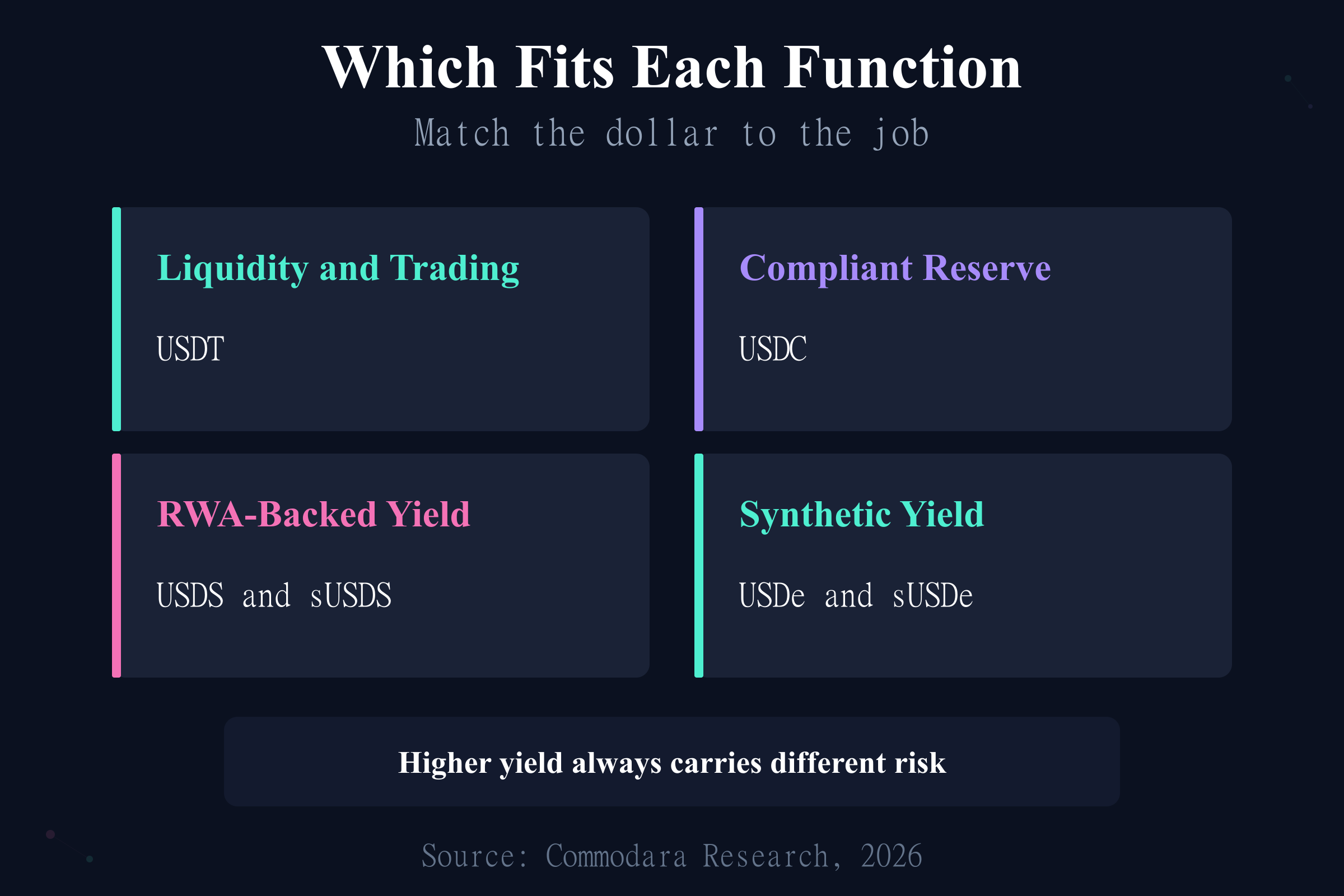
For pure liquidity and trading, the depth of USDT is hard to beat. For a compliant, transparent cash reserve that a regulated institution can hold comfortably, USDC is the standard. For a yield-bearing dollar backed largely by real-world assets, USDS and its sUSDS variant fit the role. For investors comfortable with a novel, higher-risk model in pursuit of higher yield, USDe offers a synthetic alternative.
In practice, many investors hold more than one, using each for its strength: a fiat-backed coin for liquidity and settlement, and a yield-bearing coin for the portion of a cash position they can afford to leave at some additional risk. This mirrors the allocation logic covered in our guide to tokenized portfolio construction, where stablecoins form the cash sleeve of the portfolio.
Whatever the mix, monitoring matters more than the initial selection. Reserve compositions change, regulatory status evolves, and yield mechanisms get adjusted by governance. A stablecoin that was the conservative choice a year ago may not be today, so periodic review of the issuer’s disclosures is part of holding these instruments responsibly.
For readers newer to the asset class, our guides to tokenized real world assets and how to buy tokenized assets cover the fundamentals that sit behind these settlement decisions. None of this is investment advice, and reserve models can change, so verify the current disclosures before committing capital.
Frequently Asked Questions
What is the best stablecoin in 2026?
There is no single best stablecoin; it depends on the use. This stablecoin comparison 2026 shows USDT leads on liquidity, USDC on transparency and compliance, USDS on real-world-asset-backed yield, and USDe on synthetic yield. The right choice matches the coin’s architecture to your specific need.
What backs USDT, USDC, USDS, and USDe?
USDT and USDC are backed by cash and short-term US Treasuries. USDS is over-collateralized by crypto assets and tokenized Treasuries. USDe holds no fiat reserve, maintaining its peg through a delta-neutral hedge of staked crypto and short perpetual-futures positions.
Which stablecoins pay yield?
USDS pays yield through its staked version sUSDS, drawn largely from tokenized Treasuries via the Sky Savings Rate. USDe pays yield through sUSDe, drawn from staking rewards and funding rates. USDT and USDC do not pay holders yield directly, though the issuers earn on the reserves.
Is USDe safe compared to USDC?
They carry different risks. USDC is a cash-backed, transparent, regulated dollar with straightforward reserve risk. USDe is a synthetic dollar whose peg depends on hedging positions, funding rates, and exchange counterparties. USDe can offer higher yield but is structurally more complex and higher-risk than USDC.
How does the GENIUS Act affect stablecoins?
The GENIUS Act sets US federal rules for how dollar-backed stablecoins must be reserved, disclosed, and supervised. It reinforces the position of transparent, fully reserved coins like USDC and pressures less transparent or synthetic models to adapt, sharpening the distinctions in any stablecoin comparison 2026.
The Bottom Line
This stablecoin comparison 2026 comes down to a single principle: a dollar is not a dollar. USDT, USDC, USDS, and USDe trade at the same price but rest on entirely different foundations, from cash and Treasuries to crypto collateral to a synthetic hedge, and those foundations are exactly where the risk lives.
The mature approach is to match the stablecoin to the job rather than defaulting to whichever is most familiar or highest-yielding. Liquidity, transparency, yield, and regulatory standing are real trade-offs, and holding the wrong dollar for the wrong reason is an avoidable risk in an otherwise careful portfolio.
As regulation and yield mechanics keep evolving, these distinctions will only sharpen, and any stablecoin comparison 2026 will need constant updating. Subscribe to the Commodara newsletter for ongoing analysis of stablecoins, reserves, and the settlement layer of the tokenized economy.