
Tokenized Insurance: How Programmable Risk Is Reshaping On-Chain Protection
Tokenized insurance is emerging as the risk transfer layer the tokenized economy has been missing, with reinsurance securities now trading on Solana and parametric insurance protocols processing payouts across multiple countries. Every other part of the tokenized stack has been built out, from issuance to custody to settlement, while the question of who absorbs the loss when something goes wrong has gone largely unanswered.
Insurance is what makes a financial system usable at scale. This analysis explains what tokenized insurance actually is, how parametric payouts and tokenized reinsurance differ, who is building in the sector, and what has to happen before on-chain risk transfer becomes standard infrastructure.
Table of Contents
This analysis opens with why tokenized insurance is the missing layer in the tokenized economy. It then explains parametric insurance and how it differs from traditional claims, examines tokenized reinsurance and insurance-linked securities, profiles who is building in the sector, and closes with the obstacles still in the way, followed by the most common questions and the bottom line.
Why Tokenized Insurance Is the Missing Layer
Every mature financial market rests on a risk transfer layer. Traditional finance has insurers and reinsurers who absorb losses that individual participants cannot, which is precisely what allows those participants to take risk in the first place. The tokenized economy has been building without that foundation.
The absence shows up as hesitation. An institution holding tokenized assets faces custody risk, smart contract risk, issuer risk, and settlement risk, with limited ability to transfer any of it to a third party. Where traditional custody arrangements come with insurance as covered in our guide to institutional tokenized asset custody, coverage for on-chain specific risks has remained thin and expensive.
Tokenized insurance addresses this from two directions at once. It brings insurance capital on-chain as an investable asset class, and it brings coverage on-chain as a product that tokenized asset holders can actually buy. Both directions are necessary, because a risk transfer market needs capital on one side and demand on the other.
The gap also limits who can participate. Many institutional mandates require that material risks be insurable, so an asset class without a functioning coverage market is effectively closed to a segment of capital regardless of its returns. Building the risk transfer layer is therefore not a refinement of the tokenized economy, it is a precondition for its largest potential allocators.
Parametric Insurance and Programmable Payouts
The clearest application of blockchain technology to insurance is parametric coverage, which pays out based on a measurable trigger rather than an assessed loss.
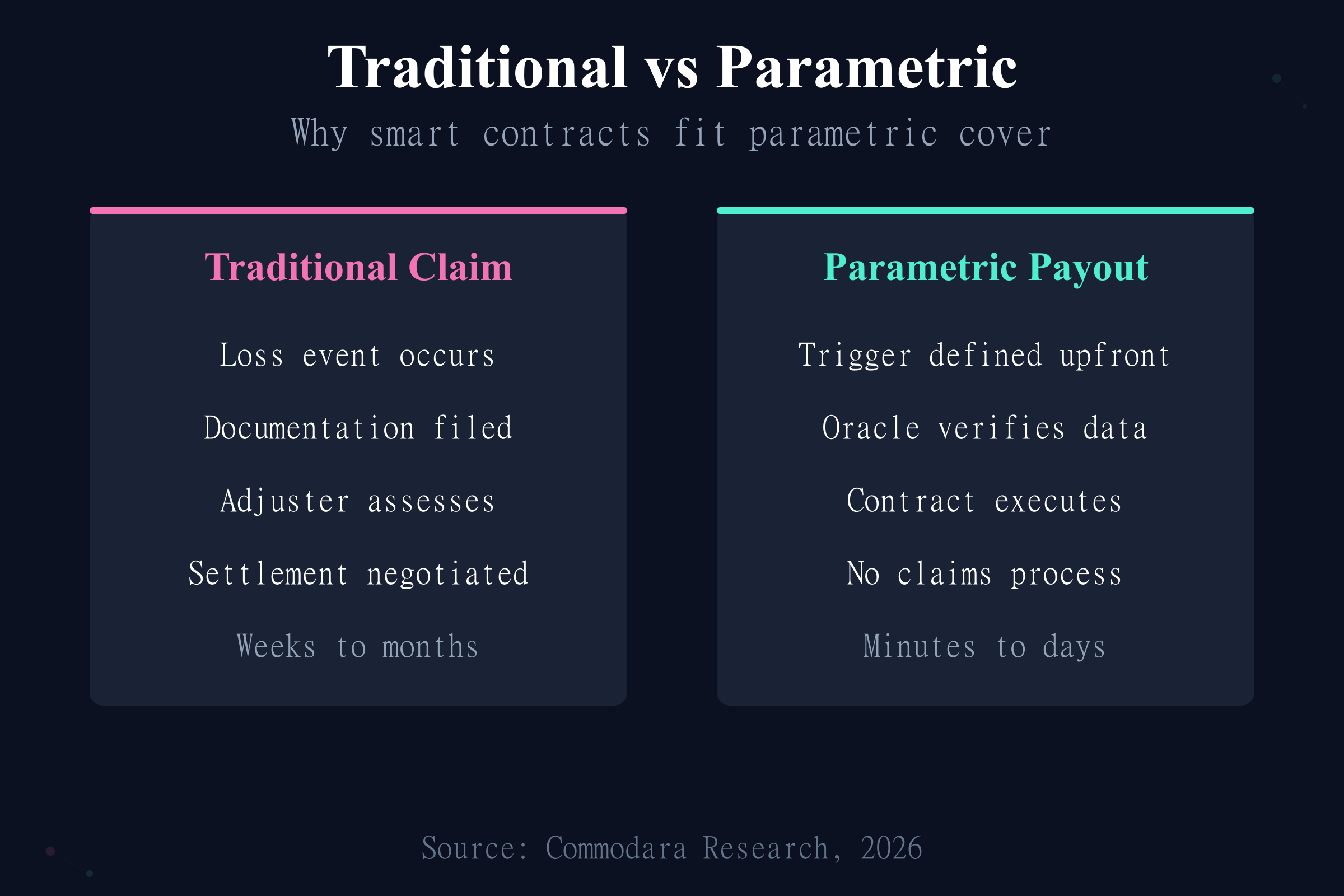
In a traditional policy, a claim requires a loss event, documentation, an adjuster’s assessment, and a settlement negotiation, a process that can take months. In a parametric policy, the payout is defined in advance against an objective data point: rainfall below a threshold, a flight delayed beyond a set time, an earthquake above a given magnitude at a specified location. If the data confirms the trigger, the policy pays.
This maps almost perfectly onto smart contracts. The trigger condition is encoded in the contract, an oracle supplies the verified data, and the payout executes automatically without a claims process. Protocols such as Etherisc have built this model for crop insurance, flight delay coverage, and similar risks, dramatically reducing both settlement time and administrative cost.
The trade-off is basis risk. A parametric policy pays on the trigger, not on the actual loss, so a policyholder can suffer real damage and receive nothing if the measured parameter falls just short. That gap is the central design challenge in parametric tokenized insurance, and it is why these products work best where losses correlate tightly with measurable data.
Where parametric coverage works best is in markets traditional insurance has struggled to serve economically. Smallholder farmers, small businesses in emerging markets, and short-duration risks have historically been uninsurable because the cost of assessing a claim exceeds the value of the policy. Automating the payout removes that cost, which makes small policies viable for the first time.
Tokenized Reinsurance and Insurance-Linked Securities
The larger opportunity is not retail policies but the reinsurance market, where insurance risk has long been packaged into securities that investors can buy.
Insurance-linked securities, including catastrophe bonds, let investors earn a premium for accepting a defined slice of insurance risk. If the covered catastrophe does not occur, investors keep the premium; if it does, their capital covers the losses. These instruments have historically been available almost exclusively to large institutional investors, with high minimums and limited liquidity.
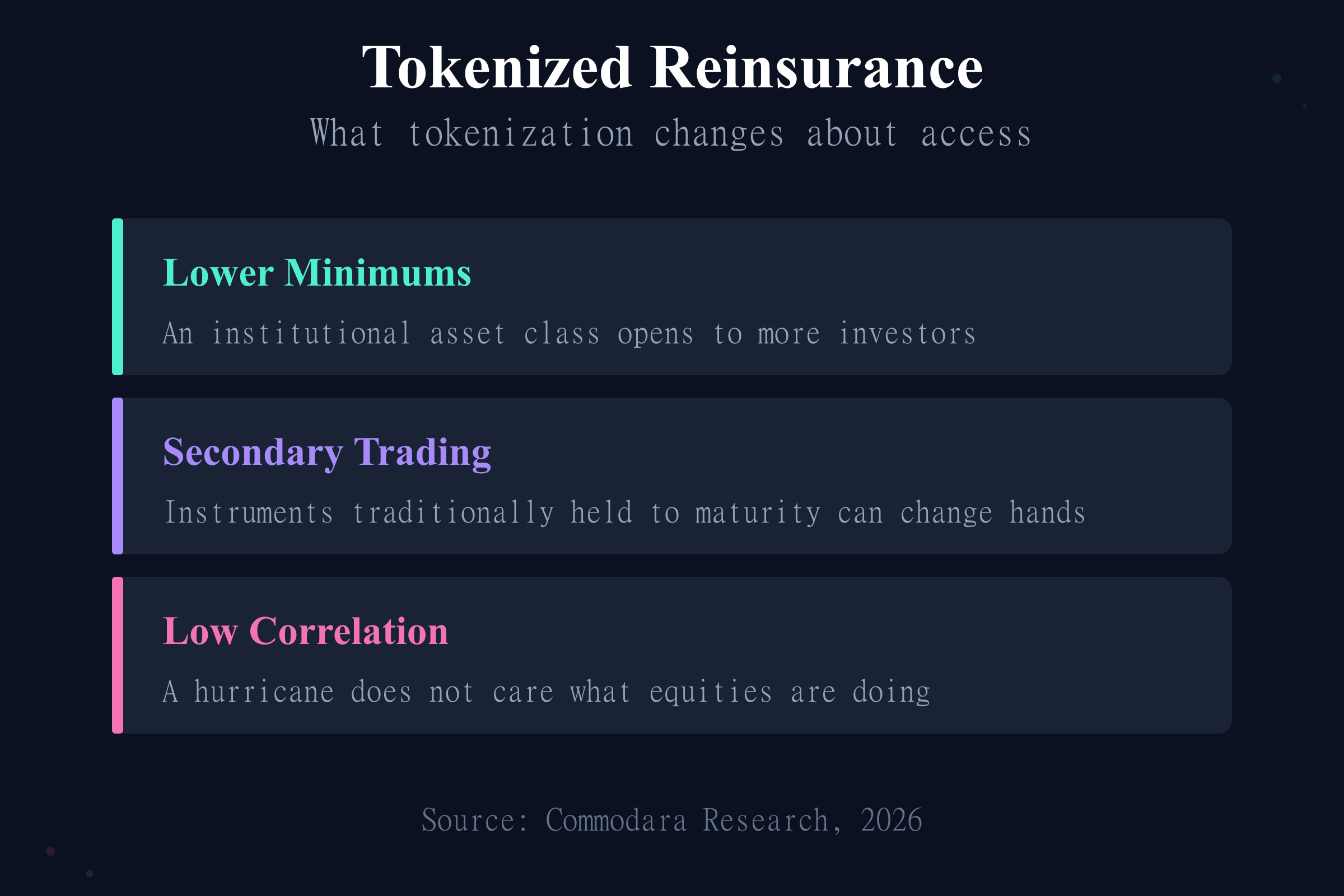
Tokenization changes the access profile. By issuing insurance-linked securities as tokens, sponsors can lower minimums, broaden the investor base, and create the possibility of secondary trading in an asset class that has traditionally been held to maturity. Reinsurance securities issued on-chain, including tokenized offerings settled on Solana, are the clearest example of this model reaching production.
What makes this attractive to investors is correlation. Insurance risk is largely uncorrelated with financial markets, since a hurricane does not care what equities are doing. That makes tokenized insurance-linked securities a genuine diversifier in the kind of allocation framework covered in our guide to tokenized portfolio construction, which is exactly the property sophisticated allocators look for.
Sponsors such as SurancePlus have brought tokenized reinsurance products to market, structuring participation in reinsurance risk as on-chain securities. The significance is less the technology than the precedent: a regulated insurance risk transfer instrument, issued and held on a public blockchain, carrying the legal characteristics investors already understand.
Liquidity is the open question for these instruments. Tokenization makes secondary trading technically possible, but a market only exists if buyers appear when a holder wants out. Until that depth develops, tokenized insurance-linked securities will trade closer to the held-to-maturity profile of their traditional counterparts than the liquid instruments the technology theoretically enables.
Who Is Building in Tokenized Insurance
The sector splits into three groups, each attacking a different part of the problem.
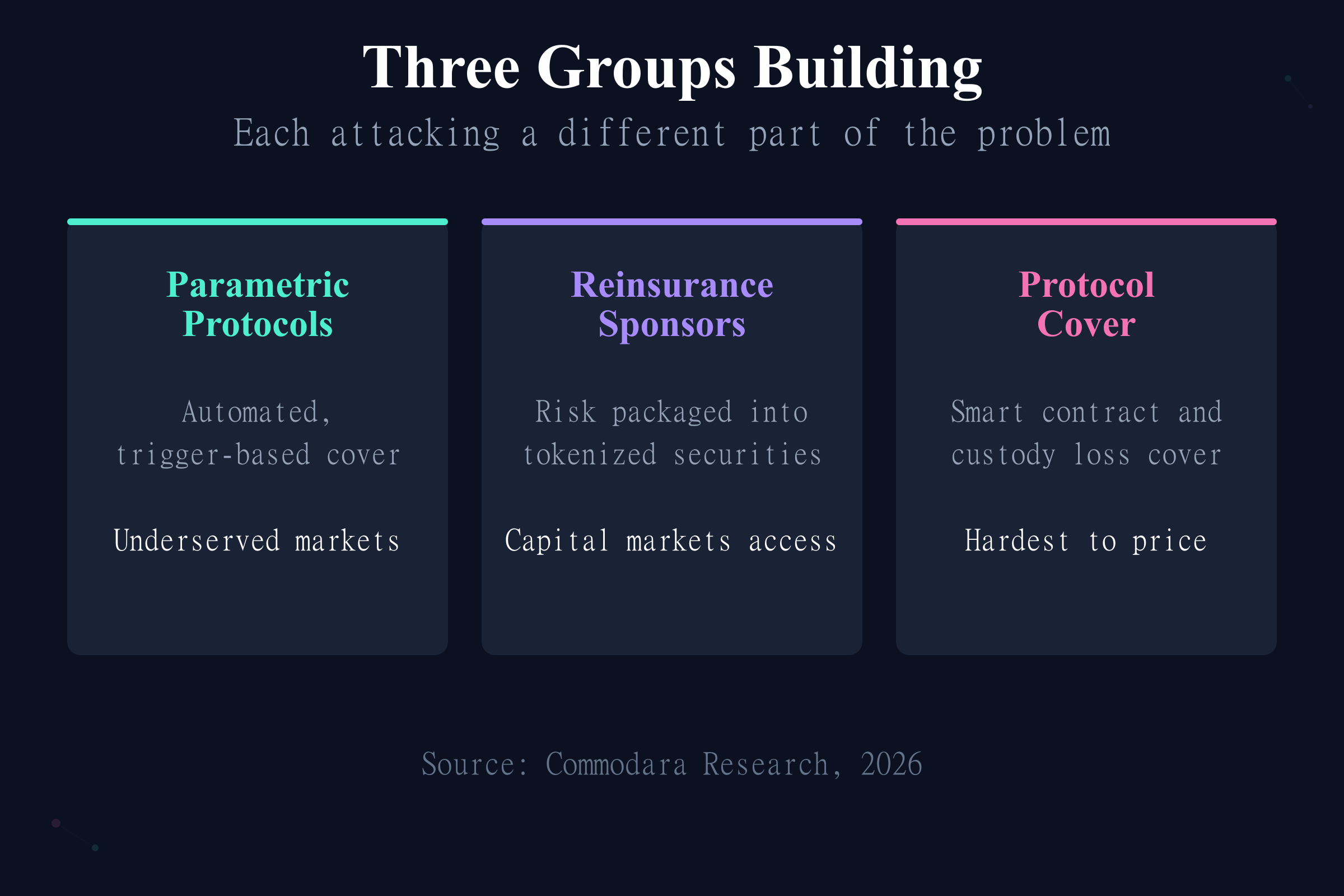
The first group is parametric protocols, led by projects like Etherisc, which build the smart contract infrastructure for automated, trigger-based coverage. Their focus is operational efficiency and reaching underserved markets where traditional insurance distribution is uneconomic, such as smallholder agriculture.
The second group is tokenized reinsurance sponsors, including SurancePlus and similar issuers, which package reinsurance risk into tokenized securities for investors. Their focus is capital markets access, bringing a well-established institutional asset class to a broader investor base through on-chain issuance.
The third group is on-chain protocol cover, providers offering protection against smart contract failure, custody loss, and depegging events. This is the coverage the tokenized economy most obviously needs, and it is also the hardest to price, because the loss history is short and the risks are correlated in ways that traditional actuarial models handle poorly.
What these groups share is a dependence on reliable external data. Parametric triggers need weather and flight feeds, reinsurance instruments need loss reporting, and protocol cover needs on-chain monitoring. Oracles are as central to tokenized insurance as they are to collateral valuation, which makes the data layer a shared dependency across the entire sector.
What Still Has to Be Solved
Tokenized insurance remains small relative to its potential, and the obstacles are as much regulatory and actuarial as technical.
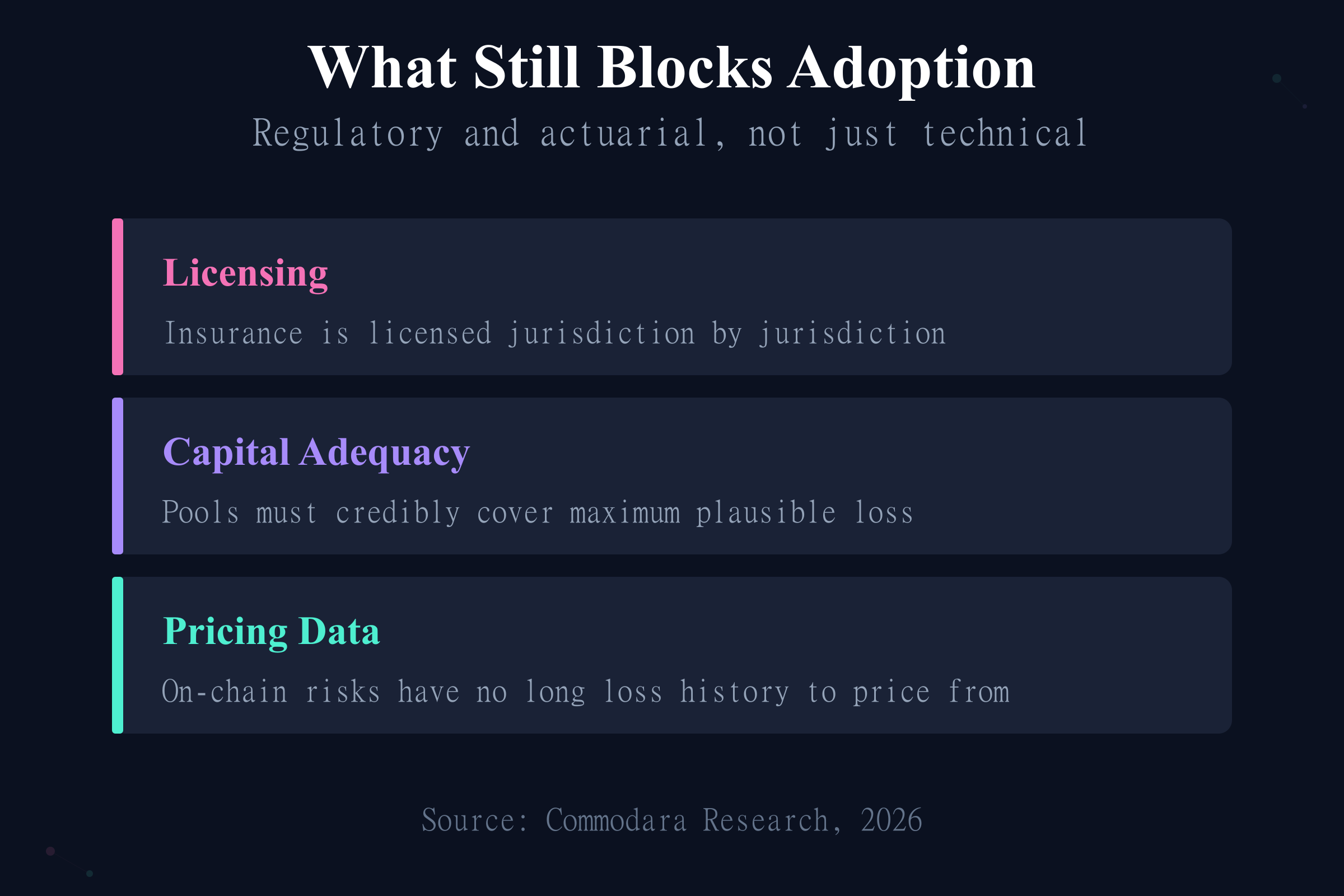
Regulation is the first constraint. Insurance is licensed jurisdiction by jurisdiction, often more restrictively than securities, and a protocol offering coverage across borders confronts a patchwork of rules that were not written with programmable contracts in mind. Most successful projects operate through licensed carriers rather than around them.
Capital adequacy is the second. An insurance pool must credibly cover its maximum plausible loss, which requires either substantial locked capital or reinsurance backing. Protocols that under-reserve work fine until the first large correlated event, which is precisely when they are most needed. The thin, illiquid secondary markets described in our analysis of tokenized asset liquidity compound the problem, because capital that cannot exit is capital that arrives reluctantly.
Pricing is the third. Actuarial science depends on long loss histories, and on-chain risks simply do not have them. Underwriters are pricing smart contract failure and custody loss with limited data, which pushes premiums up and suppresses demand, a cycle that only breaks as the loss record accumulates.
Progress is nonetheless visible. Each year of operating history narrows the pricing gap, licensed carriers are increasingly willing to partner with protocols rather than compete with them, and regulators in several jurisdictions have begun addressing parametric products explicitly. The sector is small, but it is no longer speculative, and the products settling today are real contracts with real capital behind them.
Frequently Asked Questions
What is tokenized insurance?
Tokenized insurance is the issuance of insurance coverage or insurance risk as blockchain tokens. It covers parametric policies that pay automatically on a verified trigger, and insurance-linked securities such as tokenized reinsurance that let investors earn premiums for accepting a defined slice of insurance risk.
How does parametric insurance work on-chain?
A smart contract encodes a trigger condition, such as rainfall below a threshold or a flight delay beyond a set time. An oracle supplies verified data, and if the trigger is met the payout executes automatically with no claims process, adjuster, or settlement negotiation required.
What are tokenized insurance-linked securities?
They are instruments such as catastrophe bonds issued as tokens. Investors receive a premium for accepting defined insurance risk and lose capital if the covered event occurs. Tokenization lowers minimums, broadens access, and makes secondary trading possible in an asset class traditionally held to maturity.
Why is insurance risk attractive to investors?
Because it is largely uncorrelated with financial markets. A natural catastrophe is independent of equity or bond performance, so insurance-linked returns diversify a portfolio in a way most asset classes cannot. That property is why institutional allocators have long held these securities.
What is the biggest obstacle to tokenized insurance?
Three obstacles stand out: jurisdiction-by-jurisdiction licensing that was not written for programmable contracts, capital adequacy requirements that demand credible reserves against maximum losses, and the absence of long loss histories for on-chain risks, which makes accurate pricing difficult.
The Bottom Line
Tokenized insurance is the layer that turns the tokenized economy from a place where risk accumulates into one where risk can be transferred. Parametric contracts remove the friction of claims processing, and tokenized reinsurance opens an uncorrelated institutional asset class to a broader investor base.
Neither breakthrough is complete. Regulation remains fragmented, capital adequacy is unresolved, and pricing on-chain risks without loss history is genuinely hard. But the direction is clear, and the products now settling on public blockchains are real rather than theoretical.
For institutions, the practical significance is that tokenized insurance is what will eventually make holding tokenized assets defensible to a risk committee. Subscribe to the Commodara newsletter for ongoing analysis of the protocols, carriers, and securities building the on-chain risk transfer layer.