
AI Tokenization: How Artificial Intelligence Is Transforming RWA Infrastructure
AI tokenization has moved from concept to production in 2026, with a majority of new DeFi protocols shipping built-in AI agents and autonomous systems settling tens of millions of dollars in on-chain transactions. The convergence is not a marketing overlay. Tokenization produces exactly the kind of structured, continuous, machine-readable data that artificial intelligence is best suited to act on.
This is the most consequential technical shift in the sector since institutional issuance began. This analysis explains what AI tokenization actually means in practice, the four areas where it is already deployed, why the two technologies fit together so naturally, and the risks that come with automating financial infrastructure.
Table of Contents
This analysis opens with what AI tokenization means and why the two technologies converge so naturally. It then works through the four production applications: compliance automation, real-time valuation, autonomous agents, and predictive risk scoring. The closing sections examine the risks of automating financial infrastructure and answer the most common questions before the bottom line.
What AI Tokenization Actually Means
AI tokenization is the application of machine learning and autonomous software agents to the infrastructure that issues, prices, monitors, and trades tokenized real world assets. It is not about tokenizing AI models, and it is not about chatbots attached to finance apps. It is about automating the operational layer that has historically made tokenization slow and expensive.
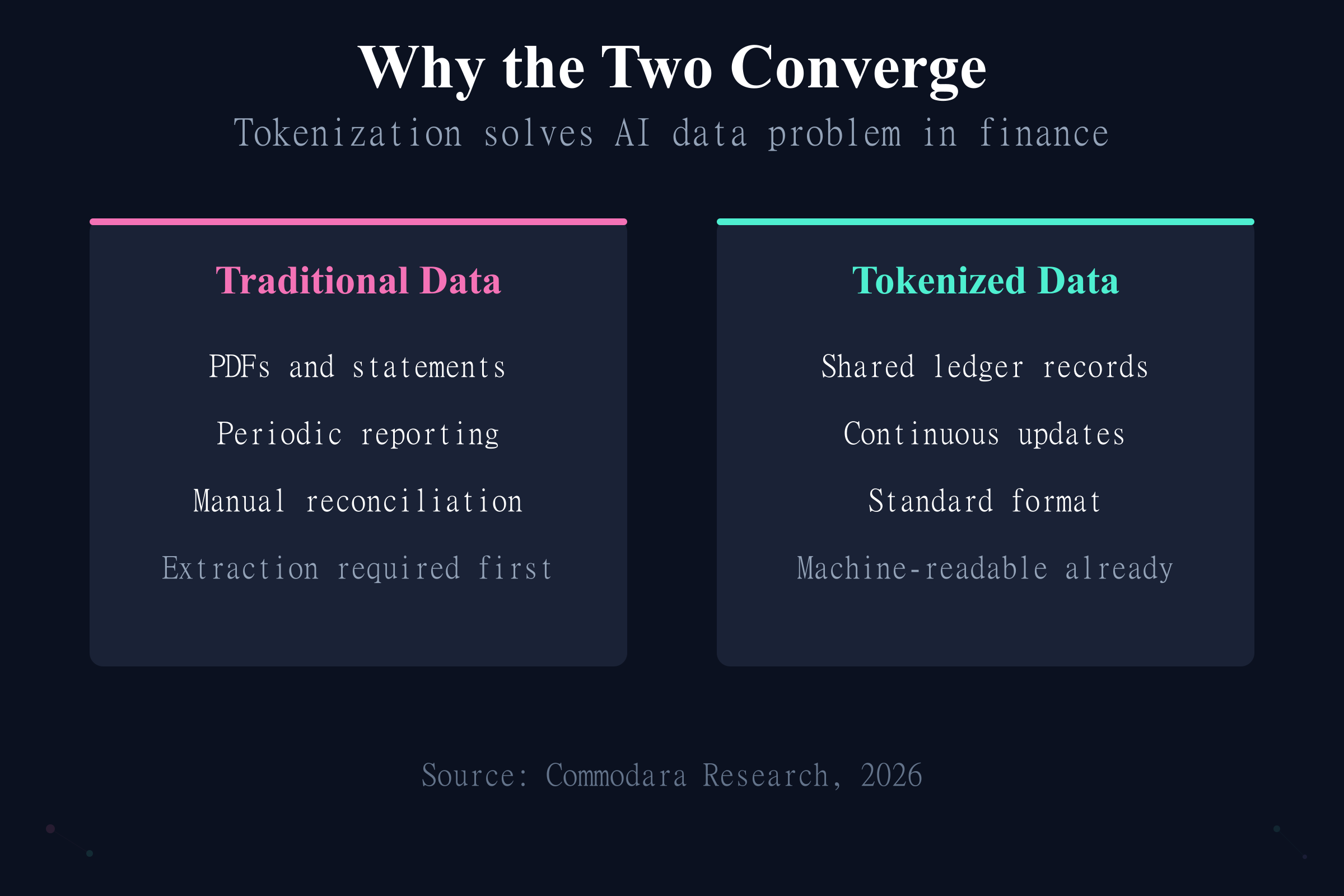
The fit is structural rather than fashionable. Traditional finance runs on unstructured data: PDF statements, emailed confirmations, quarterly reports, and manual reconciliation between systems that do not talk to each other. Tokenized finance runs on a shared ledger where ownership, transfers, and collateral positions are recorded continuously in a standard format.
That difference matters enormously for automation. An AI system analyzing traditional private credit must extract data from documents of varying quality before it can begin. An AI system analyzing tokenized credit reads the ledger directly. Tokenization does not merely benefit from AI; it removes the data preparation problem that has limited AI adoption across finance generally.
This is why AI arrived faster in tokenized finance than in traditional finance despite the latter having far more capital and longer timelines. The blocker was never model capability; it was data readiness. Tokenization delivers that readiness as a byproduct of how it records ownership, which is why adoption has been quick and largely uncontroversial on the operational side. It also means the sector’s cost curve bends earlier than most observers expected.
Application One: Compliance Automation
The most immediately valuable use of AI tokenization is compliance, because compliance is where the largest share of operational cost sits.
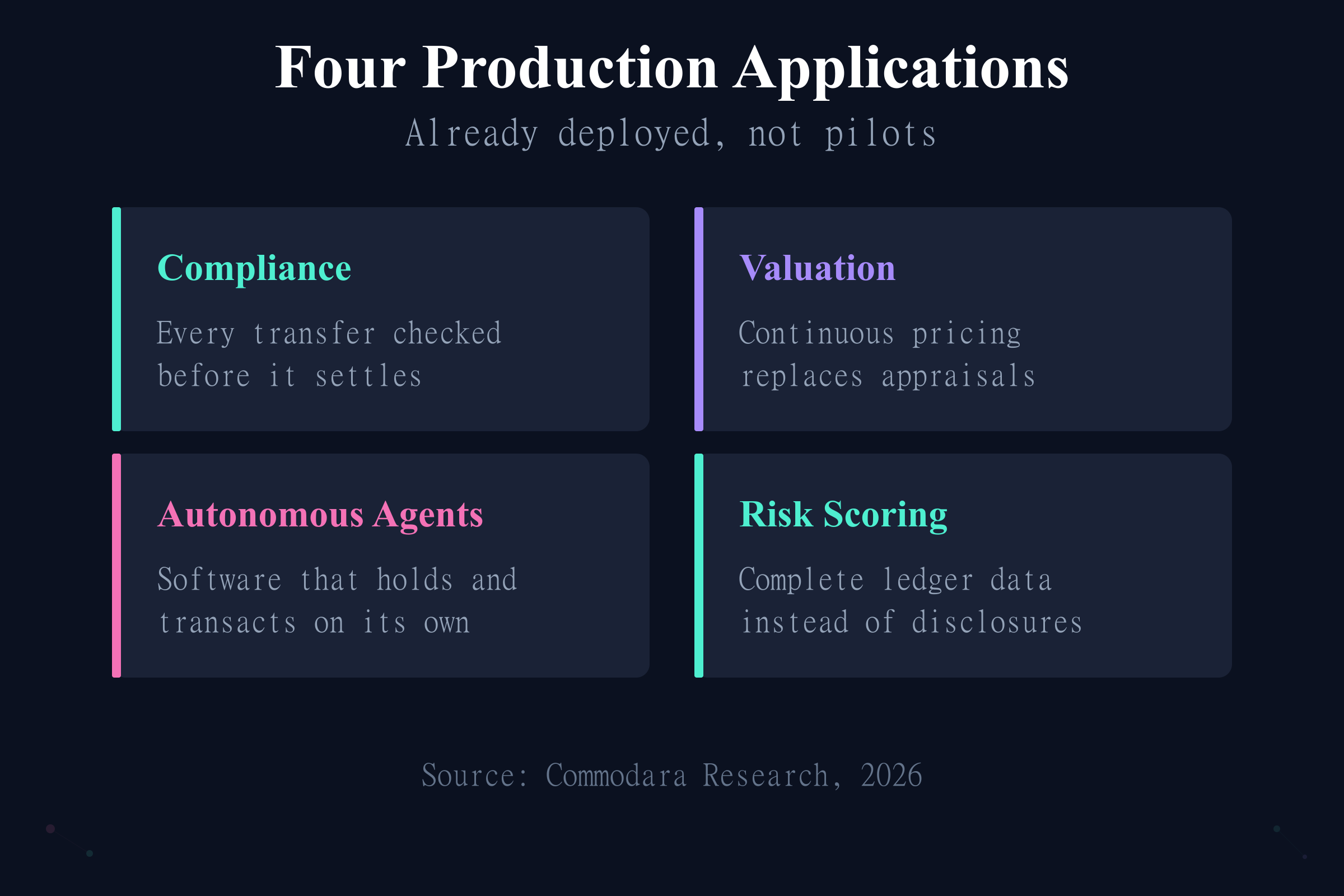
AI systems now handle investor onboarding checks, sanctions screening, transaction monitoring, and jurisdiction eligibility verification at a speed and cost no manual team can match. The rules that govern who may hold a tokenized security are precise and repetitive, which is exactly the problem shape machine learning handles well. Our guide to KYC and AML for tokenized assets covers the obligations these systems are automating.
The deeper change is continuous monitoring. Traditional compliance samples: it reviews a percentage of transactions after the fact. An AI system connected to a tokenized register can evaluate every transfer against every rule before it settles, shifting compliance from detection to prevention. For a permissioned security where a non-compliant transfer is a regulatory breach rather than an inconvenience, that shift is significant.
The economics are compelling. Compliance has historically been a fixed cost that scales poorly, requiring more staff as transaction volume grows. Automated checking scales at near-zero marginal cost, which changes the minimum viable size of a tokenized offering. Deals too small to justify a compliance team become feasible, which widens the range of assets worth tokenizing at all.
Application Two: Real-Time Valuation
The second application addresses tokenization’s most awkward mismatch: assets that trade continuously but are valued occasionally.
A tokenized building can change hands at any hour, but the appraisal underpinning its price may be a year old. That gap undermines the entire premise of continuous trading, because a market cannot price what it cannot value. Machine learning models trained on transaction data, comparable sales, rental yields, and market indicators can produce continuously updated valuations instead.
This is a deep enough subject that we cover it separately in our analysis of how machine learning solves tokenization’s pricing problem. The short version is that continuous valuation is what would let illiquid tokenized assets trade with confidence, which connects directly to the constraints described in our examination of why tokenized assets still struggle to trade.
The caveat is that a model is only as good as the data behind it. Assets with deep comparable-transaction histories, such as residential property in liquid markets, can be modeled accurately. Unique assets with few comparables cannot, and applying continuous valuation to them produces a false precision that is arguably worse than an honest annual appraisal.
Application Three: Autonomous Agents
The third application is the most novel: software agents that hold assets and transact independently rather than merely advising humans.
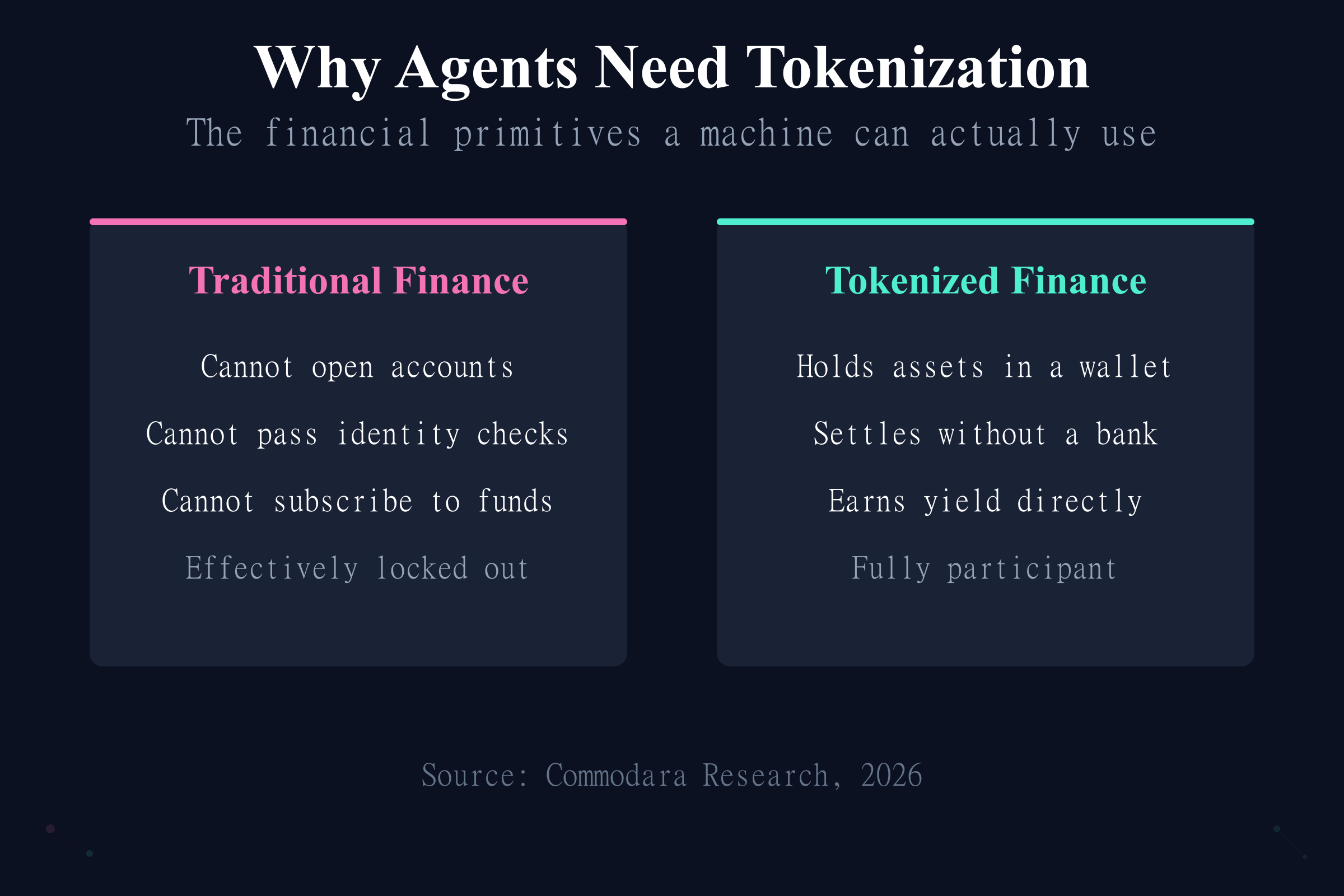
Agentic systems now execute treasury management, rebalance positions, deploy idle capital into yield-bearing instruments, and settle payments without a person approving each action. Research from firms tracking agentic finance, including analysis published by Cobo, documents autonomous systems settling meaningful transaction volume on-chain.
Tokenized assets are what make this possible. An agent cannot open a bank account or subscribe to a traditional fund, but it can hold a tokenized Treasury and earn yield with nothing more than a wallet and permission. The agent economy therefore depends on tokenization for its financial primitives, a relationship significant enough that we examine it separately in our analysis of AI agents as a new buyer class.
The scale here is still small relative to the attention it generates. Autonomous settlement volume measured in tens of millions of dollars is meaningful as a proof of concept, not as a market. What makes it worth tracking is the growth trajectory and the structural fact that this buyer class has no real alternative to tokenized instruments.
Application Four: Predictive Risk Scoring
The fourth application uses the completeness of on-chain data to assess risk in ways traditional systems cannot.
Because a tokenized asset carries its full transaction history, collateral position, and counterparty exposure on a shared ledger, models can evaluate credit and counterparty risk against complete data rather than periodic disclosures. This supports earlier detection of deteriorating positions, better collateral management, and more accurate pricing of risk in lending markets like those described in our analysis of RWA DeFi collateral.
Enterprise forecasts from research houses such as Gartner project rapid growth in autonomous agent deployment across business processes generally, and financial infrastructure is among the most data-ready environments for it. Tokenization supplies the data quality that makes predictive models trustworthy rather than speculative.
The practical benefit shows up in lending. A protocol that can see a borrower’s full on-chain position can adjust collateral requirements dynamically rather than applying a blanket haircut to everyone. That precision lets sound borrowers access better terms while genuinely risky positions are constrained earlier, which improves the efficiency of the whole market.
The Risks of Automating Financial Infrastructure
Applying AI tokenization to regulated financial infrastructure introduces risks that deserve more attention than they currently receive.
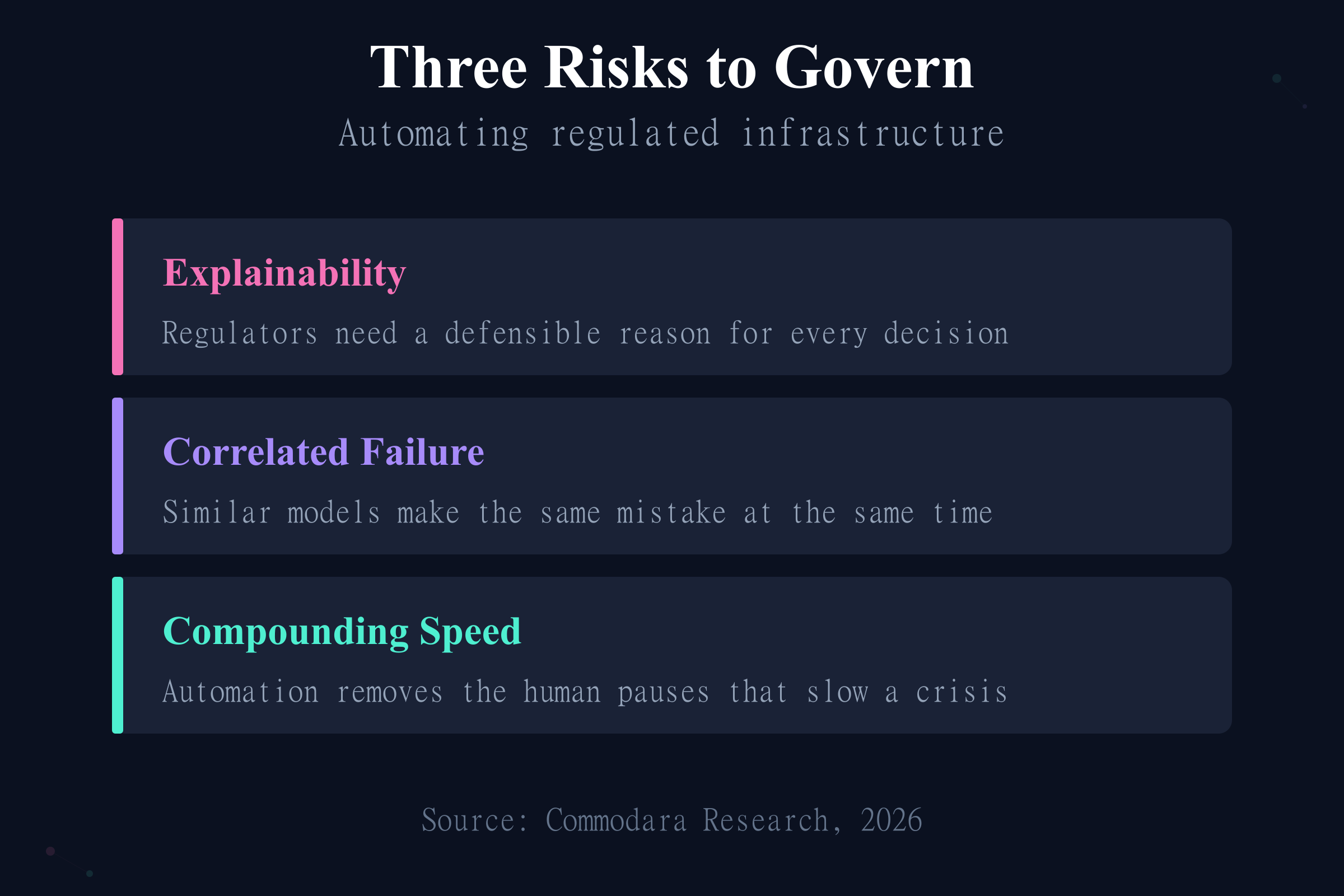
The first is explainability. A regulator asking why a transfer was blocked or an asset was valued at a particular level needs a defensible answer. Models that cannot explain their reasoning are difficult to deploy in regulated contexts regardless of accuracy, which is why simpler, auditable approaches often win over more powerful opaque ones.
The second is correlated failure. If many protocols rely on similar models trained on similar data, they will make similar mistakes simultaneously. Automation that appears to distribute decision-making can quietly concentrate it, producing the kind of synchronized behavior that turns a market move into a cascade.
The third is compounding speed. Automated systems acting on automated valuations settling on automated rails remove the human pauses that historically slowed a crisis. Efficiency in normal conditions and fragility under stress are two descriptions of the same property, which is why circuit breakers and human override remain essential design requirements rather than optional safeguards.
The reasonable position is neither resistance nor enthusiasm but insistence on governance. Automated systems in regulated finance need audit trails, defined override authority, tested failure modes, and limits on how much can happen without human review. These are ordinary controls in traditional finance, and they should not become optional simply because the system is faster. Without them, the efficiency gain is borrowed against a future incident.
Frequently Asked Questions
What is AI tokenization?
AI tokenization is the use of machine learning and autonomous agents in the infrastructure that issues, prices, monitors, and trades tokenized real world assets. It covers compliance automation, continuous valuation, agent-driven transactions, and predictive risk scoring, rather than tokenizing AI models themselves.
Why do AI and tokenization fit together?
Because tokenization produces structured, continuous, machine-readable data on a shared ledger, while traditional finance produces unstructured documents requiring extraction and reconciliation. Tokenization removes the data preparation problem that has limited AI adoption across finance, making models faster to deploy and more reliable.
How does AI improve tokenization compliance?
AI automates onboarding checks, sanctions screening, transaction monitoring, and eligibility verification. More importantly, it enables continuous monitoring, evaluating every transfer against every rule before settlement rather than sampling after the fact, which shifts compliance from detection to prevention.
What are autonomous agents in tokenized finance?
They are software systems that hold assets and transact independently, managing treasury, rebalancing positions, and settling payments without per-action human approval. They depend on tokenized assets because an agent cannot open a bank account but can hold a tokenized Treasury with a wallet.
What are the main risks of AI in tokenization?
Explainability, since regulators require defensible reasoning for automated decisions; correlated failure, where many protocols using similar models make the same mistake simultaneously; and compounding speed, since automation removes the human pauses that historically slowed crises from cascading.
The Bottom Line
AI tokenization is where the sector’s operational costs finally start falling. Compliance automation, continuous valuation, autonomous agents, and predictive risk scoring each attack a different piece of the overhead that has made tokenization expensive, and all four are running in production rather than pilots.
The reason this convergence works is structural. Tokenization creates the clean, continuous data that machine learning requires, and machine learning supplies the automation that tokenization needs to be economically viable at scale. Neither technology fully delivers on its promise in finance without the other.
The open question is governance rather than capability. Explainability, correlated model risk, and the speed at which automated systems can compound an error are unresolved, and they will shape how far regulators let AI tokenization go. Subscribe to the Commodara newsletter for ongoing analysis of the infrastructure where these two technologies meet.