
AI Asset Valuation: How Machine Learning Solves Tokenization’s Pricing Problem
AI asset valuation is closing the gap between how fast tokenized assets trade and how slowly they get priced, with machine learning models now achieving low single-digit error rates across large property datasets. A tokenized building can change ownership in seconds, but if the appraisal behind it is eleven months old, the trade is happening against a number that no longer means anything.
This mismatch is one of the quiet reasons tokenized assets fail to trade. This analysis explains the pricing problem tokenization created, how AI asset valuation works, where it performs well and where it does not, and what continuous pricing would unlock across the tokenized market.
Table of Contents
This analysis opens with the pricing problem that tokenization created and why traditional appraisal cannot solve it. It then explains how AI asset valuation models actually work, examines their accuracy and the asset classes where they succeed or fail, and closes with what continuous valuation unlocks and the governance questions it raises, followed by the most common questions and the bottom line.
The Pricing Problem Tokenization Created
Tokenization changed the speed of ownership transfer without changing the speed of valuation. Traditional illiquid assets were valued periodically because they traded rarely, and an annual appraisal was adequate when the next transaction was years away. That logic collapses when the same asset sits in a wallet that can transfer at any moment.
The consequence is a market operating on stale information. A buyer purchasing a tokenized property interest is pricing against an appraisal produced under different interest rates, different rental conditions, and a different local market. Neither side can be confident the number reflects reality, so both demand a discount for the uncertainty, which suppresses activity.
This is a direct contributor to the problem examined in our analysis of why tokenized assets still cannot trade. A market cannot be liquid if participants do not trust the price, and periodic appraisal cannot produce trustworthy prices for a continuously tradable asset. Solving valuation is therefore a precondition for solving liquidity, not a separate project.
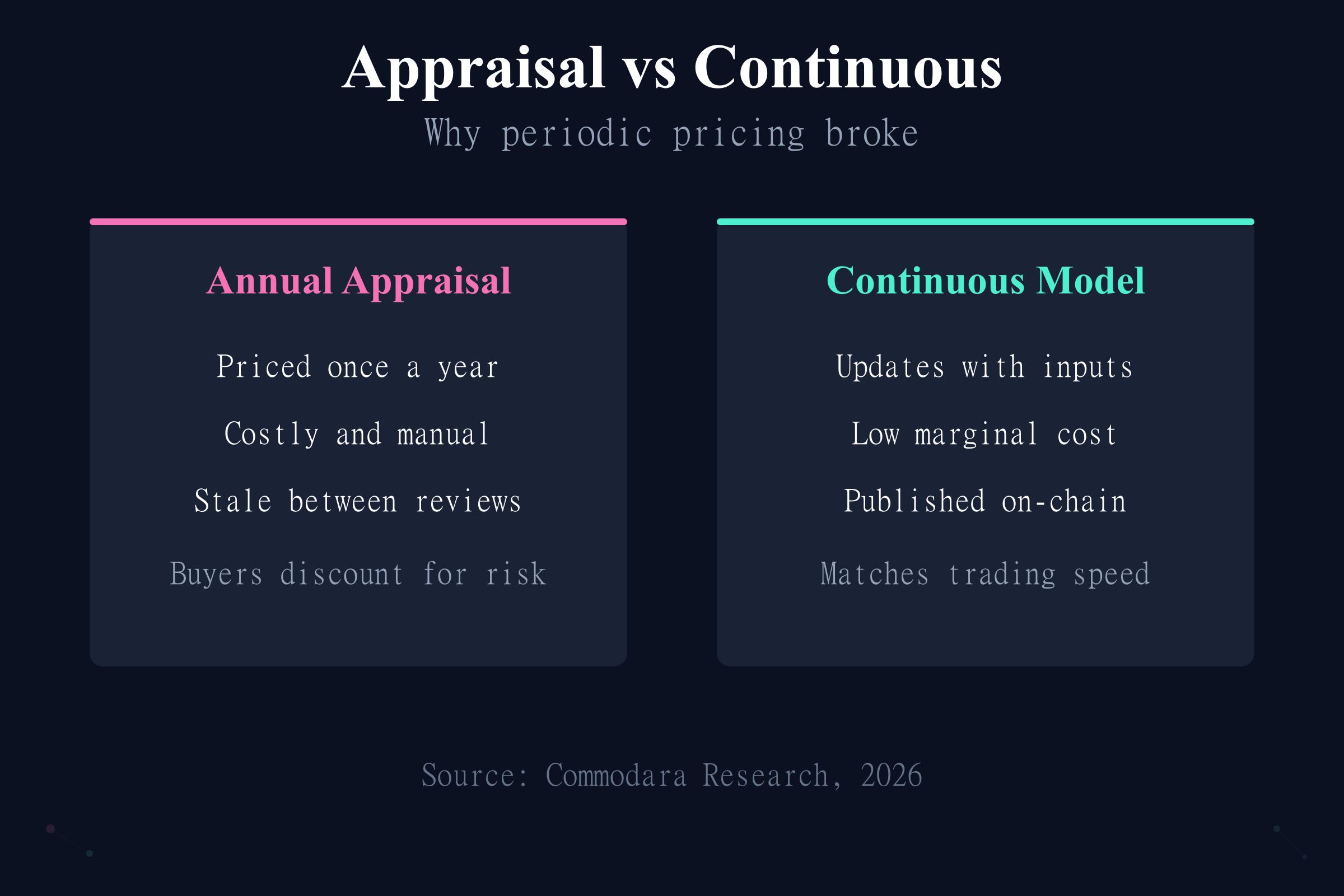
The problem compounds in fractional ownership. When a single property is split among hundreds of token holders, each of them needs a defensible value for reporting, tax, and portfolio purposes, and none of them individually can commission an appraisal. Periodic valuation was workable when one owner held the whole asset. It scales poorly the moment ownership fragments, which is precisely what tokenization does.
How AI Asset Valuation Works
Automated valuation models are not new to real estate, but their application to tokenized assets is, and the underlying method is worth understanding.
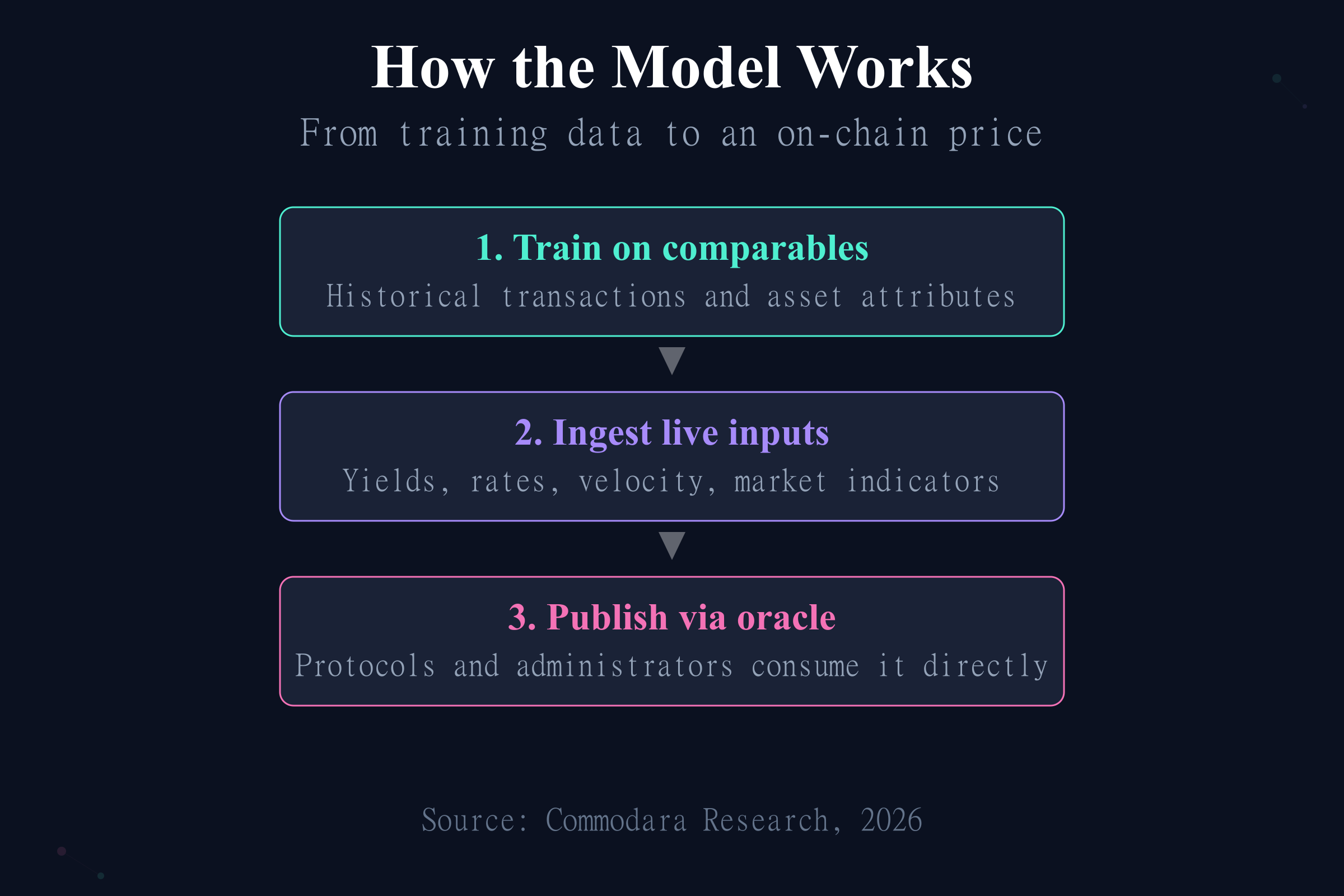
A model is trained on historical transactions for comparable assets, learning the relationship between observable characteristics and realized prices. For property, those characteristics include location, size, age, condition, and configuration. The model then applies that learned relationship to an asset that has not recently sold, producing an estimated value with a confidence range.
What distinguishes modern implementations is the breadth of inputs. Beyond the asset’s own attributes, models ingest local transaction velocity, rental yields, interest rate movements, planning activity, and broader market indicators. Each of these updates continuously, so the valuation updates with them rather than waiting for a scheduled review.
For tokenized assets specifically, the output feeds directly into on-chain infrastructure. An oracle publishes the model’s valuation to the blockchain, where lending protocols, trading venues, and fund administrators can consume it. Platforms including DigiShares have built valuation into tokenization workflows so that net asset value updates without manual intervention.
Crucially, a well-designed model publishes a confidence range rather than a single number. A valuation of a given amount with a narrow band communicates something very different from the same figure with a wide one, and downstream systems can treat them differently. Lending protocols, for example, can apply larger haircuts where model confidence is low, which is a far more intelligent response than either trusting or ignoring the estimate outright.
Accuracy and Where Models Succeed
The credibility of AI asset valuation rests on measurable accuracy, and the record varies sharply by asset class.
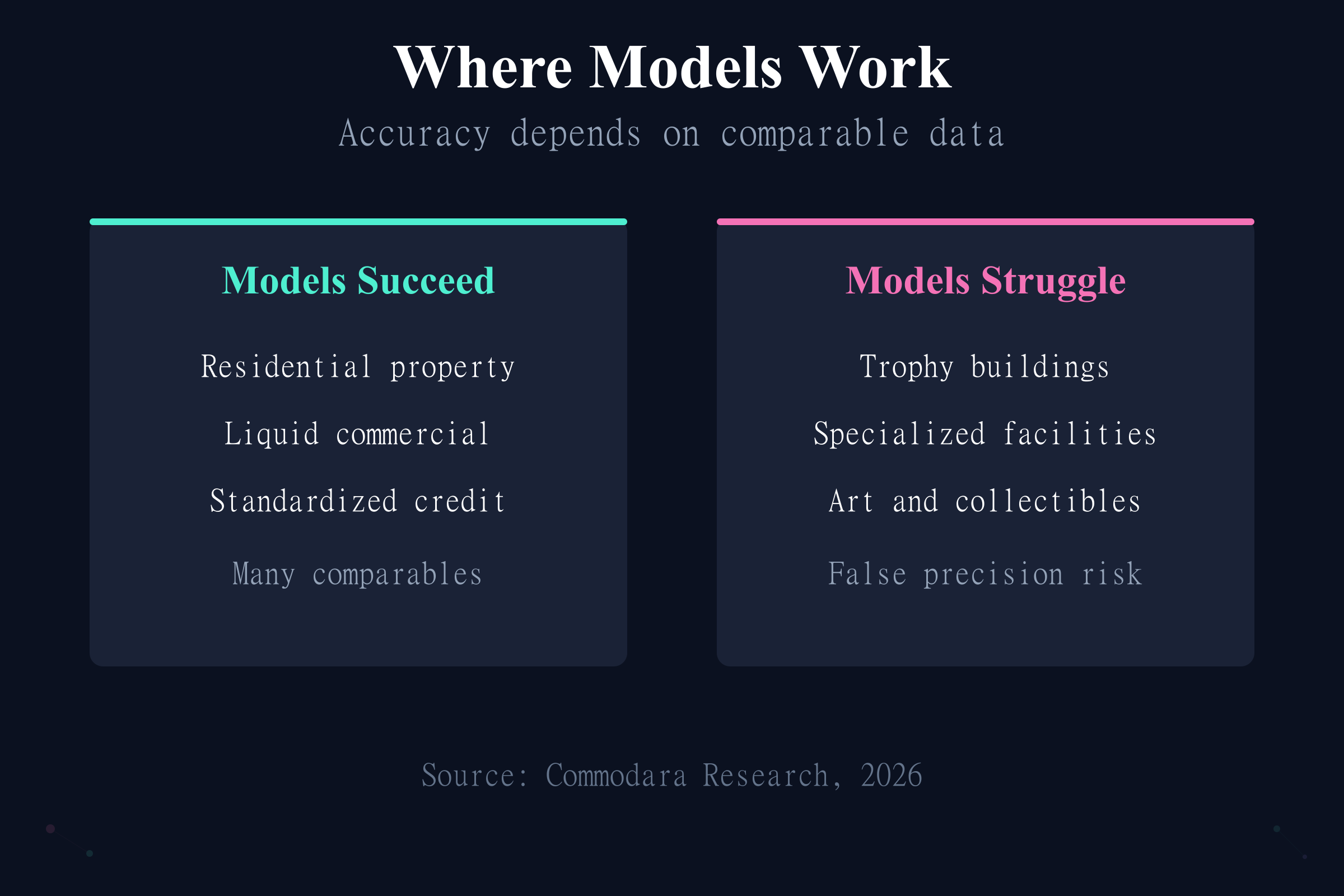
Models perform best where comparable transactions are plentiful and asset characteristics are standardized. Residential property in active markets is the clearest success case, with well-built models achieving low single-digit percentage error against eventual sale prices. Commercial property in liquid segments and standardized private credit portfolios also model well, because the inputs that drive value are consistent and observable.
Performance degrades as assets become unique. A trophy commercial building, a specialized industrial facility, or a piece of art has few genuine comparables, and a model extrapolating from loosely similar assets produces confident-looking numbers with wide real uncertainty. That false precision is more dangerous than an honest appraisal, because it invites reliance the underlying data does not support.
Professional standards bodies including the Royal Institution of Chartered Surveyors have developed guidance for automated valuation models, covering when they are appropriate and what disclosure should accompany them. That guidance matters for tokenization, because a valuation feeding an on-chain lending market carries consequences a marketing estimate does not.
The pragmatic approach most serious issuers take is hybrid. Models handle continuous updating between periodic professional appraisals, which act as calibration points. The appraisal anchors the model to an independent human judgment at intervals, and the model fills the long gaps between them. Neither replaces the other, and the combination is more defensible to an auditor than either alone.
What Continuous Valuation Unlocks
Reliable continuous pricing changes what tokenized assets can actually do, in three specific ways. Each one is currently blocked by the same missing input, which is why valuation is a higher-leverage problem than it first appears.
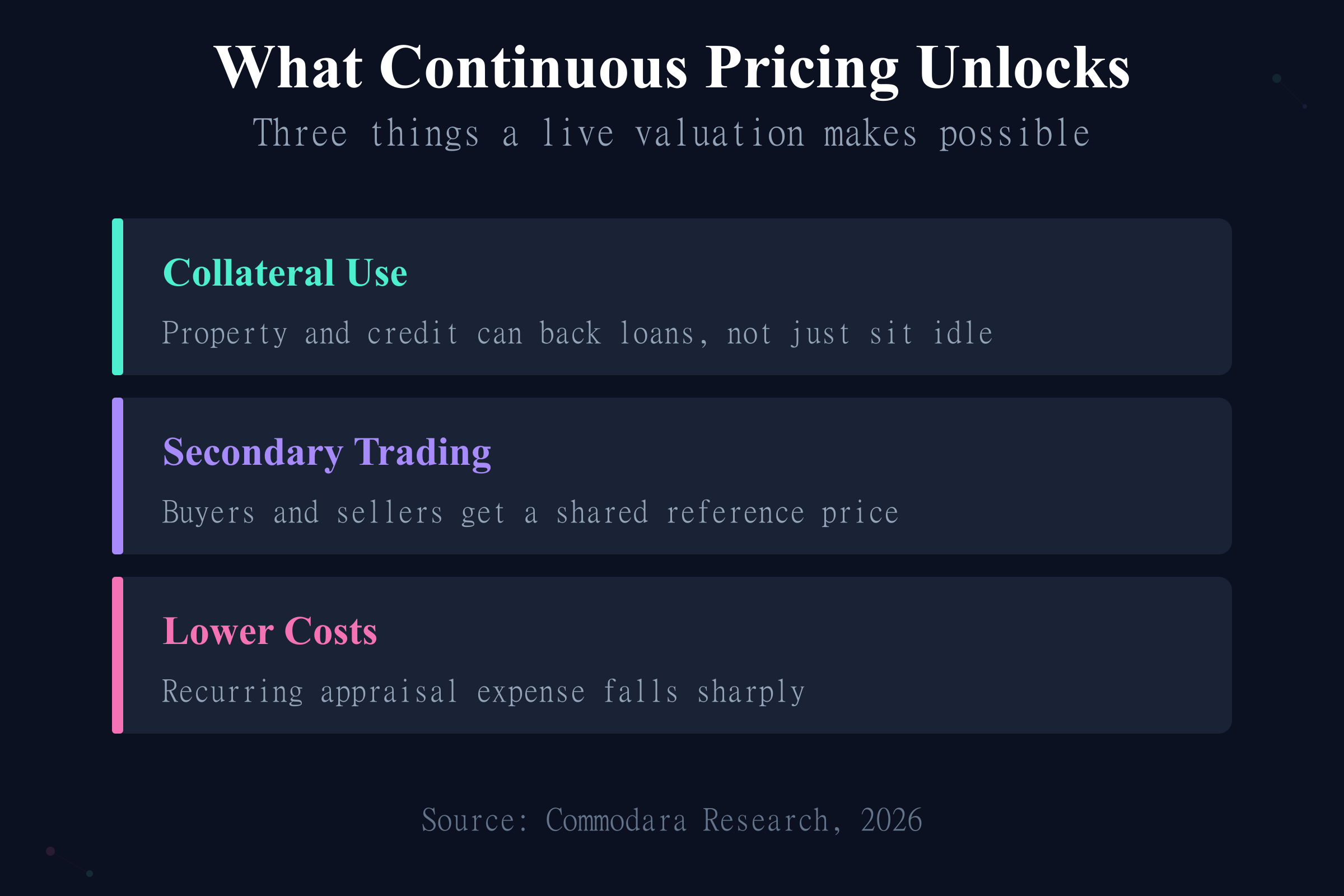
The first is collateral. An asset cannot serve as lending collateral without a current, trustworthy value, which is why tokenized Treasuries dominate the collateral market described in our analysis of RWA DeFi collateral while tokenized property barely features. Continuous valuation is what would let real estate and private credit function as collateral rather than remaining passive holdings.
The second is secondary trading. Buyers and sellers need a common reference price to transact with confidence, and a live valuation provides one. This does not create liquidity by itself, but it removes one of the specific frictions that prevents a market from forming around an asset that theoretically trades continuously.
The third is issuer economics. Traditional appraisals are expensive and recur annually, forming part of the ongoing costs covered in our breakdown of the real economics of tokenization. Automated valuation reduces that line materially, and for smaller assets it can be the difference between a tokenization that is economically viable and one that is not. Issuers weighing this trade-off can estimate the cost of tokenizing and maintaining an asset before committing.
There is a fourth effect that is easy to miss: reporting. Fund administrators producing net asset values for tokenized share classes currently reconcile inputs manually, which limits how often they can publish. Automated AI asset valuation lets a fund report daily or even continuously rather than monthly, which changes what investors can see and how quickly they can act on it. For products competing for institutional allocations, that transparency is itself a feature.
The Governance Question
Automated valuation raises questions that the technology alone does not answer.
The most important is who is accountable when a model is wrong. A human appraiser carries professional liability and can be challenged; a model producing a number consumed automatically by a lending protocol has a more diffuse accountability chain. Regulators and auditors are still working out what standard applies, and issuers should assume that clarity will arrive as a requirement rather than an option.
A related concern is manipulation. If asset values are set by models reading observable inputs, then influencing those inputs becomes a way to influence valuations. This is a familiar oracle problem in a new setting, and it is why serious implementations use multiple independent data sources and publish confidence ranges rather than single point estimates.
Model drift is the third governance issue and the least visible. A model trained on one market regime gradually becomes less accurate as conditions change, and the degradation is silent because the outputs continue to look reasonable. Ongoing back-testing against realized transactions is the only reliable check, and it needs to be a scheduled obligation rather than something performed when someone becomes suspicious.
Frequently Asked Questions
What is AI asset valuation?
AI asset valuation uses machine learning models trained on historical transactions to estimate what an asset is worth, updating continuously as market inputs change. For tokenized assets, the output is published on-chain through an oracle so lending protocols, trading venues, and administrators can consume it automatically.
How accurate is AI valuation for real estate?
Well-built models achieve low single-digit percentage error against eventual sale prices for residential property in active markets, where comparable transactions are plentiful. Accuracy declines sharply for unique assets with few genuine comparables, where models produce confident numbers with much wider real uncertainty.
Why does tokenization need continuous valuation?
Because tokenization made assets tradable continuously without making them priceable continuously. A tokenized property can transfer in seconds against an appraisal that is months old, so participants discount for uncertainty. Continuous valuation removes that gap and is a precondition for genuine liquidity.
Can tokenized real estate be used as collateral?
Not easily today, because lending protocols need a current trustworthy value to lend against, and periodic appraisals do not provide one. Reliable continuous valuation is the missing piece that would let tokenized property and private credit serve as collateral rather than sitting as passive holdings.
What are the risks of automated valuation models?
The main risks are false precision on unique assets with few comparables, unclear accountability when a model is wrong and its output is consumed automatically, and manipulation of the observable inputs that drive the model. Multiple data sources and published confidence ranges mitigate but do not eliminate these.
The Bottom Line
AI asset valuation addresses the specific mismatch tokenization created: assets that can trade at any moment priced by a process designed for assets that traded once a year. Machine learning models now close that gap credibly for standardized assets, and less credibly for unique ones, which is an important distinction issuers should not blur.
The payoff is larger than pricing accuracy alone. Continuous valuation is what would let tokenized real estate and private credit function as collateral, give secondary markets a reference price to trade around, and remove a recurring cost that makes smaller tokenizations uneconomic.
What remains unresolved is governance rather than capability: accountability for model error and resistance to input manipulation both need answers before automated pricing carries systemic weight. Model drift belongs on that list too, since a quietly degrading model is harder to detect than an obviously broken one. Subscribe to the Commodara newsletter for ongoing analysis of the valuation, oracle, and pricing infrastructure behind AI asset valuation.