
Tokenization Due Diligence: The 7-Point Framework for Evaluating Any Tokenized Asset
Tokenization due diligence is the process that separates investable tokenized assets from marketing exercises, and most investors skip at least three of the seven critical checkpoints. A token can look institutional, cite a real asset, and quote an attractive yield while offering almost no enforceable claim on anything. The polish of the interface says nothing about the strength of the structure beneath it.
This guide gives you a repeatable, seven-point framework for evaluating any tokenized asset before you commit capital. It applies whether you are an institution allocating millions or a retail investor buying a single token, because the questions that determine whether a tokenized asset is real do not change with the size of the check.
Table of Contents
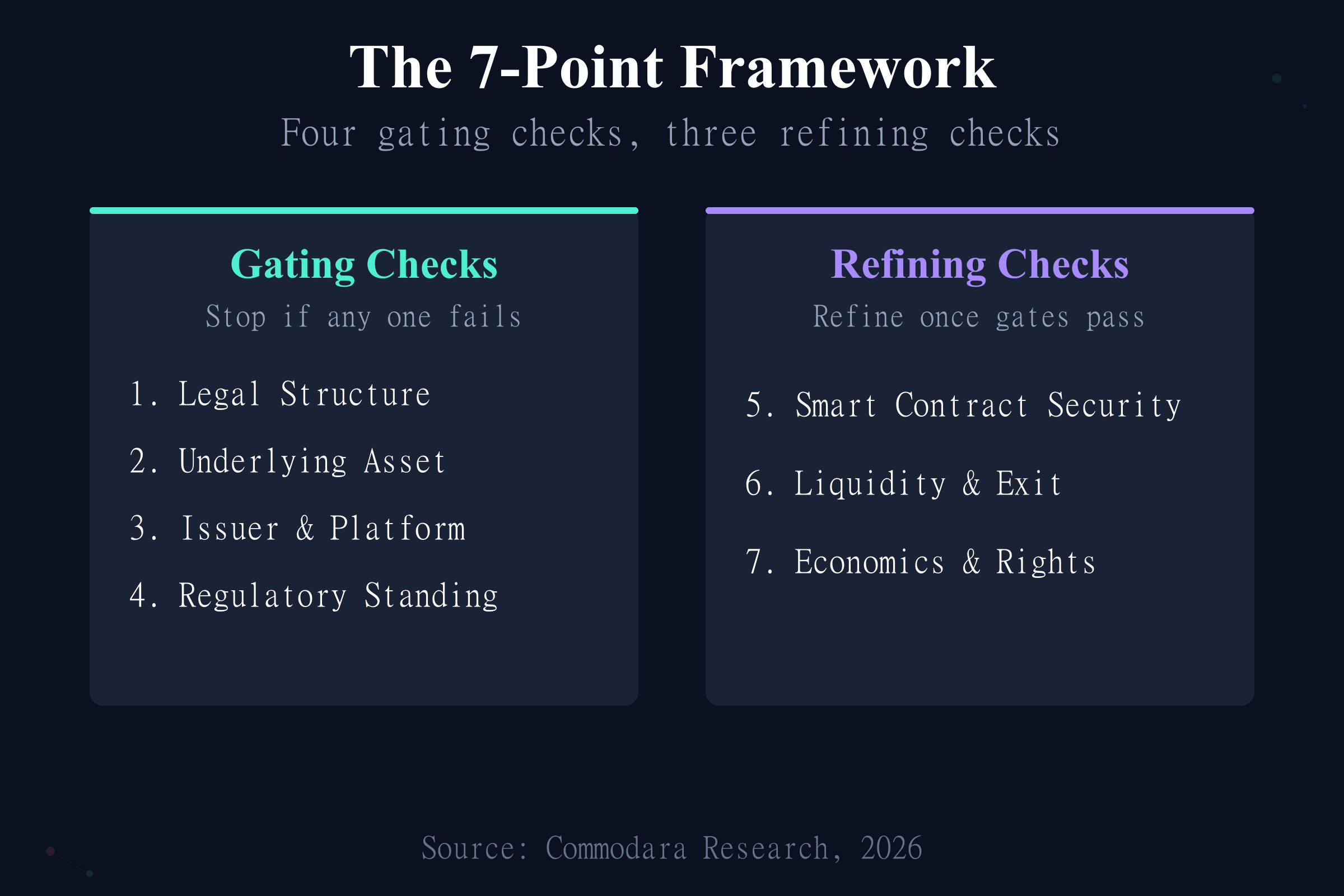
This guide opens with why tokenization due diligence matters and how tokenized assets actually fail. It then walks through the seven-point framework in order: legal structure, the underlying asset, the issuer and platform, regulatory standing, smart contract security, liquidity and exit, and economics and investor rights. The closing sections show how to apply the framework in practice and answer the most common questions before the bottom line.
Why Tokenization Due Diligence Matters
Tokenization wraps a real world asset in a digital token, but the wrapper is only as good as what is inside it. The failures in the tokenized market rarely come from the blockchain itself. They come from weak legal claims, assets that cannot be verified, issuers without a track record, and redemption promises that cannot be honored under stress.
Traditional due diligence assumes intermediaries who vouch for the asset: auditors, custodians, transfer agents, and regulators. In tokenized markets, some of those intermediaries are present, some are replaced by code, and some are quietly absent. Tokenization due diligence is the discipline of checking, point by point, which protections actually exist and which have been removed.
The pattern behind most tokenized losses is consistent. The technology works exactly as advertised, the token transfers cleanly, and the interface reports a balance, yet the holder discovers too late that the balance represents a claim no court will enforce or an asset no one can locate. Nothing broke on-chain. The failure was in the layers the buyer never checked.
The framework below is not a guarantee against loss. It is a structured way to find the gaps before your capital does. For readers newer to the asset class, our complete guide to how tokenized real world assets work covers the fundamentals this framework assumes. Assets that pass all seven checks can still underperform, but assets that fail two or three of them are usually where investors lose money they never needed to risk.
The 7-Point Tokenization Due Diligence Framework
Each point in this tokenization due diligence framework isolates one way a tokenized asset can be strong or hollow. Work through them in order, because the early points, structure and asset, determine whether the later ones even matter.
1. The Legal Structure
Start with what you actually own. A tokenized asset can represent equity in an entity, an interest in a fund, a debt claim, or the asset itself, and each gives you a different set of rights and a different position if things go wrong. If the token grants no enforceable legal claim on the underlying asset, nothing else on this list can save it, because you are holding a digital placeholder rather than a security. Understanding the legal structure behind the token is the first and most important check in any tokenization due diligence process.
2. The Underlying Asset
Confirm the asset exists and can be independently verified. Look for third-party attestation, proof of reserves, and clear evidence that a qualified custodian holds the real asset rather than a related party. A tokenized gold bar should be matched by an audited bar in an insured vault; a tokenized Treasury fund should publish its holdings and net asset value. If verification depends entirely on the issuer’s own word, treat the asset as unproven until an independent party confirms it.
3. The Issuer and Platform
Investigate who issued the token and who operates the platform beneath it. Do they have a track record, disclosed leadership, audited financials, and relevant registrations such as transfer agent or broker-dealer status? A capable, regulated issuer is itself a form of investor protection, while an anonymous or unproven one is a concentration of risk that no yield fully compensates. The question you should be able to answer before buying is simple: what happens to your token, and your claim, if the issuer ceases to operate?
4. Regulatory and Compliance Standing
Establish which jurisdiction governs the asset and which regulator, if any, stands behind it. Check whether the offering follows a recognized exemption or framework, whether it restricts sales to eligible investors, and whether it enforces KYC and AML at onboarding. Our guide to KYC and AML for tokenized assets details what compliant onboarding actually looks like in practice. Public resources from the SEC investor education office provide a useful baseline for understanding the protections a compliant offering should give you.
5. Smart Contract and Technical Security
Examine the code that moves and records the asset. Has the smart contract been audited, by a reputable firm, and were the findings actually resolved rather than merely noted? Understand who controls the admin keys, whether the contract can be upgraded or frozen, and where the private keys behind custody are held. On-chain analytics from firms like Chainalysis can help verify contract behavior and surface suspicious flows, and an unaudited contract with a single unaccountable admin key should be read as a technical single point of failure.
6. Liquidity and Exit
Determine how, and whether, you can actually sell. Is there a functioning secondary market, a regulated trading venue, or only a redemption right the issuer controls at its discretion? Read the redemption terms in full, including lockups, notice periods, and any gates that can suspend withdrawals. Be especially wary of instant-redemption promises backed by assets that cannot be sold instantly, because that liquidity mismatch is precisely the feature that fails when markets turn.
7. Economics and Investor Rights
Finally, read the economics closely. Understand the full fee stack, how the yield is actually generated, and exactly what rights you hold to distributions and information. Most importantly, learn your position if the asset defaults or the vehicle winds down, because creditors rank ahead of equity and some structures leave token holders near the back of the queue. A yield that looks attractive before fees, taxes, and default risk can look very different once all three are subtracted.
How to Apply the Framework in Practice
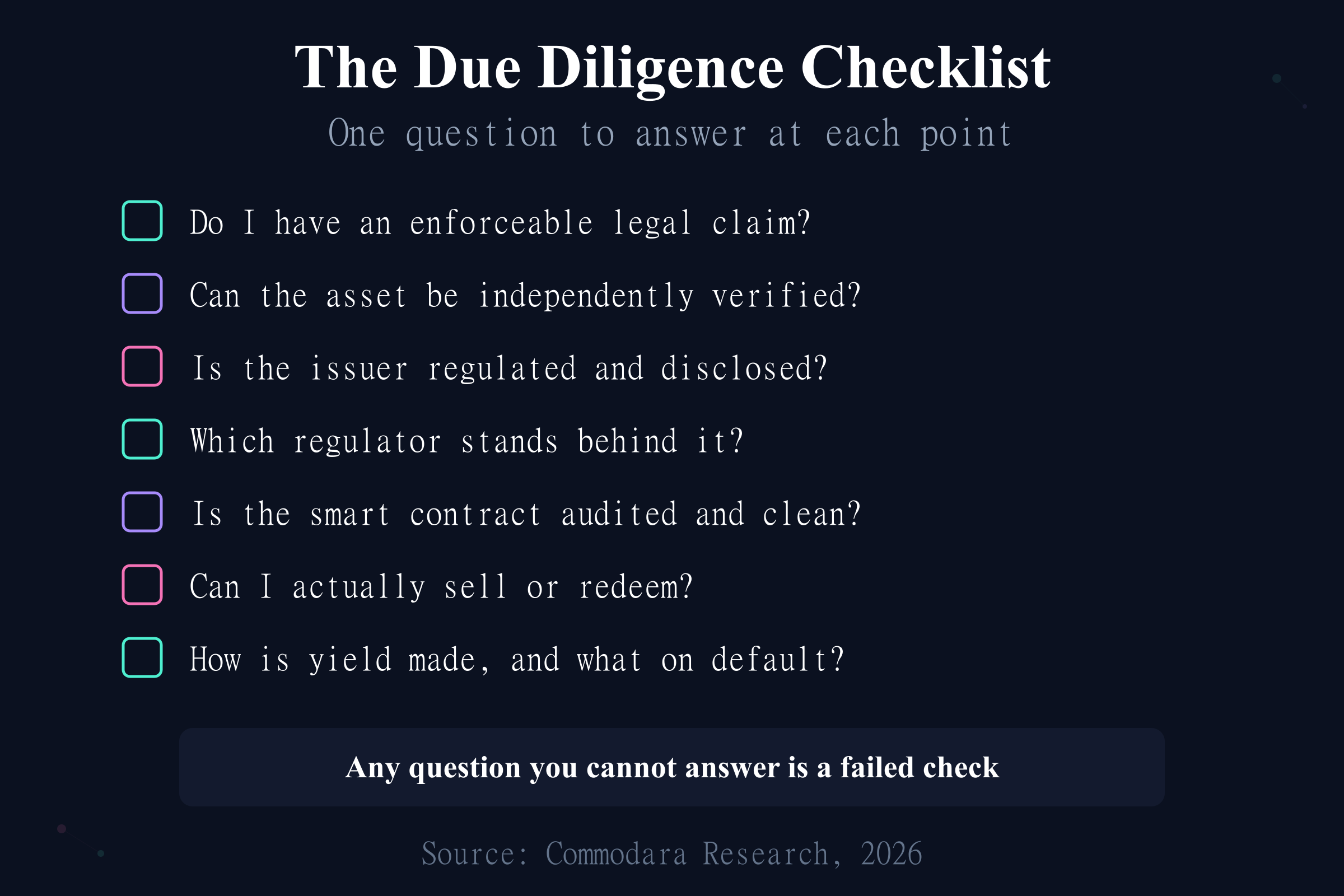
Applying tokenization due diligence is less about scoring each point perfectly and more about weighting them correctly. The first four points, structure, asset, issuer, and regulation, are gating: a serious failure in any one of them should stop the process regardless of how strong the rest look. The last three, technical security, liquidity, and economics, are where you refine a decision that has already cleared the gates.
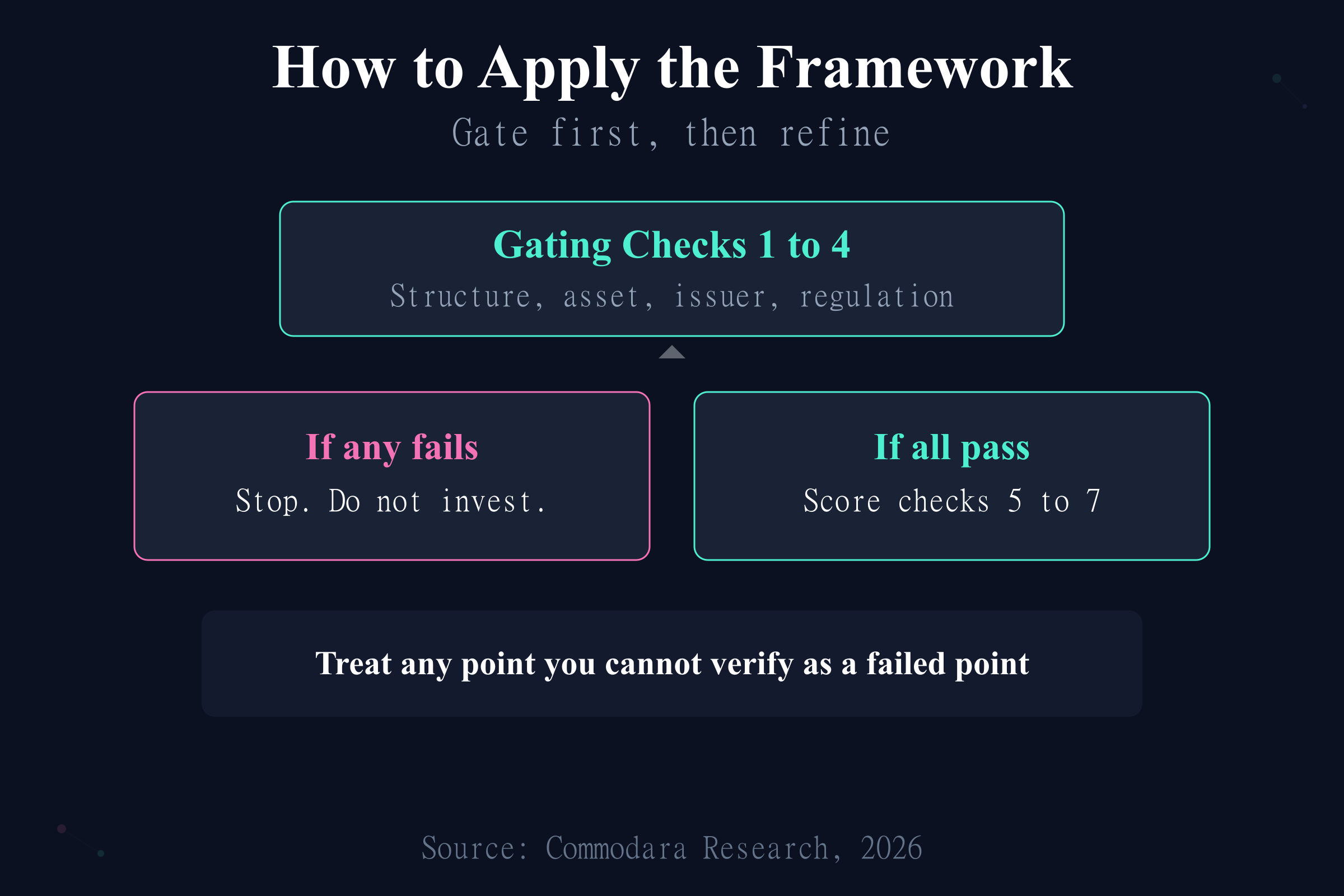
In practice, treat any point you cannot verify as a point that fails. Missing information is not neutral. If an issuer will not disclose custody arrangements, audit reports, or redemption terms, the absence itself is the finding. Strong tokenized assets tend to make verification easy, because transparency is cheap for those who have nothing to hide.
It also helps to document each answer as you go. A short written record of what you verified, what you could not, and where the evidence came from turns a vague impression into a decision you can defend, compare against other assets, and revisit later. Verification you cannot reconstruct is worth little when you need to justify the position.
For investors weighing several tokenized assets, the framework doubles as a comparison tool. Scoring each asset across the seven points surfaces which ones are genuinely investable and which merely look the part. To structure that assessment for your own situation, the Commodara Tokenization Readiness Tool walks through the same dimensions, and a consultation can pressure-test a specific asset before you commit.
Finally, revisit the framework periodically. Tokenized assets are not static; issuers change custodians, regulators update rules, and contracts get upgraded. A tokenized asset that passed cleanly a year ago can quietly fail a check today, so treating due diligence as an ongoing process rather than a one-time gate is what protects capital over a full holding period.
Frequently Asked Questions
What is tokenization due diligence?
Tokenization due diligence is the structured evaluation of a tokenized asset before investing. It checks the legal structure, the underlying asset, the issuer, regulatory standing, smart contract security, liquidity, and economics to confirm the token carries a real, enforceable claim rather than just a polished interface.
What are the biggest red flags in a tokenized asset?
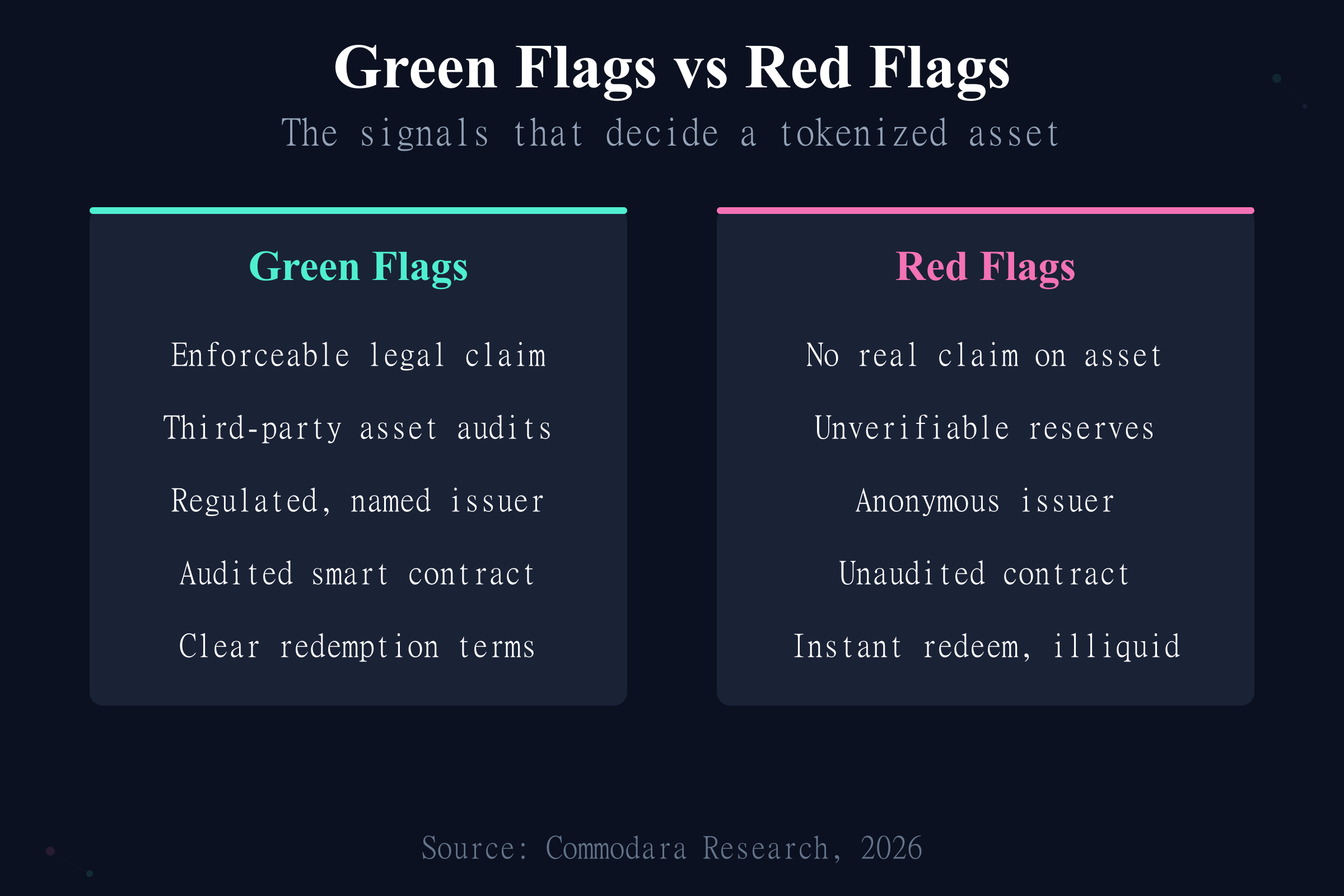
The clearest red flags are a token with no enforceable legal claim, an underlying asset that cannot be independently verified, an anonymous or unregulated issuer, an unaudited smart contract, and instant-redemption promises backed by illiquid assets. Any one of these should stop a purchase.
How do I verify the asset behind a token exists?
Look for third-party attestation, proof of reserves, and confirmation that a qualified custodian holds the real asset. Audited disclosures, published holdings, and independent valuations are the standard. If verification depends only on the issuer’s own statements, treat the asset as unproven.
Is a smart contract audit enough to trust a tokenized asset?
No. An audit reduces technical risk but does not address legal structure, asset verification, or issuer quality. A well-audited contract can still sit on top of a weak legal claim. Treat the audit as one of seven checks, not a substitute for the rest.
Does tokenization due diligence differ for retail and institutional investors?
The checkpoints are the same, but the depth differs. Institutions can commission legal opinions and technical audits; retail investors rely more on disclosures and public records. The framework scales: the questions do not change, only how thoroughly each one can be investigated.
The Bottom Line
Tokenization due diligence is what turns a leap of faith into an informed decision. The seven points, legal structure, underlying asset, issuer, regulation, technical security, liquidity, and economics, cover the ways a tokenized asset can be strong or hollow, and working through them in order exposes the gaps that marketing is designed to hide.
The discipline is repeatable. The same seven questions apply to a tokenized building, a tokenized Treasury fund, or a tokenized credit product, which means the framework improves with every asset you run through it. Over time, the assets that fail two or three checks become easy to spot and easy to avoid.
Before committing to any tokenized asset, run it through the Commodara Tokenization Readiness Tool to structure your review across all seven dimensions, and book a consultation when a specific asset warrants a closer look. Disciplined tokenization due diligence is the cheapest protection available in a market that rewards it.